Hair Growth for Women: Procedure, Recovery and Results

A proper diagnosis is important because female hair thinning has many possible causes. Hair transplant surgery redistributes healthy follicles; it does not create new follicles or stop ongoing hair loss.
Key Takeaways
- A proper diagnosis is important because female hair thinning has many possible causes.
- Hair transplant surgery redistributes healthy follicles; it does not create new follicles or stop ongoing hair loss.
- After a transplant, temporary shedding is expected before new hairs usually begin to emerge after several months.
- Visible transplant density commonly develops gradually, with final maturation taking up to 12 to 18 months.
- Early assessment is especially important for sudden shedding, patchy loss, scalp discomfort, or signs of scarring.
Hair growth for women depends on the cause of thinning, the health of the scalp, and whether hair follicles remain active. Treatments may include medical care and lifestyle changes, while hair transplant surgery can be an option for carefully selected women with stable hair loss and sufficient donor hair.
Hair Growth for Women: An Individual Process
Hair growth for women is influenced by the normal hair cycle, genetics, hormones, nutrition, medical conditions, medications, and everyday hair-care practices. It is normal to shed some hairs each day, but a widening part, reduced ponytail volume, visible scalp, or persistent excess shedding may indicate a type of hair loss that should be assessed.
For many women, the first step is identifying why thinning has occurred. Some causes are temporary and can improve once the trigger is addressed. Others, such as female pattern hair loss, tend to progress slowly and may benefit from ongoing treatment to preserve existing hair and support fuller-looking growth.
Hair transplantation is a surgical approach for selected patients. It moves follicular units from an area with adequate density, usually the back or sides of the scalp, to areas of thinning. The transferred follicles may continue producing hair, but a transplant does not prevent untreated thinning in the surrounding natural hair.
Why Hair Thinning Happens and How It Is Diagnosed
Female pattern hair loss is one of the most common reasons for gradual thinning. It often causes a broader central part and reduced density across the top of the scalp while the front hairline is relatively preserved. A different pattern, called telogen effluvium, causes diffuse shedding when more follicles than usual enter the resting phase after a trigger such as illness, surgery, childbirth, significant stress, restrictive dieting, or a medication change.
Other possible causes include autoimmune alopecia areata, repeated tension from tight hairstyles, fungal or inflammatory scalp conditions, thyroid disorders, iron deficiency, and forms of scarring alopecia. Scarring hair loss can permanently damage follicles, so early specialist review is particularly important when the scalp is painful, burning, itchy, crusted, or unusually smooth and shiny.
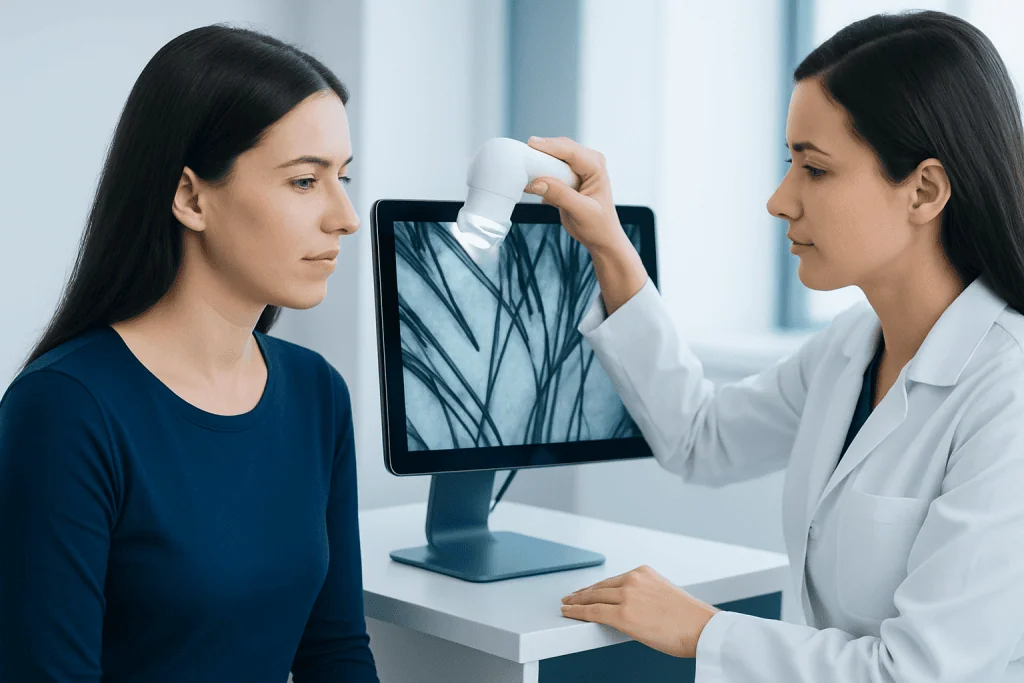
A clinician may ask about the timing and pattern of hair loss, family history, menstrual and pregnancy history, diet, recent illness, medicines, and styling habits. Scalp examination and dermoscopy can help distinguish conditions. Blood tests, such as tests for iron stores or thyroid function, may be recommended when the history and examination suggest an underlying contributor.
Which Surgery Is Best for Hair Growth?

No single surgery is best for hair growth in every woman. The most appropriate method depends on the diagnosis, stability of hair loss, donor-hair density, scalp characteristics, hairstyle preferences, treatment goals, and whether there is ongoing diffuse thinning. A qualified hair restoration surgeon should assess the donor area carefully before recommending surgery.
The two main methods are follicular unit extraction, often called FUE, and strip follicular unit transplantation, often called FUT. During FUE, individual follicular units are removed from the donor area and implanted into carefully planned recipient sites. FUT involves removing a narrow strip of donor scalp, dividing it into follicular units, and closing the donor area with a linear scar.
FUE may suit women who prefer to avoid a linear scar, although it may require partial trimming or shaving of donor hair and can leave small dot-like scars. FUT may be considered when a surgeon believes it can safely provide the needed number of grafts, but it leaves a linear scar. In either procedure, local anesthesia is commonly used, and the surgeon designs placement to create a natural-looking pattern of coverage.
Women with active inflammatory or scarring scalp disease, unstable hair loss, or inadequate donor density may be advised to delay or avoid transplantation. Medical treatment is often recommended before and after surgery to stabilize the underlying condition and help protect non-transplanted hair.
How Long After Surgery Does Hair Grow Back?
After a hair transplant, the scalp generally begins healing during the first one to two weeks. Small crusts around the implanted follicles are common and should be managed according to the surgical team’s washing and aftercare instructions. Patients should avoid picking, rubbing, or applying unapproved products to the grafted area while it heals.
The transplanted hair shafts commonly shed between about two and eight weeks after surgery. This temporary phase is sometimes called shock shedding and can be concerning, but it does not usually mean that the transplanted follicles have been lost. The follicles remain under the skin and enter a new growth cycle.
New transplanted hairs often begin to emerge at approximately three to four months after surgery. Early growth may be fine, uneven, or slower in some areas. Follow-up appointments allow the clinical team to check healing, review ongoing hair-loss treatment, and address concerns such as persistent redness, swelling, pain, or drainage.
How Long Does It Take to See Hair Regrowth Results?
Hair regrowth results take time because follicles grow in cycles. Following hair transplant surgery, early new hairs may be noticeable from three to four months, while a more visible improvement in coverage often develops between six and nine months. A fuller, more mature result may take around 12 months, and crown areas can continue maturing for up to 18 months.
Results vary with the number and quality of transplanted follicles, scalp circulation, hair texture and color contrast, the extent of pre-existing thinning, and whether natural hair loss continues. Curly or wavy hair can sometimes create the appearance of greater coverage than very straight hair, while extensive diffuse thinning may limit the density that can be safely achieved in one procedure.
Non-surgical treatments also require patience. Clinician-recommended topical treatments for female pattern hair loss may take several months before changes are noticeable, and consistent use is usually needed to maintain benefit. Standardized photographs taken before treatment and at follow-up visits can provide a more reliable comparison than day-to-day mirror checks.
Can Hair Grow Back After Thinning Female?
Hair can grow back after female thinning when follicles are still present and the underlying cause can be corrected or controlled. For example, shedding related to a temporary trigger may gradually improve after recovery, nutritional deficiencies can be treated when confirmed, and early traction-related thinning may improve when tight or pulling hairstyles are stopped.
Female pattern hair loss is a long-term condition, but treatment can often slow progression and improve the appearance of density. A clinician may recommend topical minoxidil or, in selected patients, prescription medicines that affect hormonal pathways. These options are not suitable for everyone, and some require particular consideration for women who are pregnant, breastfeeding, or planning pregnancy.
Good scalp care and adequate intake of protein and essential nutrients support general hair health, but supplements do not reverse every kind of hair loss. Taking high-dose vitamins or supplements without evidence of a deficiency may be unhelpful or harmful. Platelet-rich plasma and low-level light therapies are offered in some settings, but evidence and expected benefit vary, so they should be discussed realistically with a qualified clinician.
A hair transplant may improve coverage where donor follicles are strong enough, but it is not a cure for ongoing diffuse thinning. Continued medical care may still be needed to protect existing hair and maintain the overall result.
When to Seek Medical Care
A woman should arrange medical assessment if hair loss is sudden, rapidly progressing, patchy, or accompanied by scalp pain, burning, intense itching, scaling, pustules, or bleeding. Review is also sensible when shedding continues for several months, follows a new medication, occurs with fatigue or major weight change, or is associated with menstrual changes, acne, or increased facial hair growth.
Early diagnosis can help distinguish temporary shedding from conditions that need targeted treatment and may help preserve remaining follicles. For international patients, Acibadem International’s multidisciplinary specialists at JCI-accredited hospitals can assess hair and scalp conditions and discuss appropriate medical or surgical options after an individual evaluation.
Frequently asked questions
Is a hair transplant suitable for every woman with thinning hair?
No. Hair transplantation is most suitable when hair loss is stable, the cause has been assessed, and there is enough healthy donor hair to harvest safely. Women with active scalp inflammation, widespread donor-area thinning, or untreated medical causes may need medical treatment instead of, or before, surgery.
Does transplanted hair fall out after surgery?
The visible transplanted hair shafts often shed in the first weeks after surgery, which is an expected part of the growth cycle. The follicles usually remain in place and later begin producing new hair, commonly from around three to four months.
Is FUE better than FUT for women?
FUE is not automatically better than FUT. FUE avoids a linear scar, while FUT may be appropriate in selected cases depending on donor hair, graft needs, scalp laxity, and the person's preferences. A surgeon should explain the benefits and limitations of both techniques.
Can minoxidil help female hair thinning?
Topical minoxidil can help some women with female pattern hair loss by supporting follicles in the growth phase. Results develop gradually and continued use is usually needed to maintain improvement. A clinician can advise whether it is appropriate and how to use it safely.
Can hair grow back after postpartum shedding?
Postpartum shedding is often a temporary form of telogen effluvium caused by hormonal changes after pregnancy. Many women notice gradual recovery as the hair cycle normalizes, although it can take several months. Medical review is helpful if shedding is severe, prolonged, or accompanied by other symptoms.
Do vitamins and hair supplements make hair grow faster?
Vitamins and minerals are most helpful when a true deficiency is present. For people without a deficiency, supplements do not reliably reverse genetic or inflammatory hair loss. It is safer to discuss testing and supplement use with a healthcare professional than to take high-dose products independently.
References
- American Academy of Dermatology
- British Association of Dermatologists
- U.S. Food and Drug Administration
- National Health Service
This article is for general information only and is not a substitute for professional medical advice. Please consult a qualified doctor about your individual situation.
Hair transplant in Turkey — costs, graft counts & a free assessment
JCI-accredited · board-certified surgeons · reply within 24h
Add us as a Preferred Source to see more of our trusted health content across Google Search, AI Overviews and Discover.