Hairline Design in Hair Transplants: What Makes a Natural Result

Natural-looking hair transplants depend on careful hairline design, not just graft number. A good hairline is usually irregular, age-appropriate, and tailored to the person’s facial proportions.
Key Takeaways
- Natural-looking hair transplants depend on careful hairline design, not just graft number.
- A good hairline is usually irregular, age-appropriate, and tailored to the person’s facial proportions.
- Planning should account for donor hair supply and the chance of future hair loss.
- Hair direction, angle, and single-hair graft placement are important at the front edge.
- Consultation with an experienced specialist helps balance aesthetics with long-term stability.
Hairline design is the part of hair transplant planning that most strongly affects whether the result looks natural. A well-designed hairline considers face shape, age, hair characteristics, and the likely pattern of future hair loss rather than simply placing the hairline as low or as straight as possible.
Overview: What hairline design means in a hair transplant
Hairline design is the process of planning where the new frontal hairline will sit, how it will curve, and how dense and soft it should appear. In practical terms, it is what helps a hair transplant blend with the person’s face instead of looking obvious or artificial. Even when graft survival is good, a poorly planned hairline can make the result look unnatural.
A natural result usually comes from restraint and balance. The best designs do not aim for the lowest possible hairline or a perfectly straight edge. Instead, surgeons generally create a hairline that suits facial anatomy, follows realistic patterns of human hair growth, and remains believable as the person ages.
Hairline planning is also a medical decision, not only a cosmetic one. It should take into account the cause and pattern of hair loss, the quality of donor hair, and how hair loss may continue over time. Patients exploring hair transplant treatment often learn that the frontal hairline uses donor hair very strategically because this zone has a large influence on appearance.
What makes a hairline look natural
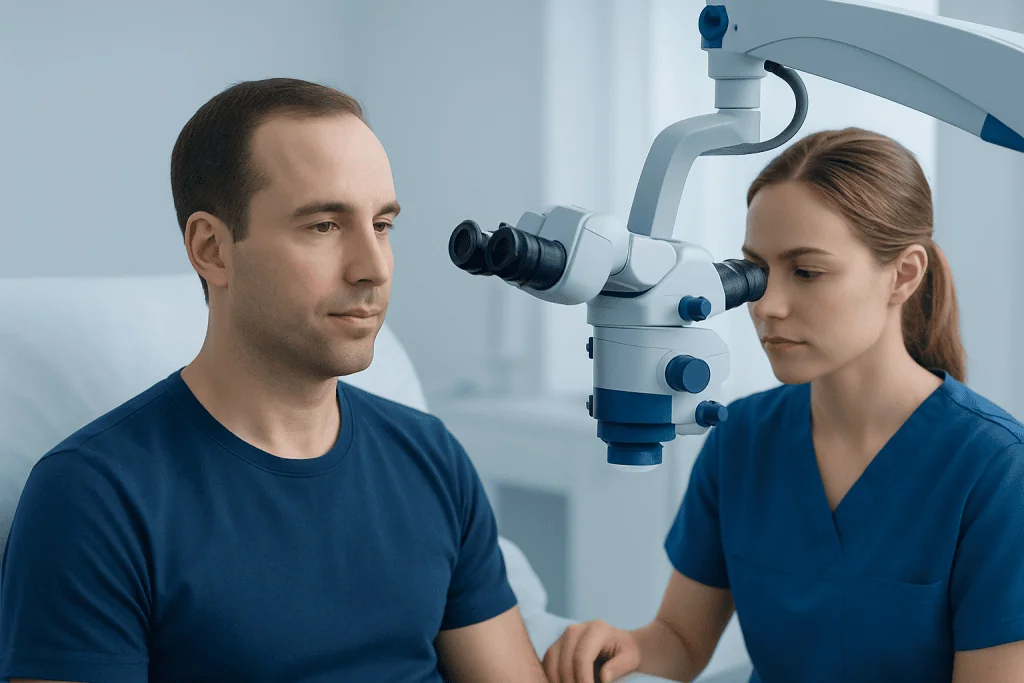
A natural hairline rarely looks perfectly even. In most people, the front edge of the hairline has subtle irregularity, with tiny variations in height and small changes in contour. This softness prevents the transplanted area from looking like a drawn line across the forehead. The goal is not asymmetry that looks accidental, but gentle irregularity that mimics normal growth.
Position matters just as much as shape. A youthful hairline is usually lower and flatter, while a mature hairline often sits slightly higher and may have more recession at the temples. For many adults, an age-appropriate design looks more convincing than trying to recreate a teenage hairline. This is especially important in people with progressive male pattern baldness, often discussed in relation to Norwood stages of hair loss.
Density and graft selection are also important. The very front edge often benefits from finer, single-hair follicular units to create a soft transition. Behind this softer zone, density can gradually increase. Direction and angle must match natural hair growth as well, because hairs placed at the wrong angle may stand up or grow in a way that looks unnatural under bright light or when styled back.
- Soft, irregular front edge
- Age-appropriate height and temple shape
- Gradual increase in density behind the first rows
- Natural hair direction, angle, and curl pattern
- Design that fits both the face and future hair-loss pattern
How specialists plan hairline design
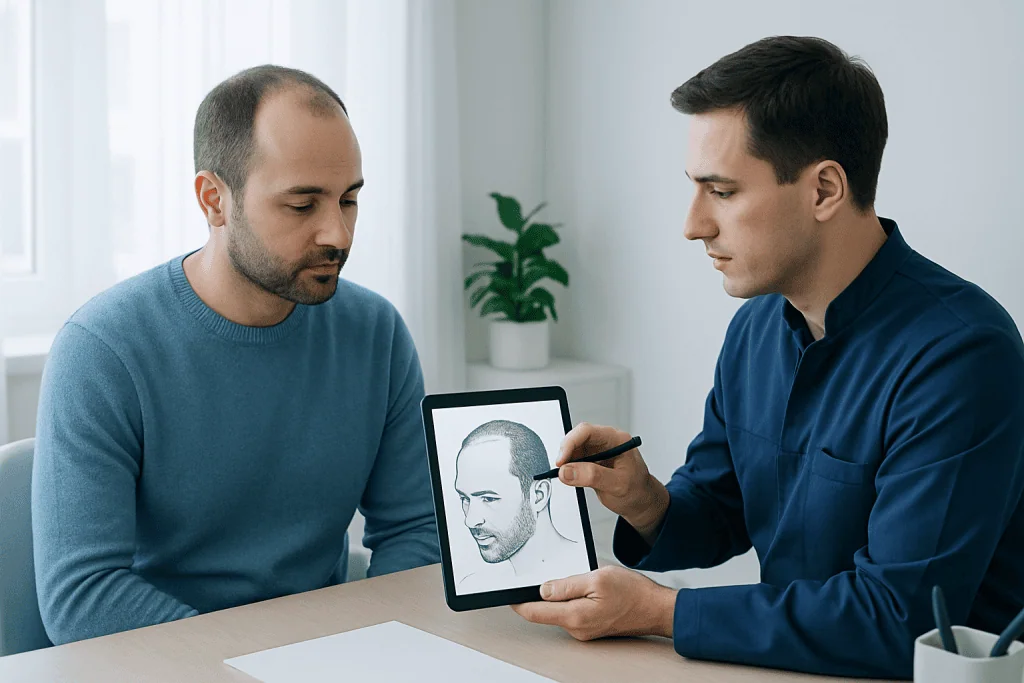
Planning usually begins with a detailed consultation and scalp examination. The surgeon assesses the forehead, brow position, temple areas, facial width, and overall symmetry. Hair characteristics are reviewed as well, including thickness, color contrast with the skin, wave or curl, and donor density. These features affect how full the final hairline can look and how much coverage can be achieved with a given number of grafts.
The underlying diagnosis is equally important. The most common reason for transplantation is androgenetic alopecia, also known as male pattern hair loss. Some patients, however, may have diffuse thinning, traction-related loss, scarring conditions, or temporary shedding disorders that require a different approach. Designing a permanent hairline without understanding the cause of hair loss can lead to poor long-term planning.
Specialists also consider progression over time. If a person is young or continues to lose native hair, a very low or aggressive design can become difficult to maintain and may use too much donor hair early. In many cases, conservative planning is the safest route because it preserves grafts for future needs. During consultation, some patients also ask how many grafts may be needed overall, which relates closely to articles discussing hair transplant graft counts and planning.
Factors that influence the best hairline for each person
No single hairline suits everyone. Face shape can influence whether a rounded, slightly flatter, or more receded contour appears balanced. Temple recession, forehead height, and the relationship between the eyes, brows, and upper face all play a role. Surgeons often use anatomical landmarks, but the final design still needs individual judgment rather than a fixed formula.
Hair texture changes the visual effect of a transplant. Curly or wavy hair often creates more apparent coverage than very straight, fine hair. Dark hair against light skin may make the hairline appear more defined, while lower contrast can look softer. Coarse hair may provide strong coverage but may need careful placement at the front edge to avoid a harsh appearance.
Sex and cultural preferences may also matter. Masculine and feminine hairlines usually differ in contour, temple configuration, and central shape. At the same time, personal styling goals should be discussed realistically. A specialist should explain which preferences are achievable while still protecting the donor area and maintaining a believable long-term result.
Common mistakes that can affect the result
One common mistake is placing the hairline too low. Although this may seem attractive at first, it can look unnatural over time and requires many grafts to maintain. If surrounding native hair continues to thin, the contrast between a low transplanted front line and a receding mid-scalp can become more noticeable. This is one reason surgeons often favor long-term planning over short-term cosmetic appeal.
Another issue is creating a hairline that is too straight, too dense at the very front, or too uniform in direction. Natural hairlines generally do not have a solid wall of thick multi-hair grafts. Overpacking the front edge can remove the softness that gives a realistic appearance. Poor angulation can also interfere with styling and make growth patterns look unusual.
Finally, donor management matters. Using too many grafts in the frontal hairline may limit options for crown or mid-scalp treatment later. This is why hairline design should be discussed together with the whole scalp plan, including whether treatments such as PRP for hair loss or medical therapy might help support existing hair alongside transplantation.
Treatment approach: from design to implantation
Once the hairline plan is agreed upon, the procedure itself should reproduce that design accurately. During modern transplantation, follicular units are harvested and then placed according to a preplanned pattern. The surgeon determines where single-hair grafts should soften the leading edge and where greater density can be built just behind it. Precision in recipient-site creation is critical because tiny differences in angle and spacing can change the final appearance.
Technique choice may vary by case, but the principles of natural hairline design remain similar. Whether a patient is considering follicular unit extraction or another accepted method, what matters most is careful execution and realistic planning. The front zone often receives the greatest artistic attention because it frames the face and is most visible in daily life.
Patients should also understand that the final look develops gradually. Transplanted hairs typically shed first, then regrow over time, with maturation continuing for months. Learning about the expected hair transplant recovery timeline can help set realistic expectations about when the softness, density, and shape of the new hairline become easier to judge.
Prevention, self-care, and long-term maintenance
Hairline design is not only about the day of surgery. Long-term success depends on protecting existing hair and monitoring any ongoing thinning. Many patients benefit from a broader treatment plan that may include medical evaluation, scalp care, and evidence-based therapies recommended by a doctor. This can help preserve native hair around the transplant and keep the overall result more balanced over time.
Before and after a procedure, patients should follow their specialist’s instructions carefully. This may include guidance on washing, exercise, sun exposure, and avoiding trauma to the scalp. Gentle care is especially important during the early healing period, when newly placed grafts are settling into the recipient area.
Healthy expectations are part of self-care too. A transplant can improve framing of the face and restore density in selected areas, but it cannot recreate unlimited donor supply. A thoughtful, conservative hairline often ages better than an aggressive one. Near the end of the treatment journey, some international patients choose centers such as Acibadem International, where multidisciplinary specialists in JCI-accredited hospitals evaluate hair loss and provide transplant care based on individualized planning.
When to seek medical care
A medical assessment is helpful before deciding on a hair transplant, especially if hair loss is sudden, patchy, associated with pain or itching, or accompanied by scalp redness or scaling. These features may suggest causes other than typical pattern hair loss and may need treatment before any surgical planning. A dermatologist or hair restoration specialist can help clarify the diagnosis.
Medical advice is also important if a previous hair transplant has left an unnatural hairline, visible scarring, or persistent concerns about density and direction. Revision planning can be more complex than a first procedure because donor supply may already be reduced. Early review with a qualified specialist can help identify safe options.
After transplantation, prompt medical attention is appropriate for increasing swelling, significant pain, fever, spreading redness, drainage, or any healing problem that seems to worsen rather than improve. Patients should also seek follow-up if they feel uncertain about how the hairline is maturing, since regular reviews help track progress and discuss any need for supportive treatment.
Frequently asked questions
Why is hairline design so important in a hair transplant?
Hairline design strongly affects whether the transplant looks natural because the frontal hairline frames the face. Even with good graft growth, a poorly positioned or overly straight hairline can make the result look artificial.
Can a lower hairline always give a better result?
Not necessarily. A very low hairline may use too many grafts, look unnatural with age, and become harder to maintain if hair loss continues behind it. A slightly more conservative design often gives a more believable long-term result.
How do surgeons make a transplanted hairline look soft?
They usually create subtle irregularity at the front edge and place fine single-hair grafts in the first rows. Hair angle, direction, and spacing are also adjusted to match natural growth patterns.
Does face shape affect hairline design?
Yes. Forehead height, temple shape, brow position, and overall facial proportions can influence where the hairline should sit and how it should curve. The best design is individualized rather than copied from another person.
Will the new hairline stay natural if hair loss continues?
It can, but only if future hair loss is considered during planning. This is why specialists often avoid aggressive designs in younger patients or in people with progressive thinning and may recommend ongoing medical management.
Can an unnatural hairline from a previous transplant be corrected?
In some cases, yes. Revision may involve redistributing grafts, softening the front edge, adjusting density, or addressing scarring, but the options depend on the remaining donor hair and the details of the original procedure.
References
- American Academy of Dermatology
- International Society of Hair Restoration Surgery
- British Association of Dermatologists
- National Institutes of Health
- Mayo Clinic
This article is for general information only and is not a substitute for professional medical advice. Please consult a qualified doctor about your individual situation.
Hair transplant in Turkey — costs, graft counts & a free assessment
JCI-accredited · board-certified surgeons · reply within 24h
Add us as a Preferred Source to see more of our trusted health content across Google Search, AI Overviews and Discover.