Hand Anatomy: What Patients Need to Know

The hand contains 27 bones arranged in the wrist, palm, and fingers. Joints, ligaments, tendons, and muscles allow fine movement, grip, and coordination.
Key Takeaways
- The hand contains 27 bones arranged in the wrist, palm, and fingers.
- Joints, ligaments, tendons, and muscles allow fine movement, grip, and coordination.
- Major nerves in the hand provide feeling and help control thumb and finger motion.
- Pain, swelling, numbness, weakness, or deformity can suggest injury or disease.
- Early evaluation can help protect hand function after trauma, nerve compression, or joint problems.
Hand anatomy refers to the bones, joints, ligaments, tendons, muscles, nerves, and blood vessels that work together to create movement, strength, and sensation. Understanding these parts can help patients better recognize symptoms, describe injuries, and know when medical care may be needed.
Overview: what hand anatomy includes
Hand anatomy includes the structures that allow the hand to move, grip, pinch, feel touch, and perform precise daily tasks. In practical terms, this means the hand is made up of bones, joints, cartilage, ligaments, tendons, muscles, nerves, blood vessels, and soft tissue that all work together.
For patients, understanding hand anatomy is useful because many symptoms relate to a specific structure. Pain near a joint may point to arthritis or a sprain, numbness may involve a nerve, and difficulty straightening a finger may relate to a tendon or muscle problem. Knowing the basic layout of the hand can make medical visits easier and help patients explain where symptoms begin and how they affect daily life.
The hand is often divided into three main parts: the wrist, the palm, and the fingers. The wrist connects the hand to the forearm, the palm provides support for gripping, and the fingers provide reach, dexterity, and precision. The thumb is especially important because its range of motion allows pinching and opposition, which are essential for tasks such as writing, buttoning clothes, and holding small objects.
Bones and joints of the hand
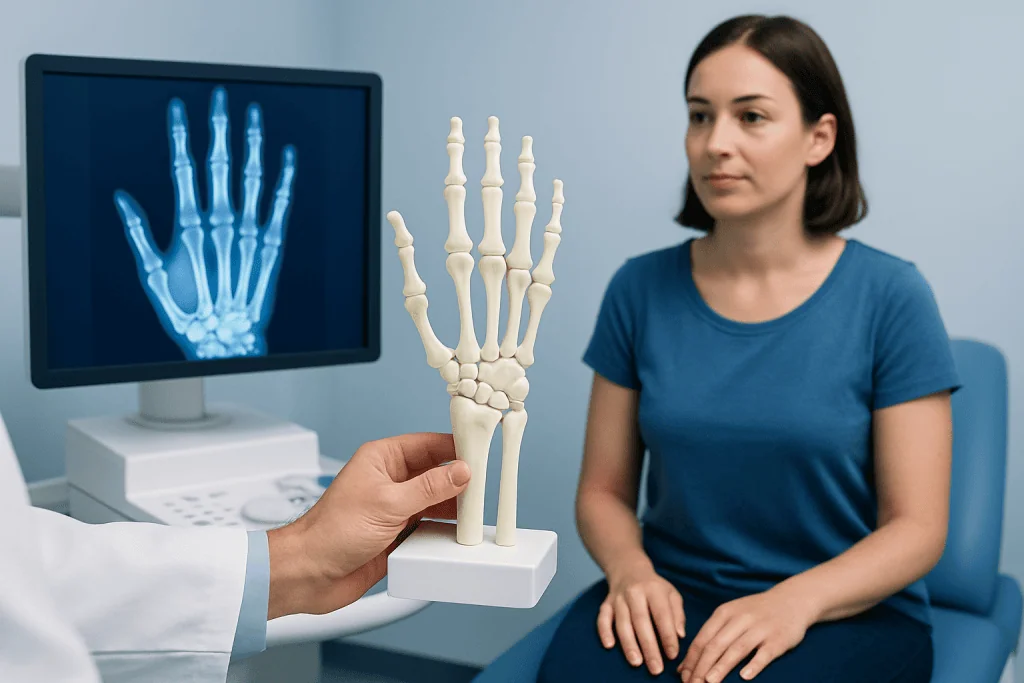
The adult hand has 27 bones. Eight small carpal bones form the wrist, five metacarpal bones form the palm, and 14 phalanges form the fingers and thumb. Each finger usually has three phalanges, while the thumb has two. This arrangement creates a strong but flexible framework that supports both power grip and delicate hand movements.
The joints are where these bones meet. Important hand joints include the wrist joints, the knuckle joints where the metacarpals meet the fingers, and the finger joints themselves. These joints are lined with cartilage, which helps reduce friction and allows smoother movement. Joint capsules and supporting ligaments help keep the bones in proper alignment.
The thumb has a particularly specialized base joint, often called a saddle joint, which allows a wide range of motion. This is one reason the human hand can perform complex actions. However, this same mobility can make the thumb vulnerable to overuse and joint wear over time.
- Carpal bones: form the wrist and help with flexibility
- Metacarpals: create the palm and support grip strength
- Phalanges: make up the fingers and thumb
- Joints: allow bending, straightening, rotation, and fine coordination
Tendons, ligaments, and muscles: how the hand moves
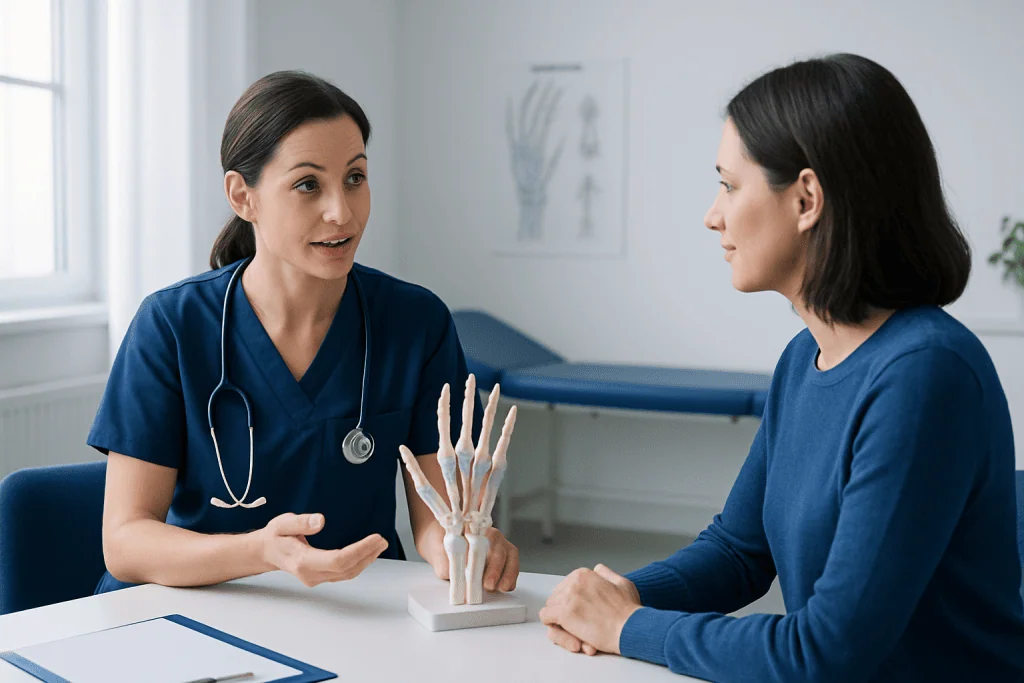
Movement of the hand depends on a coordinated system of tendons, ligaments, and muscles. Tendons connect muscles to bones and transmit the pulling force that bends or straightens the fingers and thumb. Some of these muscles are located in the forearm, with long tendons traveling into the hand, while smaller intrinsic muscles are located within the hand itself for fine control.
Flexor tendons on the palm side help bend the fingers, and extensor tendons on the back of the hand help straighten them. The thumb also has specialized tendons that support pinching, lifting, and opposition. If a tendon becomes inflamed, torn, or trapped, movement may become painful or limited.
Ligaments connect bone to bone and stabilize the joints. They help prevent excessive movement and are often injured in sprains. In the palm, bands of connective tissue also help protect deeper structures and contribute to the shape of the hand. When hand function is affected by trauma or long-term wear, evaluation may overlap with care used for orthopedic assessment and treatment and hand rehabilitation planning.
The hand muscles can be broadly grouped into those that move the thumb, those that spread or bring together the fingers, and those that assist with grip and pinch. Because many structures work in a very small space, even a mild injury or swelling can have a noticeable effect on function.
Nerves, blood vessels, and sensation
The hand is richly supplied by nerves, which allow a person to feel temperature, pressure, pain, and fine touch. Three major nerves are especially important: the median nerve, ulnar nerve, and radial nerve. Each nerve supplies different areas of sensation and helps power different groups of muscles.
The median nerve is closely linked to feeling in parts of the thumb, index finger, middle finger, and part of the ring finger, and it also helps control some thumb movements. The ulnar nerve supplies sensation to the little finger and part of the ring finger and supports many of the small muscles needed for precise finger control. The radial nerve mainly helps with extension and sensation on part of the back of the hand.
Blood reaches the hand through arteries that branch from the forearm and form arches in the palm. These vessels supply oxygen and nutrients to the tissues and are essential for healing. Injury to blood vessels can reduce circulation, while swelling inside tight spaces can put pressure on nearby nerves and tendons.
When a nerve is compressed, irritated, or injured, patients may notice numbness, tingling, burning pain, clumsiness, or weakness. One common example is carpal tunnel syndrome, which affects the median nerve at the wrist and can lead to nighttime numbness or difficulty gripping objects.
Common problems that affect hand anatomy
Because the hand is used constantly, many conditions can affect its anatomy. These include fractures, sprains, tendon injuries, joint inflammation, nerve compression, and soft-tissue overuse. Symptoms may begin suddenly after trauma or develop gradually with repetitive activities, aging, or underlying medical conditions.
Joint-related problems may cause pain, stiffness, swelling, and reduced range of motion. Over time, wear of the cartilage can contribute to osteoarthritis, especially in the thumb base or finger joints. Inflammatory conditions can also affect the hand joints and nearby tendons. In some cases, hand symptoms may be part of broader arthritis affecting multiple joints.
Tendon problems can lead to clicking, locking, weakness, or pain with movement. Nerve problems can produce numbness, tingling, reduced hand coordination, or muscle wasting if they become severe or long-standing. Fractures and dislocations may cause obvious deformity, swelling, bruising, or inability to move a finger normally.
Some symptoms may seem mild at first but still deserve attention if they persist. Hand function is important for work, self-care, communication, and independence, so protecting normal movement and sensation matters even when the problem does not seem urgent.
How doctors evaluate hand problems
Evaluation usually begins with a medical history and physical examination. A doctor may ask when symptoms started, whether there was an injury, which movements worsen the problem, and whether there is numbness, swelling, clicking, or weakness. During the examination, the doctor may compare both hands, check skin color and swelling, feel for tenderness, and test movement, strength, stability, and sensation.
Imaging or other tests may be used when needed. X-rays are often helpful for suspected fractures, dislocations, and some joint conditions. Ultrasound or MRI may be used to assess tendons, ligaments, or soft tissues. Nerve studies can help when numbness or weakness suggests compression or nerve injury.
The diagnosis depends on which structure appears to be involved. A patient with numbness and nighttime symptoms may need an evaluation for a nerve compression disorder, while a patient with a painful, swollen knuckle after a fall may need imaging to rule out fracture or ligament injury. If symptoms are complex or function is significantly limited, specialists may recommend a more detailed approach that can include physical therapy and rehabilitation as part of recovery.
Treatment and self-care based on the affected structure
Treatment for hand problems depends on the specific part of the hand involved. Minor strains or overuse injuries may improve with rest, temporary activity changes, cold application, elevation, and medical guidance on pain relief. Splints or braces may sometimes be used to support a joint or reduce stress on a tendon or nerve.
If symptoms are related to inflammation, doctors may recommend exercise modification, hand therapy, or targeted rehabilitation. Fractures, severe ligament injuries, dislocations, or major tendon tears may need more specialized treatment to restore alignment and function. For persistent nerve compression, treatment may focus on reducing pressure and protecting sensation and muscle strength.
Self-care can also support hand health. Patients may benefit from pacing repetitive tasks, taking regular breaks during keyboard or tool use, maintaining joint mobility, and using ergonomically supportive positions. Smoking cessation and good control of long-term conditions such as diabetes can also support circulation and nerve health.
When surgery is needed, the goal is usually to relieve pressure, repair damaged structures, or restore function after significant injury. Depending on the problem, care may include hand surgery followed by supervised rehabilitation. Near the end of the care journey, some patients may be managed by multidisciplinary teams; Acibadem International’s JCI-accredited hospitals and specialists diagnose and treat hand conditions for international patients when advanced evaluation or coordinated care is needed.
When to seek medical care
Patients should seek medical care promptly if hand pain follows a fall, crush injury, sports accident, or deep cut. Urgent assessment is also important if there is visible deformity, severe swelling, significant bleeding, loss of feeling, blue or pale fingers, or inability to move part of the hand normally.
Medical advice is also appropriate for symptoms that develop gradually but do not improve. Persistent numbness, nighttime tingling, repeated dropping of objects, thumb weakness, locking fingers, or swelling that lasts more than a few days may suggest a tendon, joint, or nerve problem that deserves evaluation.
Even when symptoms are not an emergency, early diagnosis can help prevent long-term stiffness, weakness, or loss of function. Patients who are unsure whether a symptom is serious should contact a qualified healthcare professional for guidance, especially if symptoms interfere with work, sleep, or daily activities.
Frequently asked questions
How many bones are in the hand?
The adult hand has 27 bones. These include 8 carpal bones in the wrist, 5 metacarpal bones in the palm, and 14 phalanges in the fingers and thumb.
What is the difference between tendons and ligaments in the hand?
Tendons connect muscles to bones and help create movement. Ligaments connect bone to bone and help stabilize joints so they do not move too far or in the wrong direction.
Why is the thumb so important in hand anatomy?
The thumb has a unique range of motion that allows opposition, meaning it can meet the fingers. This makes gripping, pinching, writing, and handling small objects much easier.
What causes numbness or tingling in the hand?
Numbness or tingling often happens when a nerve is compressed, irritated, or injured. Common causes include repetitive strain, swelling around the wrist, or conditions such as carpal tunnel syndrome, but a doctor should assess persistent symptoms.
Can hand pain come from joints, nerves, or tendons?
Yes. Hand pain can come from several structures, including joints affected by arthritis, tendons irritated by overuse, or nerves under pressure. The exact location of pain and the presence of swelling, weakness, or numbness can help guide diagnosis.
When should a hand injury be checked by a doctor?
A doctor should evaluate a hand injury if there is severe pain, deformity, major swelling, numbness, weakness, or limited motion after trauma. Medical care is also important if a cut is deep, bleeding is hard to control, or a finger changes color.
This article is for general information only and is not a substitute for professional medical advice. Please consult a qualified doctor about your individual situation.
Joint and spine care in Turkey — expert assessment & treatment
JCI-accredited · board-certified surgeons · reply within 24h
Add us as a Preferred Source to see more of our trusted health content across Google Search, AI Overviews and Discover.

More from the Health Library

Ulnar Nerve: A Complete Medical Overview

Dmt Drug: A Complete Medical Overview

Spasm of the Neck: What Patients Need to Know

Sertraline and Alcohol: What Patients Need to Know

Twice Baked Potatoes Recipe: An Evidence-Based Guide for Patients