Hearing Test: A Complete Medical Overview

A hearing test is painless and can evaluate hearing in one or both ears across different sound pitches and volumes. Different tests assess different parts of hearing, including the outer, middle, and inner ear and the hearing nerve pathway.
Key Takeaways
- A hearing test is painless and can evaluate hearing in one or both ears across different sound pitches and volumes.
- Different tests assess different parts of hearing, including the outer, middle, and inner ear and the hearing nerve pathway.
- Results can help identify conductive, sensorineural, or mixed hearing loss and support treatment planning.
- People should consider testing if they notice muffled hearing, ringing in the ears, dizziness, ear fullness, or trouble following conversation.
- Regular hearing checks may be helpful for newborns, children, older adults, and people with noise exposure or certain medical risks.
A hearing test is a group of simple, painless assessments used to measure how well a person hears and to identify possible hearing loss or related ear problems. It can help show whether hearing changes are temporary or long-term and guide decisions about treatment, monitoring, or hearing support.
What a Hearing Test Is and Why It Matters
A hearing test is a medical assessment that checks how well a person hears sounds at different pitches and volumes. It is commonly used to investigate symptoms such as muffled hearing, difficulty understanding speech, ringing in the ears, imbalance, or a sense of ear fullness. In many cases, the test helps confirm whether hearing is normal, reduced, or affected in a specific way.
Rather than being a single exam, a hearing test often includes several complementary procedures. Some measure how a person responds to tones or spoken words, while others evaluate how the eardrum and middle ear move or how the inner ear and hearing nerve respond to sound. Together, these results help clinicians understand where the hearing problem may be coming from.
Hearing plays an important role in communication, learning, social interaction, and safety. Early testing can help detect problems before they begin to affect daily life more significantly. For children, hearing assessment is especially important because hearing supports speech and language development. For adults, prompt evaluation may help identify treatable causes such as earwax, infection, middle ear fluid, or noise-related damage.
Who May Need a Hearing Test
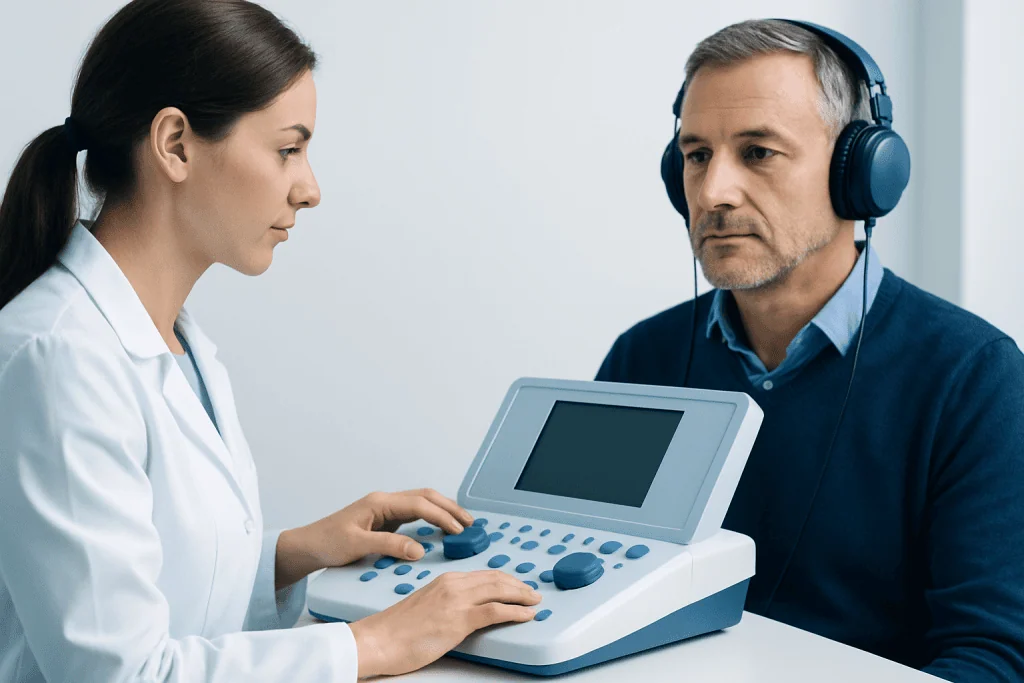
People of all ages may benefit from a hearing test. Newborn screening is routine in many healthcare systems because hearing loss can be present at birth. Children may need additional testing if they have delayed speech, frequent ear infections, trouble following instructions, or concerns raised by parents or teachers.
Adults often seek testing when they notice that voices sound less clear, television volume keeps increasing, or conversation is difficult in noisy places. Some people do not realize they are missing sounds until family members mention repeated misunderstandings or a tendency to ask others to repeat themselves.
Certain groups may need hearing checks even without obvious symptoms. These include older adults, people who work in loud environments, musicians, those with a history of repeated ear infections, and people taking medicines that can affect hearing. Individuals with conditions that affect the ear or balance may also be evaluated as part of a broader ENT assessment, including for concerns related to hearing loss or tinnitus.
- Difficulty hearing conversations, especially in background noise
- Ringing, buzzing, or humming in the ears
- Dizziness or balance symptoms
- Ear pain, pressure, or repeated infections
- Occupational or recreational noise exposure
Common Types of Hearing Tests

The type of hearing test depends on a person’s age, symptoms, and medical history. Pure-tone audiometry is one of the most common tests. During this test, the person wears headphones and indicates when tones are heard. This shows the softest sounds that can be detected at different frequencies and helps create an audiogram, which is a chart of hearing levels.
Speech testing is often done alongside pure-tone testing. It evaluates how well a person can hear and understand spoken words at different volumes. This can be especially useful because some people can hear sounds but still struggle to understand speech clearly, particularly in noisy settings.
Tympanometry checks how the eardrum and middle ear respond to changes in air pressure. It can help detect middle ear fluid, eardrum stiffness, pressure problems, or issues with the tiny bones of hearing. Otoacoustic emissions testing measures sound waves produced by the inner ear and is often used for newborn screening or when cooperation with standard testing is limited.
In some situations, clinicians may also use auditory brainstem response testing, especially for babies, young children, or people who cannot complete standard hearing tests. This assesses how the hearing nerve and brain pathways respond to sound. If symptoms suggest structural concerns, specialists may recommend further ENT evaluation or related care such as cochlear implant evaluation when hearing loss is severe.
How to Prepare and What to Expect During the Visit
Most hearing tests require little preparation. It is often helpful to avoid very loud noise for several hours before the appointment, since recent noise exposure can temporarily affect hearing. Patients should also mention any current ear pain, discharge, congestion, dizziness, recent infections, or medicines they are taking.
The visit may begin with questions about symptoms, noise exposure, medical history, and family history of hearing problems. An ear examination is usually performed to look for earwax, infection, inflammation, or visible eardrum changes. If a temporary and reversible cause is found, treatment may be recommended before or alongside hearing testing.
The tests themselves are generally painless. For pure-tone and speech testing, the person sits in a quiet booth and responds to sounds through headphones or inserts placed in the ears. Tympanometry involves a soft probe in the ear canal for a short time, while other tests may use small sensors or ear tips. The full visit may be brief or more detailed depending on the reason for testing and the number of tests needed.
Understanding Hearing Test Results
Hearing test results help show whether hearing is within the expected range or whether hearing loss is present. If hearing loss is found, the results can suggest its degree and pattern. Hearing may be reduced in one ear or both ears, and it may affect low, middle, or high frequencies more than others. This detail is important because it often shapes the most suitable next steps.
Clinicians usually classify hearing loss into three broad categories. Conductive hearing loss happens when sound cannot travel efficiently through the outer or middle ear, often due to earwax, fluid, infection, or eardrum problems. Sensorineural hearing loss usually involves the inner ear or hearing nerve and may be related to aging, noise exposure, genetic factors, or certain illnesses. Mixed hearing loss includes features of both.
Audiograms can look technical, but the main question is practical: how hearing changes may affect communication and daily life. A doctor or audiologist explains whether the findings are mild or more significant, whether the issue may be temporary, and whether monitoring, medical treatment, hearing devices, or further tests are recommended. If the hearing pattern is unusual or one-sided, additional evaluation may be needed to rule out underlying conditions.
Treatment and Next Steps After a Hearing Test
Treatment depends on the cause of the hearing problem rather than on the test alone. Some causes are temporary or reversible, such as earwax blockage, middle ear fluid, or infection. In these cases, medical treatment or a simple office procedure may improve hearing. When hearing changes are linked to chronic ear disease or structural problems, an ENT specialist may recommend targeted care.
If hearing loss is sensorineural and not reversible, hearing support can still make a meaningful difference. Hearing aids are commonly used to amplify sound and improve speech understanding. In some cases, assistive listening devices, communication strategies, or auditory rehabilitation may also help. For more complex middle ear conditions or longstanding ear disease, additional treatment options may be discussed, including ear surgery.
Severe or profound hearing loss may require evaluation for advanced hearing restoration options. Depending on age, hearing history, and test findings, some patients may benefit from specialized assessment for hearing aids or implantable devices. The best approach is individualized and usually developed by an audiologist and ENT specialist working together.
Near the end of the care pathway, patients may also seek multidisciplinary evaluation in centers experienced in international care. Acibadem International’s specialists in ENT and audiology, working in JCI-accredited hospitals, diagnose and treat hearing conditions for international patients when further assessment or management is needed.
Protecting Hearing and Supporting Ear Health
Not all hearing loss can be prevented, but many people can lower their risk by protecting their ears from excessive noise. Earplugs or earmuffs are useful in loud workplaces, concerts, or when using power tools. Reducing headphone volume and taking listening breaks may also help preserve hearing over time.
General ear care matters as well. Cotton swabs and other objects should not be inserted into the ear canal because they can push wax deeper or injure the ear. Persistent earwax, recurring ear infections, or ongoing ear pressure should be assessed by a clinician rather than managed aggressively at home.
People with diabetes, cardiovascular disease, autoimmune conditions, or repeated infections may need closer follow-up because these factors can sometimes affect hearing health. Routine checks can be useful for those at higher risk, especially if they have occupational noise exposure or a family history of hearing loss. Prompt testing after a noticeable change in hearing can improve the chance of identifying a treatable cause.
When to Seek Medical Care
A hearing test should be arranged if hearing seems reduced, voices sound unclear, or ringing in the ears becomes persistent. Medical review is also appropriate for repeated ear infections, ear fullness, dizziness, or sudden difficulty hearing from one or both ears. These symptoms do not always signal a serious problem, but they deserve professional assessment.
Urgent medical care is especially important for sudden hearing loss, severe dizziness, ear injury, intense ear pain, facial weakness, or drainage from the ear. Early evaluation may help identify causes that need prompt treatment. Parents should seek care for children who do not respond to sounds, have delayed speech, or seem to hear inconsistently.
A qualified doctor, ENT specialist, or audiologist can decide which type of hearing test is most appropriate and whether further investigations are needed. Seeking advice early is often the best way to protect hearing and reduce the impact of untreated hearing problems on communication and quality of life.
Frequently asked questions
Is a hearing test painful?
A hearing test is usually painless and noninvasive. Most tests involve listening to sounds through headphones or having a small probe placed gently in the ear canal for a short time.
How long does a hearing test take?
The length depends on the person's age, symptoms, and the number of tests needed. A basic hearing evaluation may be relatively quick, while a more detailed assessment can take longer.
Can a hearing test detect all causes of hearing problems?
A hearing test can identify the presence and pattern of hearing loss, but it may not explain every underlying cause on its own. Additional ear examination, imaging, or specialist evaluation may sometimes be needed.
What is the difference between a hearing screening and a full hearing test?
A hearing screening is a quick check to see whether further evaluation is needed. A full hearing test is more detailed and helps define the type, degree, and possible source of hearing loss.
Should children have hearing tests even if they seem fine?
Yes, hearing checks are important in infancy and childhood because some hearing problems are subtle or develop over time. Early detection supports speech, language, and learning.
What happens if a hearing test shows hearing loss?
The next step depends on the cause and severity. A clinician may recommend treatment for an ear condition, repeat testing, hearing aids, specialist referral, or further investigations.
This article is for general information only and is not a substitute for professional medical advice. Please consult a qualified doctor about your individual situation.
Explore treatments in Turkey — costs, top hospitals & a free quote
JCI-accredited · board-certified surgeons · reply within 24h
Add us as a Preferred Source to see more of our trusted health content across Google Search, AI Overviews and Discover.

More from the Health Library

How Left Ventricle Function Is Measured

Quetiapine — Explained by Medical Evidence, Not Myths

Monk Fruit Extract: A Complete Medical Overview

Yergason’s Test: What Patients Need to Know

Thoracic: What Patients Need to Know

Transverse Fracture — Explained by Medical Evidence, Not Myths
Otorhinolaryngology Specialists at Acibadem

Prof. Dr. Ahmet Onur Odabaşı
Ear Nose & Throat
Assoc. Prof. Dr. Akif İşlek
Ear Nose & Throat
Dr. Alaaddin Zirek
Otorhinolaryngology
Assoc. Prof. Dr. Ali Titiz
Otorhinolaryngology