Hip Impingement and Its Effect on Movement

Hip impingement involves abnormal contact between the ball and socket of the hip joint. Groin pain during sitting, squatting, twisting, or sports is a common symptom.
Key Takeaways
- Hip impingement involves abnormal contact between the ball and socket of the hip joint.
- Groin pain during sitting, squatting, twisting, or sports is a common symptom.
- A clinical examination and imaging tests help confirm the diagnosis and assess joint damage.
- Physiotherapy, activity changes, and pain-relief strategies are often first-line treatments.
- Surgery may be considered when symptoms persist despite non-surgical care or when joint damage is significant.
Hip impingement, also called femoroacetabular impingement (FAI), occurs when the bones of the hip joint do not move smoothly together. It may cause groin pain, stiffness, clicking, or discomfort during activities that involve bending or rotating the hip.
Overview of Hip Impingement
Hip impingement is a condition in which the ball-and-socket parts of the hip joint come into contact in a way that limits smooth movement. Its medical name is femoroacetabular impingement, often shortened to FAI. The hip joint is formed by the rounded top of the thigh bone, called the femoral head, and the cup-shaped socket in the pelvis, called the acetabulum.
In a healthy hip, the ball rotates freely within the socket. In hip impingement, changes in the shape of one or both bones can cause repeated pinching or friction, particularly during deep bending, pivoting, and rotation. Over time, this may irritate or damage the labrum, a ring of cartilage that helps deepen and stabilize the socket, as well as the smooth cartilage covering the joint surfaces.
Hip impingement can affect active people, but it is not limited to athletes. Some people have a hip shape that developed during growth and may not experience symptoms until later in life. Symptoms and the need for treatment vary considerably, so an imaging finding alone does not always mean that a person needs treatment.
Types and Symptoms
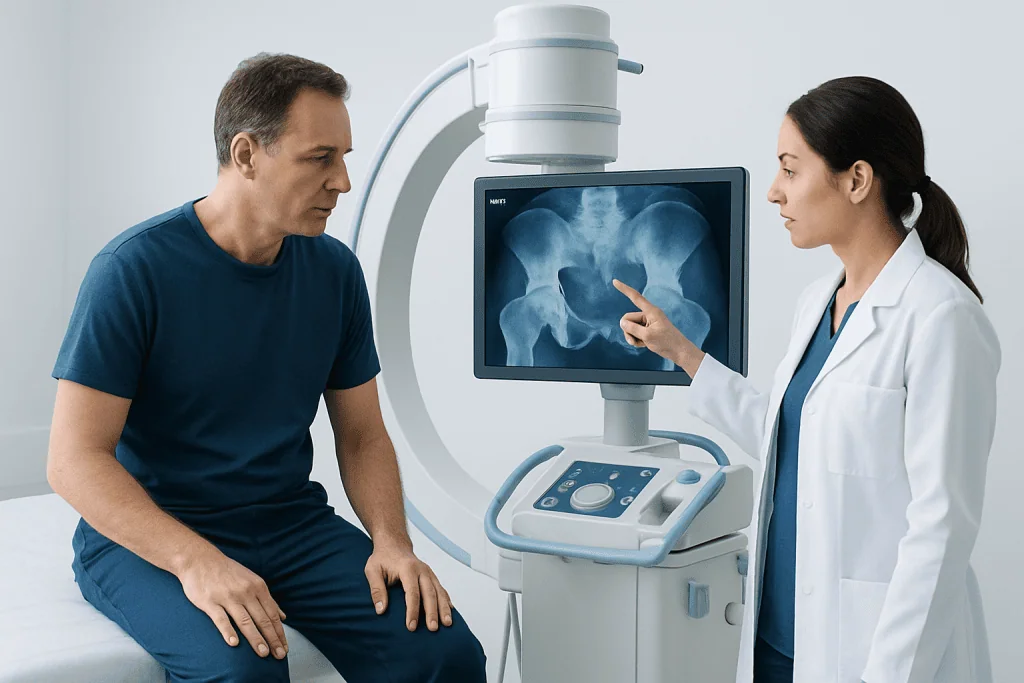
Doctors generally describe three patterns of hip impingement. Cam impingement occurs when there is an extra bony prominence at the upper femur near the femoral head. Pincer impingement occurs when the hip socket covers too much of the femoral head or is angled in a way that causes contact. Many people have a mixed form, with features of both cam and pincer impingement.
The most typical symptom is discomfort felt deep in the groin or at the front of the hip. Pain may develop gradually and may be worse after prolonged sitting, walking uphill, running, cycling, squatting, or sports that involve twisting and rapid changes in direction. Some people point to the front of the hip with a hand shaped like a “C,” which clinicians sometimes call the C-sign.
Other possible symptoms include stiffness, reduced ability to bend or rotate the hip, catching, clicking, locking, or a sensation that the hip is giving way. Pain can occasionally be felt in the outer hip, buttock, thigh, or lower back. These symptoms can also occur with other conditions, so a proper assessment is important.
- Groin or front-of-hip pain, especially with bending
- Reduced hip flexibility or pain at the end of movement
- Clicking, catching, or locking sensations
- Discomfort after sitting for a long time
- Pain during sport, exercise, or everyday activities such as getting in and out of a car
Causes and Risk Factors
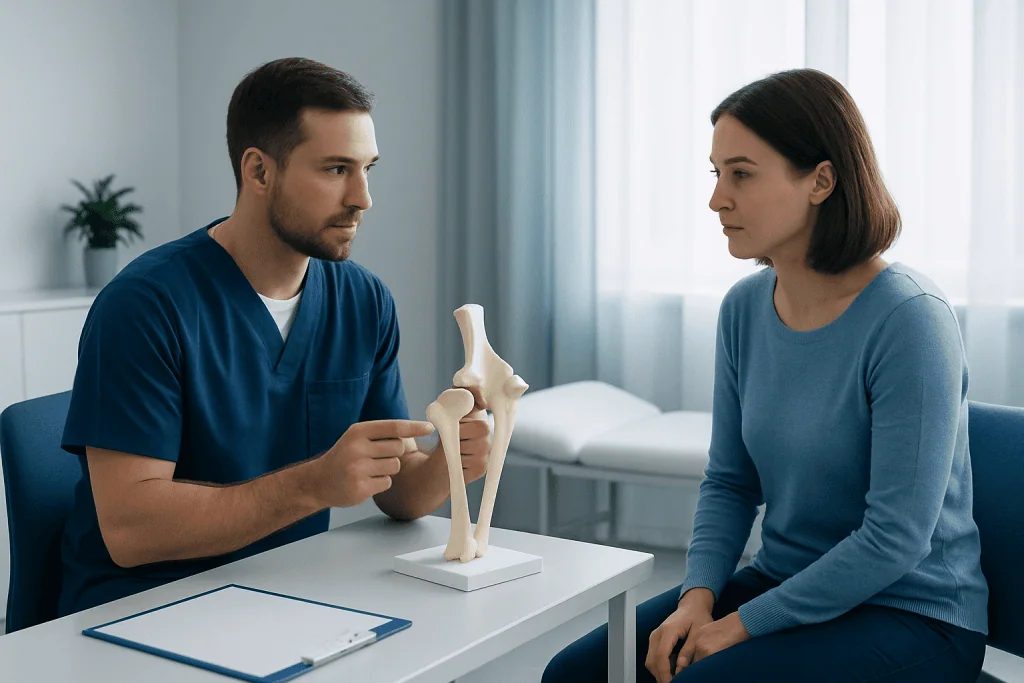
Hip impingement is usually related to the shape of the bones around the hip rather than a single injury. These shape differences may develop during childhood or adolescence while the skeleton is growing. Genetics may contribute in some families, although the exact causes are not always clear.
Intensive sport during adolescence may be associated with cam-type changes in some people, particularly in activities involving repeated hip flexion and rotation. Examples include football, hockey, dance, martial arts, gymnastics, and certain running or field sports. However, being active does not automatically cause symptoms, and many people with bony shape changes remain pain-free.
Repeated movements that place the hip in deep flexion or rotation can make symptoms more noticeable. Previous hip injury, joint laxity, muscle weakness or imbalance, and movement patterns that overload the hip may also contribute. Hip impingement may coexist with a labral tear or early cartilage wear, but these findings need to be interpreted alongside symptoms and examination results.
How Hip Impingement Is Diagnosed
Diagnosis begins with a clinician discussing the person’s symptoms, activities, medical history, and previous injuries. During the physical examination, the clinician checks walking pattern, hip range of motion, strength, and areas of tenderness. Specific movements that bend and rotate the hip may reproduce symptoms, but these tests alone cannot confirm hip impingement.
X-rays are commonly used to evaluate the shape of the femur and hip socket and to look for signs of arthritis. They may be taken in several positions to provide a detailed view of the joint. MRI, sometimes with contrast injected into the joint, can help assess the labrum, cartilage, tendons, and other soft tissues. CT scans may be useful when precise three-dimensional bone detail is needed for surgical planning.
Not every person with hip pain needs every test. Because hip and groin pain may come from the lower back, muscles, tendons, hernia, pelvic structures, or other joints, clinicians consider alternative explanations as part of the assessment. A local anesthetic injection into the hip joint may occasionally help clarify whether the joint is the main source of pain.
Treatment Options for Hip Impingement
Treatment is tailored to symptoms, daily function, activity goals, imaging findings, and the condition of the joint cartilage. Many people improve with non-surgical care. A doctor or physiotherapist may recommend temporarily reducing movements that reliably provoke pain, such as deep squats, low chairs, repeated pivoting, or high-impact activity, while helping the person remain appropriately active.
Physiotherapy is a central part of conservative treatment. A structured program may focus on hip and core strength, movement control, flexibility where appropriate, posture, and gradual return to activity. The aim is not simply to increase range of motion, but to improve how the hip and pelvis move together and reduce painful joint loading. A clinician may also discuss suitable pain-relief medicines when medically appropriate.
If symptoms remain significant after a well-guided period of non-surgical treatment, referral to an orthopedic hip specialist may be considered. Hip arthroscopy is a minimally invasive procedure that can address certain problems, such as reshaping bony areas that cause impingement and repairing or treating labral damage. Surgery is not suitable for everyone; outcomes may be less predictable when there is advanced osteoarthritis or substantial cartilage loss.
Recovery after surgery includes rehabilitation and a gradual return to work, exercise, and sport. The timeline differs according to the procedure, the person’s overall health, and the demands of their activities. Decisions about surgery should follow a detailed discussion of potential benefits, limitations, risks, and alternatives.
Prevention and Everyday Self-Care
It may not be possible to prevent the underlying bone shape associated with hip impingement. However, symptoms can often be managed by recognizing painful movement patterns early and adapting activity before pain becomes persistent. Avoiding repeated deep hip bending or forceful twisting during a flare-up may help settle irritation.
Maintaining general fitness with low-impact activities can be useful for many people. Depending on symptoms, options may include walking on level ground, swimming, water-based exercise, or cycling with adjustments to seat height and riding position. A physiotherapist can help identify exercises that support strength and mobility without repeatedly provoking the joint.
It is sensible to progress training gradually, use good technique, and allow adequate recovery between demanding sessions. Sudden increases in training volume or intensity may aggravate hip pain. Maintaining a body weight that supports overall joint health can also reduce the load placed on the hips, although hip impingement can occur at any body size.
Self-care should not mean pushing through sharp or worsening pain. Persistent symptoms deserve assessment, especially if they limit sleep, walking, work, sport, or usual daily activities.
When to See a Doctor
A person should arrange a medical assessment for hip or groin pain that lasts more than a few weeks, repeatedly returns, or interferes with normal activities. Early evaluation can help identify whether hip impingement, a labral problem, arthritis, tendon-related pain, or another condition may be involved. Assessment is particularly helpful before returning to high-demand sport after recurrent symptoms.
More urgent medical advice is appropriate for severe pain after an injury, inability to bear weight, a visibly deformed hip, fever with a painful swollen joint, or sudden severe symptoms. These signs can indicate conditions that need prompt care and should not be assumed to be hip impingement.
For international patients, Acibadem International’s multidisciplinary specialists and JCI-accredited hospitals can assess and treat hip conditions, including hip impingement, with individualized diagnostic and rehabilitation planning. A qualified orthopedic clinician can help determine the most appropriate next steps based on the individual’s symptoms and goals.
Frequently asked questions
Is hip impingement the same as femoroacetabular impingement?
Yes. Hip impingement is the commonly used name for femoroacetabular impingement, or FAI. It describes abnormal contact between the femoral head and the hip socket during movement.
Can hip impingement heal without surgery?
Many people can manage hip impingement without surgery through activity modification, physiotherapy, and appropriate pain management. These approaches can improve symptoms and function, even though they do not change the underlying bone shape. Surgery may be considered if symptoms remain limiting despite suitable conservative care.
Does hip impingement always lead to arthritis?
No. Hip impingement does not always lead to arthritis, and many people with FAI-shaped hips never develop significant symptoms or joint damage. Repeated impingement may contribute to cartilage and labral injury in some people, which is why persistent symptoms should be assessed.
What exercises should be avoided with hip impingement?
Exercises involving deep hip flexion, forceful twisting, or pain-provoking positions may need to be modified, especially during a flare-up. Deep squats, lunges beyond a comfortable range, and some high-impact or pivoting activities can aggravate symptoms. A physiotherapist can recommend alternatives based on the person’s movement pattern and activity goals.
Can an X-ray show hip impingement?
An X-ray can show bone shapes associated with cam or pincer impingement and can help identify arthritis. It does not show labral tears and cartilage injuries as clearly as MRI. Diagnosis depends on symptoms, physical examination, and imaging considered together.
How long does recovery take after hip impingement surgery?
Recovery varies depending on the procedure, the extent of repair, and the person’s rehabilitation needs. Physiotherapy is usually an important part of recovery, and return to demanding sport or physical work may take several months. The surgical team can provide a more personalized timeline.
References
- American Academy of Orthopaedic Surgeons
- National Institute of Arthritis and Musculoskeletal and Skin Diseases
- National Health Service
- Mayo Clinic
- International Society for Hip Preservation
This article is for general information only and is not a substitute for professional medical advice. Please consult a qualified doctor about your individual situation.
Joint and spine care in Turkey — expert assessment & treatment
JCI-accredited · board-certified surgeons · reply within 24h
Add us as a Preferred Source to see more of our trusted health content across Google Search, AI Overviews and Discover.