How Huntington’s Disease Is Diagnosed: Exams, Imaging, and Genetic Testing

There is no single screening exam for everyone; diagnosis is based on clinical assessment plus genetic confirmation when appropriate. Doctors usually begin with medical history, family history, and a neurological examination.
Key Takeaways
- There is no single screening exam for everyone; diagnosis is based on clinical assessment plus genetic confirmation when appropriate.
- Doctors usually begin with medical history, family history, and a neurological examination.
- Brain imaging does not diagnose Huntington’s disease by itself, but it can support the evaluation and help rule out other causes.
- Genetic testing can confirm the HTT gene change linked to Huntington’s disease and is often paired with genetic counseling.
- Early specialist assessment can help with symptom management, future planning, and family support.
Huntington’s disease is diagnosed through a careful process that brings together symptoms, family history, neurological assessment, brain imaging, and genetic testing. Because several conditions can cause similar movement, mood, or thinking changes, an accurate diagnosis usually takes a step-by-step evaluation by specialists.
Overview of Huntington’s Disease Diagnosis
Huntington’s disease is an inherited neurodegenerative condition that affects movement, thinking, and behavior. Diagnosing it involves more than checking for one symptom, because the condition can look different from one person to another. Some people first notice involuntary movements, while others experience changes in mood, concentration, or daily functioning before movement symptoms become clear.
Doctors usually diagnose Huntington’s disease by combining several pieces of information. These include a detailed personal and family history, a neurological examination, cognitive and psychiatric assessment when needed, brain imaging, and a genetic test that looks for a change in the HTT gene. The goal is to build a complete picture rather than rely on a single finding.
This careful approach is important because other neurological or psychiatric conditions may cause similar symptoms. A structured evaluation helps confirm whether Huntington’s disease is present, estimate how symptoms are affecting the person, and guide treatment planning and support for the patient and family.
Symptoms That May Lead to Testing
The evaluation often begins when a person develops symptoms that suggest a movement disorder or notices changes in mood or thinking. Huntington’s disease symptoms can appear gradually, which is why family members sometimes notice subtle changes before the affected person does. These early signs may be mild and easy to confuse with stress, aging, or another health problem.
Symptoms that may prompt testing include involuntary jerking or writhing movements, clumsiness, balance problems, unusual eye movement findings, slowed thinking, difficulty organizing tasks, mood changes, depression, irritability, or changes in behavior. Speech and swallowing may also become affected over time. In younger people, symptoms can sometimes present differently, with stiffness, slowness, or behavioral changes rather than typical chorea.
Not everyone with these symptoms has Huntington’s disease. Doctors also consider other causes of abnormal movements, memory concerns, psychiatric symptoms, and walking problems. This is one reason specialist assessment is so valuable, especially when symptoms are evolving or the family history is uncertain.
- Movement changes such as chorea, poor coordination, or balance difficulty
- Thinking changes such as slowed processing or poor planning
- Behavioral or emotional symptoms such as depression, irritability, or apathy
- Speech, swallowing, or gait changes
- A known family history of Huntington’s disease
Medical History, Family History, and Neurological Exam

A detailed medical history is one of the most important parts of Huntington’s disease diagnosis. The doctor asks when symptoms started, how they have changed over time, and how they affect work, school, driving, sleep, and daily activities. Current medications, alcohol or substance use, prior neurological conditions, and mental health history are also reviewed because they may influence symptoms or test interpretation.
Family history is especially important because Huntington’s disease is inherited in an autosomal dominant pattern. This means a person with an affected parent may have a higher risk of carrying the gene change. Even so, a family history is not always obvious. Some families have limited medical records, adoption history, misdiagnosis in earlier generations, or relatives who died before a diagnosis was made.
During the neurological examination, the doctor looks for signs involving movement, coordination, reflexes, eye movements, muscle tone, balance, and walking. They may observe involuntary movements, slowed reactions, trouble with rapid alternating movements, or changes in posture and gait. Cognitive screening and questions about mood and behavior may also be included, since Huntington’s disease can affect the brain in multiple ways.
Often, this assessment is performed by a neurologist with experience in movement disorders. In some cases, the evaluation may also involve neuropsychology, psychiatry, rehabilitation specialists, or speech and swallowing experts to understand the full impact of symptoms.
How Brain Imaging Supports the Diagnosis
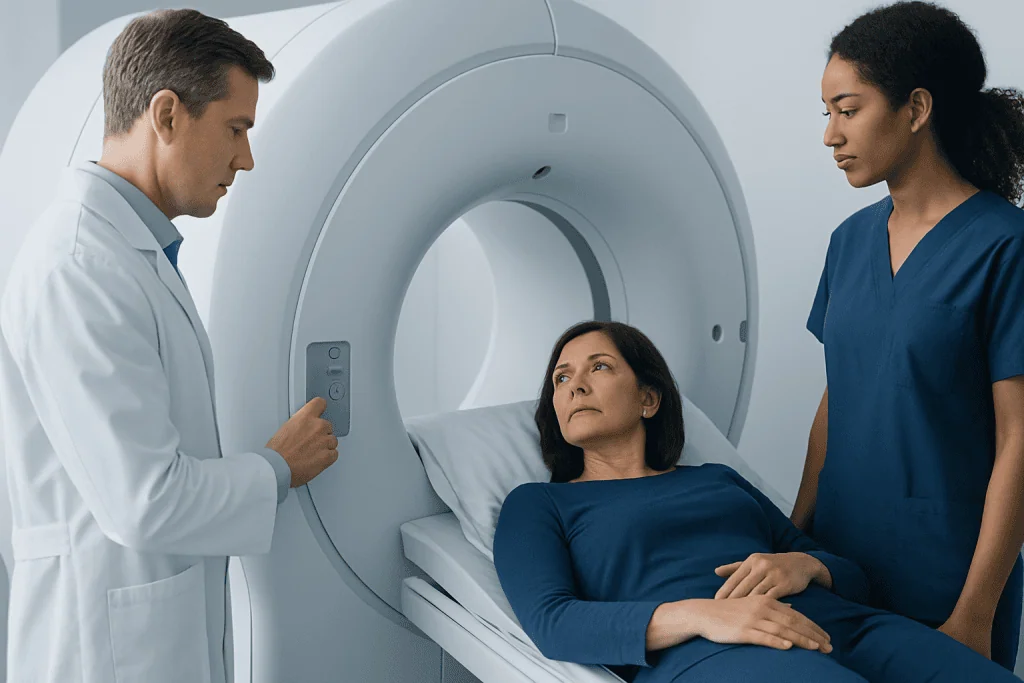
Imaging tests do not confirm Huntington’s disease on their own, but they can provide useful supporting information. Brain scans may show changes in structures deep within the brain, especially the caudate nucleus and putamen, which are involved in movement and cognitive control. These findings can fit with Huntington’s disease, particularly when combined with symptoms and family history.
MRI is commonly used because it gives detailed images of the brain. CT may also be used in some situations, although it provides less detail than MRI for many neurological conditions. In early disease, imaging can sometimes appear normal or show only subtle changes, so a normal scan does not rule out Huntington’s disease.
One of the main reasons imaging is ordered is to help exclude other possible causes of symptoms. For example, doctors may want to look for stroke, tumor, structural abnormalities, or other neurodegenerative conditions that can mimic aspects of Huntington’s disease. When needed, the broader neurological workup may overlap with evaluations used for other movement disorders such as Parkinson’s disease.
Imaging results are interpreted alongside the clinical examination and genetic findings. Rather than serving as a stand-alone answer, they are one part of a comprehensive diagnostic process.
The Role of Genetic Testing and Counseling
Genetic testing is the test that can confirm Huntington’s disease in a person who has symptoms suggestive of the condition. The test looks for an expanded CAG repeat in the HTT gene. If this disease-causing expansion is present, it strongly supports the diagnosis in the right clinical setting. Because the test result can have major emotional and family implications, it is usually offered with careful counseling.
Before testing, a clinician or genetic counselor explains what the test can and cannot show. They discuss possible outcomes, the effect on close relatives, future planning, insurance or employment concerns where relevant, and emotional readiness for receiving results. After testing, follow-up counseling helps the person understand the meaning of the result and consider next steps.
Genetic testing may be used in two main settings: diagnostic testing for someone who already has symptoms, and predictive testing for an adult who has no symptoms but has a family history and wants to know whether they carry the gene change. Predictive testing is a personal decision and is usually not done casually. It follows a structured process because knowing the result can affect mental health, relationships, and life planning.
Testing in children is generally approached very carefully. If a child has symptoms that raise concern for juvenile Huntington’s disease, specialists may recommend a full pediatric neurological assessment and targeted testing. If there are no symptoms, predictive testing for minors is usually avoided in order to protect future autonomy and reduce unnecessary psychological harm.
Other Tests and Conditions Doctors May Consider
There is no blood test, scan, or bedside exam that replaces a full Huntington’s disease evaluation. However, doctors may order additional tests to rule out other medical problems that can contribute to movement abnormalities, confusion, mood changes, or difficulty walking. These may include general blood tests, metabolic screening, or assessments for other neurological disorders, depending on the symptoms and age of the patient.
Neuropsychological testing may be helpful when thinking or behavioral changes are prominent. This testing looks at memory, attention, problem-solving, language, and executive function. It does not confirm Huntington’s disease by itself, but it can document the pattern of cognitive difficulties and help with treatment planning, daily support, and work or school accommodations.
In some situations, doctors consider other hereditary or acquired causes of chorea and related symptoms. The differential diagnosis may include medication-related movement disorders, Wilson disease, autoimmune disorders, other neurodegenerative diseases, or psychiatric conditions. A specialist in neurology evaluation and care may coordinate this broader workup when the diagnosis is not straightforward.
Because diagnosis can affect multiple aspects of life, some people also benefit from referral to speech therapy, physical therapy, psychiatry, nutrition, or rehabilitation services. These assessments may begin early, even while the diagnostic process is still being completed.
What Happens After a Diagnosis
After Huntington’s disease diagnosis is confirmed, the next step is usually a personalized care plan. Although there is currently no cure, treatment can help manage symptoms and support quality of life. Care often focuses on movement symptoms, mood changes, sleep, swallowing, communication, safety, and maintaining as much independence as possible.
Management may involve medications, physical therapy, occupational therapy, speech and swallowing assessment, nutritional guidance, and mental health support. Cognitive and behavioral symptoms are taken seriously, since they can affect relationships, employment, and day-to-day decision-making. A multidisciplinary approach is often the most helpful, especially as needs change over time. In selected cases, patients may also need physical therapy and rehabilitation or speech and language therapy as part of supportive care.
The diagnosis also creates important questions for family members. Since Huntington’s disease is inherited, relatives may want information about their own risk and whether genetic counseling is appropriate. Many families find it useful to discuss planning, emotional support, and caregiving needs early, before symptoms become more advanced.
Near the end of the diagnostic journey, some people seek care at centers that can coordinate neurology, genetics, psychiatry, rehabilitation, and imaging in one place. Acibadem International’s multidisciplinary specialists in JCI-accredited hospitals diagnose and treat Huntington’s disease for international patients when this kind of coordinated care is needed.
When to See a Doctor
A person should see a doctor if they develop unexplained involuntary movements, balance problems, changes in thinking, personality changes, or a decline in daily functioning. Medical advice is also important when there is a family history of Huntington’s disease and new symptoms begin to appear. Early assessment does not only help with diagnosis; it can also improve symptom management and support planning.
Urgent medical attention is needed if symptoms lead to falls, choking, severe confusion, thoughts of self-harm, or sudden worsening. These issues may relate to Huntington’s disease or another serious condition, and they should not be ignored. Mental health symptoms deserve prompt care just as much as physical symptoms.
People with a known family history but no symptoms may also wish to speak with a neurologist or genetic counselor before considering predictive testing. This gives them time to understand the process, prepare emotionally, and make an informed decision. For many individuals and families, expert guidance can make the diagnostic path feel clearer and more manageable.
Frequently asked questions
Can Huntington’s disease be diagnosed before symptoms start?
Yes. An adult with a family history can choose predictive genetic testing to learn whether they carry the HTT gene change before symptoms begin. This is usually done with genetic counseling because the decision can have emotional and family consequences.
Is a brain MRI enough to diagnose Huntington’s disease?
No. MRI can show brain changes that support the diagnosis, but it cannot confirm Huntington’s disease by itself. Doctors use imaging together with symptoms, neurological examination, family history, and genetic testing.
What genetic test is used for Huntington’s disease?
The standard test looks for an expanded CAG repeat in the HTT gene. In a person with compatible symptoms, a disease-causing expansion can confirm the diagnosis. The result is usually explained with pre-test and post-test counseling.
If there is no family history, can someone still have Huntington’s disease?
Yes, although family history is common. Sometimes the history is not known because of adoption, limited records, misdiagnosis in relatives, or early deaths in previous generations. This is why doctors still consider Huntington’s disease based on symptoms and examination findings.
Who usually diagnoses Huntington’s disease?
Diagnosis is often made by a neurologist, especially one with experience in movement disorders. Genetic counselors, psychiatrists, neuropsychologists, and rehabilitation specialists may also be involved. A team approach is often helpful because the condition affects movement, thinking, and behavior.
Should children be tested if a parent has Huntington’s disease?
In general, predictive testing for children without symptoms is usually not recommended. If a child has symptoms that raise concern for juvenile Huntington’s disease, doctors may consider testing as part of a specialist evaluation. Families should discuss this carefully with a pediatric neurologist and genetic counselor.
References
- National Institute of Neurological Disorders and Stroke
- National Human Genome Research Institute
- NHS
- MedlinePlus
- Huntington's Disease Society of America
This article is for general information only and is not a substitute for professional medical advice. Please consult a qualified doctor about your individual situation.
Explore treatments in Turkey — costs, top hospitals & a free quote
JCI-accredited · board-certified surgeons · reply within 24h
Add us as a Preferred Source to see more of our trusted health content across Google Search, AI Overviews and Discover.

IVF & Reproductive Health
Assisted reproduction and fertility treatments tailored to each couple.