IV: A Complete Medical Overview

IV stands for intravenous and refers to treatment delivered directly into a vein. Common IV uses include hydration, medications, blood products, and nutrition.
Key Takeaways
- IV stands for intravenous and refers to treatment delivered directly into a vein.
- Common IV uses include hydration, medications, blood products, and nutrition.
- Different IV devices are used depending on how long treatment is needed and what is being infused.
- Most IV treatments are routine, but they still require monitoring for infection, irritation, or other complications.
- A healthcare professional should decide whether IV treatment is necessary and which type is safest.
IV means intravenous, a method of giving fluids, medicines, blood products, or nutrition directly into a vein. It is commonly used in hospitals and clinics because it can work quickly, allow precise dosing, and support people who cannot take enough by mouth.
Overview: what IV means in medicine
IV stands for intravenous. In medicine, this means a fluid, medicine, blood product, or nutrient solution is delivered directly into a vein through a small tube called a catheter. Because the bloodstream carries substances throughout the body, IV treatment can act quickly and can be carefully adjusted by the healthcare team.
Many people think of an IV only as a bag of fluid hanging beside a hospital bed, but IV care is broader than that. It may be used in emergency treatment, planned surgery, cancer care, infection treatment, nutrition support, and routine hospital care. Some IV therapies are given over minutes, while others continue for hours or days.
An IV is not automatically “stronger” or “better” than oral treatment. It is chosen when direct vein access is the safest or most effective option, such as when a person is dehydrated, cannot swallow, needs rapid medication delivery, or requires close control of the dose. In many situations, care later switches from IV treatment to oral treatment once the person is stable.
Why an IV may be needed
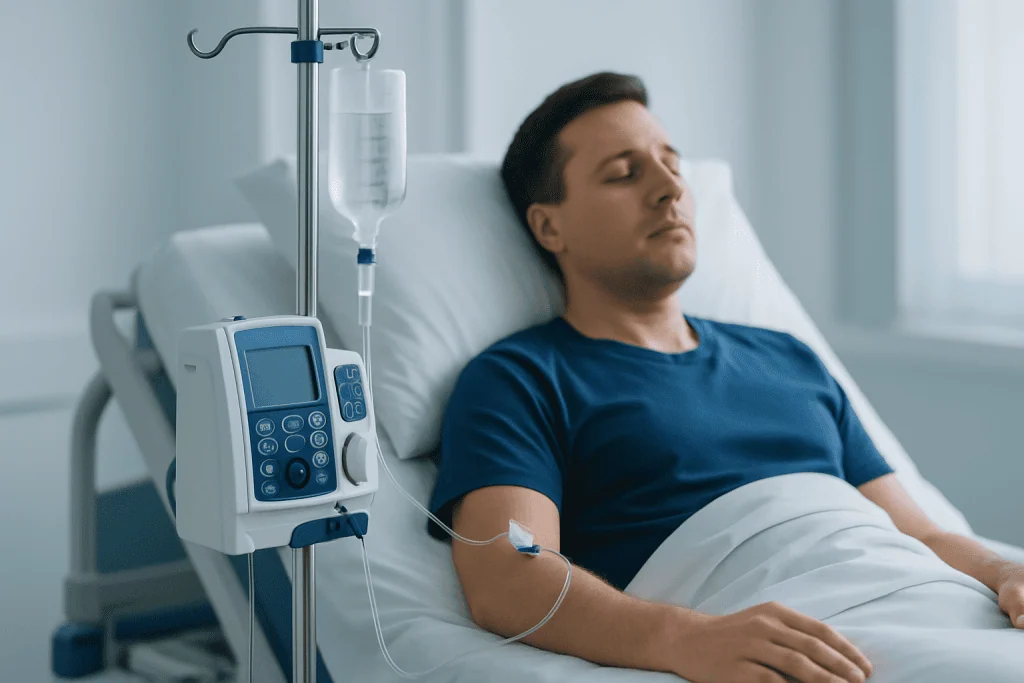
Doctors use IV therapy for several practical reasons. One of the most common is hydration. If a person has vomiting, diarrhea, fever, bleeding, or poor oral intake, IV fluids can help restore fluid balance more reliably than drinking alone. IV treatment may also be used to correct electrolyte problems, such as low sodium or potassium, when close monitoring is needed.
Another major use is medication delivery. Some medicines work best, or only, when given intravenously. Examples include certain antibiotics, pain relief medicines, anesthesia drugs, and medications used during emergencies. IV access is also essential for many hospital procedures and for treatments that must enter the bloodstream at a precise rate.
IVs can also deliver blood products and nutrition. Blood transfusion may be needed after major blood loss or for some blood disorders. People who cannot eat enough or whose digestive system cannot absorb nutrients properly may need intravenous nutrition. In selected patients, an IV may be part of care for serious infections, surgery recovery, or complex conditions such as colon cancer or stomach cancer when treatment affects eating and hydration.
- Fluids for dehydration or low blood pressure
- Medicines that need fast or controlled delivery
- Blood transfusion or blood components
- Electrolyte replacement
- Nutrition support when eating is not possible or not enough
Types of IV lines and how they differ

Not every IV is the same. The simplest type is a peripheral IV, usually placed in a vein in the hand, wrist, or arm. This is the common short-term IV used for fluids, routine medicines, and many hospital treatments. It is quick to place and suitable for temporary use, but it may need to be changed if the vein becomes irritated or the line stops working.
For longer treatment or medicines that may irritate smaller veins, doctors may use a central venous catheter. This type reaches a larger vein and can stay in place longer. A peripherally inserted central catheter, often called a PICC line, is inserted through the arm and advanced to a central vein. Implanted ports and other central lines may be used for repeated therapies such as chemotherapy or long courses of immunotherapy.
The right device depends on the purpose of treatment, the expected duration, and the person’s veins and overall health. A short course of IV antibiotics after dehydration is very different from long-term intravenous nutrition or repeated cancer treatment. Choosing the best IV access helps lower the risk of discomfort and complications while making treatment more efficient.
What happens during IV placement and infusion
IV placement is usually a straightforward procedure. After cleaning the skin, a clinician inserts a small needle into a vein and threads a tiny flexible catheter into place. The needle is then removed, leaving the catheter in the vein. The line is secured with a dressing, and tubing may be connected to a fluid bag, syringe, or infusion pump.
Patients often feel a brief pinch or sting when the IV is inserted. Once it is in place, there may be mild awareness of the catheter, but it should not be sharply painful. During an infusion, the healthcare team checks the site and monitors the person’s blood pressure, pulse, symptoms, and the speed of the infusion as needed.
Some infusions are given by gravity, while others use an electronic pump for exact control. The type of fluid or medicine, and how quickly it should be given, are prescribed individually. If the IV site becomes painful, swollen, red, cool, or starts leaking, the patient should tell a nurse or doctor promptly so the line can be assessed.
Benefits, risks, and possible complications
The main advantage of IV treatment is direct access to the bloodstream. This allows fast action, predictable absorption, and close control over dose and timing. For people who are very unwell, unable to swallow, or preparing for surgery, IV therapy can be an important part of safe medical care. It can also make it possible to give treatments that would not work well by mouth.
At the same time, IV therapy is a medical procedure with potential risks. Common minor issues include bruising, temporary discomfort, and difficulty finding a vein. The IV may also stop flowing if it becomes blocked or if the catheter shifts out of place. Sometimes fluid or medicine leaks into the surrounding tissue, a problem called infiltration or extravasation, which can require prompt attention.
Less commonly, there can be infection, inflammation of the vein, allergic reactions, or fluid overload in people who are sensitive to extra fluid, such as some patients with heart or kidney disease. Central lines carry additional risks because they stay in place longer and reach deeper veins. Careful insertion technique, proper line care, and regular monitoring are important parts of reducing these risks. If advanced imaging or procedures are needed as part of evaluating complications or related conditions, doctors may also use radiology services to guide diagnosis and treatment.
IV fluids, medications, and nutrition: common examples
IV fluids are often grouped into crystalloids and other specialized solutions. Crystalloids, such as saline-based or balanced electrolyte solutions, are commonly used for hydration and fluid replacement. The exact fluid depends on the person’s condition, age, blood test results, heart and kidney function, and how much fluid they have lost.
IV medications include antibiotics, pain medicines, anti-nausea drugs, sedatives, anesthesia agents, and medicines used in intensive care or emergencies. Blood products, such as red blood cells or plasma, are also given through IV access under close supervision. In some cases, contrast material is injected intravenously for scans to help diagnose internal problems.
When the digestive tract cannot be used normally, intravenous nutrition may be considered. This is called parenteral nutrition and is carefully tailored to provide protein, glucose, fats, vitamins, and minerals. It is usually reserved for situations where oral or tube feeding is not possible or not enough. Because it requires close monitoring, it is managed by a specialist team.
When to seek medical care
Medical care should be sought promptly if a person may need IV treatment because of severe dehydration, fainting, confusion, persistent vomiting, major blood loss, difficulty breathing, chest pain, or signs of serious infection such as high fever with weakness. These symptoms do not always mean an IV is required, but they do need professional assessment without delay.
Anyone who already has an IV should tell a healthcare professional as soon as possible if there is redness, swelling, warmth, increasing pain, pus, bleeding, leaking fluid, numbness, or a fever. These signs may indicate irritation, infection, or that the IV is not in the correct position. Central line problems should always be taken seriously.
People do not need to decide on their own whether an IV is necessary. The safest approach is assessment by a qualified clinician, who can examine the person, review symptoms, and perform tests if needed. Near the end of a hospital journey, some patients may also require supportive procedures or surgery related to the underlying problem, such as colon cancer treatment when IV care forms part of broader management. Acibadem International’s multidisciplinary specialists and JCI-accredited hospitals diagnose and treat conditions that may require IV care for international patients.
Frequently asked questions
What does IV stand for?
IV stands for intravenous. It means fluids, medicines, blood products, or nutrients are delivered directly into a vein through a small tube.
Why would someone need an IV instead of drinking fluids?
An IV may be needed when a person is dehydrated, vomiting, unable to swallow, or needs treatment to work quickly. It can also be used when doctors need precise control over the type and amount of fluid or medicine being given.
Is getting an IV painful?
Most people feel a brief pinch or sting when the IV is inserted. After placement, it may feel slightly uncomfortable at first, but ongoing sharp pain, swelling, or burning should be reported because the line may need to be checked.
How long can an IV stay in place?
The length of time depends on the type of IV and the reason for treatment. Short-term peripheral IVs are usually used for temporary care, while PICC lines or other central lines may stay in place longer when prolonged treatment is needed.
What are the risks of IV therapy?
Common risks include bruising, irritation, blockage, or fluid leaking into nearby tissue. Less common but more serious risks include infection, vein inflammation, allergic reaction, or fluid overload, especially in people with certain medical conditions.
Can IV therapy be used for nutrition?
Yes. If a person cannot get enough nutrition through eating or the digestive tract cannot be used safely, doctors may provide intravenous nutrition, called parenteral nutrition. This is a specialized treatment that requires careful monitoring.
References
- World Health Organization
- Centers for Disease Control and Prevention
- MedlinePlus
- Merck Manual Consumer Version
- National Institute for Health and Care Excellence
This article is for general information only and is not a substitute for professional medical advice. Please consult a qualified doctor about your individual situation.
Explore treatments in Turkey — costs, top hospitals & a free quote
JCI-accredited · board-certified surgeons · reply within 24h
Add us as a Preferred Source to see more of our trusted health content across Google Search, AI Overviews and Discover.
Check your numbers in seconds
BMI, calories, due date, blood pressure and 30+ more clinical calculators — free, instant, doctor-reviewed ranges.