Knee Sore Walking Up Stairs: What Patients Need to Know
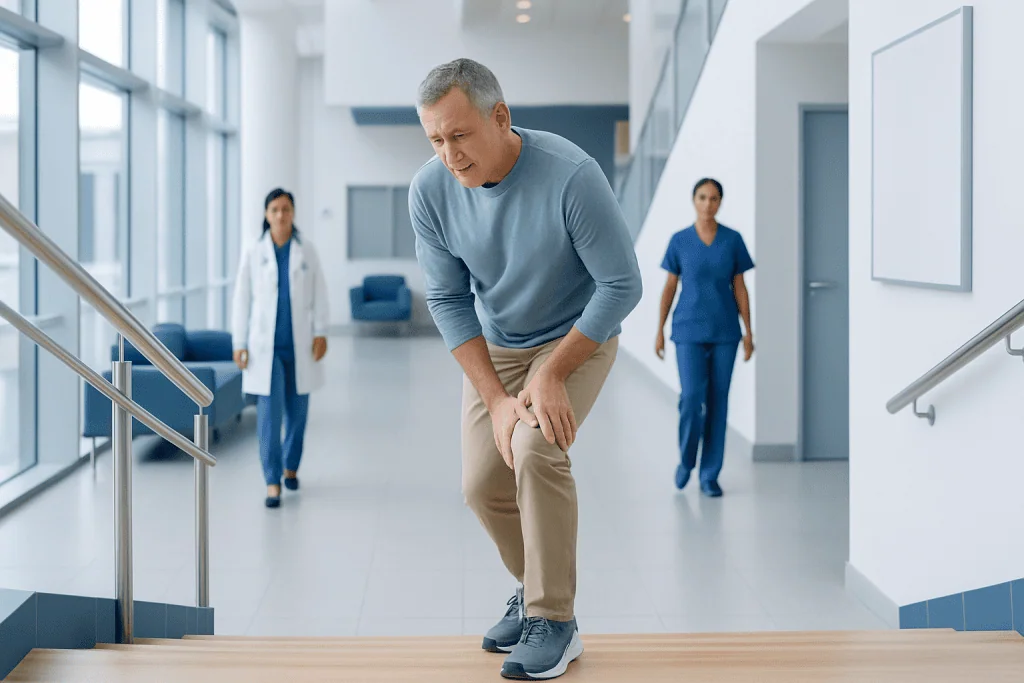
Stair climbing places greater force through the knee than level walking, which can reveal kneecap, tendon, cartilage, or arthritis-related pain. Pain at the front of the knee is often associated with patellofemoral pain, while pain on the inner, outer, or back of the knee may suggest different structures are involved.
Key Takeaways
- Stair climbing places greater force through the knee than level walking, which can reveal kneecap, tendon, cartilage, or arthritis-related pain.
- Pain at the front of the knee is often associated with patellofemoral pain, while pain on the inner, outer, or back of the knee may suggest different structures are involved.
- Reducing aggravating activity temporarily, using ice when appropriate, and gradually strengthening the hips and thighs can help many people recover.
- Sudden swelling, inability to bear weight, knee locking, fever, or pain after a significant injury needs prompt medical assessment.
- A clinician can identify the likely source of pain through a history, examination, and imaging only when it is needed.
A knee that is sore while walking up stairs commonly reflects increased pressure on the kneecap joint, often related to activity changes, muscle weakness, overuse, or early joint wear. Many cases improve with appropriate activity adjustments and strengthening, but persistent or severe pain should be assessed by a qualified clinician.
Why Does a Knee Feel Sore Walking Up Stairs?
A knee sore walking up stairs is commonly caused by the extra load that stair climbing places on the knee, especially the joint between the kneecap and thigh bone. It may occur after an increase in exercise, repeated kneeling or squatting, a minor injury, or gradual changes in the joint and surrounding muscles. The location, timing, and accompanying symptoms of the pain help guide the likely cause.
Going upstairs requires the thigh muscles to work strongly while the knee bends and supports body weight. This can increase pressure behind the kneecap several times compared with standing. A knee that feels manageable on flat ground may therefore become painful on stairs, when rising from a chair, during squats, or after sitting with the knee bent for a long time.
Not every episode of stair-related knee pain signals serious damage. However, pain that persists, worsens, limits daily activities, or follows a twisting injury deserves medical evaluation. An accurate assessment can distinguish a temporary overload problem from arthritis, a tendon condition, a cartilage injury, or another cause that may require targeted care.
How the Pattern of Pain Can Help
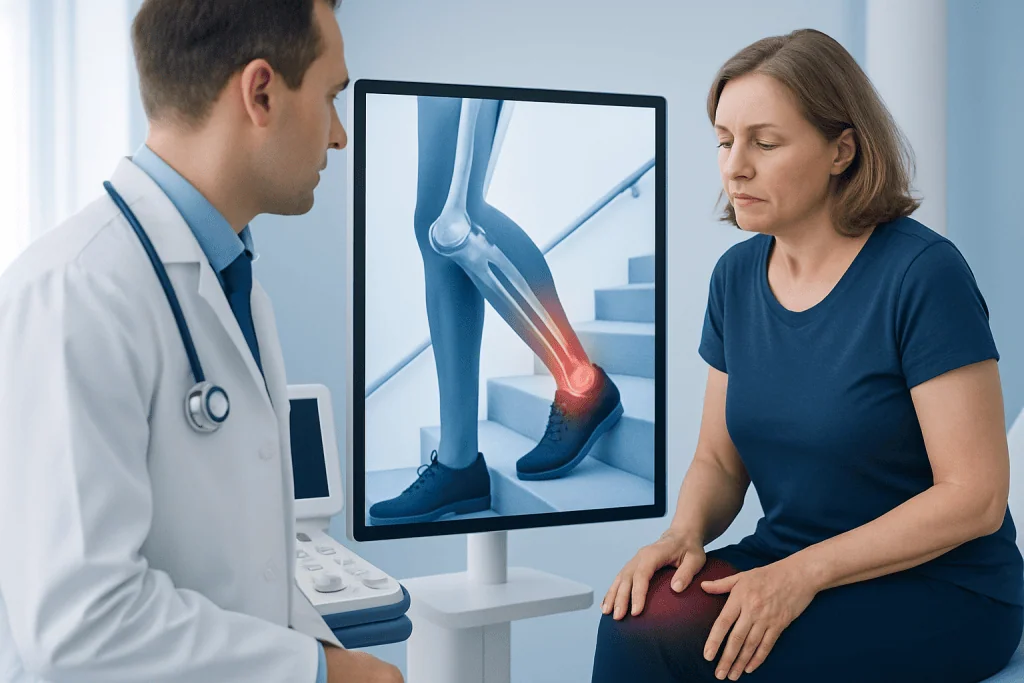
The exact pain pattern cannot diagnose a knee condition on its own, but it provides useful clues. Dull aching or pressure at the front of the knee, around or behind the kneecap, is often associated with patellofemoral pain. This is a common condition in which the kneecap joint becomes sensitive to load, sometimes because of training changes, muscle imbalance, movement patterns, or inadequate recovery.
Pain along the inner or outer joint line may be related to irritation of cartilage, ligaments, or the meniscus, a crescent-shaped cartilage cushion within the knee. Pain below the kneecap may involve the patellar tendon, particularly in people who jump, run, or repeatedly climb stairs. Pain accompanied by morning stiffness or discomfort after inactivity may be seen with osteoarthritis, especially in older adults.
Clicking or mild cracking sounds are common and are not necessarily harmful when they occur without pain, swelling, or instability. By contrast, a knee that catches, locks, gives way, becomes visibly swollen, or cannot fully straighten should be assessed. These symptoms can indicate a mechanical problem inside the joint or a more significant injury.
- Front of knee: often kneecap-related pain or patellar tendon irritation.
- Inner or outer side: may involve ligaments, meniscus, or joint wear.
- Back of knee: may relate to muscle or tendon strain, fluid collection, or joint problems.
- Whole-knee stiffness and aching: can occur with arthritis or inflammation.
Common Causes and Risk Factors

Patellofemoral pain is one of the most frequent explanations for pain while climbing stairs. It can affect active people, adolescents, and adults of any age. A sudden increase in hill walking, running, cycling resistance, squats, stair use, or sports training may overload the kneecap joint before the muscles and tissues have adapted.
Osteoarthritis is another common cause, particularly later in adulthood. In osteoarthritis, changes in joint cartilage and other joint tissues can lead to pain, stiffness, reduced movement, and occasional swelling. Excess body weight can increase the load across the knee, but osteoarthritis also occurs in people at a healthy weight and may be influenced by age, previous injury, family history, and occupational demands.
Other possible causes include patellar tendinopathy, bursitis, muscle or tendon strain, meniscus injury, ligament injury, and inflammatory forms of arthritis. Previous knee surgery, a past fracture, altered hip or foot mechanics, reduced thigh or hip strength, and limited ankle mobility may also affect how forces travel through the knee during stair climbing.
Risk factors do not mean that pain is unavoidable. They identify areas a clinician or physiotherapist may address, such as training progression, footwear, movement technique, strength, flexibility, weight management where appropriate, and recovery time between demanding activities.
How Knee Pain Is Diagnosed
A clinician usually begins by asking when the pain started, where it is felt, which movements provoke it, and whether there was an injury. They may also ask about swelling, locking, instability, fever, other joint symptoms, medical conditions, work demands, physical activity, and previous treatments. This history often provides important direction before any test is considered.
During the examination, the clinician may observe walking, stair movement, knee alignment, range of motion, and strength in the thigh and hip muscles. They may gently examine different areas of the knee and perform maneuvers that assess the ligaments, meniscus, kneecap, and surrounding tendons. Both knees may be examined for comparison.
Imaging is not always needed for recent, uncomplicated knee pain. An X-ray may be useful when osteoarthritis, fracture, or bone alignment concerns are suspected. Ultrasound can help assess some superficial tendons and fluid collections, while MRI may be considered when symptoms suggest a meniscus, ligament, cartilage, or other internal joint problem and the result would change treatment decisions.
Blood tests are occasionally used if there are signs of infection, inflammatory arthritis, or another systemic illness. A diagnosis should be based on the whole clinical picture rather than on an imaging finding alone, because some scan changes are also seen in people without pain.
Treatment Options for Stair-Related Knee Pain
Treatment depends on the cause, severity, and the person’s daily needs. For many non-urgent cases, the first step is relative rest rather than complete inactivity. This means temporarily reducing activities that sharply increase pain, such as repeated stair climbing, deep squats, running hills, or jumping, while continuing comfortable movement and low-impact activity where possible.
Guided exercise is a central part of care for many kneecap-related and osteoarthritis-related symptoms. A physiotherapist may recommend gradual strengthening of the quadriceps, hip, and core muscles, alongside exercises that improve balance, flexibility, and movement control. The program should be progressed according to symptoms; pushing through severe pain is not usually helpful.
Ice may provide short-term comfort after activity for some people, while heat can feel soothing for stiffness before movement. Simple pain-relief medicines or anti-inflammatory medicines may be appropriate for selected individuals, but they are not suitable for everyone. A doctor or pharmacist can advise based on a person’s age, medical history, allergies, kidney, stomach, heart, and blood-thinning medication considerations.
For osteoarthritis or persistent mechanical symptoms, treatment may include a structured rehabilitation plan, supportive devices in selected cases, injections when clinically appropriate, or surgery for carefully evaluated conditions. Surgery is generally not the first option for uncomplicated anterior knee pain. The goal is to match treatment to the diagnosed problem and help the person return safely to valued activities.
Practical Self-Care and Safer Stair Use
While symptoms are settling, it can help to take stairs more slowly, use the handrail, and avoid carrying heavy loads. Some people find it more comfortable to lead with the less painful leg when going up and step down with the painful leg first, using a one-step-at-a-time method temporarily. This can reduce demand on the sore knee while it recovers.
Comfortable, supportive shoes may improve confidence and reduce strain for some individuals. If pain began after a new activity or exercise routine, reducing intensity or frequency and then rebuilding gradually is often more effective than stopping all movement for a long period. Cycling with low resistance, swimming, water exercise, or level walking may be alternatives if they are comfortable.
Maintaining regular physical activity supports joint function, muscle strength, sleep, and overall health. People who are advised to work toward a weight that is healthy for them may find that even gradual, sustainable changes reduce knee load. However, knee pain should not be treated as a personal failure; it is common, multifactorial, and often manageable with individualized support.
Keeping a brief symptom record can be useful before an appointment. It may include the pain location, activities that trigger it, duration of stiffness, swelling, sensations of giving way or locking, and what improves or worsens the symptoms. This information can help a clinician develop a practical plan.
When to Seek Medical Care
Medical care should be sought promptly after a major fall, collision, twist, or direct blow if the knee is severely painful, deformed, rapidly swollen, unstable, or unable to support weight. Urgent assessment is also important if the knee is hot, red, markedly swollen, or painful with fever or feeling unwell, as these features can indicate infection or significant inflammation.
A non-urgent appointment is advisable when pain lasts more than a few weeks, regularly disrupts sleep or daily routines, progressively worsens, or does not improve with sensible activity modification. Assessment is also appropriate for repeated giving way, persistent swelling, locking, inability to fully bend or straighten the knee, or new symptoms in multiple joints.
People with known arthritis, inflammatory disease, diabetes, circulation problems, or previous knee surgery should seek personalized advice rather than relying only on self-care. Acibadem International’s multidisciplinary specialists and JCI-accredited hospitals diagnose and treat knee conditions for international patients, with care plans based on clinical assessment and individual needs.
Early assessment does not necessarily mean that invasive treatment will be needed. In many cases, it helps identify modifiable factors, provides reassurance, and supports a structured recovery plan before pain becomes more limiting.
Frequently asked questions
Why does my knee hurt going up stairs but not walking on flat ground?
Stairs require deeper knee bending and stronger contraction of the thigh muscles, increasing pressure through the kneecap joint. This may make kneecap-related pain, tendon irritation, or early arthritis more noticeable than it is during level walking. A clinician can assess persistent pain and identify the most likely cause.
Is knee pain when climbing stairs a sign of arthritis?
It can be, particularly if there is stiffness after rest, swelling, reduced movement, or gradual worsening over time. However, stair pain is also common with patellofemoral pain and tendon conditions, including in younger adults. Symptoms, examination findings, and sometimes imaging help distinguish the cause.
Should I keep using stairs if my knee is sore?
Mild discomfort may be manageable with slower pacing, a handrail, and temporarily reducing the number of stair trips. Sharp, worsening, or lingering pain is a reason to modify activity and seek professional advice. Complete rest is rarely necessary, but painful loading should not be repeatedly forced.
Can weak muscles cause knee pain on stairs?
Reduced strength or control in the thigh and hip muscles can affect how the knee tracks and absorbs force during stair climbing. This does not mean the knee is damaged, and targeted progressive exercise often helps. A physiotherapist can tailor exercises to the person’s symptoms and ability.
What is the best exercise for knee pain on stairs?
There is no single best exercise because the appropriate plan depends on the diagnosis and current pain level. Gradual quadriceps and hip-strengthening exercises are commonly used for kneecap-related pain and osteoarthritis. Exercises should be comfortable enough to perform with good control and should be progressed gradually.
When is knee pain an emergency?
Emergency or urgent evaluation is needed after serious injury if the person cannot bear weight, the knee looks deformed, or swelling develops quickly. A hot, red, swollen knee with fever or general illness also needs urgent medical attention. These symptoms may indicate conditions that should not be managed at home.
References
- American Academy of Orthopaedic Surgeons
- National Institute of Arthritis and Musculoskeletal and Skin Diseases
- National Health Service
- Arthritis Foundation
- Mayo Clinic
This article is for general information only and is not a substitute for professional medical advice. Please consult a qualified doctor about your individual situation.
Joint and spine care in Turkey — expert assessment & treatment
JCI-accredited · board-certified surgeons · reply within 24h
Add us as a Preferred Source to see more of our trusted health content across Google Search, AI Overviews and Discover.