Lice Pictures: An Evidence-Based Guide for Patients

Lice pictures are most helpful when they show both live lice and nits close to the scalp. Nits are oval eggs glued to the hair shaft and do not brush off easily like dandruff.
Key Takeaways
- Lice pictures are most helpful when they show both live lice and nits close to the scalp.
- Nits are oval eggs glued to the hair shaft and do not brush off easily like dandruff.
- Head lice are small crawling insects; they do not jump or fly.
- Diagnosis is usually made by finding a live louse or viable nit with careful scalp examination.
- Treatment usually combines a lice product, fine-tooth combing, and cleaning of recently used personal items.
- Medical advice is important if treatment fails, the scalp becomes infected, or the person is very young or medically vulnerable.
Lice pictures can be useful for recognizing what head lice and nits look like, especially when trying to tell them apart from dandruff, hair casts, or other scalp debris. The most reliable signs are tiny moving insects on the scalp and oval eggs firmly attached to the hair shaft close to the skin.
What lice pictures can and cannot show
Lice pictures are helpful because they give patients a visual reference for what to look for during a scalp check. In most cases, the goal is to identify two things: a live louse, which is a tiny crawling insect, or a nit, which is an egg attached to a hair shaft. Good images usually show where these are found, how large they are, and how they differ from common look-alikes such as dandruff or dry skin.
At the same time, pictures alone do not confirm a diagnosis. Lighting, hair color, camera quality, and the amount of magnification can all change how lice appear. A photo may make a flake of skin look like a nit, or make a harmless hair cast look more concerning than it is. That is why healthcare professionals rely on direct inspection, often with a fine-tooth comb, rather than photographs alone.
For most patients, the most useful approach is to use lice pictures as a guide, then check the scalp carefully in real life. Looking behind the ears, at the nape of the neck, and close to the scalp usually gives the best chance of finding evidence of infestation. If there is uncertainty, a doctor or pharmacist can help confirm whether the finding is actually head lice.
How head lice and nits look in real life
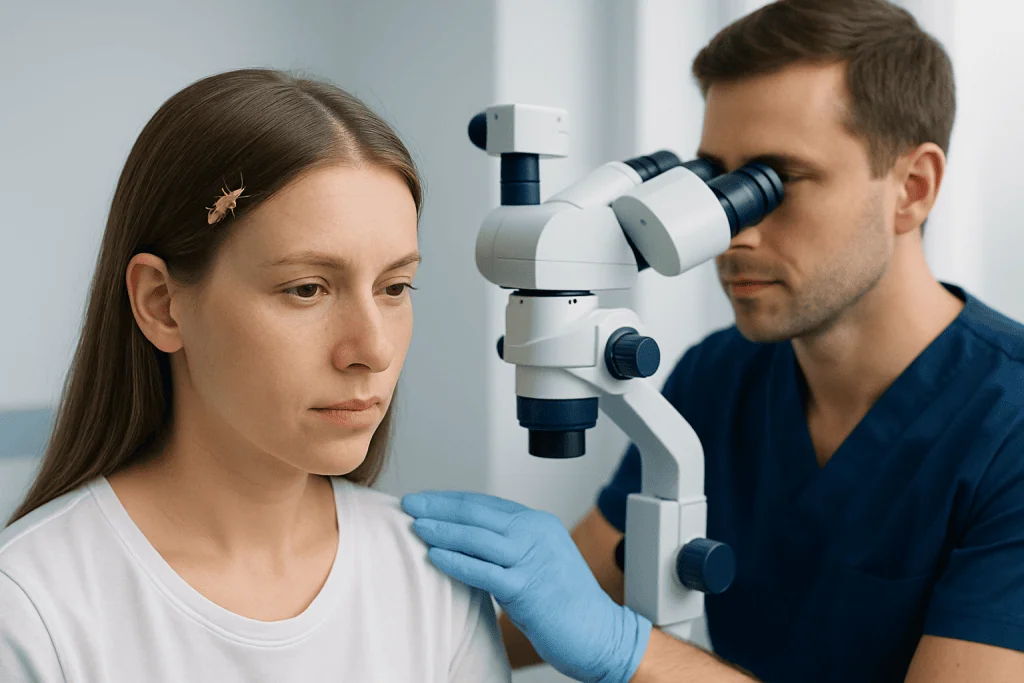
Head lice are small, wingless insects that crawl but do not jump or fly. In real life, they may appear tan, grayish, or darker depending on lighting and whether they have recently fed. Adult lice are usually about the size of a sesame seed, while younger lice, called nymphs, are smaller and can be harder to spot.
Nits are lice eggs. They are usually oval, tiny, and attached firmly to one side of the hair shaft with a glue-like substance. They are often found very close to the scalp, where warmth helps them develop. Depending on the stage of development, they may look yellowish, tan, brown, or whitish. Empty egg cases can remain on the hair even after successful treatment.
Patients often ask whether lice pictures should show movement. Live lice do move, although they can be fast and avoid light. Nits do not move on their own. One of the most practical differences between nits and dandruff is that dandruff usually slides or flakes off easily, while a nit stays fixed in place unless pulled away with the fingernails or combed out with effort.
- Live louse: tiny, crawling, found on the scalp or hair
- Nit: oval egg attached to a hair shaft, usually near the scalp
- Empty nit casing: pale shell left after hatching
- Dandruff: loose flakes that brush away easily
Common look-alikes: dandruff, hair casts, and scalp debris
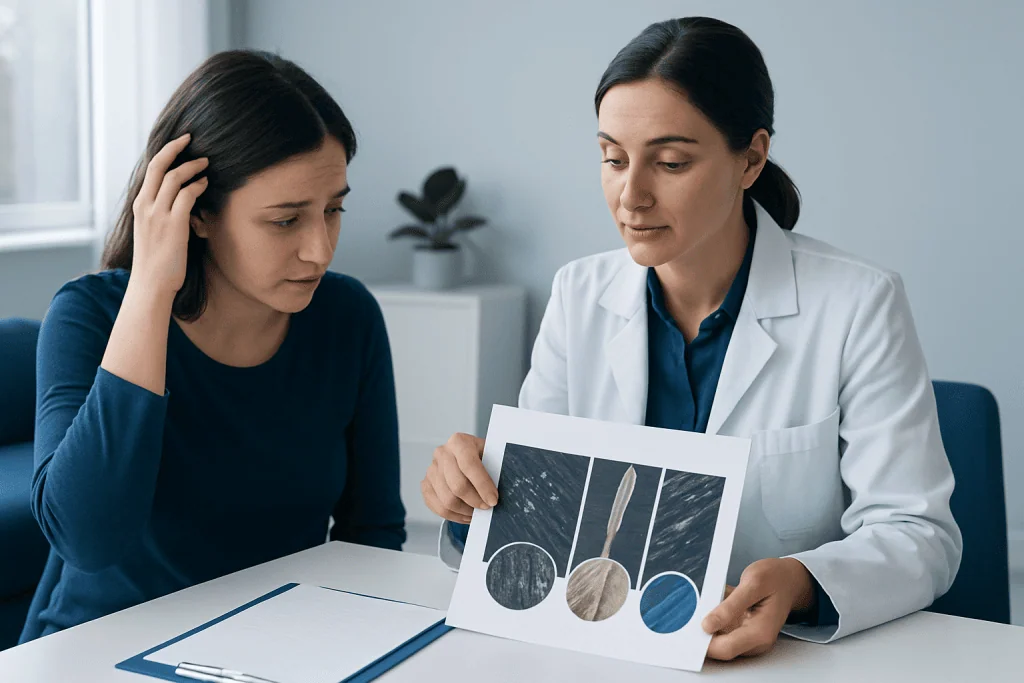
Many findings that worry patients turn out not to be lice. Dandruff is one of the most common causes of confusion. It usually appears as white or yellowish flakes on the scalp and hair, especially if the scalp is dry or irritated. Unlike nits, dandruff is not cemented to the hair shaft and usually falls away more easily.
Hair casts are another common look-alike. These are thin, sleeve-like bits of material that wrap around the hair shaft and can sometimes slide up and down the hair. They are not lice eggs. Product residue, lint, and dried hairspray can also become stuck in hair and resemble nits in photos or mirrors.
Some scalp conditions can increase confusion because they cause itching and scaling. Examples include eczema, seborrheic dermatitis, and other forms of scalp irritation. In certain cases, a clinician may evaluate for broader skin conditions if symptoms do not fit a typical head lice pattern or if there is ongoing inflammation. Careful examination matters more than any single image.
Symptoms and how head lice spread
The most common symptom of head lice is itching, especially on the scalp, behind the ears, and at the back of the neck. This itching is caused by a reaction to louse saliva. However, not everyone becomes itchy right away, and some people with lice have little or no discomfort. That is one reason lice can spread before being noticed.
Head lice spread mainly through direct head-to-head contact. This is why they are common among school-aged children, households, and close contacts. Less commonly, lice may spread through recently shared items such as hats, hair accessories, pillowcases, or brushes, although this is thought to be less important than direct contact.
Finding lice does not mean poor hygiene. Head lice can affect people with clean or unclean hair alike. They are a common and manageable condition. When itching is significant or scratching causes broken skin, a clinician may also check for secondary irritation or infection and consider whether another cause of scalp symptoms, such as hair and scalp disorders, should be considered.
How doctors diagnose lice
Diagnosis is usually based on finding a live louse. Seeing nits can support the diagnosis, but nits alone do not always prove an active infestation because old egg cases may remain after the lice are gone. For this reason, healthcare professionals often prefer wet-combing or fine-tooth combing during the examination, which can help capture live lice more effectively than looking with the naked eye alone.
During an exam, the scalp is inspected under good light, especially behind the ears and at the nape of the neck. The doctor may separate the hair in small sections and use a specialized lice comb. If the picture is unclear, the clinician may ask about itching, recent exposure, prior treatment, and whether any other family members have symptoms.
Most cases do not require laboratory tests or imaging. The key question is whether there is active lice infestation that needs treatment. If the scalp looks inflamed, crusted, or painful, the doctor may also assess for skin infection or another scalp condition. In selected cases, patients may be guided toward dermatology evaluation for persistent scalp findings that do not respond as expected.
Treatment options and practical home steps
Treatment for head lice usually includes a topical lice product and careful combing to remove lice and nits. Different products are available, and recommendations may depend on age, local resistance patterns, pregnancy status, and prior treatment history. It is important to follow the product instructions carefully and to repeat treatment when advised, because some treatments do not fully kill unhatched eggs.
Fine-tooth combing remains an important part of care. Combing wet, conditioned hair in small sections can help remove both live lice and eggs. Household members and close contacts should be checked, but not everyone needs treatment unless active lice are found. Overuse of lice products is not helpful and may irritate the scalp.
At home, recently used hats, pillowcases, bedding, and clothing can be washed according to fabric instructions. Brushes and combs can also be cleaned. Large-scale home disinfection is generally unnecessary. If standard treatment does not work, a doctor may reassess the diagnosis, review how treatment was used, and discuss other approaches. In some cases, broader hair and scalp care services may be relevant if repeated treatments have caused irritation or if another scalp issue is suspected.
- Use the lice product exactly as directed
- Comb hair section by section with a fine-tooth lice comb
- Check close contacts for live lice
- Wash recently used personal items
- Avoid sharing combs, hats, and hair accessories during treatment
Prevention, school considerations, and self-care
Prevention focuses on reducing opportunities for head-to-head spread. Children and adults can be reminded not to share hair accessories, combs, hats, helmets, or scarves. Long hair can be tied back in settings where close contact is common. Regular scalp checks may be helpful when there is a known case in the household or school community.
School exclusion policies vary, but many experts do not support keeping children out of school solely because of nits. Active lice should be treated, but children can often return after appropriate treatment begins, depending on local guidance. Families may wish to inform close contacts so they can check for symptoms and signs early.
Self-care should also include gentle management of itching and scalp irritation. Scratching can break the skin and increase the risk of infection. If there is confusion about what is being seen on the scalp, or if repeated checking causes stress, professional confirmation can be reassuring. Near the end of the care journey, some international patients may choose centers such as Acibadem International, where multidisciplinary specialists in JCI-accredited hospitals evaluate and treat scalp and skin concerns when needed.
When to seek medical care
Medical care is appropriate if there is uncertainty about whether the finding is truly lice, if over-the-counter treatment does not seem to work, or if symptoms keep returning. A doctor should also be consulted if the person affected is very young, pregnant, immunocompromised, or has a scalp condition that makes self-treatment difficult. Professional guidance can help avoid unnecessary or repeated product use.
Prompt medical review is also important if there are signs of infection, such as increasing redness, pain, swelling, crusting, pus, or fever. Severe itching, sleep disruption, or widespread rash also deserve assessment. In these situations, a clinician may recommend targeted treatment and evaluate for complications or another diagnosis.
If symptoms extend beyond simple lice infestation, clinicians may consider related scalp or skin issues and advise further care through specialist dermatology care. The main goal is accurate diagnosis and safe, effective treatment rather than repeated home treatment without clear evidence of active lice.
Frequently asked questions
Can lice pictures confirm that someone has head lice?
No. Lice pictures can help a person compare what they see, but diagnosis is most reliable when a live louse is found on direct scalp examination. A doctor or pharmacist can help if the finding is unclear.
What do nits look like compared with dandruff?
Nits are tiny oval eggs attached firmly to the hair shaft, usually close to the scalp. Dandruff is made of loose flakes that typically brush or fall away more easily. This difference in how firmly they stick is often more useful than color alone.
Are white specks in hair always lice eggs?
No. White specks may be dandruff, product residue, lint, or hair casts rather than nits. Because many things can look similar, a careful scalp check is important before starting treatment.
Can adults get head lice, or is it only a childhood problem?
Adults can get head lice, although they are more common in children because of close contact during play and school activities. Anyone in a household can be affected if there has been exposure.
Do head lice mean a person is not clean?
No. Head lice are not a sign of poor hygiene. They spread mainly through direct head-to-head contact and can affect people with any hair type or hygiene routine.
Should everyone in the family be treated if one person has lice?
Not necessarily. Household members and close contacts should be checked carefully, but treatment is usually recommended only for those with active lice. Treating people without evidence of lice may expose them to unnecessary products.
References
- Centers for Disease Control and Prevention
- American Academy of Dermatology
- National Health Service
- Mayo Clinic
This article is for general information only and is not a substitute for professional medical advice. Please consult a qualified doctor about your individual situation.
Hair transplant in Turkey — costs, graft counts & a free assessment
JCI-accredited · board-certified surgeons · reply within 24h
Add us as a Preferred Source to see more of our trusted health content across Google Search, AI Overviews and Discover.