Lunges: A Complete Medical Overview
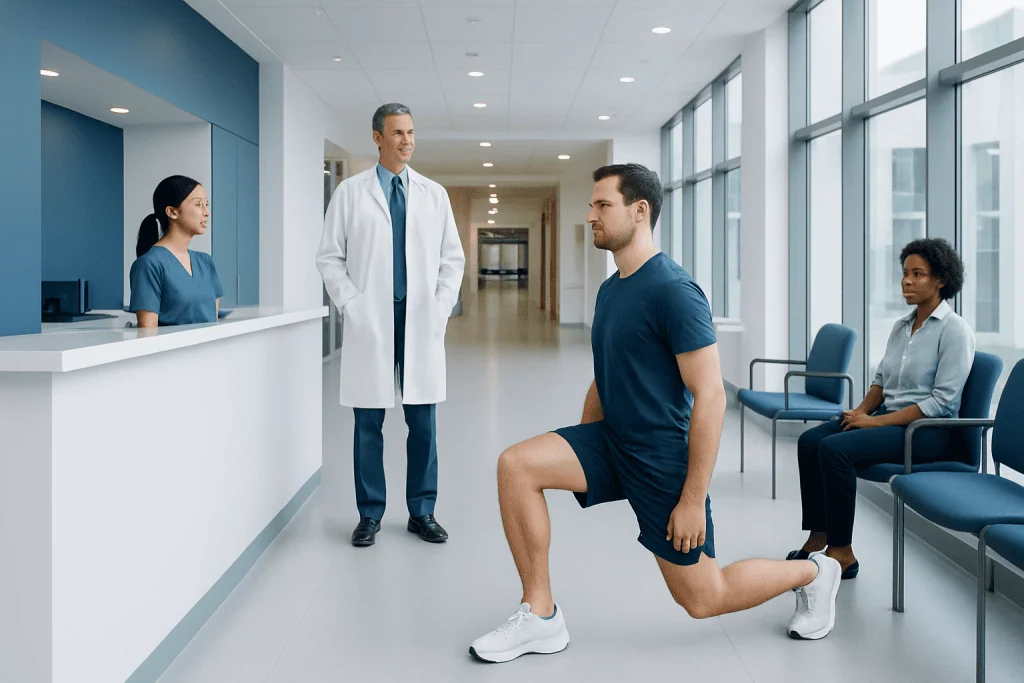
Lunges strengthen the quadriceps, gluteal muscles, hamstrings, and core while challenging balance. Good alignment of the hip, knee, ankle, and trunk helps reduce strain and improves exercise quality.
Key Takeaways
- Lunges strengthen the quadriceps, gluteal muscles, hamstrings, and core while challenging balance.
- Good alignment of the hip, knee, ankle, and trunk helps reduce strain and improves exercise quality.
- Lunges can be modified for beginners, older adults, and people returning from injury.
- Pain is not a normal training goal; persistent knee, hip, ankle, or back pain should be evaluated.
- A gradual progression in depth, repetitions, and external load is safer than doing advanced variations too soon.
Lunges are a versatile lower-body exercise that can improve leg strength, balance, coordination, and hip mobility when performed correctly. A medical overview focuses not only on fitness benefits, but also on form, common mistakes, injury prevention, and when pain during lunges may need professional assessment.
Overview: What Are Lunges?
Lunges are a common bodyweight or resistance exercise used to strengthen the lower body and improve functional movement. In a lunge, one leg steps forward, backward, sideways, or diagonally while the body lowers under control and then returns to the starting position. This simple movement pattern trains muscles used in walking, stair climbing, rising from a chair, and many sports and daily activities.
From a medical and exercise perspective, lunges are valuable because they are unilateral exercises, meaning each leg works partly on its own. This can help identify and address differences in strength, balance, or coordination between sides. Compared with some machine-based exercises, lunges also require more control from the hips, trunk, and ankles.
Lunges are not a single exercise but a family of movements. Forward lunges, reverse lunges, walking lunges, lateral lunges, and split squats all place slightly different demands on joints and muscles. The best choice depends on the person’s goals, fitness level, injury history, and comfort with the movement.
How Lunges Benefit the Body

When done with sound technique, lunges help build strength in the quadriceps, gluteal muscles, hamstrings, and calf muscles. They also recruit the core and the smaller stabilizing muscles around the pelvis and hip. Because the body must control movement in multiple planes, lunges can improve coordination and postural control in ways that are useful beyond the gym.
Lunges may also support mobility. The trailing leg often moves into hip extension, while the front leg works through flexion at the hip and knee. Over time, this can contribute to better movement quality, especially in people who spend long periods sitting. However, mobility gains depend on pain-free range and proper alignment rather than forcing depth.
Another important benefit is functional carryover. Many daily tasks involve stepping, changing direction, and controlling weight on one leg at a time. For that reason, lunges are often included in general fitness programs and rehabilitation plans. In some cases, they may be used as part of recovery after lower-limb problems under professional guidance, such as after evaluation in physical therapy and rehabilitation.
- Build lower-body strength
- Improve balance and stability
- Support hip mobility and coordination
- Train movement patterns used in everyday life
- Allow side-to-side strength comparisons
Proper Form and Common Technique Errors

Safe lunge technique starts with posture. The head stays neutral, the chest remains lifted, and the trunk is generally upright or only slightly inclined depending on the variation. The feet should begin about hip-width apart rather than on a tight straight line, because a narrow base can make balance more difficult. During the lowering phase, both knees bend while the front foot stays grounded.
Joint alignment matters. A common cue is to keep the front knee tracking in line with the toes rather than collapsing inward or rotating excessively. The heel of the front foot usually remains down, and the movement should be smooth and controlled rather than rushed. The back knee may move toward the floor, but depth should match the person’s mobility, strength, and comfort.
Common errors include taking too short or too long a step, leaning the torso excessively, pushing primarily through the toes, or allowing the front knee to drift inward. Some people also arch the lower back or rotate the pelvis. These patterns do not always cause immediate injury, but repeated poor mechanics may increase discomfort or reduce the exercise’s benefits.
Beginners often do well starting with a split squat or a supported lunge while lightly holding a stable surface. Practicing in front of a mirror or with guidance from a qualified trainer or clinician can help correct form early. People with persistent discomfort may benefit from assessment for related issues such as knee pain or movement limitations elsewhere in the chain.
Who Should Be Cautious With Lunges?
Lunges are safe for many people, but they are not ideal for everyone in every situation. Individuals with recent injury, acute joint swelling, significant balance problems, severe weakness, or uncontrolled pain may need an alternative exercise or a modified version. Pregnancy, older age, and chronic conditions do not automatically rule out lunges, but they may call for closer attention to support, range of motion, and supervision.
Knee discomfort is one of the most common concerns. Some people feel pain in the front of the knee during forward lunges, especially if the exercise is introduced too quickly or performed with poor alignment. Reverse lunges or partial-range split squats may feel better because they can reduce stress for some individuals. Hip, ankle, and low back symptoms can also change how a lunge should be performed.
People with known arthritis, a prior ligament injury, or recent surgery should not assume that all lunge styles are equally appropriate. Rehabilitation programs are individualized, and progression depends on healing, strength, and stability. If there is uncertainty, a clinician may assess whether symptoms are related to the joint, tendon, muscle, or surrounding soft tissues, including conditions such as meniscus injury.
Modifications, Variations, and Progression
Lunges can be adjusted to match many ability levels. For beginners, static split squats are often easier than stepping lunges because the feet remain planted. A shorter range of motion, a chair or wall for balance, and a slower tempo can also make the exercise more manageable. These options are often useful for people returning to exercise after illness, deconditioning, or time away from training.
Once the basic pattern is comfortable, progression may involve adding repetitions, increasing depth, or trying different directions such as lateral or walking lunges. Reverse lunges are commonly well tolerated and may be easier to control. More advanced progressions include holding dumbbells, adding a knee drive, elevating the front or back foot, or incorporating the movement into circuit training.
Progression should be gradual. A person who can perform a few well-controlled repetitions without pain or instability is likely to benefit more than someone who advances quickly and compensates with poor mechanics. If symptoms occur, reducing load or complexity is often a better first step than pushing through pain.
For people working around musculoskeletal issues, an individualized strengthening program may also include orthopedic rehabilitation or guided exercise therapy. The goal is not simply to perform lunges, but to restore safe, effective movement patterns that fit the person’s needs.
Potential Risks, Pain During Lunges, and Evaluation
Lunges themselves do not inherently damage healthy joints, but any exercise can contribute to symptoms if technique, load, frequency, or individual limitations are not respected. Pain during lunges may come from the knee, patellar tendon, hip joint, gluteal tendons, ankle, Achilles tendon, or lower back. Sometimes the source is not the site of pain alone; weak hip control or ankle stiffness can affect how forces are distributed.
A brief sense of muscle effort or fatigue is expected in exercise, but sharp pain, catching, giving way, or swelling is different. Persistent discomfort may suggest overload, inflammation, poor movement mechanics, or an underlying condition that deserves assessment. People who feel repeated pain with stepping, squatting, or stairs may need a broader musculoskeletal evaluation.
Clinical assessment may include a history, physical examination, gait and movement analysis, and occasionally imaging if there is concern for structural injury. Doctors may also consider whether symptoms overlap with other conditions affecting the lower limbs or spine. In selected cases, referral to orthopedics and traumatology may be appropriate to clarify the cause and guide treatment.
Prevention, Self-Care, and Exercise Tips
Most lunge-related problems can be reduced with thoughtful preparation and progression. A brief warm-up that includes light walking, gentle dynamic stretching, and activation of the hips and core may improve comfort and control. Wearing stable footwear and training on a non-slip surface can also support good mechanics.
Volume matters as much as form. Doing too many repetitions too soon, adding weight quickly, or combining lunges with other demanding leg exercises without adequate recovery may trigger soreness or overuse symptoms. Rest, hydration, sleep, and spacing intense lower-body sessions through the week all support adaptation.
Self-care for mild post-exercise soreness may include temporary reduction in training intensity, relative rest, and gradual return as symptoms settle. If discomfort keeps coming back, it is reasonable to pause the aggravating variation and seek guidance rather than repeatedly testing through pain. Near the end of the care pathway, patients may choose centers such as Acibadem International, where multidisciplinary specialists in JCI-accredited hospitals assess musculoskeletal complaints and guide treatment for international patients.
When to Seek Medical Care
Medical advice is appropriate if pain during or after lunges is persistent, worsening, or limiting normal walking, stairs, work, or sleep. Evaluation is also sensible if there is swelling, a popping injury, the feeling that the joint is unstable, or symptoms that do not improve after reducing activity for several days.
Urgent assessment may be needed after a fall or sudden injury with severe pain, inability to bear weight, deformity, marked swelling, numbness, or signs of infection such as fever with a red, hot joint. These symptoms do not always indicate a serious problem, but they should not be ignored.
People with chronic conditions affecting bones, joints, nerves, or balance should ask a qualified doctor or physical therapist before starting a demanding lower-body routine. Professional guidance can help select the safest lunge variation, identify contributing weaknesses or mobility restrictions, and create a plan that supports long-term progress.
Frequently asked questions
Are lunges good for beginners?
Yes, lunges can be suitable for beginners when started with simple modifications. Static split squats, shallow depth, and light support from a wall or chair can make the movement easier to learn safely.
Do lunges damage the knees?
Lunges do not usually damage healthy knees when performed with appropriate form and progression. Knee pain during lunges may reflect poor mechanics, overload, or an existing condition rather than the exercise itself.
Which muscles do lunges work?
Lunges mainly work the quadriceps, gluteal muscles, and hamstrings. They also engage the calf muscles, core, and smaller stabilizing muscles that help control balance and alignment.
Are reverse lunges better than forward lunges?
Neither version is universally better; the best option depends on the person's goals and symptoms. Reverse lunges may feel more comfortable for some people with knee sensitivity because they can be easier to control.
What should a person do if lunges cause pain?
The first step is usually to stop the painful variation and reduce intensity. If pain is sharp, recurrent, associated with swelling or instability, or interferes with daily activities, a medical evaluation is recommended.
How often should lunges be done?
Frequency depends on fitness level, overall exercise routine, and recovery. Many people include lunges one to three times per week with rest between demanding leg sessions, but an individualized plan is best.
References
- American College of Sports Medicine
- American Academy of Orthopaedic Surgeons
- National Institute of Arthritis and Musculoskeletal and Skin Diseases
- National Health Service
- MedlinePlus
This article is for general information only and is not a substitute for professional medical advice. Please consult a qualified doctor about your individual situation.
Explore treatments in Turkey — costs, top hospitals & a free quote
JCI-accredited · board-certified surgeons · reply within 24h
Add us as a Preferred Source to see more of our trusted health content across Google Search, AI Overviews and Discover.

More from the Health Library

Cortical Cataract: A Complete Medical Overview

Barley Tea Benefits — Explained by Medical Evidence, Not Myths

Genicular Artery Embolization: A Complete Medical Overview

Cells: A Complete Medical Overview

Diarrhea Otc Drugs: What Patients Need to Know