Minimally Invasive Neurosurgery vs Open Surgery: How Doctors Choose
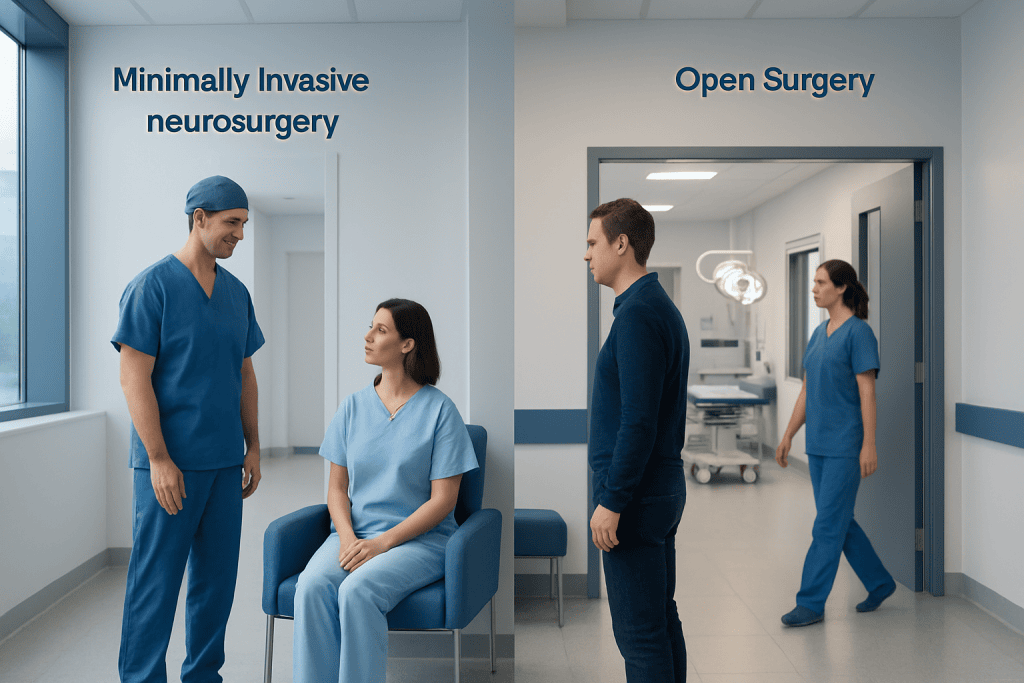
Minimally invasive neurosurgery uses smaller openings or natural pathways when possible, but it is not suitable for every condition. Open surgery may be preferred when surgeons need wider access, direct visualization, or more room to protect important structures.
Key Takeaways
- Minimally invasive neurosurgery uses smaller openings or natural pathways when possible, but it is not suitable for every condition.
- Open surgery may be preferred when surgeons need wider access, direct visualization, or more room to protect important structures.
- The choice depends on the diagnosis, tumor or lesion size, location, bleeding risk, anatomy, and the patient’s general health.
- Advanced imaging, neurological exams, and multidisciplinary planning help doctors choose the safest and most effective approach.
- Recovery may be faster after minimally invasive procedures, but long-term success is more important than incision size alone.
Doctors choose between minimally invasive neurosurgery and open surgery by balancing safety, effectiveness, access to the problem area, and the patient’s overall health. The best approach depends on the exact diagnosis, the size and location of the condition, and the goals of treatment.
Overview: What Is the Difference?
Minimally invasive neurosurgery and open surgery are two different ways surgeons can reach and treat problems in the brain, spine, or nerves. In minimally invasive procedures, the surgical team aims to use smaller incisions, narrower surgical corridors, endoscopes, microscopes, or image-guided techniques to reach the target area with as little disruption to surrounding tissue as possible. Open surgery usually involves a larger opening that gives the surgeon a wider field of view and more direct access.
Neither approach is automatically better in every situation. The main goal is always the same: to treat the condition safely and effectively while protecting healthy brain and nerve tissue. A smaller incision can be helpful, but it is only one part of the decision. Doctors focus first on which approach is most likely to achieve the best medical result.
In neurosurgery, access matters because the brain, spinal cord, and nerves are delicate structures in very tight spaces. Some problems can be treated through a keyhole opening or through the nose with endoscopic techniques. Others require a traditional open operation so the surgeon can see more clearly, control bleeding, remove more of a tumor, or safely work around critical blood vessels and nerves.
When Minimally Invasive Neurosurgery May Be an Option
Minimally invasive neurosurgery may be considered when the condition can be reached through a smaller and safe pathway. This can include certain brain tumors, pituitary tumors, some spinal conditions, fluid flow problems, and selected vascular or nerve-related disorders. In some cases, surgeons may use endoscopic approaches, tubular retractors, neuronavigation, or microscopes to reduce tissue disruption.
Potential benefits may include less pain after surgery, a shorter hospital stay, smaller scars, reduced blood loss, and a quicker return to everyday activities. However, these advantages vary from person to person and from procedure to procedure. A minimally invasive operation is still major medical care, and careful selection is essential.
Examples of procedures that may sometimes be performed with minimally invasive techniques include brain tumor surgery, selected pituitary adenoma surgery, and some forms of spine surgery. Even within these categories, not every patient is a candidate. The exact anatomy, size of the lesion, and whether important structures are nearby all influence the decision.
- Smaller skin incision or opening
- Specialized cameras or microscopes for visualization
- Image guidance to improve accuracy
- Possibly shorter recovery in well-selected patients
- Not appropriate if access is too limited or risk is too high
When Open Surgery May Be the Better Choice

Open surgery remains an essential part of modern neurosurgery. It may be the safest and most effective choice when surgeons need broad access to the area, better control of bleeding, or more room to work around important structures. This can happen with large tumors, complex vascular problems, trauma, extensive spinal disease, or lesions located near critical brain regions.
A larger opening can allow the surgeon to see the anatomy directly, use more instruments if needed, and adjust the plan during surgery. In some situations, this flexibility improves safety. For example, if a lesion has unclear borders or is closely attached to nerves or blood vessels, open surgery may offer a better chance of removing it while minimizing harm.
Open surgery may also be chosen when the primary goal is complete treatment in a single operation, especially if minimally invasive access might leave too little working space. The decision is based on the overall outcome, not only on recovery time. Doctors generally prefer the approach that provides the clearest path to successful treatment with the lowest acceptable risk.
How Doctors Decide Between the Two
The choice between minimally invasive neurosurgery and open surgery begins with an accurate diagnosis. Doctors review symptoms, perform a neurological examination, and study imaging such as MRI, CT, angiography, or specialized spine scans. These tests help define the size, shape, location, and behavior of the condition, as well as its relationship to nearby brain tissue, spinal structures, blood vessels, and nerves.
Several key questions guide the decision. Can the surgeon reach the target safely through a small corridor? Will that corridor provide enough visibility and control? Is there a risk of bleeding that may require wider exposure? Does the condition need biopsy, full removal, decompression, drainage, stabilization, or a combination of these? The answers often determine whether minimally invasive access is realistic or whether open surgery offers greater safety.
Patient-specific factors are equally important. Age, general health, previous surgeries, medications, bleeding risk, body anatomy, and other medical conditions can influence the plan. Some patients may benefit from a shorter procedure or less tissue disruption, while others may need the reliability of an open approach. Shared decision-making helps patients understand the reasoning and likely trade-offs.
In many hospitals, neurosurgeons work with neuroradiologists, neurologists, anesthesiologists, endocrinologists, rehabilitation experts, and intensive care specialists. This multidisciplinary planning is especially important for conditions such as brain tumor or pituitary adenoma, where treatment goals may include preserving vision, hormone function, speech, movement, or memory as well as removing the lesion itself.
Common Factors That Influence Surgical Planning
Location is one of the most important factors. A small lesion deep in the brain may or may not be suitable for minimally invasive access depending on the safest route. A lesion near areas controlling speech, balance, movement, breathing, or vision may require an approach that gives the surgeon the best possible view and flexibility. In the spine, the number of levels involved and whether the spine is unstable can also shape the plan.
Size and complexity matter too. A tiny, well-defined abnormality may be ideal for a focused approach, while a large mass causing pressure, swelling, or distortion of surrounding tissue may require open surgery. Doctors also consider whether the condition appears benign or aggressive, whether it has invaded nearby structures, and whether surgery is meant to cure, relieve pressure, obtain tissue for diagnosis, or improve quality of life.
Technology can expand the options but does not replace judgment. Endoscopy, intraoperative imaging, navigation systems, surgical microscopes, neuromonitoring, and robotic assistance can make less invasive procedures possible in selected cases. Even so, these tools are useful only when they support a safe route to the target. The surgeon’s experience with a particular technique is also an important part of planning.
- Exact diagnosis and treatment goal
- Size, depth, and shape of the lesion
- Distance from critical nerves and blood vessels
- Need for reconstruction or spinal stabilization
- Chance of bleeding, swelling, or fluid leakage
- Patient health, prior operations, and recovery needs
Recovery, Risks, and Expected Outcomes
Recovery often differs between minimally invasive neurosurgery and open surgery, but every patient’s experience is individual. In general, minimally invasive procedures may lead to less postoperative discomfort, smaller scars, and earlier discharge from the hospital. Open surgery may involve a longer recovery period, especially when the procedure is more extensive or when intensive monitoring is required afterward.
However, a quicker early recovery does not always mean better overall treatment. The most important outcome is whether the condition was treated effectively and safely. If open surgery gives the surgeon a better chance of complete removal, stronger decompression, or better protection of brain and nerve function, that may outweigh the appeal of a smaller incision.
All neurosurgical procedures carry risks, which vary by diagnosis and location. These can include bleeding, infection, spinal fluid leakage, swelling, seizures, weakness, numbness, changes in speech or vision, blood clots, or the need for further treatment. Doctors discuss these possibilities in the context of the individual patient rather than as a one-size-fits-all list.
Follow-up care is part of treatment planning from the beginning. Depending on the condition, patients may need rehabilitation, repeat imaging, medications, hormone testing, radiation therapy, or long-term neurological review. For some patients with herniated disc or other structural problems, physical therapy and gradual return to activity are important parts of recovery regardless of the surgical approach.
Questions Patients Can Ask Their Neurosurgeon
Patients often feel more comfortable when they understand why one method is being recommended over another. Asking clear questions can help them weigh benefits, risks, and alternatives. A good discussion should explain not only the procedure itself but also the goals of treatment, expected recovery, and what may happen if surgery is delayed or avoided.
Useful questions include whether a minimally invasive option is possible, and if not, why not. Patients can also ask what the surgeon hopes to achieve, what important structures are nearby, how much symptom relief is expected, and what kind of rehabilitation may be needed. Understanding these points can make the decision process feel more manageable.
- Why is this approach recommended for this condition?
- Is a minimally invasive option available in this case?
- What are the main risks and benefits for this patient?
- What results are realistic, and how long is recovery likely to take?
- Will additional treatment be needed after surgery?
- How urgent is the procedure, and what happens if treatment is postponed?
Near the end of planning, patients may also wish to ask about hospital experience, postoperative support, and follow-up arrangements. At Acibadem International, multidisciplinary specialists in JCI-accredited hospitals evaluate and treat neurosurgical conditions for international patients, with care plans tailored to the diagnosis and individual needs.
When to Seek Medical Advice
Any person considering neurosurgery should seek evaluation from a qualified doctor or neurosurgeon rather than trying to choose a technique based on incision size alone. Symptoms such as persistent severe headaches, seizures, weakness, numbness, balance problems, changes in vision, unexplained hormone-related symptoms, severe neck or back pain with nerve symptoms, or loss of bladder or bowel control need medical assessment. The urgency depends on the symptom pattern and the suspected cause.
Emergency care is especially important for sudden neurological symptoms. A sudden severe headache, new seizure, confusion, facial drooping, trouble speaking, sudden weakness, major head injury, or rapidly worsening loss of sensation or movement should be treated as urgent. These symptoms do not always mean surgery is needed, but they should be evaluated promptly.
For non-emergency concerns, specialist consultation can clarify whether observation, medication, rehabilitation, minimally invasive surgery, or open surgery is the most appropriate next step. An individualized opinion based on imaging and examination is the safest way to make a decision.
Frequently asked questions
Is minimally invasive neurosurgery always safer than open surgery?
Not always. Minimally invasive techniques can reduce tissue disruption in selected cases, but safety depends on whether the surgeon can reach and treat the problem effectively. If access is limited or the anatomy is complex, open surgery may actually be the safer choice.
Does a smaller incision mean a better result?
A smaller incision may help with comfort and recovery, but it does not automatically mean a better long-term outcome. In neurosurgery, the priority is complete and safe treatment of the condition while protecting neurological function. Doctors choose the approach that best supports that goal.
What types of conditions can sometimes be treated with minimally invasive neurosurgery?
Some brain tumors, pituitary tumors, selected spinal conditions, certain fluid pathway problems, and some nerve-related disorders may be suitable. Eligibility depends on size, location, surrounding anatomy, and the treatment goal. A detailed specialist evaluation is needed in each case.
Why would a doctor recommend open surgery if a minimally invasive option exists?
A doctor may recommend open surgery if it offers better visibility, more room to work, or safer control of bleeding and delicate structures. In some cases, an open approach provides a better chance of complete treatment or lowers the risk of complications. The decision is based on medical benefit, not cosmetic preference.
Is recovery always faster after minimally invasive neurosurgery?
Recovery is often faster in the early period, but not in every case. The type of condition, the complexity of surgery, and the patient’s overall health all affect recovery time. Some open procedures also have smooth recoveries when carefully planned and supported.
Can a patient ask for one approach instead of the other?
Patients can and should discuss their preferences, concerns, and goals with their surgeon. However, the final recommendation should be guided by what is medically appropriate and safest for the individual condition. Shared decision-making works best when patients understand the reasons behind the plan.
References
- World Health Organization
- National Institute of Neurological Disorders and Stroke
- American Association of Neurological Surgeons
- National Health Service
- Congress of Neurological Surgeons
This article is for general information only and is not a substitute for professional medical advice. Please consult a qualified doctor about your individual situation.
Minimally Invasive in Turkey — costs, top hospitals & a free quote
JCI-accredited · board-certified surgeons · reply within 24h
Add us as a Preferred Source to see more of our trusted health content across Google Search, AI Overviews and Discover.

Robotic Surgery
Robot-assisted procedures across urology, gynecology and general surgery for greater precision and faster recovery.
More from the Health Library



Related Specialists

Dr. Murat Karakoç
Internal Medicine
Dr. Abdurrahman Gölbaşı
Radiology
Asst. Prof. Dr. Özer Öztürk
Orthopedic Surgery & Traumatology
Fzt. Gönül Zervent
Physical Medicine & Rehabilitation