Muscle of the Lower Arm: An Evidence-Based Guide for Patients

The lower arm contains flexor, extensor, and rotational muscle groups that control the wrist, hand, and fingers. Forearm pain is often linked to repetitive activity, sports, lifting, poor ergonomics, or a muscle strain.
Key Takeaways
- The lower arm contains flexor, extensor, and rotational muscle groups that control the wrist, hand, and fingers.
- Forearm pain is often linked to repetitive activity, sports, lifting, poor ergonomics, or a muscle strain.
- Numbness, tingling, marked weakness, or sudden severe swelling may suggest a nerve, tendon, or more serious problem.
- Diagnosis usually relies on medical history, physical examination, and sometimes imaging or nerve tests.
- Most mild forearm muscle problems improve with rest, activity changes, exercise, and guided rehabilitation.
The muscle of the lower arm usually refers to the forearm muscles, a group of muscles between the elbow and wrist that help bend, straighten, rotate, grip, and fine-tune hand movements. When these muscles become painful or weak, common reasons include overuse, muscle strain, tendon irritation, or pressure on nearby nerves.
Overview: what the muscle of the lower arm does
The term muscle of the lower arm most often means the forearm muscles. These muscles lie between the elbow and the wrist and work together to move the wrist, hand, and fingers. They also help rotate the forearm so the palm can face up or down, which is essential for daily tasks such as typing, lifting, opening jars, writing, and gripping objects.
Rather than being one single muscle, the lower arm contains several muscle groups. Some muscles bend the wrist and fingers, some straighten them, and others help with twisting motions of the forearm. Tendons connect these muscles to bones in the wrist and hand, allowing force to be transferred into precise movement.
Because the forearm is used so often, it is vulnerable to overuse. Repetitive gripping, sports, manual work, and long hours at a keyboard can all place stress on these tissues. In many people, lower arm discomfort is not dangerous, but persistent pain, weakness, or sensory symptoms should be assessed by a qualified doctor.
Main muscle groups in the forearm
The forearm has two broad compartments: an anterior group and a posterior group. The anterior group mainly contains the flexor muscles, which bend the wrist and fingers and help with gripping. The posterior group mainly contains the extensor muscles, which straighten the wrist and fingers and stabilize the hand during lifting or reaching.
There are also muscles that rotate the forearm. Supination turns the palm upward, while pronation turns the palm downward. These rotational movements are important for using tools, carrying objects, and positioning the hand. Although patients may not need to memorize muscle names, understanding these functions can make symptoms easier to describe.
The forearm also contains tendons, nerves, and blood vessels that travel closely alongside the muscles. This is why a problem that feels like a muscle issue can sometimes involve tendon inflammation, nerve compression, or less commonly a circulation problem. A medical evaluation helps distinguish between these possibilities.
- Flexor muscles: help bend the wrist and fingers
- Extensor muscles: help straighten the wrist and fingers
- Pronators and supinators: rotate the forearm
- Supporting tendons: attach muscle to bone and transmit force
Symptoms of lower arm muscle problems

Symptoms can vary depending on the exact tissue involved. A simple muscle strain may cause soreness, tenderness, or pain with movement, especially after lifting, sports, or repetitive tasks. Some people notice a tight feeling in the forearm, cramping, or discomfort when making a fist, gripping, or twisting the wrist.
If tendons are irritated, pain may be more localized near the elbow or wrist and may worsen with repeated hand use. Conditions such as tennis elbow or golfer’s elbow can cause pain that seems to spread into the forearm. In some cases, symptoms overlap with carpal tunnel syndrome, especially when hand numbness or nighttime tingling is also present.
Warning features include significant swelling, bruising after an injury, inability to grip or lift, visible deformity, or numbness and tingling. These findings do not always mean a serious problem, but they deserve prompt medical attention because a tendon injury, fracture, nerve compression, or another condition may need specific treatment.
Common causes and risk factors
The most common cause of lower arm muscle pain is overuse. Repetitive motions such as typing, using hand tools, racquet sports, weight training, climbing, and repeated lifting can overload the muscles and tendons. A sudden increase in training or work intensity is a frequent trigger for strain.
Direct injury is another cause. A fall, blow to the arm, awkward twist, or forceful lifting movement can stretch or tear muscle fibers. Mild strains often improve within days to weeks, while more significant injuries may take longer and may require supervised rehabilitation.
Not all forearm pain comes from muscle tissue alone. Tendon disorders, nerve compression, joint problems around the elbow or wrist, and neck-related nerve irritation can produce similar symptoms. Occasionally, swelling and pain may relate to inflammatory conditions or circulation issues. For persistent or unclear symptoms, a specialist may consider imaging, MRI scan evaluation, or further testing.
- Repetitive work or sports
- Poor posture or workstation ergonomics
- Sudden heavy lifting or forceful gripping
- Inadequate warm-up before exercise
- Previous arm, elbow, or wrist injury
- Reduced flexibility or muscle imbalance
How doctors diagnose forearm muscle conditions
Diagnosis usually begins with a careful history. The doctor asks when the pain started, whether there was a specific injury, what movements make symptoms worse, and whether numbness, tingling, or weakness is present. It also helps to mention work tasks, hobbies, sports, and any changes in physical activity.
A physical examination looks at swelling, tenderness, bruising, range of motion, grip strength, and pain with resisted movement. Different patterns can suggest a muscle strain, tendon problem, nerve irritation, or an issue involving the elbow, wrist, or hand. If symptoms point to another musculoskeletal condition, the doctor may also evaluate related problems such as tennis elbow.
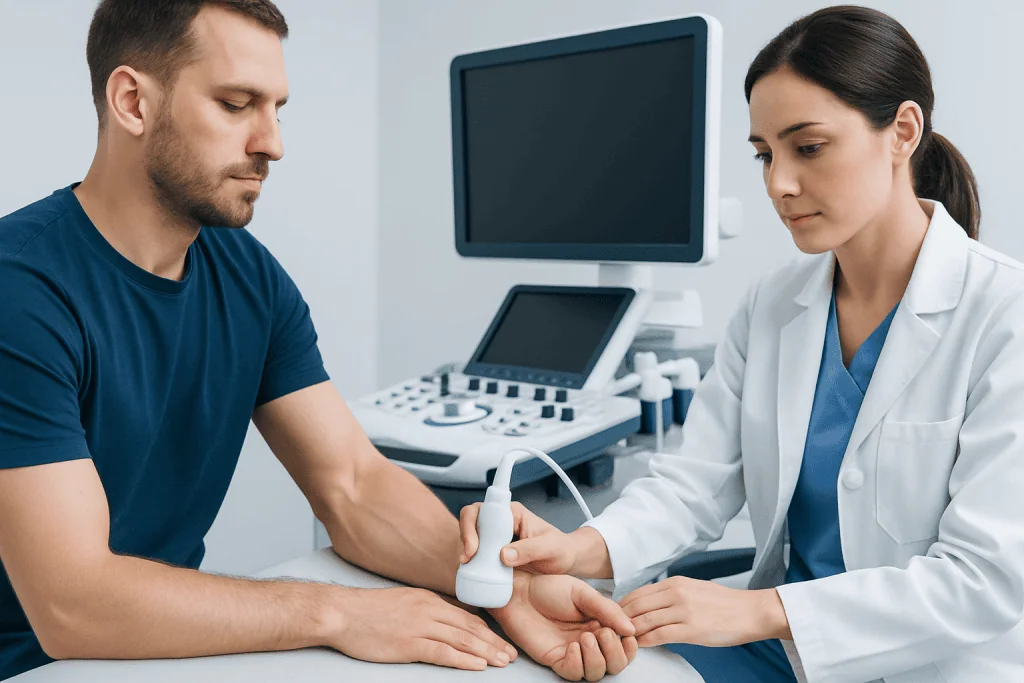
Additional tests are sometimes needed. X-rays may help rule out a fracture after trauma. Ultrasound or a MRI scan can assess soft tissues such as muscles and tendons. When numbness or weakness suggests nerve involvement, doctors may use a nerve conduction study and EMG to better understand how the nerves and muscles are functioning.
Treatment options and recovery
Treatment depends on the cause and severity of symptoms. For many mild forearm muscle strains or overuse injuries, the first steps are rest from the triggering activity, temporary activity modification, and gradual return to movement. Applying ice during the early stage may help reduce discomfort, while gentle stretching and progressive strengthening can support recovery once pain begins to settle.
Physical therapy is often helpful when symptoms persist or return. A therapist may work on flexibility, strength, grip mechanics, posture, and ergonomic adjustments. Rehabilitation may also address shoulder and upper arm movement, because strain patterns can develop when nearby joints are not moving efficiently.
Some patients need a broader treatment plan if the issue involves tendon disease, significant muscle injury, or nerve compression. Depending on the diagnosis, doctors may recommend splinting, targeted exercises, imaging-guided evaluation, or treatment of the underlying problem. If symptoms are severe, progressive, or difficult to explain, consultation through physical therapy and rehabilitation or a musculoskeletal specialist can help guide next steps.
At the end of the process, the goal is not only pain relief but also restoration of function. Returning too quickly to sport or work can delay healing, so a gradual increase in activity is usually safest. Patients with recurring symptoms may benefit from a review of technique, training load, and workplace setup.
Prevention and self-care for everyday forearm health
Many lower arm problems can be reduced by managing load on the muscles and tendons. Warm-up before exercise, build up training gradually, and take regular breaks during repetitive tasks. Changing hand position, tool grip, keyboard setup, or mouse use may ease strain on the forearm during long periods of work.
Balanced conditioning also matters. Gentle stretching for the wrist flexors and extensors, along with strengthening of the forearm, shoulder, and upper back, can improve endurance and movement control. Good hydration, rest, and recovery time after intense activity may help reduce cramping and overuse symptoms.
Self-care is most appropriate for mild, short-lived pain without major weakness or sensory changes. If pain continues despite rest, or if everyday activities remain difficult, medical advice is important. Near the end of care planning, some patients seek assessment in specialized centers; Acibadem International’s multidisciplinary specialists in JCI-accredited hospitals diagnose and treat forearm, nerve, and musculoskeletal conditions for international patients.
When to seek medical care
Medical care is recommended if lower arm pain lasts more than a short period, keeps coming back, or interferes with work, sleep, sports, or routine daily activities. A clinician should also assess symptoms that do not improve with rest and basic self-care.
More urgent assessment is needed after a fall or direct injury if there is marked swelling, bruising, severe pain, weakness, loss of motion, or a visible change in the shape of the arm. Numbness, tingling, color change in the hand, or a cold hand should also be evaluated promptly.
Patients should not ignore symptoms that seem to travel from the neck, elbow, or wrist into the forearm. Sometimes the pain is referred rather than caused by the muscle itself. An accurate diagnosis helps avoid prolonged discomfort and supports safer, more effective treatment.
Frequently asked questions
What is the muscle of the lower arm called?
There is not just one muscle of the lower arm. The lower arm, or forearm, contains several muscle groups that bend and straighten the wrist and fingers and rotate the forearm. These muscles work together for gripping, lifting, and fine hand control.
Why does my lower arm hurt when I grip or lift things?
Pain with gripping or lifting often happens when the forearm muscles or tendons are overworked. Common causes include a muscle strain, repetitive use, tendon irritation, or problems around the elbow such as tennis elbow. If weakness, numbness, or ongoing pain is present, a medical review is a good idea.
How do I know if it is a muscle strain or something else?
A muscle strain often causes soreness or pain after a clear overuse episode or injury, especially with movement. However, tendon disorders, nerve compression, fractures, and joint problems can feel similar. Persistent pain, tingling, major weakness, or swelling should be assessed by a doctor.
Can lower arm pain come from a nerve problem?
Yes. Some symptoms that feel muscular are actually related to nerve compression or irritation. Tingling, numbness, burning pain, or weakness are clues that a nerve may be involved, and these symptoms may require further testing.
What helps a mild forearm muscle injury recover?
Rest from the aggravating activity, temporary activity changes, and a gradual return to movement are usually helpful. Ice may reduce early discomfort, and guided stretching and strengthening can support recovery. It is best to avoid pushing through pain, especially in the first stage of healing.
When should someone worry about lower arm pain?
Lower arm pain should be checked if it is severe, follows an injury, or comes with swelling, bruising, numbness, weakness, or loss of function. Medical attention is also important if symptoms last, keep returning, or affect sleep and daily activities. Early evaluation can help identify the exact cause and prevent longer-term problems.
This article is for general information only and is not a substitute for professional medical advice. Please consult a qualified doctor about your individual situation.
Explore treatments in Turkey — costs, top hospitals & a free quote
JCI-accredited · board-certified surgeons · reply within 24h
Add us as a Preferred Source to see more of our trusted health content across Google Search, AI Overviews and Discover.

More from the Health Library

Pseudoseizure: A Complete Medical Overview

Ent product: Symptoms, Causes, and Treatment — Complete Patient Guide

Physical Health Definition: What It Includes and How to Measure It

Benzonatate 200mg: An Evidence-Based Guide for Patients

Heart Rate Monitor: A Complete Medical Overview

Red Ginseng: What Patients Need to Know
Orthopedic Surgery & Traumatology Specialists at Acibadem

Fzt. A.Sercan Soyarslan
Physical Medicine & Rehabilitation
Dr. Abdullah Yener İnce
Orthopedic Surgery & Traumatology
Dr. Adnan Abbasoğlu
Orthopedic Surgery & Traumatology
Prof. Dr. Ahmet Alanay
Orthopedic Surgery & Traumatology