Nasolabial Fold Filler — Explained by Medical Evidence, Not Myths

Nasolabial fold filler usually uses injectable dermal fillers, often hyaluronic acid, to soften smile lines rather than erase them completely. The best approach depends on facial anatomy; some people need cheek support or broader facial rejuvenation rather than filler placed only in the fold.
Key Takeaways
- Nasolabial fold filler usually uses injectable dermal fillers, often hyaluronic acid, to soften smile lines rather than erase them completely.
- The best approach depends on facial anatomy; some people need cheek support or broader facial rejuvenation rather than filler placed only in the fold.
- Results are temporary, and side effects are usually mild, but rare complications can be serious if treatment is not performed correctly.
- A qualified medical professional should assess skin quality, volume loss, symmetry, and overall facial proportions before treatment.
- People with active skin infection, certain allergies, or unrealistic expectations may not be good candidates for this procedure.
Nasolabial fold filler is a non-surgical treatment used to soften the lines running from the nose to the corners of the mouth. Medical evidence suggests it can improve facial balance and reduce the appearance of deeper folds, but results are temporary and depend on careful patient selection, product choice, and injector expertise.
Overview: what nasolabial fold filler does
Nasolabial fold filler is an injectable treatment used to reduce the appearance of the lines that extend from each side of the nose to the corners of the mouth. These lines, often called smile lines or laugh lines, are a normal part of facial anatomy. They usually become more noticeable over time as skin elasticity changes, facial fat shifts, and bone support gradually decreases with age.
Medical evidence supports the use of soft-tissue fillers for selected patients who want a temporary, non-surgical improvement. In most cases, treatment does not remove the fold completely. Instead, the aim is to soften shadows, restore support, and create a more balanced transition between the cheeks and lower face.
A common misconception is that every visible nasolabial fold should be filled directly. In reality, the fold may become deeper because of volume loss higher in the face, especially in the cheeks. For this reason, experienced clinicians often assess the whole face first and may recommend a broader plan that can include dermal filler treatment in more than one area.
How fillers work and which types are used
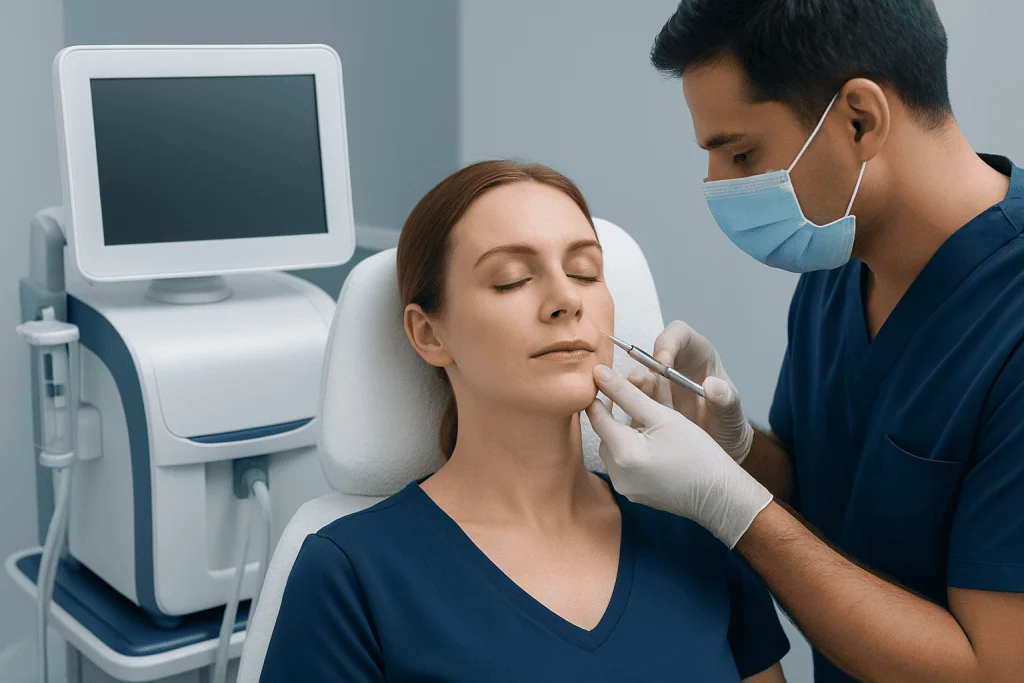
The most commonly used products for nasolabial fold filler are hyaluronic acid fillers. Hyaluronic acid is a substance naturally found in the skin and connective tissues. When injected in a controlled way, it can add volume, improve contour, and bind water, which helps soften the crease.
Different filler products vary in thickness, firmness, and how they spread in tissue. These features matter because the nasolabial area moves constantly with smiling, speaking, and eating. A product that is too firm or placed too superficially may look uneven, while one that is too soft may not provide enough support. The injector chooses the product and injection depth based on the person’s anatomy and treatment goals.
Some people are better served by support in the midface rather than adding volume directly into the line. This is because flattening of the cheeks can make the fold appear deeper. In suitable cases, clinicians may combine nasolabial treatment with facial rejuvenation strategies or other non-surgical approaches to improve overall harmony rather than focusing on a single line.
Who may be a good candidate

Good candidates are generally adults in good overall health who want a temporary improvement in the appearance of nasolabial folds and understand the limits of treatment. The most appropriate candidate is someone with realistic expectations: filler can soften a crease, but it may not fully eliminate deep folds, skin laxity, or lower-face heaviness.
Suitability depends on more than age. Skin thickness, elasticity, facial symmetry, degree of volume loss, and dental or skeletal structure all influence results. A person with mild to moderate folds and relatively good skin tone may respond very well, while someone with significant sagging may need a different strategy. If the main issue is loose skin rather than volume loss, the effect of filler alone may be modest.
Treatment may not be advised for people who are pregnant or breastfeeding, have an active skin infection near the injection site, have a history of severe allergic reactions to filler ingredients, or have certain autoimmune or bleeding-related conditions. A medical consultation is important so the clinician can review medications, prior cosmetic procedures, and any conditions that could increase risk.
Benefits, limitations, and realistic results
The main benefit of nasolabial fold filler is that it can offer visible improvement without surgery and with little downtime. Patients often appreciate that treatment is performed in an outpatient setting and that results are usually seen soon after swelling begins to settle. In selected patients, filler can make the face look less tired and improve facial proportions while preserving natural expression.
However, there are important limitations. Fillers do not stop the aging process, and they do not treat all causes of a prominent fold. Skin texture changes, sun damage, repeated facial movement, and tissue descent may still be visible. Overfilling can also create an unnatural heavy appearance, especially in the lower face. A conservative approach is usually safer and more natural-looking.
How long results last varies by product, the amount used, facial movement, metabolism, and injection technique. Hyaluronic acid fillers are temporary, and maintenance treatments are usually needed. Rather than focusing only on duration, it is helpful to think about whether the treatment plan is appropriate for the person’s anatomy and whether follow-up can be done safely by the same medical team.
Risks and side effects: separating common reactions from true complications
Most side effects after nasolabial fold filler are temporary and mild. These commonly include tenderness, redness, swelling, bruising, and a feeling of firmness at the injection site. Small lumps may sometimes be felt early on and often improve as swelling settles or with gentle clinician-guided management. Mild asymmetry can also occur because the two sides of the face are naturally different.
Less common problems include persistent swelling, delayed inflammatory reactions, visible or palpable product, and infection. In some cases, previous dental work, skin inflammation, or biofilm-related reactions may complicate healing. Individuals who have had prior filler treatment should tell their clinician what product was used and when it was injected.
Rare but serious complications can occur if filler enters or compresses a blood vessel. This can reduce blood flow to the skin and lead to pain, blanching, color changes, or tissue injury. Very rarely, filler-related vascular complications in the face can affect vision. These risks are uncommon but are the reason treatment should be done by a properly trained medical professional who understands facial anatomy, emergency recognition, and reversal protocols when appropriate.
Consultation, diagnosis, and what happens during the procedure
Unlike treating a disease, assessing nasolabial folds is less about laboratory testing and more about careful clinical evaluation. During consultation, the doctor examines facial proportions at rest and during expression, skin quality, depth of the fold, cheek support, lower-face volume, and overall symmetry. Photographs may be used to support planning and to compare before-and-after results objectively.
Patients should be prepared to discuss their medical history, medications, previous cosmetic procedures, allergies, and history of cold sores or unusual scarring. The doctor also checks whether the concern is really the fold itself or whether it reflects another issue such as cheek flattening, jowl formation, or skin laxity. In some people, a broader evaluation by specialists in skin conditions may be needed if a lesion, persistent redness, or another abnormality is present rather than a simple cosmetic crease.
The procedure itself usually involves cleansing the skin, marking the area, and using a needle or cannula to place the filler. Some products contain lidocaine to improve comfort. The amount injected is usually tailored gradually, and a cautious layered approach is often preferred over trying to achieve a dramatic change in one session. Afterward, the area is reassessed for symmetry and overall facial balance.
Aftercare, prevention, and self-care for longer-lasting results
After treatment, clinicians generally advise patients to avoid pressure on the treated area for a short period and to follow individualized aftercare instructions. Mild swelling or bruising can be expected for several days. Heavy exercise, alcohol, saunas, and very hot environments may be limited temporarily depending on the doctor’s advice. Patients should contact the clinic if they notice severe pain, worsening discoloration, or unusual swelling.
Although fillers can improve the look of existing folds, long-term facial aging is influenced by broader lifestyle factors. Consistent sun protection, not smoking, good skin care, and management of weight fluctuations may help preserve skin quality. These steps do not replace filler, but they may support more stable and natural-looking results over time.
Some patients benefit from combining filler with a comprehensive skin or facial rejuvenation plan. Depending on anatomy and goals, this may include botulinum toxin treatment for expression-related lines in other areas or specialist skin care. Toward the end of the care pathway, patients who need coordinated evaluation may seek help from centers such as Acibadem International, where multidisciplinary specialists in JCI-accredited hospitals assess and treat international patients.
When to seek medical care
Medical review is important before treatment if a person has a history of severe allergies, autoimmune disease, a bleeding disorder, repeated facial infections, or previous problems with fillers. A doctor should also assess any new facial lump, skin sore, unexplained swelling, or persistent asymmetry before cosmetic injections are considered.
After the procedure, urgent medical attention is needed if there is severe or increasing pain, white or dusky skin, blistering, mottled discoloration, rapidly worsening swelling, signs of infection, or any change in vision. These symptoms do not happen in most cases, but prompt treatment matters if they appear.
It is also sensible to seek follow-up care if the result looks uneven after the initial swelling period, if there are persistent lumps, or if the aesthetic outcome does not match expectations. Safe treatment includes not only the injection itself but also appropriate review and management afterward.
Frequently asked questions
What is nasolabial fold filler used for?
Nasolabial fold filler is used to soften the lines between the nose and corners of the mouth. It is intended to reduce depth and shadowing, not necessarily to erase the fold completely. The goal is usually a more balanced and refreshed appearance.
How long does nasolabial fold filler last?
Results are temporary and vary from person to person. Longevity depends on the filler used, facial movement, metabolism, injection technique, and how much product is placed. A qualified clinician can give a more personalized estimate after examining the face.
Is nasolabial fold filler painful?
Most people describe the procedure as tolerable rather than very painful. Discomfort is often reduced by topical numbing, ice, careful technique, or fillers that contain lidocaine. Mild tenderness for a short time afterward is common.
Can nasolabial folds be treated without filling the line directly?
Yes. In many people, the fold appears deeper because of volume loss in the cheeks or changes in facial support. Treating surrounding areas rather than placing all of the product directly into the fold can produce a more natural result.
What are the main risks of nasolabial fold filler?
Common side effects include bruising, swelling, redness, and temporary tenderness. Less common issues include lumps, persistent swelling, infection, or asymmetry. Rare vascular complications are serious, which is why treatment should be performed by an experienced medical professional.
Who should avoid nasolabial fold filler?
People with an active skin infection, known allergy to filler ingredients, certain medical conditions, or unrealistic expectations may not be suitable candidates. Pregnancy and breastfeeding are also common reasons to postpone treatment. A medical consultation is the safest way to decide.
This article is for general information only and is not a substitute for professional medical advice. Please consult a qualified doctor about your individual situation.
Explore treatments in Turkey — costs, top hospitals & a free quote
JCI-accredited · board-certified surgeons · reply within 24h
Add us as a Preferred Source to see more of our trusted health content across Google Search, AI Overviews and Discover.

More from the Health Library

Home treatment for corns between toes: A Complete Medical Guide for Patients

Pale Poop — Explained by Medical Evidence, Not Myths

Love Hormone: An Evidence-Based Guide for Patients

Tripod Position COPD: An Evidence-Based Guide for Patients

Piles Alcohol: An Evidence-Based Guide for Patients

Skin Tag Remover: What Patients Need to Know
Aesthetic Plastic & Reconstructive Surgery Specialists at Acibadem

Dr. Ömercan Yağız Öksüz
Aesthetic Plastic & Reconstructive Surgery
Dr. Şenol Durukan
Aesthetic Plastic & Reconstructive Surgery
Dr. Serkan Tokgönül
Aesthetic Plastic & Reconstructive Surgery
Prof. Dr. Şükrü Yazar
Aesthetic Plastic & Reconstructive Surgery