Near Sighted: What Patients Need to Know

Near sighted vision causes blurry distance vision because light focuses in front of the retina instead of directly on it. It often starts in childhood or adolescence and may worsen as the eyes continue to grow.
Key Takeaways
- Near sighted vision causes blurry distance vision because light focuses in front of the retina instead of directly on it.
- It often starts in childhood or adolescence and may worsen as the eyes continue to grow.
- An eye exam can confirm myopia and check for related eye health concerns.
- Treatment may include glasses, contact lenses, and in some cases refractive surgery.
- Regular follow-up is important, especially for children and people with high myopia.
Near sighted, also called myopia, is a common vision problem in which close objects are clear but distant objects appear blurry. It often begins in childhood, can progress over time, and is usually managed effectively with glasses, contact lenses, or refractive treatment options.
Overview: What Near Sighted Means
Near sighted means a person can usually see nearby objects clearly, but objects farther away look blurry. The medical term is myopia. This happens when the eye focuses incoming light slightly in front of the retina rather than directly on it, so distance vision loses sharpness.
For many people, near sightedness is first noticed when road signs, classroom boards, television subtitles, or faces across a room become harder to see. Some people describe frequent squinting or the feeling that distance vision improves only a little when they strain to focus.
Myopia is very common and often begins in school-age children, though adults can also develop it or notice it worsening over time. In most cases it is not dangerous on its own, but stronger degrees of myopia can be linked with a higher risk of certain eye conditions later in life. That is why clear diagnosis and routine eye follow-up matter.
How the Eye Focuses in Myopia
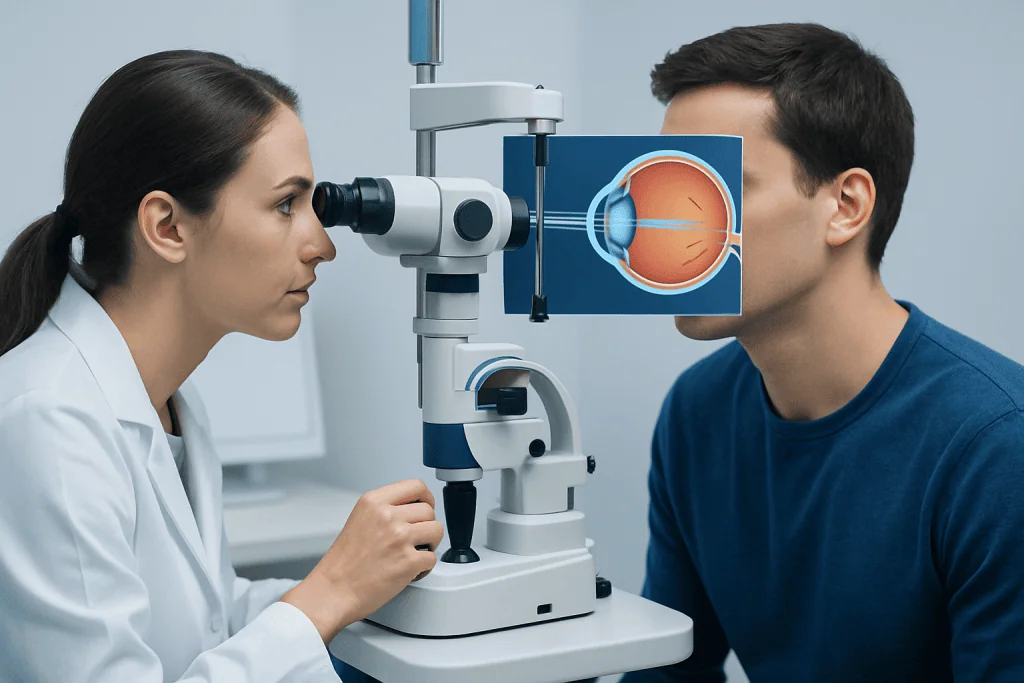
To understand near sightedness, it helps to know how normal vision works. Light enters the eye through the cornea and lens, which bend the light so that it lands precisely on the retina, the light-sensitive layer at the back of the eye. The retina then sends visual signals to the brain.
In a near sighted eye, the eye may be slightly longer than usual from front to back, or the cornea may curve too steeply. Either change can cause light rays from distant objects to focus before they reach the retina. As a result, faraway images look out of focus, while nearby images may remain relatively clear.
Myopia can range from mild to high. Mild myopia may only be noticed in situations that require sharp distance vision, such as driving or seeing a presentation screen. Higher myopia can affect daily tasks more consistently and usually requires stronger correction.
Symptoms and Everyday Signs
The main symptom of being near sighted is blurry distance vision. A person may see well when reading, using a phone, or doing close work, but struggle with street signs, classroom boards, sports, or faces at a distance. Some people notice more difficulty in low light, such as while driving at night.
Other symptoms can develop because the eyes are trying to focus harder. These may include squinting, eye strain, headaches, or tired eyes after activities that require visual concentration. Children may sit very close to screens, move closer to the board at school, or seem less interested in activities that depend on distance vision.
Symptoms that may be associated with near sightedness include:
- Blurred vision when looking at distant objects
- Frequent squinting
- Headaches related to visual effort
- Eye fatigue, especially later in the day
- Difficulty seeing clearly while driving, particularly at night
- Children holding books or devices very close
If vision changes suddenly, or if blurred vision comes with flashes, floaters, eye pain, or a curtain-like shadow in the visual field, medical evaluation should not be delayed. Those symptoms are not typical of ordinary myopia and may point to another eye problem.
Causes and Risk Factors
Near sightedness usually develops because of a combination of genetics and environment. It often runs in families, so a child with one or both parents who are myopic may have a higher chance of developing it. At the same time, lifestyle factors can influence how the eye grows during childhood.
Researchers continue to study why myopia is becoming more common in many parts of the world. More time spent doing close-up tasks, such as reading or screen use, and less time outdoors are thought to play a role in some children. These factors do not mean a child will definitely become near sighted, but they may contribute in people who are already susceptible.
Risk factors may include:
- Family history of myopia
- Childhood or teenage years, when the eyes are still developing
- Long periods of close work
- Limited time spent outdoors
- Existing refractive errors or changes in eye shape
In adults, new blurred distance vision is not always simple myopia. It may also be related to lens changes, blood sugar shifts, or other eye conditions. That is another reason a proper eye examination is important rather than assuming the cause.
Diagnosis and Eye Exams
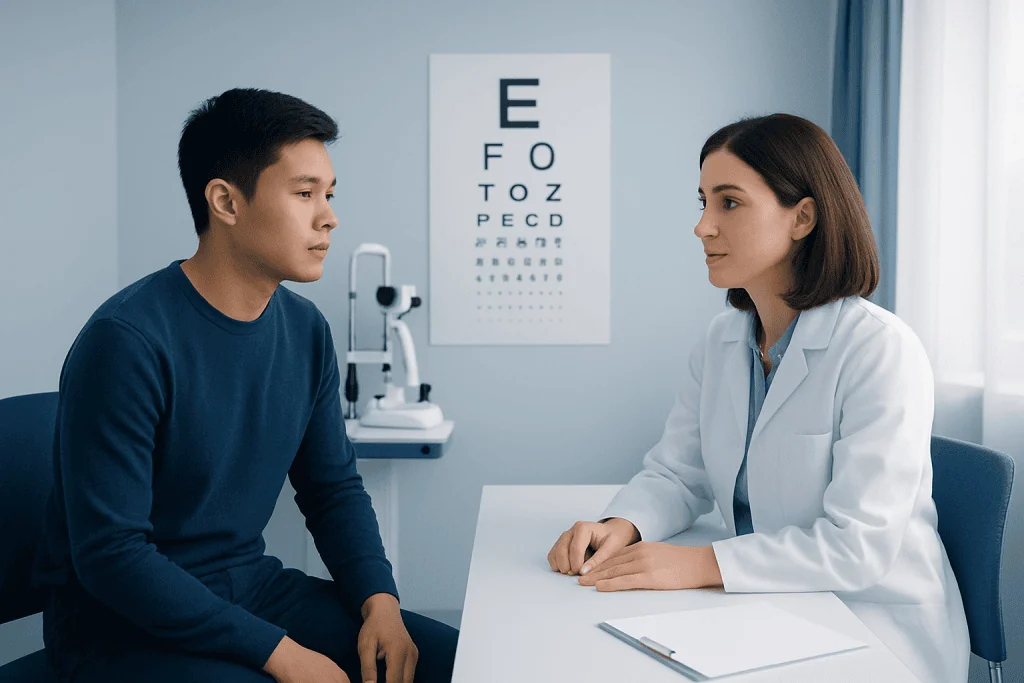
Near sightedness is diagnosed with a comprehensive eye examination. During the visit, an eye specialist will ask about symptoms, visual habits, family history, and whether the problem has changed over time. Visual acuity testing checks how clearly a person can see letters or symbols at different distances.
Refraction testing helps determine the lens power needed to sharpen vision. The doctor may also examine the front and back of the eye to make sure there are no other conditions affecting sight. In children, the exam may include special drops to temporarily relax focusing so the prescription can be measured more accurately.
These exams do more than identify a glasses prescription. They can also help detect other causes of blurred vision and monitor for complications in people with stronger myopia. If needed, an ophthalmologist may assess related concerns such as retinal detachment risk in patients with high myopia or new visual symptoms.
Regular rechecks are especially useful during the growing years, because children’s prescriptions may change as the eyes develop. Adults should also have periodic eye care, particularly if they notice worsening vision, headaches, or trouble with driving and work tasks.
Treatment Options for Near Sighted Vision
Treatment for near sightedness aims to focus light correctly on the retina so distance vision becomes clearer. The most common and simplest option is prescription glasses. Many people find that glasses provide clear, comfortable vision for everyday activities, and the prescription can be updated as needed over time.
Contact lenses are another common option. They sit directly on the eye and can provide a wider field of vision for some people. However, they require careful hygiene and proper follow-up to reduce the risk of irritation or infection. The best choice depends on age, lifestyle, eye health, and personal preference.
Some adults may consider refractive procedures when the prescription is stable and the eyes are otherwise healthy. Options may include laser eye surgery or a broader evaluation for refractive surgery. These treatments are not suitable for everyone, so careful assessment is essential.
In children, management may also include strategies aimed at slowing progression in selected cases. An eye specialist may discuss monitoring, lifestyle measures, or pediatric myopia-control approaches when appropriate. People with very strong myopia may also need ongoing observation for related eye conditions, including cataract and changes affecting the retina.
Prevention, Self-Care, and Living Well With Myopia
There is no guaranteed way to prevent near sightedness, but healthy visual habits may support eye comfort and may be especially helpful for children. Regular breaks during close work, balanced screen use, and spending time outdoors are commonly recommended as part of overall eye care. These habits are simple, practical, and generally good for well-being.
For people who already have myopia, self-care focuses on keeping vision clear and protecting long-term eye health. Wearing the correct prescription, attending follow-up appointments, and replacing glasses or contact lenses when needed can make daily life easier and safer. Good lighting for reading and work can also reduce eye strain.
Helpful self-care habits include:
- Scheduling regular eye exams
- Using the current, correct prescription
- Taking breaks during prolonged reading or screen use
- Encouraging outdoor time for children
- Following contact lens hygiene instructions carefully
- Reporting sudden changes in vision promptly
Near sightedness itself can usually be managed very well, and many people live comfortably with it. The key is not to ignore worsening vision or assume that all blurriness is harmless, especially if symptoms change quickly or occur in only one eye.
When to Seek Medical Care
A routine appointment is appropriate if distance vision has gradually become blurry, if squinting is becoming more frequent, or if a child seems to have trouble seeing the board at school. Early evaluation can improve comfort, learning, work performance, and driving safety.
Prompt medical care is important if vision changes suddenly or if blurred vision is accompanied by flashes of light, many new floaters, a dark curtain over part of the vision, significant eye pain, redness, or sudden loss of vision. These symptoms are not typical of ordinary myopia and need urgent assessment.
People with high myopia should be especially careful about regular eye follow-up because they may have a greater chance of certain retinal and eye-structure changes over time. For international patients who need evaluation or treatment, Acibadem International’s multidisciplinary specialists in JCI-accredited hospitals diagnose and manage a wide range of eye conditions, including assessment for cataract surgery when clinically appropriate.
Frequently asked questions
Is near sighted the same as myopia?
Yes. Near sighted is the everyday term, and myopia is the medical term for the same condition. Both describe vision that is clearer up close than at a distance.
Can near sightedness get worse over time?
It can, especially during childhood and adolescence while the eyes are still growing. In many people, progression slows or stabilizes in early adulthood, but regular eye exams are still important.
Do screens cause near sightedness?
Screens are not thought to be the only cause, but prolonged close work may contribute in some people, especially children who are already predisposed. Regular breaks and time outdoors are often recommended as healthy habits.
Can glasses cure near sightedness?
Glasses do not cure myopia, but they correct the focus of light so vision becomes clearer. They are a safe and effective way to manage symptoms for many people.
Who may be a candidate for surgery for near sighted vision?
Some adults with stable prescriptions and otherwise healthy eyes may be candidates for refractive procedures. Suitability depends on several factors, including eye structure, age, and overall eye health, so a specialist evaluation is needed.
When should a child be checked for near sightedness?
A child should be assessed if they squint, sit very close to screens, complain of headaches, or have trouble seeing at school. Even without symptoms, routine vision screening and eye exams can help detect problems early.
References
- American Academy of Ophthalmology
- National Eye Institute
- American Optometric Association
- World Health Organization
This article is for general information only and is not a substitute for professional medical advice. Please consult a qualified doctor about your individual situation.
Explore treatments in Turkey — costs, top hospitals & a free quote
JCI-accredited · board-certified surgeons · reply within 24h
Add us as a Preferred Source to see more of our trusted health content across Google Search, AI Overviews and Discover.