Oncogenes — Explained by Medical Evidence, Not Myths

Oncogenes usually arise when normal genes called proto-oncogenes become abnormally active. They do not automatically mean a person has cancer, but they can contribute to cancer development and growth.
Key Takeaways
- Oncogenes usually arise when normal genes called proto-oncogenes become abnormally active.
- They do not automatically mean a person has cancer, but they can contribute to cancer development and growth.
- Oncogenes may be activated by mutations, gene amplification, or chromosomal rearrangements.
- Testing a tumor for specific genetic changes can help guide diagnosis, prognosis, and treatment planning.
- Targeted therapies may work against cancers driven by particular oncogenes, but treatment depends on the full clinical picture.
Oncogenes are genes that can help cancer develop when normal growth-control mechanisms are switched on too strongly or at the wrong time. Understanding oncogenes helps explain how some cancers start, why they behave differently, and how modern treatments may be chosen.
Overview: what oncogenes are
Oncogenes are genes that can promote cancer when they become abnormally active. In healthy cells, related genes called proto-oncogenes help regulate normal processes such as growth, division, repair, and survival. When these normal genes are altered in certain ways, they may send excessive “grow” signals, allowing cells to multiply when they should not.
This is why oncogenes matter in cancer biology: they help explain how normal cells can gradually lose control. An oncogene is not a myth, a vague label, or a synonym for cancer itself. It is a specific biological concept supported by decades of medical research, and it is one of several mechanisms that can contribute to tumor formation alongside tumor suppressor gene loss, DNA repair problems, and environmental influences.
Importantly, the presence of an oncogene is only one part of the story. Many cancers arise through a series of changes over time rather than a single event. Doctors use molecular testing to identify these changes in some tumors because the pattern of genetic alterations may affect diagnosis, treatment choices, and expectations for follow-up care.
How normal genes become oncogenes
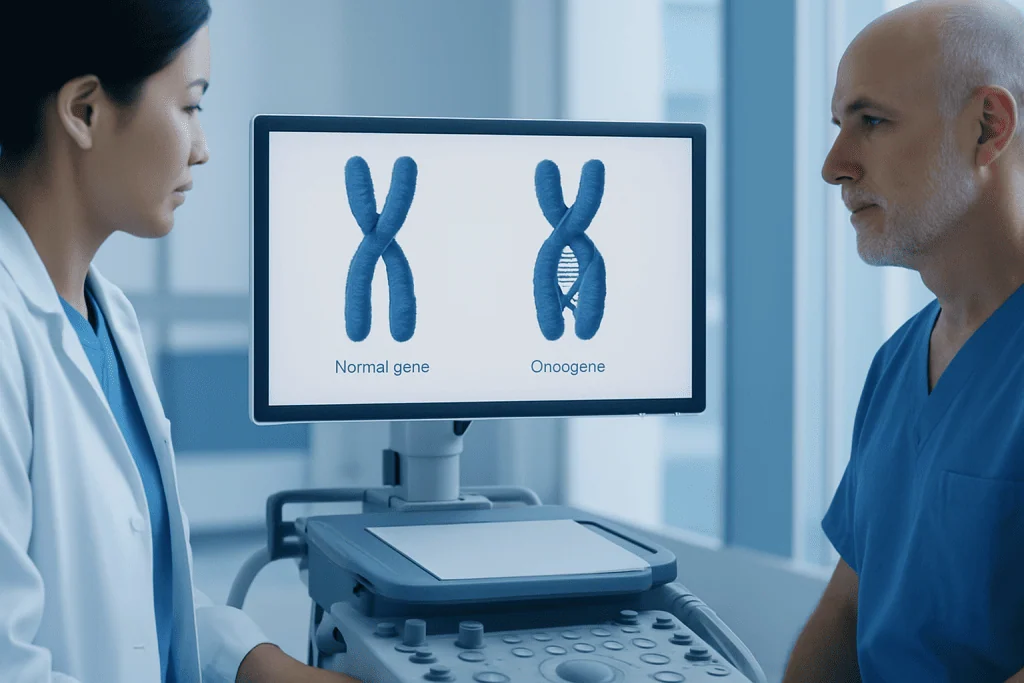
Proto-oncogenes are normal genes involved in communication pathways that tell cells when to grow, divide, or stay alive. They are essential for development and tissue repair. Problems begin when these genes are changed in a way that makes them overactive, persistently active, or expressed in unusually high amounts.
Several mechanisms can turn a proto-oncogene into an oncogene. A mutation within the gene may change the protein it makes, causing constant activation. Gene amplification can create many extra copies of the gene, leading to excessive protein production. In other cases, a chromosomal rearrangement places the gene next to a highly active DNA region or fuses it with another gene, creating an abnormal growth-promoting signal.
These changes may occur in body cells during a person’s lifetime and are then called somatic alterations. More rarely, a cancer-related gene change may be inherited, but most oncogenic changes found in tumors are not passed from parent to child. This distinction is important because tumor testing and inherited genetic testing answer different medical questions.
- Mutation: changes the gene’s instructions
- Amplification: increases the number of gene copies
- Rearrangement: moves or fuses genetic material
- Overexpression: increases production of a growth-driving protein
Why oncogenes matter in cancer

Oncogenes can influence how a tumor starts, grows, spreads, and responds to treatment. Some act like a stuck accelerator pedal, continuously stimulating cell division. Others help cancer cells avoid normal cell death, invade nearby tissues, or create signals that support blood vessel growth. This does not mean every cancer has the same driver, or that one oncogene explains everything about a tumor.
Examples often discussed in medicine include HER2 in some breast and gastric cancers, EGFR in certain lung cancers, BRAF in melanoma and some other tumors, and KRAS in several solid tumors. These names refer to specific genes or signaling pathways that doctors may test for in selected cases. Their clinical relevance depends on the type of cancer, the sample tested, and the treatment options available.
Because the same cancer type can have different molecular features from one person to another, modern oncology increasingly combines traditional pathology with genetic and molecular information. This approach helps move beyond broad labels and toward more individualized care. For people learning about cancer, oncogenes provide one evidence-based way to understand why tumors can behave differently even when they arise in the same organ.
Common myths and evidence-based facts
A common myth is that oncogenes are always inherited. In reality, most oncogenic changes detected in tumors are acquired during life in individual cells. Another misunderstanding is that finding an oncogene means cancer is inevitable. It does not. Cancer usually develops through multiple biological steps, and one genetic change alone may not be enough.
Another myth is that oncogene testing is the same for everyone. In practice, doctors order molecular tests selectively, based on the suspected or confirmed cancer type, stage, tissue availability, and whether results could change management. Some tests look for one alteration; others use broader panels to assess many genes at once.
It is also inaccurate to assume that every oncogene has a matching medicine. While some cancers may respond to targeted therapy, not all genetic changes are currently treatable with a specific drug. In addition, a tumor may contain several important abnormalities, and treatment decisions also depend on pathology findings, imaging, a person’s general health, and previous therapies.
How doctors test for oncogenes
Doctors usually look for oncogenic changes in tumor tissue obtained during a biopsy or surgery. In some situations, they may also use a blood-based test known as a liquid biopsy to detect tumor DNA circulating in the bloodstream. The choice of test depends on the cancer type, the question being asked, and whether enough tumor material is available.
Laboratories may use methods such as immunohistochemistry, fluorescence in situ hybridization, polymerase chain reaction, or next-generation sequencing. Each method has strengths and limitations. Some are better for finding protein overexpression, some for extra gene copies, and others for detailed mutation analysis across many genes. The results need expert interpretation in the context of the person’s diagnosis.
Testing is not usually done to screen the general population for cancer. Rather, it is most often performed after a cancer is suspected or confirmed. In some cases, the findings may help clarify the exact tumor subtype, estimate likely behavior, or identify eligibility for therapies such as systemic cancer treatment, immunotherapy, or a precision medicine approach.
Treatment implications and personalized care
When a tumor is driven by a known oncogene, treatment may be tailored to that biology. Targeted medicines are designed to block specific molecules or pathways that cancer cells depend on. This can sometimes improve treatment precision compared with approaches that affect many rapidly dividing cells, though side effects and resistance can still occur.
Even when an oncogene is identified, treatment is rarely based on that finding alone. Doctors consider the cancer type, stage, pathology report, symptoms, imaging findings, prior treatments, and the person’s overall health and preferences. Surgery, radiation therapy, chemotherapy, immunotherapy, targeted therapy, or combinations of these may all be appropriate depending on the situation. For some patients, options such as radiation therapy remain an important part of care regardless of the tumor’s gene profile.
Over time, tumors can change. A cancer that initially responded to targeted treatment may develop resistance through additional mutations or alternative signaling pathways. This is one reason repeat testing may sometimes be recommended if the disease progresses. Multidisciplinary teams help integrate molecular findings with standard oncology care to build a treatment plan that is medically sound and realistic.
Reducing risk and understanding what you can control
People cannot directly feel an oncogene or prevent every genetic change that may occur in cells over a lifetime. However, some cancer risks are modifiable. Avoiding tobacco, limiting alcohol, protecting skin from excessive ultraviolet exposure, maintaining a healthy weight, staying physically active, and keeping up with recommended vaccinations and screening can help lower the risk of certain cancers.
It is also helpful to understand that not all cancers are preventable and not all oncogenic changes are linked to lifestyle. Aging, random DNA errors during cell division, environmental exposures, chronic inflammation, and inherited susceptibility can all play roles. For this reason, prevention should be viewed as risk reduction rather than a guarantee.
Patients with a strong family history of cancer may benefit from discussing genetic counseling with a doctor, especially if several relatives developed cancer at younger ages or the same unusual cancer pattern appears in the family. Hereditary cancer evaluation is different from tumor oncogene testing, but both may become relevant in a person’s care pathway.
When to seek medical care
Oncogenes themselves do not cause symptoms that a person can identify at home, but cancers driven by genetic changes may produce warning signs. Medical evaluation is advisable for unexplained weight loss, persistent fatigue, unusual bleeding, a new or changing lump, ongoing pain, a lasting cough, changes in bowel or bladder habits, or symptoms that do not improve as expected.
Anyone who has already been diagnosed with cancer should speak with their oncology team if they have questions about molecular testing, targeted treatments, or whether additional genetic evaluation is appropriate. Clear communication can help patients understand what their test results mean and what they do not mean.
Acibadem International’s multidisciplinary specialists and JCI-accredited hospitals diagnose and treat cancer for international patients, including care plans that may incorporate pathology, imaging, and molecular testing when appropriate. Regardless of where care is received, prompt assessment by a qualified doctor is the safest way to investigate persistent or concerning symptoms.
Frequently asked questions
What is the difference between an oncogene and a proto-oncogene?
A proto-oncogene is a normal gene that helps regulate healthy cell growth and survival. An oncogene is the altered, overactive version of that gene, which can contribute to cancer when normal controls are lost.
Do oncogenes mean a person definitely has cancer?
No. An oncogene can help drive cancer, but cancer usually develops through several biological changes rather than one change alone. In practice, oncogene findings are interpreted together with symptoms, scans, pathology, and other laboratory results.
Are oncogenes inherited from parents?
Most oncogenic changes found in tumors are not inherited. They usually develop in body cells during a person’s lifetime. Some inherited genetic variants can increase cancer risk, but these are not the same as most tumor-specific oncogene changes.
How do doctors test for oncogenes?
Doctors most often test a tumor sample taken during biopsy or surgery. Depending on the cancer type, they may use methods such as immunohistochemistry, PCR, FISH, next-generation sequencing, or occasionally a liquid biopsy from blood.
Can oncogenes be treated?
Some cancers with specific oncogenic drivers can be treated with targeted medicines that block the abnormal pathway. However, not every oncogene has an effective targeted treatment, and many patients still need surgery, radiation, chemotherapy, immunotherapy, or a combination approach.
Why would two people with the same cancer type have different treatment plans?
Cancers that start in the same organ can have different molecular features, including different oncogenes. Treatment also depends on stage, tumor location, pathology findings, symptoms, general health, and previous therapies, so care is often individualized.
This article is for general information only and is not a substitute for professional medical advice. Please consult a qualified doctor about your individual situation.
Oncology care in Turkey — second opinion and treatment plan
JCI-accredited · board-certified surgeons · reply within 24h
Add us as a Preferred Source to see more of our trusted health content across Google Search, AI Overviews and Discover.
Check your numbers in seconds
BMI, calories, due date, blood pressure and 30+ more clinical calculators — free, instant, doctor-reviewed ranges.

More from the Health Library

Recovering From a Cesarean: What Patients Need to Know

Acth Stimulation Test: What Patients Need to Know

L Arginine — Explained by Medical Evidence, Not Myths

Best Workout for Abs: An Evidence-Based Guide for Patients

Tube Thoracostomy: A Complete Medical Overview