Patent Foramen Ovale and Stroke: When a Hole in the Heart May Matter

A patent foramen ovale is common and often harmless, but it can matter after certain strokes. PFO is most often considered when a person has a cryptogenic stroke, meaning no clear cause is found.
Key Takeaways
- A patent foramen ovale is common and often harmless, but it can matter after certain strokes.
- PFO is most often considered when a person has a cryptogenic stroke, meaning no clear cause is found.
- Diagnosis usually combines brain imaging, heart ultrasound, and a careful search for other stroke causes.
- Treatment may include antiplatelet medicine, anticoagulation in selected cases, or catheter-based PFO closure.
- The best treatment depends on age, stroke pattern, heart anatomy, and whether another cause of stroke is more likely.
Patent foramen ovale (PFO) is a common small opening between the upper chambers of the heart that usually causes no symptoms. It becomes important when doctors suspect it may have allowed a blood clot to travel to the brain and contribute to an otherwise unexplained stroke.
Overview: what patent foramen ovale means
A patent foramen ovale, often called a PFO, is a small flap-like opening between the right and left upper chambers of the heart. Before birth, this opening is normal and helps blood circulate while the lungs are still developing. After birth, it usually closes on its own. In some people, it remains partly open.
For most people, a PFO never causes symptoms and may never be discovered. It is often found incidentally during heart tests done for another reason. The reason it gets medical attention is that, in certain situations, it may allow a small blood clot to pass from the venous circulation to the arterial circulation and then travel to the brain.
That possibility is why doctors think about patent foramen ovale and stroke together, especially after a cryptogenic stroke, which means a stroke with no definite cause despite a thorough evaluation. Even then, finding a PFO does not automatically prove it caused the stroke. Many adults have a PFO, so the challenge is deciding whether it is an incidental finding or a meaningful contributor.
How a PFO may be linked to stroke
The main concern is a process called paradoxical embolism. A blood clot can form in a vein, often in the legs or pelvis. Normally, such a clot would be filtered out by the lungs. If a PFO is present, however, the clot may cross from the right side of the heart to the left side and then move into the bloodstream that supplies the brain.
This crossing is more likely when pressure temporarily rises on the right side of the heart, such as during coughing, straining, or heavy lifting. In some people, the anatomy of the PFO also increases concern, especially if the opening is larger or if there is an atrial septal aneurysm, meaning extra movement of the tissue between the atria.
Still, not every stroke in a person with PFO is caused by the PFO. Other causes are often more likely, including hardening of the arteries, atrial fibrillation, small-vessel disease, or other heart conditions. This is why doctors use a careful, step-by-step evaluation before recommending treatment.
Symptoms and when it may be suspected

A PFO itself usually does not cause noticeable symptoms. Most people do not feel it and do not know they have it. In many cases, the first reason to look for a PFO is after a stroke or transient ischemic attack, also called a TIA or “mini-stroke.”
Stroke symptoms begin suddenly and depend on the part of the brain affected. Warning signs can include weakness or numbness on one side of the body, facial drooping, trouble speaking, trouble understanding speech, vision loss, dizziness, loss of balance, or a severe sudden headache. These symptoms need urgent medical attention because fast treatment can limit brain injury.
Doctors are more likely to suspect a PFO-related stroke when a younger or middle-aged adult has an ischemic stroke without the usual risk factors or when routine testing does not show another clear explanation. The pattern of injury on brain imaging and the presence of a clotting event such as deep vein thrombosis may also raise suspicion.
- Call emergency services right away for any sudden stroke symptoms.
- Do not wait to see if symptoms improve on their own.
- Even brief symptoms that fully resolve may still signal a TIA and should be assessed urgently.
Causes and risk factors doctors consider
A PFO is not something a person causes through lifestyle choices. It is a remnant of normal fetal circulation that did not completely seal after birth. What matters clinically is not only whether the opening exists, but whether it is likely to have played a role in a stroke.
Features that may increase concern include a larger right-to-left shunt, the presence of an atrial septal aneurysm, and evidence of venous clots. Certain situations that increase clot risk can also matter, such as prolonged immobility, recent surgery, some inherited or acquired clotting disorders, pregnancy and the postpartum period, or use of estrogen-containing medications in selected patients.
At the same time, doctors also assess more common stroke risk factors. These include high blood pressure, diabetes, smoking, high cholesterol, obesity, sleep apnea, and irregular heart rhythms such as atrial fibrillation. If one of these provides a stronger explanation, the PFO may be less likely to be the main cause.
How diagnosis is made
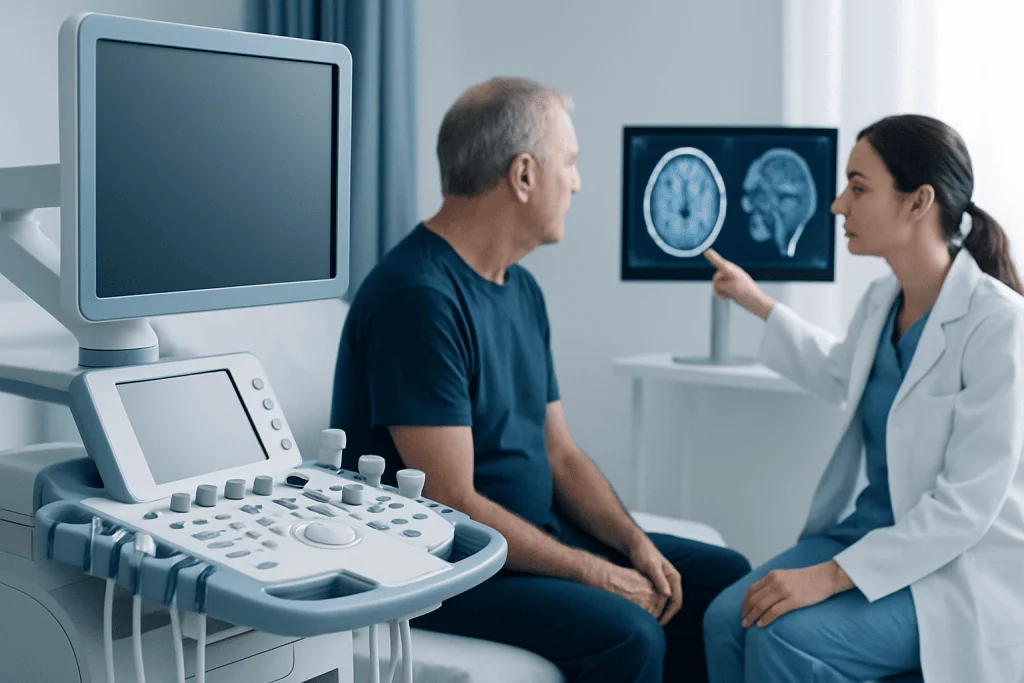
Diagnosis begins with confirming the stroke and looking for its most likely cause. Brain imaging such as CT or MRI shows whether a stroke occurred and what pattern it has. Blood vessel imaging of the head and neck helps identify narrowing, dissection, or other vascular problems. Heart rhythm monitoring may be used to look for intermittent atrial fibrillation that could otherwise be missed.
To identify a PFO, doctors often use echocardiography, which is an ultrasound of the heart. A transthoracic echocardiogram may be the first step. A bubble study, in which saline mixed with tiny bubbles is injected into a vein, can show whether bubbles pass from the right side of the heart to the left. In many patients, a transesophageal echocardiogram gives a clearer view of the atrial septum and nearby structures.
The overall diagnosis is not simply “PFO present.” The key question is whether the stroke appears related to the PFO after other causes have been excluded. This usually involves collaboration between stroke neurologists, cardiologists, and imaging specialists. In some cases, additional evaluation for deep vein thrombosis, clotting disorders, or related structural heart findings is needed.
Treatment options: medicines, closure, and individualized care
Treatment is tailored to the person’s age, stroke history, heart anatomy, and overall risk profile. For many patients, antiplatelet medication is part of treatment after an ischemic stroke. Some people may need anticoagulation instead, particularly if there is another reason for it, such as a proven venous clot or a separate condition that increases clot formation.
In selected patients, especially those with a prior cryptogenic ischemic stroke and a PFO thought likely to be causative, doctors may recommend PFO closure. This is a catheter-based procedure in which a device is placed across the opening to seal it. It is generally considered after a careful evaluation has ruled out other likely stroke causes and when the expected benefit outweighs the risks.
PFO closure is not the right choice for everyone. Potential downsides include procedural complications, device-related issues, or rhythm problems such as atrial fibrillation in some patients. The goal is not simply to close an opening, but to reduce future stroke risk in the right clinical setting.
Because treatment decisions can overlap with broader stroke treatment planning and long-term prevention, shared decision-making is important. A balanced discussion should cover expected benefits, possible risks, alternatives, and the uncertainty that can exist when a PFO is found after stroke.
Prevention and self-care after a stroke or PFO diagnosis
If a person is found to have a PFO, the most important preventive steps depend on whether they have had a stroke or TIA and whether another cause has been identified. Many people with an incidental PFO do not need any procedure. They may simply need routine medical follow-up and management of general cardiovascular health.
After a stroke, prevention usually includes controlling blood pressure, cholesterol, and blood sugar; avoiding tobacco; staying physically active as advised; and maintaining a heart-healthy diet. If medicines are prescribed, taking them consistently is essential. People with prolonged travel or immobility should also ask their doctor how to reduce the risk of venous blood clots.
Follow-up care may involve a neurologist and cardiologist, and sometimes specialists in interventional cardiology if closure is being considered. Rehabilitation may also be part of recovery if stroke symptoms affected movement, speech, balance, or daily activities.
Near the end of the care pathway, some patients seek coordinated international evaluation. Acibadem International’s multidisciplinary specialists and JCI-accredited hospitals diagnose and treat conditions such as stroke and related heart findings for international patients when appropriate.
When to see a doctor
Any sudden symptoms of stroke should be treated as a medical emergency. Immediate assessment is important even if symptoms improve quickly, because TIAs can be warning signs of a future stroke. Early treatment and evaluation can make a major difference.
A person should also seek medical advice if they have had a stroke with no clear explanation, if a heart scan unexpectedly shows a PFO, or if they have symptoms or signs of a possible blood clot in the leg, such as swelling, pain, warmth, or redness. New palpitations or an irregular heartbeat after stroke treatment or PFO closure also deserve prompt review.
Questions about whether closure is needed are best answered in a specialist setting, where both neurologic and cardiac factors can be assessed together. Patients should bring prior scans, test results, and a list of medicines to help support a clear treatment plan.
Frequently asked questions
Is a patent foramen ovale dangerous?
Usually, no. A patent foramen ovale is common and often harmless throughout life. It becomes more important when a person has had a stroke or TIA and doctors are trying to decide whether the PFO may have allowed a clot to reach the brain.
Can a PFO cause a stroke by itself?
A PFO does not usually create a clot on its own. The concern is that it may provide a pathway for a clot formed elsewhere, often in a vein, to cross into the arterial circulation and travel to the brain. Even when a PFO is present, doctors still need to evaluate other possible stroke causes carefully.
How do doctors know if the PFO really caused the stroke?
They look at the whole clinical picture rather than relying on one test. This includes the person's age, brain imaging pattern, echocardiogram findings, heart rhythm monitoring, vascular imaging, and whether any other stroke cause is more likely. In many cases, the decision is based on probability rather than absolute certainty.
Does everyone with a PFO need closure?
No. Many people with an incidental PFO do not need any procedure at all. Closure is usually considered only in selected patients, most often after a cryptogenic ischemic stroke when the PFO is thought likely to be relevant and other causes have been reasonably excluded.
What is PFO closure like?
PFO closure is typically done through a catheter inserted into a blood vessel, usually in the groin, rather than with open-heart surgery. A device is placed to seal the opening between the atria. Recovery is often quicker than with surgery, but follow-up is still important to monitor healing and rhythm changes.
If a PFO is found incidentally, should the person worry?
In most cases, no. An incidental PFO often does not require treatment and may never cause any health problem. The best next step is to discuss the finding with a doctor, who can explain whether it has any real significance based on the person's age, symptoms, and medical history.
References
- American Heart Association
- American Stroke Association
- National Institute of Neurological Disorders and Stroke
- Centers for Disease Control and Prevention
- European Society of Cardiology
This article is for general information only and is not a substitute for professional medical advice. Please consult a qualified doctor about your individual situation.
Explore treatments in Turkey — costs, top hospitals & a free quote
JCI-accredited · board-certified surgeons · reply within 24h
Add us as a Preferred Source to see more of our trusted health content across Google Search, AI Overviews and Discover.
Check your numbers in seconds
BMI, calories, due date, blood pressure and 30+ more clinical calculators — free, instant, doctor-reviewed ranges.