Platysma — Explained by Medical Evidence, Not Myths

The platysma is a superficial neck muscle involved in facial expression and mild neck movement. Visible platysma bands are usually related to normal aging, muscle activity, skin changes, and individual anatomy.
Key Takeaways
- The platysma is a superficial neck muscle involved in facial expression and mild neck movement.
- Visible platysma bands are usually related to normal aging, muscle activity, skin changes, and individual anatomy.
- A healthcare professional can assess whether symptoms are cosmetic, muscular, nerve-related, or linked to another condition.
- Treatment depends on the concern and may include observation, skin care, non-surgical options, or surgery in selected cases.
- Sudden weakness, pain, swelling, or trouble swallowing should be evaluated promptly.
The platysma is a thin, broad muscle that lies just under the skin of the neck and lower face. It helps with facial expression and neck movement, and it can become more visible, tight, or banded with age, anatomy, weight changes, or muscle activity.
Overview: what the platysma is and why it matters
The platysma is a thin sheet-like muscle that covers the front and sides of the neck, extending from the upper chest and shoulder region toward the jaw and lower face. In simple terms, it is one of the most superficial muscles in the body, meaning it sits close to the skin rather than deep under other tissues. Because of this location, changes in the platysma often become visible from the outside.
This muscle helps pull the lower lip and corners of the mouth downward and can also tense the skin of the neck. It is active during certain facial expressions, such as grimacing, and may assist with subtle jaw and neck movements. Although it is not the main muscle for chewing or swallowing, it contributes to the coordinated movement of the lower face and neck.
Many people search for information about the platysma because they notice vertical neck bands, tightness, asymmetry, or age-related changes in the jawline. In most cases, these changes are not dangerous. However, understanding the anatomy helps explain why the neck can look or feel different over time and why evaluation is useful when symptoms are new, one-sided, painful, or associated with weakness.
How the platysma works in the face and neck
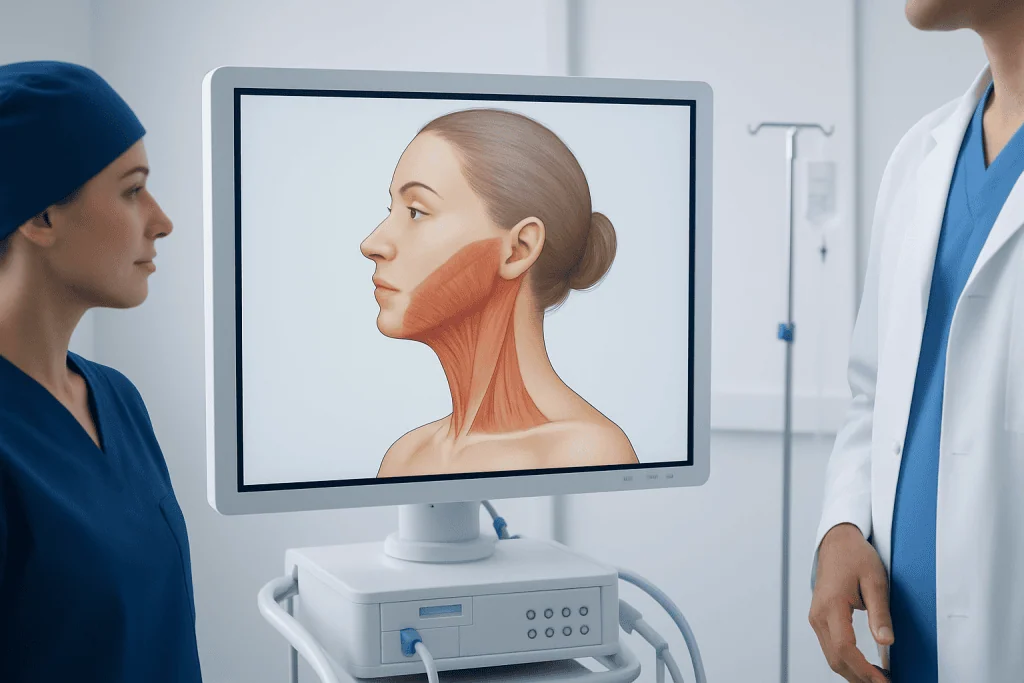
The platysma belongs to the group of muscles used for facial expression. Unlike deeper neck muscles that support posture or help turn the head, the platysma mainly influences the skin and soft tissues of the lower face and anterior neck. When it contracts, it can pull down the lower facial tissues and accentuate vertical lines or bands in the neck.
Its nerve supply comes from a branch of the facial nerve. This is important because true weakness of the platysma may occasionally be part of a broader facial nerve problem. For example, if a person develops sudden one-sided facial drooping together with neck muscle changes, a clinician may need to consider conditions affecting facial movement rather than assuming the issue is purely cosmetic.
The appearance of the platysma varies widely from person to person. In some people it remains subtle even with age, while in others it becomes more defined due to inherited anatomy, thinner skin, less supportive connective tissue, or stronger muscle activity. This is why two people of the same age can have very different neck contours.
The platysma also interacts with nearby structures such as the skin, fat layer, salivary glands, jawline, and deeper neck muscles. A visible neck concern may therefore involve more than one tissue. A good assessment looks at the whole area rather than focusing on the platysma alone.
Common platysma-related concerns and symptoms

The most common concern is the appearance of platysma bands. These are vertical cords or ridges in the neck that may become more noticeable when speaking, smiling, clenching the jaw, or tensing the neck. They are usually a normal anatomical change and tend to become more apparent with age as the skin loses elasticity and soft tissue support changes.
Some people also describe tightness, pulling, or discomfort in the front of the neck. Mild tension can occur with muscle overuse, stress, posture habits, or after changes in weight. Others are more concerned about changes in neck definition, such as loss of a smooth jawline or a heavier appearance under the chin, which may involve the platysma along with skin laxity and fat distribution.
Less commonly, there may be asymmetry, twitching, or weakness. These symptoms deserve closer attention because they can reflect muscle strain, irritation of nearby nerves, previous surgery, trauma, or a neurological condition. A clinician may also consider other causes of neck lumps, swelling, or discomfort if the appearance does not fit a typical platysma pattern.
- Visible vertical neck bands
- Neck tightness or a pulling sensation
- Changes in jawline or lower-face contour
- Asymmetry of the lower face or neck
- Muscle twitching or unusual movement
Why platysma changes happen: causes and risk factors
Age is one of the main reasons the platysma becomes more noticeable. Over time, skin naturally becomes thinner and less elastic, and the supporting tissues under the skin shift. The platysma itself may separate into more visible edges or bands, especially during movement. This process is common and not necessarily a sign of disease.
Genetics also plays a major role. Some people are simply born with anatomy that makes the platysma more visible. Muscle activity patterns, body composition, sun exposure, and smoking can also influence neck appearance by affecting skin quality and soft tissue support.
Weight gain or weight loss can change the neck contour in different ways. Extra fullness under the chin may mask the platysma in some cases, while significant weight loss can make the muscle and overlying skin changes more apparent. Posture, repetitive facial expressions, and jaw clenching may also contribute to a sense of tension or prominence, although these are usually not the sole cause.
Not every neck change comes from the platysma. Conditions affecting the thyroid, lymph nodes, salivary glands, cervical spine, or facial nerve can create symptoms in the same region. This is one reason medical evaluation is important when the change is sudden, painful, associated with a lump, or paired with trouble speaking, swallowing, or smiling.
How doctors evaluate platysma concerns
Evaluation usually begins with a medical history and physical examination. A doctor may ask when the change started, whether it is getting worse, whether it happens only with movement, and whether there are associated symptoms such as pain, numbness, facial droop, swallowing difficulty, or prior injury. Photographs or looking in a mirror during muscle contraction can help clarify what the patient is noticing.
The examination often includes observing the neck at rest and while the patient speaks, smiles, grimaces, or tenses the neck. This helps determine whether visible bands truly come from the platysma and whether the issue is symmetrical. The doctor also checks the jawline, skin quality, fat distribution, salivary glands, thyroid area, and facial nerve function.
Further testing is not always needed for straightforward age-related platysma bands. However, imaging or specialist referral may be appropriate if there is a mass, significant pain, sudden asymmetry, or concern for another condition. Depending on the symptoms, a patient may benefit from assessment by a general practitioner, dermatologist, plastic surgeon, ENT specialist, neurologist, or maxillofacial specialist.
When structural or cosmetic concerns are the main issue, the evaluation may overlap with a broader facial and neck assessment. In selected cases, clinicians may discuss options used in plastic surgery or advanced facial evaluation if jawline and neck anatomy are both involved.
Treatment options: from reassurance to procedures
Treatment depends on what is actually causing the concern. If the platysma is simply more visible with age and there are no troubling symptoms, reassurance may be all that is needed. Some people choose no treatment at all once they understand that platysma bands are common and usually benign.
For patients mainly concerned about appearance, management may include skin care, sun protection, and discussion of non-surgical or surgical options. If skin laxity, soft tissue descent, and muscle banding occur together, treatment planning often looks at the whole neck rather than one structure alone. In appropriate cases, a specialist may discuss options related to aesthetic and plastic surgery to address banding, contour, or tissue laxity.
If symptoms suggest muscle strain or tension, supportive measures such as posture improvement, stress reduction, and evaluation for jaw clenching or related habits may help. Persistent discomfort should be assessed rather than self-diagnosed. When symptoms are caused by another medical issue, treatment focuses on the underlying problem rather than the platysma itself.
In selected people, visible neck bands may be treated with targeted procedures, including specialist-administered injections or surgical neck contouring. These options are individualized and should be discussed with a qualified clinician who can explain expected benefits, limitations, and recovery. If there is any sign that the concern may involve another neck disorder, the doctor may first rule out conditions such as thyroid cancer or other structural causes before considering cosmetic treatment.
Self-care, prevention, and when to seek medical care
No method can completely prevent age-related platysma changes, but healthy habits can support skin and soft tissue quality. Daily sun protection, avoiding smoking, maintaining a stable weight, and following general wellness habits may help reduce the visibility of neck aging over time. Good posture and awareness of jaw clenching may also lessen unnecessary neck tension in some people.
At-home exercises are often promoted online for the platysma, but evidence for dramatic cosmetic improvement is limited. Gentle mobility and posture work may help comfort in some individuals, yet aggressive or repetitive routines can sometimes increase muscle prominence rather than reduce it. It is sensible to approach viral claims with caution and seek professional advice for persistent concerns.
Medical care should be sought if neck changes are sudden, painful, one-sided, or associated with weakness, numbness, a lump, trouble swallowing, voice change, fever, or unexplained weight loss. Sudden facial drooping or difficulty speaking requires urgent medical evaluation. These symptoms do not automatically mean a serious illness, but they should not be attributed to the platysma without assessment.
For international patients who need evaluation, Acibadem International’s multidisciplinary specialists in JCI-accredited hospitals assess neck, facial, and soft tissue concerns and guide treatment based on the cause. If symptoms overlap with ear, throat, or neck conditions, doctors may also consider whether an neck mass or another ENT-related issue is contributing.
Frequently asked questions
Is the platysma a muscle or a cosmetic problem?
The platysma is a real muscle that lies just under the skin of the neck. It may become a cosmetic concern when its edges or bands become more visible, but the structure itself is a normal part of anatomy.
Are platysma bands dangerous?
In most cases, platysma bands are not dangerous and are related to normal aging, anatomy, or muscle activity. They should be evaluated if they appear suddenly, are painful, or come with weakness, a lump, or trouble swallowing.
Can exercise get rid of the platysma?
Exercise may help posture and neck comfort in some people, but it usually does not remove platysma bands. In some cases, frequent tensing of the neck can make the bands more noticeable rather than less.
What makes the platysma more visible with age?
The platysma often becomes more visible because the skin loses elasticity and the soft tissues of the neck change over time. Genetics, sun exposure, smoking, and weight changes can also affect how prominent it looks.
Which doctor treats platysma concerns?
The right specialist depends on the problem. A primary care doctor may start the evaluation, while dermatologists, ENT specialists, neurologists, or plastic surgeons may be involved depending on whether the issue is cosmetic, muscular, structural, or nerve-related.
Can platysma problems cause swallowing trouble?
The platysma itself is not a major swallowing muscle. If swallowing trouble is present, a doctor should look for other causes rather than assuming the platysma is responsible.
References
- American Association of Clinical Anatomy
- American Academy of Otolaryngology–Head and Neck Surgery
- American Society of Plastic Surgeons
- National Institute of Neurological Disorders and Stroke
- MedlinePlus
This article is for general information only and is not a substitute for professional medical advice. Please consult a qualified doctor about your individual situation.
Explore treatments in Turkey — costs, top hospitals & a free quote
JCI-accredited · board-certified surgeons · reply within 24h
Add us as a Preferred Source to see more of our trusted health content across Google Search, AI Overviews and Discover.

More from the Health Library

Chicken Pox in Adults — Explained by Medical Evidence, Not Myths

Ozempic Feet — Explained by Medical Evidence, Not Myths

Binocular Vision Dysfunction: An Evidence-Based Guide for Patients

Seed Wart: A Complete Medical Overview

Sinus Pressure Points: What Patients Need to Know