Positive tb skin test pics: A Complete Medical Guide for Patients

A positive TB skin test is usually judged by the size of a firm, raised swelling, not by redness alone. The meaning of a positive result depends on a person’s risk factors, medical history, and the measured induration.
Key Takeaways
- A positive TB skin test is usually judged by the size of a firm, raised swelling, not by redness alone.
- The meaning of a positive result depends on a person’s risk factors, medical history, and the measured induration.
- A positive skin test does not automatically mean active tuberculosis disease.
- Further evaluation may include a physical exam, medical history, chest imaging, and sometimes blood or sputum tests.
- People with symptoms such as cough, fever, night sweats, or unexplained weight loss should seek prompt medical care.
Positive TB skin test pics typically show a firm, raised area at the injection site rather than simple redness alone. The test does not diagnose active tuberculosis by itself, but it can show that the immune system has reacted to TB proteins and that further medical evaluation is needed.
Overview: what positive TB skin test pics usually show
When people search for positive tb skin test pics, they are usually trying to understand what a positive reaction looks like after a tuberculin skin test, also called the Mantoux test. In most cases, a positive-looking test shows a raised, firm, well-defined bump at the test site on the forearm. The key finding is called induration, which means a hardened area under the skin that can be felt and measured.
Pictures can be helpful for general understanding, but they cannot confirm a diagnosis. Lighting, skin tone, camera angle, and the amount of redness can make images misleading. A healthcare professional does not rely on a photo alone; the site is examined in person and the induration is measured in millimeters 48 to 72 hours after the test is placed.
It is also important to know that redness by itself is not the main sign of a positive result. Some people have a pink or irritated area that looks dramatic in photos but is not considered positive if there is no measurable firm swelling. For that reason, patients should avoid trying to judge the result from appearance alone and should return for proper reading at the recommended time.
How the TB skin test works
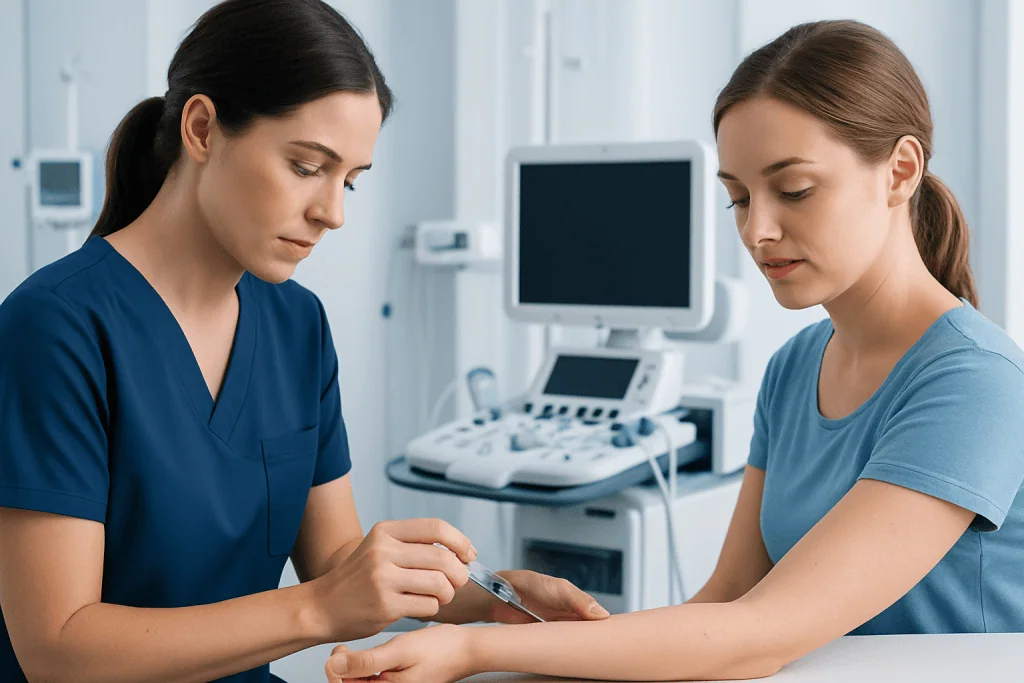
The TB skin test is a screening tool used to look for immune system exposure to the bacteria that cause tuberculosis. A small amount of purified protein derivative is injected just under the skin of the forearm. If the immune system recognizes these proteins, a delayed reaction may develop over the next two to three days.
The test does not tell whether a person has latent TB infection or active TB disease on its own. It only shows that the body may have been sensitized to TB-related proteins. To make sense of a positive result, clinicians consider symptoms, risk factors, past vaccination history, possible immune suppression, and whether there has been recent contact with someone who has tuberculosis.
Some people may instead be advised to have a TB blood test, especially when returning for skin test reading is difficult or when the Bacillus Calmette-Guérin (BCG) vaccine may affect interpretation. In clinical practice, the skin test remains a widely used screening method, but its result always needs context.
What counts as a positive result

A positive TB skin test is based on the size of induration, not simply on color change. During the reading visit, a clinician gently feels the area and measures the diameter of the raised, firm swelling. Different induration sizes are considered positive for different groups of people, depending on their risk of TB exposure or progression to disease.
In general, a smaller induration may be considered positive in people at higher risk, such as those with weakened immune systems, recent close exposure to TB, or certain medical conditions. Larger induration sizes may be required to call the test positive in people with lower risk. This risk-based approach helps reduce both missed cases and false-positive interpretations.
Photos often fail to show the most important part of the reaction: firmness beneath the skin. A flat red area may look concerning online but may not be positive. By contrast, a subtle-looking area can still be significant if there is a clearly measurable, raised firmness. If there is uncertainty, the safest next step is professional review rather than self-interpretation.
- Positive-looking reaction: firm, raised, measurable swelling
- Not enough by itself: redness, bruising, itching, or mild irritation without firmness
- Timing matters: the result should usually be read 48 to 72 hours after placement
Why a result may be positive or misleading
A positive TB skin test may mean prior exposure to TB bacteria, especially if the person has risk factors or has lived in or traveled to areas where TB is more common. In many cases, this reflects latent TB infection, which means TB bacteria are present in the body but inactive and not causing symptoms. Latent infection is different from active disease and is not contagious in the same way.
However, skin test results are not perfect. Some people may have a false-positive result, meaning the test looks positive even though they do not have TB infection. This can happen after prior BCG vaccination or exposure to certain non-tuberculous mycobacteria. It is one reason that a positive skin test is followed by further evaluation rather than being treated as a final diagnosis.
False-negative results can also occur. A person with a weakened immune system, a very recent infection, or certain serious illnesses may not react strongly even if TB infection is present. That is why symptoms and risk history remain important, and why doctors may recommend additional testing such as a medical check-up and chest imaging when needed.
What happens after a positive TB skin test
After a positive result, the next step is to determine whether the person has latent TB infection or active TB disease. This usually begins with a medical history and physical examination. The clinician asks about cough, fever, night sweats, weight loss, fatigue, recent travel, known TB exposure, and any conditions or medicines that weaken the immune system.
Further tests often include a chest X-ray to look for signs of active infection in the lungs. Depending on the situation, a TB blood test, sputum testing, or additional laboratory studies may be recommended. These steps help clarify whether the positive reaction represents previous exposure alone or ongoing disease that needs prompt treatment. In some cases, evaluation may also involve chest X-ray assessment and specialist review.
If active disease is suspected, doctors may arrange more comprehensive testing and infection-control precautions. If active disease is ruled out, the person may still be offered treatment for latent TB infection to reduce the future risk of becoming ill. A specialist in infectious diseases or pulmonary medicine may guide this process, particularly for complex cases or people with other medical conditions.
Treatment and follow-up options
Treatment depends on whether the person has latent TB infection or active TB disease. Latent infection is commonly treated to lower the chance that TB will become active later, especially in people at higher risk. Active TB disease requires a full treatment plan using multiple medications over time and close medical follow-up.
The exact treatment approach varies from person to person. Doctors consider age, liver health, pregnancy status, medication interactions, immune status, and whether the TB bacteria are likely to be drug-resistant. Because management can be complex, follow-up visits are important to monitor symptoms, side effects, and treatment response. If active lung involvement is suspected, a broader lung evaluation may be part of care.
Patients should not start or stop treatment based only on online images or a skin test result read at home. A positive skin test is only one part of the overall picture. When needed, multidisciplinary specialists at Acibadem International and its JCI-accredited hospitals evaluate international patients with coordinated diagnostic and treatment planning.
Self-care, prevention, and when to seek medical care
After the skin test is placed, the area should generally be left alone. Patients should avoid scratching, rubbing, or covering it with irritating products. Normal washing is usually acceptable, but the site should not be aggressively scrubbed. The most important self-care step is returning on time for the reading, since the result may not be accurate before or after the recommended 48-to-72-hour window.
Prevention focuses on reducing TB exposure risk and identifying infection early in people who may have been exposed. This may include workplace screening, contact tracing, and testing before certain treatments that weaken the immune system. People diagnosed with latent TB should discuss the benefits and risks of treatment with a qualified clinician, because completing recommended treatment can help prevent future active disease.
When to seek medical care: prompt medical review is important if a skin test appears raised and firm, if there has been close contact with someone known to have TB, or if symptoms suggest active disease. A person should seek timely care for a cough lasting more than a few weeks, coughing up blood, fever, night sweats, chest pain, fatigue, or unexplained weight loss. Emergency care may be needed for severe breathing difficulty or significant coughing of blood.
Frequently asked questions
What do positive TB skin test pics usually look like?
They usually show a raised, firm bump at the test site on the forearm. The most important feature is induration, meaning a hardened area that can be felt and measured, not just redness.
Is redness alone a positive TB skin test?
No. Redness alone does not usually determine whether the test is positive. A clinician mainly looks for a measurable firm swelling and interprets it based on the person’s risk factors.
Does a positive TB skin test mean a person has active tuberculosis?
Not necessarily. A positive result can mean latent TB infection, prior immune exposure, or sometimes a false-positive reaction. Active TB disease is diagnosed only after further medical evaluation.
Can the BCG vaccine cause a positive TB skin test?
Yes, in some people it can contribute to a positive skin test result. That is one reason doctors may use a TB blood test in certain situations, especially when BCG vaccination history may affect interpretation.
What happens after a positive TB skin test result?
A doctor usually reviews symptoms, exposure history, and medical risk factors, then may order a chest X-ray or other tests. The goal is to determine whether the result reflects latent infection or active TB disease.
Can someone judge their TB skin test from a photo at home?
Photos can give a general idea, but they are not reliable for diagnosis. The test should be read in person by a trained healthcare professional who can feel and measure the induration.
References
- World Health Organization
- Centers for Disease Control and Prevention
- National Institutes of Health
- European Centre for Disease Prevention and Control
This article is for general information only and is not a substitute for professional medical advice. Please consult a qualified doctor about your individual situation.
Explore treatments in Turkey — costs, top hospitals & a free quote
JCI-accredited · board-certified surgeons · reply within 24h
Add us as a Preferred Source to see more of our trusted health content across Google Search, AI Overviews and Discover.