Procedure Code for CT of Head Without Contrast: An Evidence-Based Patient Guide
CPT 70450 commonly describes a CT scan of the head or brain performed without contrast material. CPT codes identify the imaging service, while ICD-10-CM codes document the symptom, injury, or condition prompting the examination.
Key Takeaways
- CPT 70450 commonly describes a CT scan of the head or brain performed without contrast material.
- CPT codes identify the imaging service, while ICD-10-CM codes document the symptom, injury, or condition prompting the examination.
- A non-contrast head CT is fast and is often used to assess acute bleeding, fractures, major stroke changes, or other urgent concerns.
- The scan uses ionizing radiation but is painless, noninvasive, and usually does not require recovery time.
- Coding requirements can vary by payer, clinical setting, documentation, and national billing system.
The procedure code for CT of head without contrast is generally CPT 70450 in the United States. The correct diagnosis code is not a single CT-specific ICD-10 code; it reflects why the scan is medically needed, such as head injury, headache, confusion, or suspected stroke.
Overview: the procedure code and what it means
The procedure code for CT of head without contrast is typically CPT 70450 in US Current Procedural Terminology coding. This code describes computed tomography of the head or brain performed without injected contrast material. It is generally used whether the request says “CT head” or “CT brain,” provided the examination is non-contrast and fits the code descriptor.
A procedure code does not explain why the scan was needed. That purpose is documented separately with an ICD-10-CM diagnosis code, such as a code for head injury, headache, dizziness, altered mental status, or a known neurological condition. Accurate coding should always be based on the clinician’s documentation, the radiology order, the final report, and applicable payer or local coding rules.
A CT scan of the head produces cross-sectional images using X-rays and computer processing. It can provide rapid information about the skull, brain tissue, fluid spaces, and signs of bleeding. Clinicians may request it after injury or when symptoms could suggest an urgent neurological problem.
How to code CT head without contrast?
For a standard CT examination of the head or brain performed without contrast, the usual US CPT code is 70450. The ordering clinician and imaging facility should document that the anatomical area is the head or brain and that contrast was not administered. The radiology report should also accurately state the examination performed.
Appropriate coding includes more than selecting the procedure code. The claim usually also needs a diagnosis code that supports medical necessity. For example, a person evaluated after a fall may have a code reflecting head trauma, while a person with new neurological symptoms may have a symptom-based code when no diagnosis has yet been confirmed.
Administrative teams should not assume that an imaging order alone establishes the final diagnosis. If documentation is unclear, the appropriate approach is to clarify it through established clinical and coding processes. Coding standards, coverage rules, and modifiers may differ between outpatient, emergency, inpatient, and international care settings.
- Procedure: CPT 70450 for CT head or brain without contrast in US CPT coding.
- Clinical indication: ICD-10-CM code selected for the documented symptom, injury, or disease.
- Documentation: imaging order, clinical history, technique, and radiology interpretation should align.
What is the CPT code for a CT scan without contrast?

There is no single CPT code for every CT scan without contrast because the code depends on the part of the body examined. For a CT scan of the head or brain without contrast, the commonly used code is 70450. Other body regions, such as the chest, abdomen, spine, or sinuses, have different CPT codes.
“Without contrast” means that no iodinated contrast dye is injected into a vein for the scan. This does not make the test less useful; rather, it is selected when it best answers the clinical question. In emergency neurological assessment, non-contrast CT is often the first imaging test because it is quick and can clearly identify acute blood in or around the brain.
Contrast-enhanced CT may be considered when clinicians need additional detail about blood vessels, inflammation, infection, tumors, or certain other findings. The decision depends on symptoms, examination findings, prior imaging, kidney function where relevant, allergies, and the question the clinician needs the scan to answer.
What is the ICD-10 code for a CT scan of the head without contrast?
There is no single ICD-10-CM code that means “CT scan of the head without contrast.” ICD-10-CM codes describe diagnoses, symptoms, injuries, and health circumstances rather than the imaging procedure itself. In the United States, CPT 70450 describes the procedure, while the ICD-10-CM code explains the reason for ordering it.
The diagnosis code may reflect a symptom such as headache, fainting, weakness, confusion, or seizure; an injury such as traumatic head injury; or a known condition being evaluated or followed. The most appropriate code depends on what is documented at the time of care. When a definitive diagnosis is not established in an outpatient setting, a clinician may document and code the presenting symptom or sign instead.
Because code selection affects clinical communication and billing, patients should not need to choose the diagnosis code themselves. Questions about a bill, referral, preauthorization, or medical record can be directed to the imaging center, healthcare professional, or insurance provider. The clinical priority remains making sure concerning symptoms are assessed promptly.
What are the CPT codes for a CT scan of the brain with and without contrast?
For CT of the head or brain performed with contrast, the commonly used CPT code is 70460. For CT of the head or brain performed without contrast followed by with contrast, the commonly used CPT code is 70470. By comparison, 70450 is used for a non-contrast head CT alone.
“With and without contrast” generally means that images are obtained before contrast administration and again after contrast is given. It is not the same as a scan that uses contrast only. The correct selection should reflect the actual imaging protocol documented by the radiology department.
Not every patient needs contrast or both phases of imaging. Clinicians balance the expected diagnostic benefit against factors such as the urgency of the situation, previous results, possible contrast reactions, and kidney health. A radiologist may also recommend a different test, such as MRI, when it is better suited to the clinical question.
How a non-contrast head CT works and what to expect
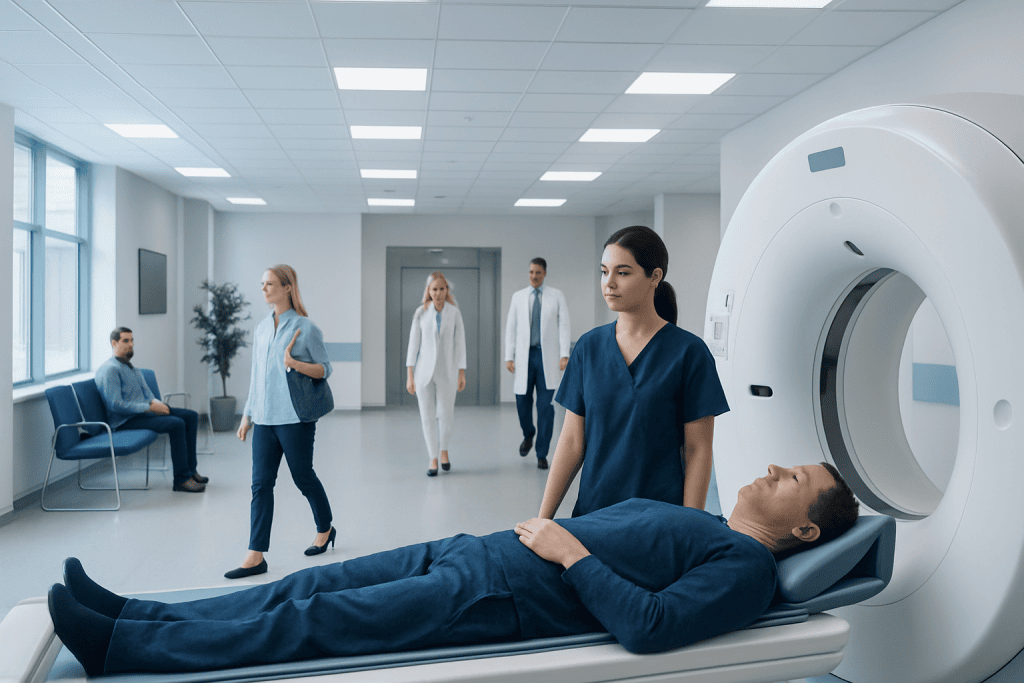
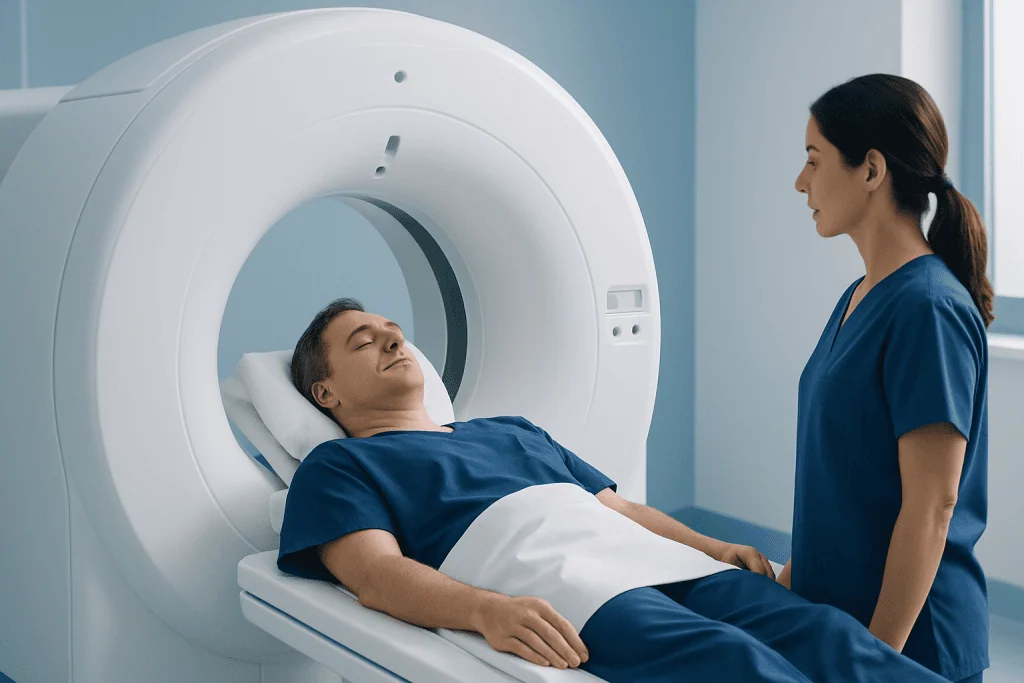
A CT scanner is a large ring-shaped machine. During the examination, the person lies on a narrow table that moves smoothly through the opening while the scanner takes a series of X-ray images. Computer software combines these images into detailed views that a radiologist interprets.
Before the scan, the patient may be asked to remove glasses, hearing aids, hair accessories, dentures, or jewelry near the head and neck. They are usually able to eat and drink normally before a non-contrast head CT unless the care team gives different instructions. The technologist helps position the head and asks the patient to remain still briefly to reduce motion blur.
The scan itself commonly takes only a few minutes, although the full visit may take longer because of registration, safety checks, positioning, and review of urgent findings. The test is painless. The scanner can make whirring sounds, but it does not usually enclose the entire body like a traditional MRI scanner.
A CT head without contrast may be used for symptoms or situations including significant head injury, sudden severe headache, new confusion, seizures, weakness, speech changes, or concern for bleeding. It may also be part of assessment for conditions involving the brain and nervous system, including stroke.
Benefits, limitations, risks and recovery
The main benefit of a non-contrast CT head is speed. It can help clinicians identify problems that may need urgent treatment, including some forms of bleeding, skull fracture, pressure-related changes, and major stroke-related abnormalities. Results may guide decisions about observation, medication, specialist referral, surgery, or further imaging.
A normal CT scan does not rule out every neurological condition. Some small strokes, early changes, inflammation, nerve disorders, and certain soft-tissue abnormalities may be better evaluated with MRI or other tests. The care team interprets CT findings together with the person’s symptoms, examination, medical history, and laboratory results when needed.
CT uses ionizing radiation. Imaging teams use protocols intended to keep exposure as low as reasonably achievable while obtaining useful diagnostic images. There is no contrast-related risk in a non-contrast scan because contrast dye is not used. People who are pregnant or may be pregnant should tell the healthcare team so the need for imaging and the safest approach can be discussed.
Recovery is usually immediate. Most people can return to ordinary activities straight after the scan unless their underlying illness, injury, medicines, or emergency evaluation requires observation. If further assessment is needed, specialists may recommend appropriate neurology care or other targeted services.
When to seek medical care
Urgent medical assessment is important for sudden or severe neurological symptoms. Emergency care should be sought for a sudden severe headache unlike usual headaches, new weakness or numbness on one side, facial drooping, trouble speaking or understanding speech, loss of consciousness, seizure, sudden vision loss, severe confusion, or new difficulty walking.
After a head injury, prompt evaluation is appropriate for worsening headache, repeated vomiting, increasing drowsiness, confusion, unusual behavior, seizure, weakness, fluid or blood from the nose or ears, or symptoms that do not improve. Older adults, people who use blood-thinning medicines, and those with bleeding disorders may need a lower threshold for medical assessment after head trauma.
For non-emergency concerns, a doctor can determine whether CT, MRI, or another test is appropriate and explain what the results mean. Acibadem International’s multidisciplinary specialists and JCI-accredited hospitals diagnose and treat neurological conditions for international patients, with imaging choices guided by individual clinical needs.
Frequently asked questions
Is CPT 70450 the code for CT head without contrast?
Yes. In US CPT coding, 70450 commonly describes computed tomography of the head or brain without contrast material. The final code used should match the documented examination and applicable payer requirements.
Does a CT head without contrast require an injection?
No. A non-contrast CT head is performed without an injected iodinated contrast agent. An intravenous line may still be placed in some emergency settings for other aspects of care, but it is not required for the scan itself.
Why would a doctor order a CT head without contrast first?
A non-contrast CT head is fast and is particularly helpful for detecting acute bleeding and some injury-related changes. It is often used in urgent evaluations, while MRI or contrast imaging may be considered later if more information is needed.
Can CPT 70450 be used with any diagnosis code?
No. The diagnosis code should accurately represent the documented reason for the scan, such as a symptom, injury, or known condition. Coverage policies may also require that the indication meets medical-necessity criteria.
How long does a CT scan of the head without contrast take?
The image acquisition itself often takes only a few minutes. The complete appointment may take longer for check-in, safety screening, positioning, and discussion of results, especially in an emergency setting.
Can a normal CT head rule out a stroke?
A normal CT may not exclude every type of stroke, particularly very early or small ischemic strokes. Clinicians consider symptom timing, examination findings, CT results, and sometimes MRI or vascular imaging when evaluating possible stroke.
References
- American College of Radiology
- Radiological Society of North America
- Centers for Medicare & Medicaid Services
- National Institute of Neurological Disorders and Stroke
- World Health Organization
This article is for general information only and is not a substitute for professional medical advice. Please consult a qualified doctor about your individual situation.
Explore treatments in Turkey — costs, top hospitals & a free quote
JCI-accredited · board-certified surgeons · reply within 24h
Add us as a Preferred Source to see more of our trusted health content across Google Search, AI Overviews and Discover.