Proton Therapy Center Non-Clinical Support Registry Partnership: How It Works, Results and What to Expect

Proton therapy is a form of external-beam radiation that can deliver radiation precisely to a tumor while reducing exposure to some nearby healthy tissues. A non-clinical support registry records practical and patient-reported needs, such as transportation, accommodation, language support, nutrition, emotional wellbeing, and return-to-work concerns.
Key Takeaways
- Proton therapy is a form of external-beam radiation that can deliver radiation precisely to a tumor while reducing exposure to some nearby healthy tissues.
- A non-clinical support registry records practical and patient-reported needs, such as transportation, accommodation, language support, nutrition, emotional wellbeing, and return-to-work concerns.
- Registry participation is usually voluntary and should not affect a person's access to cancer treatment or the medical decisions made by their oncology team.
- Whether proton therapy is appropriate depends on the cancer type, location, stage, prior treatments, anatomy, and the likely benefit compared with other radiation techniques.
- Proton therapy has potential advantages for selected cancers, but it also has side effects, logistical demands, and may not be the best option for every patient.
A proton therapy center non-clinical support registry partnership is a structured way for treatment centers and support teams to record patient needs, experiences, and practical outcomes during proton therapy. It does not replace clinical cancer care; it helps services better coordinate areas such as travel, communication, emotional support, rehabilitation, and follow-up.
Overview: what is a proton therapy center non-clinical support registry partnership?
A proton therapy center non-clinical support registry partnership is a collaboration between a proton therapy service and organizations that help patients manage the non-medical parts of cancer treatment. The registry may collect information about practical concerns, support services used, patient-reported wellbeing, treatment attendance, and barriers that can make care harder to complete.
Its purpose is to understand what patients and families need before, during, and after proton therapy. Information may help a center improve referral coordination, accommodation planning, interpreter access, psychosocial care, rehabilitation support, and communication with local healthcare teams. It is separate from the radiation plan itself: treatment decisions remain the responsibility of the patient and their multidisciplinary cancer team.
Before agreeing to join any registry, patients should receive clear information about what data are collected, how confidentiality is protected, whether participation is optional, and how results may be used. A registry can support service improvement and research, but it does not promise a particular treatment outcome.
How proton therapy works to treat cancer
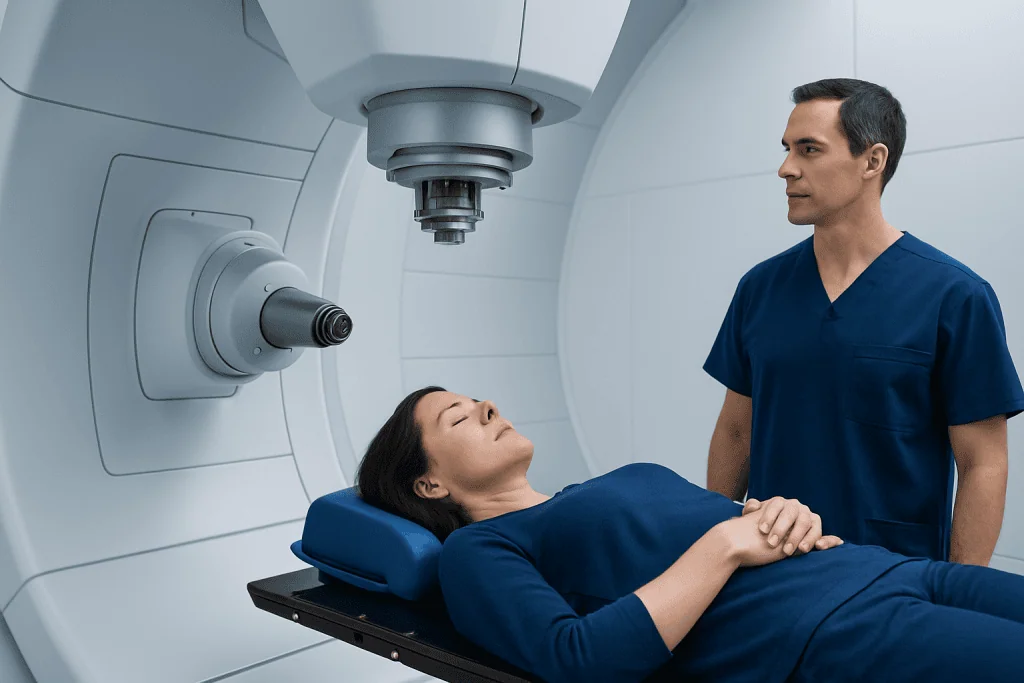
Proton therapy, also called proton beam therapy, is an advanced type of external-beam radiation treatment. It uses positively charged particles called protons rather than X-rays. A machine accelerates protons and directs a carefully shaped beam toward the planned treatment area.
As protons travel through the body, they release relatively little energy at first and then release most of their energy at a selected depth. This physical feature, often called the Bragg peak, can allow the radiation team to limit the dose beyond the target. The treatment goal is the same as with other radiation therapies: to damage cancer-cell DNA so cancer cells cannot continue to divide and grow.
The potential value of proton therapy depends on where a tumor is located and which healthy structures are nearby. It may be particularly considered when reducing radiation to tissues such as the brain, spinal cord, eyes, heart, lungs, bowel, or reproductive organs is important. It is one option within proton therapy cancer treatment, not a universal replacement for conventional radiation.
How a non-clinical support registry partnership works

A partnership commonly begins with a patient needs assessment around the time of referral or treatment planning. With the patient’s permission, a coordinator may ask about distance from the treatment center, caregiving responsibilities, language needs, financial or workplace concerns, emotional wellbeing, mobility, nutrition, and access to local follow-up care.
The registry may then document which support resources are offered or used. These can include social work, psychology or counseling referrals, accommodation guidance, transport planning, interpreter services, dietetic support, physiotherapy, fertility counseling, patient navigation, and coordination with a patient’s home oncologist. The exact services differ between centers and countries.
During and after treatment, patients may be invited to complete questionnaires about fatigue, daily functioning, symptoms, satisfaction with communication, and practical challenges. Data are generally reviewed in a de-identified or protected form to identify service gaps and improve care pathways. Patients can ask whether opting out will change their care; in well-designed programs, it should not affect access to clinically appropriate treatment.
Candidacy and treatment planning for proton therapy
Proton therapy candidacy is assessed individually. The oncology team considers the cancer diagnosis, tumor size and location, stage, whether surgery or chemotherapy is planned, previous radiation exposure, and the ability to position the patient consistently for daily treatment. A comparison radiation plan may be created to assess whether proton therapy offers a meaningful advantage over modern photon-based radiation.
It may be considered for certain childhood cancers, tumors near sensitive organs, some head and neck cancers, selected brain and spinal tumors, eye tumors, and certain cancers of the chest, abdomen, pelvis, or prostate. However, appropriateness varies widely. For example, patients may also discuss related diagnoses such as brain tumors or prostate cancer with their specialist when reviewing radiation options.
A recommendation for proton therapy does not mean that standard radiation is unsafe or ineffective. Contemporary photon radiation techniques are highly sophisticated and remain the most suitable treatment for many people. The best approach is the one that offers effective tumor treatment with an acceptable balance of expected benefits, side effects, availability, and individual priorities.
What to expect: step-by-step treatment and recovery timeline
Before treatment, the patient has a planning appointment called simulation. This often includes a CT scan and may include MRI or PET imaging. The team creates an individualized immobilization device, such as a mask for head and neck treatment or a body support, to help reproduce the same position each day. Radiation oncologists, medical physicists, and dosimetrists then design and verify the treatment plan.
At each treatment visit, radiographers position the patient and use imaging to confirm alignment. The beam delivery itself is painless and usually lasts only a few minutes, although the full appointment can take longer because of preparation and safety checks. Proton therapy is commonly delivered on weekdays over several weeks, but schedules differ according to the cancer type and treatment intent.
Most people return home after each session. Side effects can build gradually during treatment and may continue for a short time afterward before improving. The recovery timeline depends mainly on the treated area, total radiation plan, other treatments, and a person’s general health. Follow-up visits monitor recovery, manage side effects, and assess the response to cancer treatment.
Non-clinical registry follow-up may occur during treatment, at the end of therapy, and at later intervals. It may focus on whether support was accessible and helpful, rather than on medical imaging results alone. Patients should continue to report new or worsening symptoms directly to their clinical team, whether or not they participate in a registry.
What is the success rate of proton therapy?
There is no single success rate for proton therapy. Outcomes depend on the cancer type, stage, tumor biology, treatment purpose, whether cancer has spread, the use of surgery or systemic treatments, and the patient’s overall health. Proton therapy is a radiation delivery method, so its cancer-control results must be interpreted within the context of the full treatment plan.
For selected cancers, proton therapy can provide tumor control comparable to other high-quality radiation techniques while reducing radiation exposure to some nearby normal tissues. In some situations, this may lower the likelihood of particular short- or long-term side effects. However, reduced dose to healthy tissue does not automatically translate into better cancer cure rates for every diagnosis.
Patients should ask their radiation oncologist about outcomes for their specific cancer, including the goal of treatment, expected local control, survival-related factors, likely side effects, and available alternatives. The team can explain what is known from research and where evidence is still developing.
What is the downside of proton therapy?
The main downside of proton therapy is that its precision requires complex planning, specialized equipment, and careful daily positioning. Small changes in body position, breathing, weight, or the size of air-filled spaces can affect how the proton beam travels. Teams use imaging and quality checks to manage these issues, but they remain important aspects of treatment planning.
Proton therapy can still cause side effects because healthy tissue near or within the treatment area receives radiation. Depending on the body site, effects may include tiredness, skin irritation, hair loss in the treated area, swallowing difficulty, nausea, bowel or bladder changes, or temporary worsening of local symptoms. Late effects are possible with any radiation treatment and should be discussed before care begins.
Practical burdens can also be significant if a proton center is far from home. Repeated travel, time away from work or school, accommodation needs, and caregiver arrangements may affect a patient’s experience. This is one reason a non-clinical support registry partnership can be useful: it helps services identify and respond to these barriers early.
Why doesn't insurance cover proton therapy?
Insurance coverage for proton therapy varies by country, insurer, policy, cancer type, and treatment indication. Some insurers cover it for diagnoses where they consider the clinical benefit well established, while requiring additional review or declining coverage for situations where they believe evidence is insufficient compared with less costly radiation options.
Coverage decisions may also depend on prior authorization requirements, whether the facility is in the insurer’s network, and documentation from the radiation oncologist explaining why proton therapy is medically appropriate. A denial does not necessarily mean proton therapy is medically unsuitable; it may reflect the terms of a particular health plan or the evidence criteria used by that payer.
Patients can ask the treating center’s financial counseling or patient-navigation team for help understanding authorization steps and required documentation. They should avoid delaying urgent cancer care while coverage questions are being resolved and should discuss clinically appropriate alternatives with their oncology team.
Benefits, support, and when to seek medical care
For an appropriately selected patient, proton therapy may reduce radiation exposure to certain nearby organs and tissues. This can be especially relevant when a tumor is close to sensitive structures or when limiting long-term radiation effects is an important goal. The expected benefit should be weighed against treatment demands, possible side effects, and other effective radiation approaches.
Patients receiving radiation should contact their treatment team promptly for severe or rapidly worsening pain, trouble breathing, chest pain, fever, inability to keep fluids down, confusion, new weakness, uncontrolled vomiting, heavy bleeding, or symptoms that feel urgent. They should also report troublesome skin reactions, dehydration, worsening swallowing problems, or significant bowel or urinary symptoms rather than waiting for the next scheduled appointment.
Acibadem International’s multidisciplinary specialists and JCI-accredited hospitals support international patients undergoing cancer assessment and treatment planning, including evaluation of radiation options. Supportive care may also be coordinated alongside treatments such as radiotherapy and chemotherapy when clinically indicated.
Patients and families can make registry participation more useful by sharing practical concerns honestly and early. Questions about transport, housing, employment, caregiving, mental health, nutrition, or communication are valid parts of cancer care and can often be addressed through the wider treatment team.
Frequently asked questions
Is a non-clinical support registry part of my medical record?
This depends on the registry's design and local privacy rules. Some information may be linked to clinical records for care coordination, while other data may be stored separately for service evaluation or research. Patients should receive an explanation of data handling and consent before taking part.
Does joining a registry affect whether I can receive proton therapy?
Participation in a non-clinical support registry should generally be voluntary and should not determine access to clinically appropriate treatment. The decision to recommend proton therapy is based on medical assessment by the cancer team. Patients can ask directly whether declining participation will affect any aspect of care.
Can you explain how proton therapy works and how it works to treat cancer?
Proton therapy directs accelerated protons into a planned tumor target. The protons deposit most of their energy at a controlled depth, damaging cancer-cell DNA and limiting the cells' ability to grow and divide. The treatment is planned to target the cancer while reducing unnecessary radiation beyond the tumor where possible.
Is proton therapy painful?
The radiation beam itself is not felt and proton therapy is generally painless during delivery. Patients may need to remain still in a treatment position, which can be uncomfortable for some people. Side effects can develop over time depending on the area treated, but the team can provide symptom support.
How long does proton therapy take?
The planning process may take several appointments and includes imaging, positioning preparation, and individualized treatment design. Individual treatment sessions are usually short, but daily visits include setup and imaging checks. The total number of sessions depends on the cancer type, treatment goal, and radiation plan.
Can proton therapy be used with surgery or chemotherapy?
Yes, proton therapy may be combined with surgery, chemotherapy, immunotherapy, or other treatments when this is appropriate for the cancer type and stage. The sequence is planned by a multidisciplinary team. Combining treatments can also change side-effect risks, so individualized monitoring is important.
References
- National Cancer Institute
- American Society for Radiation Oncology
- European Society for Radiotherapy and Oncology
- International Atomic Energy Agency
- National Health Service
This article is for general information only and is not a substitute for professional medical advice. Please consult a qualified doctor about your individual situation.
Oncology care in Turkey — second opinion and treatment plan
JCI-accredited · board-certified surgeons · reply within 24h
Add us as a Preferred Source to see more of our trusted health content across Google Search, AI Overviews and Discover.