Scabies vs Bed Bugs: Key Differences and How Doctors Tell Them Apart

Scabies usually causes severe itching, often worse at night, with a rash in skin folds and sometimes tiny burrows. Bed bug bites tend to appear on exposed areas such as the arms, legs, neck, or face, often in small clusters or lines.
Key Takeaways
- Scabies usually causes severe itching, often worse at night, with a rash in skin folds and sometimes tiny burrows.
- Bed bug bites tend to appear on exposed areas such as the arms, legs, neck, or face, often in small clusters or lines.
- Doctors distinguish scabies from bed bugs by the location and pattern of the rash, close-contact history, and sometimes skin examination or microscopy.
- Scabies treatment focuses on prescription anti-mite medicine and treating close contacts, while bed bug management centers on bite relief and removing the insects from the environment.
- Persistent itching, widespread rash, signs of infection, or symptoms affecting multiple household members should prompt medical evaluation.
Scabies and bed bugs can both cause itchy skin, but they are not the same. Scabies is a mite infestation that lives in the skin and often causes intense nighttime itching with burrow-like tracks, while bed bugs are insects that bite exposed skin and do not live on the body.
Scabies vs bed bugs: a quick side-by-side comparison
Scabies vs bed bugs is a common question because both can cause itchy bumps and sleep disruption. The key difference is that scabies is caused by microscopic mites that burrow into the outer layer of skin, while bed bugs are visible insects that feed briefly on blood and then hide in bedding, furniture, or cracks nearby.
Doctors often start by comparing where the rash appears, how the itch behaves, and whether other people in the home are affected. A careful history and skin exam usually provide strong clues, and in some cases a clinician may confirm scabies by identifying mites, eggs, or burrows.
- Cause: Scabies is caused by human itch mites; bed bugs are insects that bite the skin.
- Where they live: Scabies mites live in the skin; bed bugs live in the environment, not on the body.
- Itching: Scabies often causes very intense itching, especially at night; bed bug bites can itch but the severity varies.
- Typical rash pattern: Scabies often affects finger webs, wrists, waistline, genitals, and underarms; bed bug bites usually appear on exposed skin such as the face, neck, arms, and legs.
- Spread: Scabies commonly spreads through prolonged skin-to-skin contact; bed bugs spread by infesting mattresses, furniture, luggage, and clothing.
- Treatment: Scabies usually needs prescription treatment for the person and close contacts; bed bug bites are treated symptomatically, while the home environment must be treated to remove the bugs.
What scabies and bed bug bites look and feel like
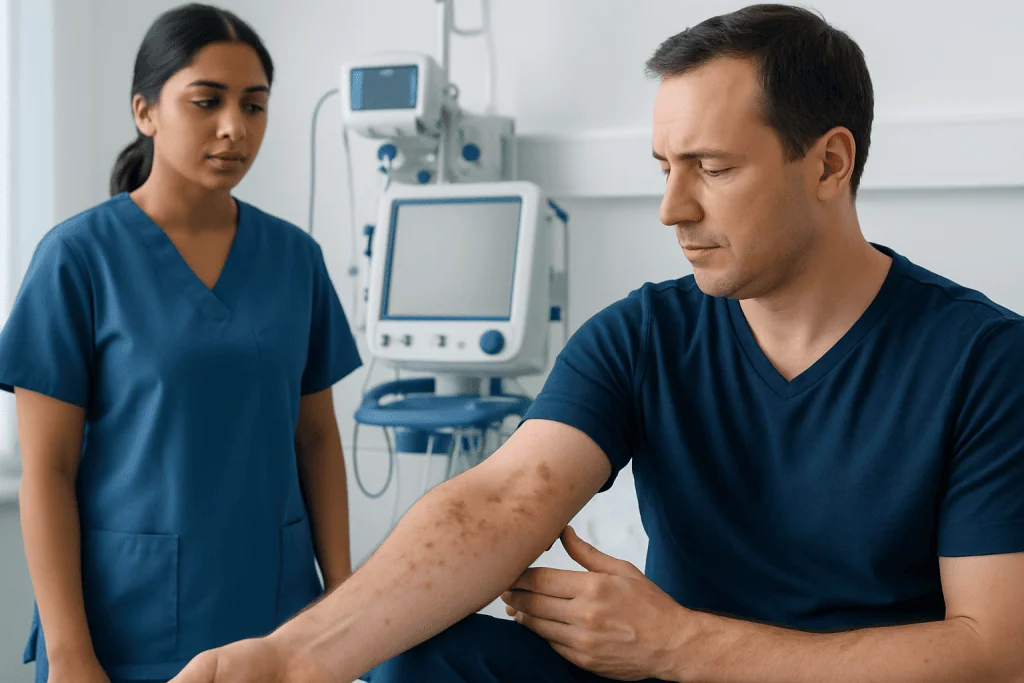
Scabies often causes a very itchy rash made up of small red bumps, tiny blisters, or scaly irritated patches. Some people develop thin, wavy, grayish or skin-colored lines called burrows, which may be easier to see on the hands, wrists, or between the fingers. The itching is often worse at night and may continue even after scratching causes visible irritation.
Bed bug bites usually appear as small, itchy, red bumps or welts. They are often found in groups, clusters, or a rough line, sometimes described as several bites close together. Unlike scabies, bed bug bites tend to affect areas that are exposed during sleep rather than covered skin folds.
It is also important to know that skin reactions differ from person to person. Some people with bed bug bites have very little reaction, while others develop prominent swelling and itching. In scabies, symptoms may be subtle at first, especially during the first infestation, and then become more obvious over time as the immune system reacts.
Because many rashes can resemble either condition, appearance alone is not always enough. Eczema, allergic reactions, folliculitis, and other skin problems can overlap with these symptoms, which is one reason a medical evaluation can be helpful when the diagnosis is uncertain.
How clinicians tell them apart

A clinician usually begins by asking a few practical questions: When did the itching start? Is it worse at night? Are other household members or close contacts also itchy? Has there been recent travel, a new sleeping environment, or known contact with a person diagnosed with scabies? These details often point strongly in one direction.
The pattern and location of the rash are especially helpful. Scabies commonly affects the finger webs, inner wrists, elbows, underarms, around the waist, buttocks, nipples, and genitals. In infants, older adults, or people with weakened immune systems, the scalp, palms, and soles may also be involved. Bed bug bites more often appear on exposed areas, including the arms, lower legs, neck, and face.
During the examination, a doctor looks for burrows, scratch marks, crusting, and signs of secondary infection. If scabies is suspected, the clinician may use dermoscopy or perform a skin scraping to look for mites, eggs, or mite waste under a microscope. Not every case requires laboratory confirmation, but these tools can support the diagnosis when the findings are unclear.
In contrast, bed bug diagnosis often depends on the history and the environment as much as the skin itself. Evidence such as bugs, shed skins, dark spotting on mattresses, or similar bites in people who share the same sleeping area can help confirm the cause. Dermatologists may also help distinguish these bites from other skin conditions, including eczema or contact dermatitis.
Causes, spread, and risk factors
Scabies is caused by infestation with the human itch mite, which is usually spread through prolonged skin-to-skin contact. It can move through households, childcare settings, dormitories, nursing homes, and other places where close personal contact is common. Less often, transmission may occur through shared bedding or clothing, particularly in heavier infestations.
Bed bugs do not burrow into the skin and do not live on the body. They usually hide in mattresses, bed frames, upholstered furniture, baseboards, luggage, or nearby cracks, and emerge to feed, often at night. Infestations can occur in many settings and are not a sign of poor hygiene.
Risk factors for scabies include close living conditions, sexual contact, institutional outbreaks, and a weakened immune system. Risk factors for bed bugs include recent travel, used furniture, apartment living, or exposure to infested rooms or belongings. Either problem can happen to anyone.
One practical difference is that scabies tends to affect people through direct contact with an infested person, whereas bed bugs usually point to an environmental source. This distinction shapes both diagnosis and treatment: scabies requires attention to close contacts, while bed bugs require attention to the living space.
What to do if it is scabies
If a doctor diagnoses scabies, treatment usually includes a prescription medicine that kills the mites. Common approaches include medicated creams or, in selected cases, oral treatment. A clinician will explain how to apply or take the medicine correctly and whether treatment is needed for household members, sexual partners, or other close contacts, even if they do not yet have symptoms.
Itching may continue for a few weeks after successful treatment because the skin is still reacting to the mites and their debris. This does not always mean treatment failed. Doctors may recommend soothing skin care, antihistamines in some cases, or anti-inflammatory treatment for persistent itch; if another skin problem is present, evaluation by a dermatologist may help, including for conditions such as psoriasis that can sometimes confuse the picture.
Clothing, towels, and bedding used recently are usually washed in hot water and dried on a hot cycle, or sealed away if washing is not possible. Fingernails should be kept short to reduce skin injury from scratching. Because the treatment plan may vary by age, pregnancy status, skin sensitivity, or immune health, professional guidance is important.
When symptoms are widespread, crusted, recurrent, or uncertain, specialist care may be useful. In some settings, doctors may coordinate dermatology assessment with additional skin testing to confirm the diagnosis and rule out similar-looking conditions.
What to do if it is bed bugs
If the problem is bed bugs, the bites themselves are usually managed with symptom relief. Gentle skin care, avoiding scratching, and using clinician-recommended anti-itch treatments can help. If scratching has broken the skin or there are signs of infection such as increasing pain, warmth, pus, or spreading redness, a doctor should review the area.
The main solution, however, is environmental control. Bed bugs need to be identified and removed from the home, hotel room, or other sleeping area. This may involve careful inspection of bedding and furniture, laundering fabrics on hot settings as appropriate, vacuuming, reducing clutter, encasing mattresses, and using professional pest-control services when needed.
Throwing away belongings is not always necessary, and home treatment without a clear plan may not fully solve the problem. Because bed bugs hide well, repeated inspections may be needed. Clinicians may also ask about travel or recent moves because bites can continue if the source is not found.
If the rash is severe, prolonged, or difficult to identify, a skin specialist can help exclude other causes of itchy bumps. In selected cases, allergy tests or other assessments may be considered if the history suggests a separate allergic skin reaction rather than bed bug bites alone.
Prevention and self-care
Preventing scabies depends mainly on reducing direct spread. If someone in a household is diagnosed, following the treatment instructions exactly and addressing close contacts at the same time can reduce reinfestation. Shared clothing, towels, and bedding used recently should be cleaned according to medical guidance.
Preventing bed bugs focuses on the environment. After travel, checking luggage and clothing, inspecting mattresses and upholstered furniture, and being cautious with secondhand items can help lower risk. In buildings with repeated infestations, reporting concerns early may help stop spread to neighboring rooms or units.
For both conditions, scratching can worsen irritation and increase the chance of bacterial infection. Gentle cleansers, fragrance-free moisturizers, cool compresses, and keeping nails trimmed can support skin healing. It also helps to avoid assuming every itchy rash is caused by an infestation, because unnecessary pesticide use or repeated scabies treatment can create added problems.
When the diagnosis remains unclear, a clinician may recommend expert skin evaluation rather than repeated self-treatment. Acibadem International’s multidisciplinary specialists and JCI-accredited hospitals diagnose and treat skin conditions for international patients, including cases where rashes need careful differentiation through medical check-up and specialist review.
When to seek medical care
Medical care is a good idea if the itching is intense, the rash is spreading, sleep is being disrupted, or more than one person in the household has similar symptoms. A prompt evaluation is also helpful if there are burrows, rash in typical scabies areas, or a concern about close-contact spread. Diagnosis matters because the treatment for scabies is different from the approach used for bed bug bites.
Urgent review is appropriate if there are signs of skin infection, such as fever, increasing pain, pus, or rapidly expanding redness. Babies, older adults, pregnant people, and individuals with weakened immune systems may need earlier assessment because symptoms can be atypical or complications can develop more easily.
Anyone who has used over-the-counter products repeatedly without improvement should consult a qualified doctor rather than continuing trial-and-error treatment. A clinician can confirm the cause, recommend safe treatment, and help protect other household members if scabies is present.
Frequently asked questions
How can someone tell if it is scabies or bed bugs?
Scabies usually causes intense itching, often worse at night, and commonly affects skin folds such as between the fingers, wrists, waistline, and genitals. Bed bug bites usually appear on exposed skin like the arms, legs, neck, or face and often show up in clusters or lines. A doctor uses the rash pattern, contact history, and sometimes skin testing to tell them apart.
Do bed bugs live on the body like scabies mites?
No. Bed bugs do not live on the body or burrow into the skin. They hide in the environment and come out to feed, while scabies mites live in the outer layer of the skin.
Can scabies be mistaken for bed bug bites?
Yes, especially early on when both can look like itchy red bumps. Misidentification is common because many rashes overlap in appearance. This is why doctors pay close attention to where the rash appears, whether itching is worse at night, and whether close contacts are affected.
Will washing bedding alone get rid of scabies or bed bugs?
Washing bedding is helpful, but it is usually not enough by itself for either problem. Scabies generally needs prescription treatment for the affected person and often close contacts, while bed bugs require environmental removal from sleeping areas and furniture. Cleaning fabrics should be part of a larger treatment plan.
Do bed bug bites always happen at night?
Bed bugs often feed at night, but the timing of visible bites can vary because skin reactions may appear later. Not everyone reacts the same way, so some people notice bites quickly while others may not. The pattern and location of the bites are usually more helpful than timing alone.
How long does itching last after scabies treatment?
Itching can continue for several weeks even after the mites have been successfully treated. This happens because the skin may keep reacting for a while after the infestation is gone. If symptoms are getting worse rather than gradually improving, a doctor should review the situation.
This article is for general information only and is not a substitute for professional medical advice. Please consult a qualified doctor about your individual situation.
Explore treatments in Turkey — costs, top hospitals & a free quote
JCI-accredited · board-certified surgeons · reply within 24h
Add us as a Preferred Source to see more of our trusted health content across Google Search, AI Overviews and Discover.

More from the Health Library

What Does Biotin Do for the Body? Here Is What the Evidence Says

Can Constipation Cause Heartburn? Causes, Explanations, and Next Steps

Is Kosher Salt Iodized? Here Is What the Evidence Says

Why Do I Fart So Much? Causes, Explanations, and Next Steps

How to Get Rid of Alcohol Breath? Here Is What the Evidence Says