Schober Test: An Evidence-Based Guide for Patients

The Schober test assesses forward bending and flexibility of the lumbar, or lower, spine. A clinician measures marked points on the lower back before and after the person bends forward.
Key Takeaways
- The Schober test assesses forward bending and flexibility of the lumbar, or lower, spine.
- A clinician measures marked points on the lower back before and after the person bends forward.
- Reduced movement can occur with inflammatory spinal conditions, degenerative changes, pain, muscle tightness, or prior surgery.
- The modified Schober test is commonly used because it samples a larger area of the lower back.
- Results should always be interpreted with symptoms, examination findings, medical history, and sometimes imaging or blood tests.
The Schober test is a simple bedside movement test that measures how much the skin over the lower back stretches when a person bends forward. It can help clinicians assess reduced lumbar spine mobility, but it cannot diagnose a condition on its own.
What Is the Schober Test?
The Schober test is a quick physical examination used to assess flexibility in the lumbar spine, the lower portion of the back. During the test, a clinician makes small marks on the skin over the lower back, measures the distance between them, and repeats the measurement after the person bends forward as far as comfortably possible. The amount that the distance increases gives an estimate of lower-back movement.
The test is often used when someone has persistent back stiffness, reduced ability to bend, or symptoms that may suggest inflammatory disease affecting the spine. It is particularly associated with assessment for axial spondyloarthritis, including ankylosing spondylitis, but reduced movement has many possible explanations. The Schober test is therefore one piece of a broader clinical assessment, not a standalone diagnostic test.
Because it is noninvasive, does not involve radiation, and generally takes only a few minutes, the Schober test can be useful at an initial appointment and during follow-up visits. Repeating the same type of measurement over time may help a clinician understand whether spinal mobility is stable, improving, or becoming more limited.
Why Clinicians Use This Back Mobility Test

Lower-back mobility may be affected when joints, ligaments, muscles, discs, or spinal structures become painful, stiff, inflamed, or altered over time. The Schober test gives the clinician an objective measurement to accompany a person’s description of symptoms, such as morning stiffness, difficulty putting on shoes, discomfort when bending, or loss of flexibility.
In rheumatology, the test may contribute to an examination for inflammatory back pain. Inflammatory conditions can cause stiffness that is often more noticeable after rest and may improve somewhat with gentle activity. However, this symptom pattern is not enough to establish a diagnosis, and a normal or abnormal Schober test does not by itself confirm or exclude inflammation.
Clinicians may also use lower-back movement testing in people with longstanding mechanical back pain, spinal osteoarthritis, muscle guarding after an injury, scoliosis, or recovery after spinal treatment. The meaning of any result depends on the individual’s age, body shape, baseline flexibility, pain level on the day, and the exact technique used.
How the Schober Test Is Performed
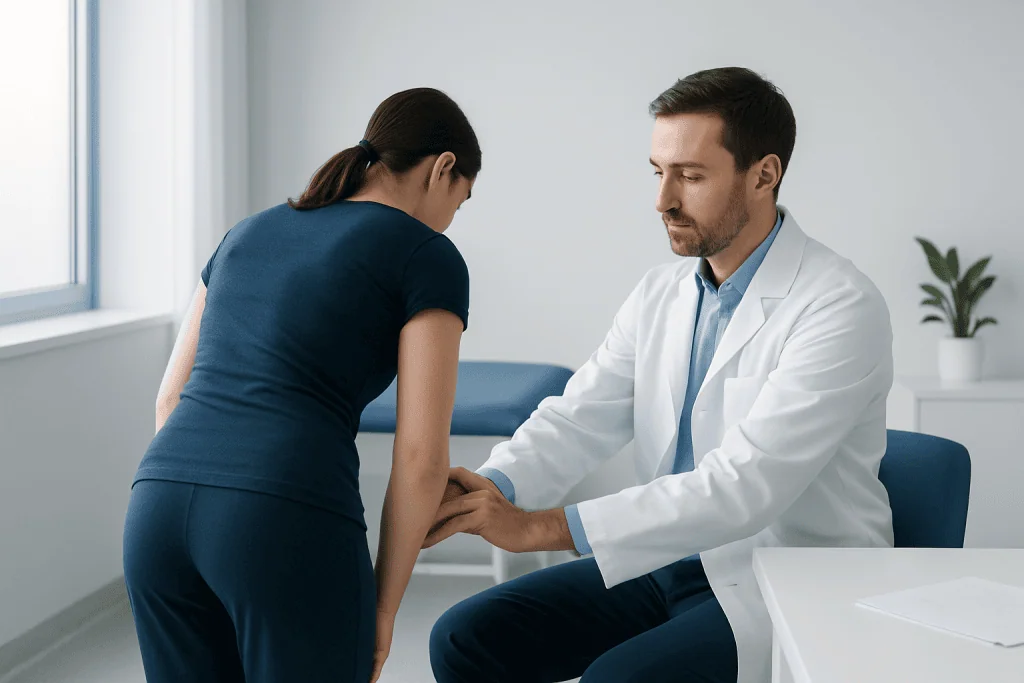
The traditional Schober test is usually performed with the person standing upright and their lower back exposed sufficiently for accurate skin marking. The examiner identifies a landmark near the base of the spine, commonly at the level of the dimples over the back of the pelvis, and marks a point a short distance above it. The distance between the marks is measured while the person is standing normally.
The person is then asked to bend forward slowly, usually with knees kept straight if this is safe and comfortable. The examiner measures the distance between the same marks again. As the lower back bends, the skin distance should increase. The difference between the standing and bent measurements represents the measured lumbar flexion.
A commonly used variation is the modified Schober test. This technique uses marks both above and below the landmark at the base of the spine, so it measures movement across a larger section of the lumbar area. This may better reflect lower-back flexion in some settings, although methods and reference values vary between healthcare services.
The examination should not be forced. If bending causes marked pain, dizziness, weakness, or concern about balance, the person should tell the clinician immediately. A qualified professional can adapt the examination or choose other ways to assess spinal movement.
Understanding Schober Test Results
In general, a larger increase in distance during forward bending suggests greater lumbar flexibility, while a smaller increase suggests reduced movement. There is no single result that can be interpreted in isolation for every adult. Results can vary according to whether the traditional or modified method was used, how landmarks were located, the measuring technique, and characteristics such as age and natural flexibility.
Reduced expansion may be seen in people with inflammatory spinal disease, including axial spondyloarthritis. It may also occur because of muscle tightness, acute pain that limits movement, degenerative changes in the spine, previous spinal injury or surgery, excess soft tissue, or fear of provoking pain. For this reason, an abnormal measurement should be viewed as a sign to consider in context rather than a diagnosis.
Likewise, a result within an expected range does not necessarily rule out a cause of back pain. Early inflammatory disease may not yet cause measurable restriction, and symptoms may fluctuate. Clinicians may compare the result with other mobility measures, such as chest expansion, neck movement, side bending, hip movement, and the distance from fingers to floor during forward bending.
For meaningful follow-up, it is helpful for the same method to be used consistently. A clinician may focus less on one isolated number and more on changes over time, symptom control, physical function, and the person’s ability to manage daily activities.
What Happens After an Abnormal Result?
An abnormal or unexpectedly limited Schober test result usually leads to further questions and examination rather than an immediate conclusion. A clinician may ask when back pain began, whether stiffness is worse in the morning or after inactivity, whether exercise helps, and whether there is a personal or family history of inflammatory conditions. They may also ask about fatigue, eye inflammation, psoriasis, bowel symptoms, or pain and swelling in other joints.
Depending on the history and examination, further assessment may include blood tests for markers of inflammation and imaging of the sacroiliac joints or spine. X-rays can show some structural changes, while magnetic resonance imaging (MRI) may be useful when active inflammation is suspected or when symptoms are present before changes are visible on X-ray. These tests are selected individually; they are not needed for every person with limited flexibility.
Treatment is directed at the underlying cause rather than the Schober measurement itself. Options may include education about back care, guided exercise, physiotherapy, pain management, and treatment from a rheumatology, orthopedics, or rehabilitation specialist when appropriate. For confirmed inflammatory spinal disease, a specialist may discuss anti-inflammatory medicines and other disease-targeted treatments based on the person’s condition and health needs.
Acibadem International’s multidisciplinary specialists and JCI-accredited hospitals can assess persistent back symptoms and coordinate diagnostic and treatment planning for international patients.
Supporting Back Mobility and Day-to-Day Comfort
Regular, comfortable movement is often beneficial for general spinal health. Walking, swimming, cycling, yoga adapted to individual ability, and mobility exercises may help maintain flexibility and confidence with everyday movement. The best activity is one that can be done consistently without causing a significant flare of pain.
People with back symptoms may benefit from a physiotherapist-guided plan that includes posture, hip and trunk mobility, core endurance, and safe ways to bend, lift, and pace activity. Exercises should be tailored when there is known inflammatory arthritis, osteoporosis, nerve symptoms, recent injury, surgery, or another medical condition affecting the spine.
Long periods in one position can contribute to a feeling of stiffness. Taking regular movement breaks, adjusting workstations, using supportive footwear when needed, and gradually building activity levels can be practical measures. Sleep, stress management, and avoiding tobacco may also support overall musculoskeletal health.
It is important not to use stretching or exercise to push through severe pain. A sudden loss of movement, escalating pain, or new neurological symptoms should be assessed by a healthcare professional rather than managed with self-directed exercise alone.
When to Seek Medical Care
A person should arrange a medical evaluation for back pain or stiffness that lasts for several weeks, repeatedly interrupts sleep, limits daily activities, or does not improve with reasonable self-care. Assessment is especially important when symptoms began before midlife, are associated with prolonged morning stiffness, improve with movement rather than rest, or occur with pain in the buttocks that alternates from side to side.
Prompt medical advice is also appropriate for back symptoms accompanied by a painful red eye, unexplained weight loss, fever, a new skin rash consistent with psoriasis, persistent diarrhea, or swollen joints. These features do not always indicate a serious condition, but they can help clinicians identify whether inflammatory or systemic causes should be considered.
Urgent care is needed for severe back pain following significant trauma, new weakness or numbness in the legs, numbness around the groin or buttocks, or new difficulty controlling bladder or bowel function. These symptoms require timely assessment because they may indicate nerve involvement or another condition needing urgent treatment.
Frequently asked questions
Is the Schober test painful?
The Schober test itself is not intended to be painful. It involves standing and bending forward while the clinician measures marked points on the lower back. Someone with back pain or stiffness may feel discomfort during bending and should tell the examiner so the movement can be modified or stopped.
Can the Schober test diagnose ankylosing spondylitis?
No. The Schober test can show reduced lower-back movement, which may occur in ankylosing spondylitis and related inflammatory conditions. Diagnosis requires a full clinical assessment and may involve symptom history, examination, blood tests, and imaging.
What is the difference between the Schober test and modified Schober test?
The traditional Schober test measures the distance between marks placed over a limited area of the lower back. The modified Schober test uses marks above and below a pelvic landmark, measuring a larger area. Clinicians may prefer the modified version because it may capture lumbar movement more broadly.
Does a low Schober test result always mean there is a spinal disease?
No. A smaller-than-expected change in measurement can result from pain, muscle spasm, reduced general flexibility, degenerative changes, body shape, or differences in testing technique. A clinician interprets the result alongside the person’s symptoms and other findings.
How should someone prepare for a Schober test?
No special preparation is usually required. Wearing clothing that allows access to the lower back and permits comfortable movement can be helpful. The person should tell the clinician about recent injuries, severe pain, surgery, balance problems, or any reason that bending forward may be unsafe.
Can a person do the Schober test at home?
A person may be able to measure bending movement at home, but this is not a reliable substitute for a clinical examination. Finding spinal landmarks and using a consistent method require training. Home measurements can also cause unnecessary worry if interpreted without medical context.
References
- American College of Rheumatology
- National Institute of Arthritis and Musculoskeletal and Skin Diseases
- Spondylitis Association of America
- National Institute for Health and Care Excellence
- Merck Manual Consumer Version
This article is for general information only and is not a substitute for professional medical advice. Please consult a qualified doctor about your individual situation.
Joint and spine care in Turkey — expert assessment & treatment
JCI-accredited · board-certified surgeons · reply within 24h
Add us as a Preferred Source to see more of our trusted health content across Google Search, AI Overviews and Discover.