

Shoulder Muscles: An Evidence-Based Guide for Patients

Shoulder muscles include the rotator cuff and larger muscles such as the deltoid, trapezius, pectoralis major, latissimus dorsi, and biceps. These muscles work together to lift, rotate, and stabilize the arm rather than acting alone.
Key Takeaways
- Shoulder muscles include the rotator cuff and larger muscles such as the deltoid, trapezius, pectoralis major, latissimus dorsi, and biceps.
- These muscles work together to lift, rotate, and stabilize the arm rather than acting alone.
- Pain in shoulder muscles may come from overuse, poor posture, strain, tendon injury, inflammation, or nearby neck problems.
- Early evaluation is helpful if symptoms follow trauma, cause weakness, disturb sleep, or do not improve with rest and gentle self-care.
- Treatment depends on the cause and may include activity changes, physical therapy, pain relief, and sometimes injections or surgery.
Shoulder muscles are a coordinated group of muscles that move the arm and help keep the shoulder joint stable during daily activities, work, and sports. When these muscles are strained, weak, inflamed, or injured, they can cause pain, stiffness, weakness, and limited movement that may need medical evaluation.
Overview: what shoulder muscles do
Shoulder muscles are the muscles that move the upper arm and help keep the shoulder joint stable. They let a person reach overhead, lift objects, push, pull, throw, dress, drive, and perform many small daily tasks. Because the shoulder is designed for a wide range of motion, it relies heavily on muscles and tendons for control.
Rather than being a single muscle group, the shoulder works as a team. Small stabilizing muscles guide the head of the upper arm bone within the joint, while larger muscles create strength and movement. This balance is important because even mild weakness, fatigue, or irritation in one area can change how the whole shoulder moves.
Patients often look up shoulder muscles because they have pain, tightness, clicking, or weakness. In some cases the problem is a simple strain. In others, symptoms may involve the rotator cuff, shoulder tendons, bursae, the joint itself, or even the neck. Understanding how the muscles work can make symptoms easier to describe and treatment easier to follow.
Main shoulder muscles and how they work together
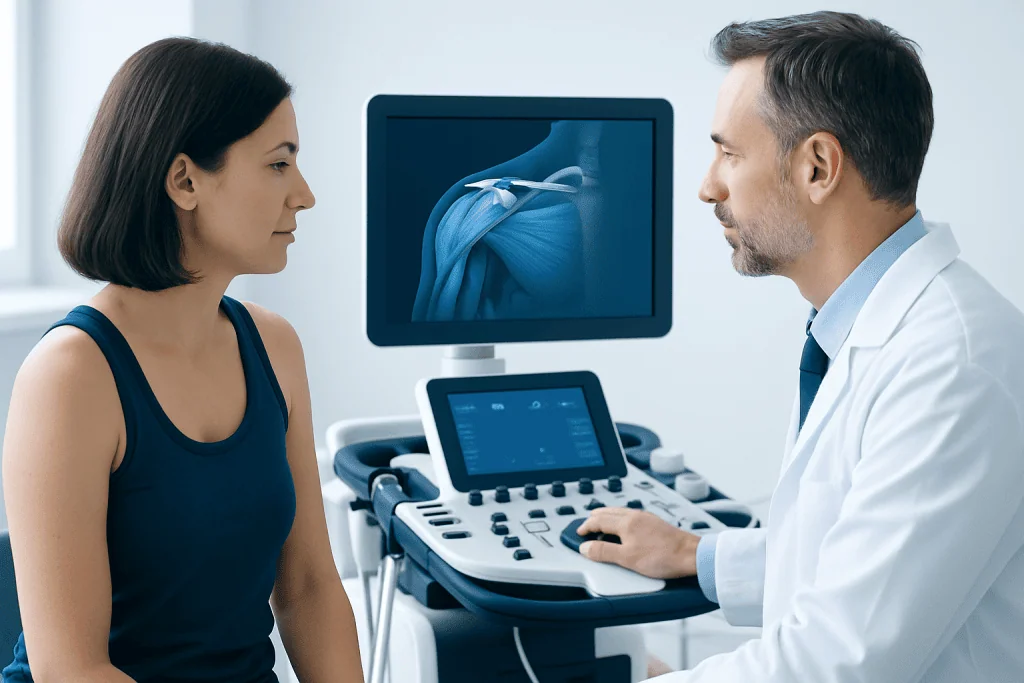
The rotator cuff is the best-known shoulder muscle group. It includes four muscles: supraspinatus, infraspinatus, teres minor, and subscapularis. These muscles do not just rotate the arm. They also hold the upper arm bone centered in the shoulder socket during movement, which helps prevent pinching and loss of control.
The deltoid is the large rounded muscle covering the outside of the shoulder. It is especially important for lifting the arm away from the body and helping with forward and backward arm motion. The trapezius and serratus anterior help position the shoulder blade, which creates a stable base for the arm to move smoothly.
Other important contributors include the pectoralis major in the chest, latissimus dorsi in the back, biceps at the front of the upper arm, and triceps at the back. These muscles assist with pushing, pulling, lowering the arm, and forceful overhead actions. If one part of this system is tight or weak, nearby muscles often compensate, which can lead to fatigue and pain over time.
- Rotator cuff: stabilizes and rotates the shoulder
- Deltoid: lifts and positions the arm
- Trapezius and serratus anterior: control the shoulder blade
- Pectoralis major and latissimus dorsi: support strong pushing and pulling
- Biceps and triceps: assist arm and shoulder movement
Common symptoms related to shoulder muscles

Shoulder muscle problems can feel different depending on the cause. Some people notice a dull ache after exercise or repetitive work. Others develop sharp pain when reaching overhead, behind the back, or across the body. Pain may stay localized to the top, side, front, or back of the shoulder, or it may travel into the upper arm.
Weakness is another common symptom. A person may find it harder to carry a bag, wash their hair, put on a jacket, or lift objects onto a shelf. Stiffness, reduced range of motion, muscle tightness, or a feeling that the shoulder is unstable may also occur. Some patients notice discomfort at night, especially when lying on the affected side.
Not all symptoms come directly from the muscles themselves. Tendon irritation, bursitis, joint inflammation, or nerve-related pain from the neck can feel similar. If the shoulder is painful and weak after an injury, a doctor may check for conditions such as shoulder impingement syndrome or a tear affecting the rotator cuff or other soft tissues.
Why shoulder muscles become painful or weak
Overuse is one of the most common reasons for shoulder muscle symptoms. Repeated overhead work, heavy lifting, racket sports, swimming, throwing sports, and sudden increases in exercise can strain muscles and tendons. Poor technique and not allowing enough recovery time can make irritation more likely.
Posture also matters. Rounded shoulders, prolonged desk work, and weak shoulder blade muscles can change the way the joint moves. Over time, this may overload some muscles while underusing others. Age-related wear in tendons, reduced flexibility, and preexisting joint changes can further increase the risk of pain.
Trauma is another cause. A fall, sudden pull, direct blow, or dislocation can injure shoulder muscles, tendons, or ligaments. In some cases, symptoms reflect another condition rather than a simple strain, such as frozen shoulder, cervical spine problems, or arthritis. A clinician may use imaging such as MRI or ultrasound when the diagnosis is not clear from the examination alone.
How doctors evaluate shoulder muscle problems
Diagnosis usually begins with a careful history. The doctor asks when the pain started, whether there was an injury, what movements make symptoms worse, and whether weakness, numbness, or neck pain is present. Information about work, sports, sleep disturbance, and previous shoulder problems can help narrow the cause.
The physical examination looks at posture, swelling, tenderness, range of motion, muscle strength, and shoulder blade movement. Specific tests can help identify whether the main problem involves a muscle strain, tendon irritation, impingement, instability, stiffness, or a possible tear. The neck may also be examined because some nerve-related symptoms can mimic shoulder disease.
Imaging is not needed for every patient. However, X-rays may help evaluate bone structure or arthritis, while ultrasound or MRI can assess muscles, tendons, bursae, and soft tissues in more detail. If symptoms are complex or prolonged, a referral to orthopedics and traumatology or physical medicine specialists may be appropriate.
Treatment options for shoulder muscle pain and injury
Treatment depends on the underlying cause, symptom severity, and the person’s daily needs. Many mild shoulder muscle strains improve with relative rest, temporary activity changes, ice or heat as advised by a clinician, and simple pain relief if appropriate. Short-term rest is useful, but prolonged immobilization is usually avoided because it can increase stiffness.
Physical therapy is often central to recovery. A rehabilitation plan may focus on gentle mobility, posture correction, rotator cuff strengthening, shoulder blade control, and gradual return to activity. Exercise programs are usually progressed step by step to reduce pain while restoring function. Patients with persistent symptoms may benefit from physical therapy and rehabilitation guided by a professional.
Some conditions need more targeted treatment. Inflammation around the shoulder may respond to a carefully selected injection, while major tendon tears, instability, or injuries that do not improve with conservative care may need surgical assessment. If surgery is recommended, options may range from minimally invasive repair to broader shoulder surgery, depending on the diagnosis. Near the end of the care pathway, Acibadem International’s multidisciplinary specialists and JCI-accredited hospitals provide diagnosis and treatment for international patients with shoulder disorders.
Prevention and self-care for healthier shoulder muscles
Prevention focuses on balanced movement rather than building strength in only one area. Regular stretching and strengthening of the rotator cuff and shoulder blade muscles can improve control. Warming up before sports, increasing training gradually, and allowing recovery days can lower the risk of overuse problems.
Posture and ergonomics are also important. Keeping screens at a comfortable height, taking movement breaks during desk work, and avoiding long periods with the shoulders rounded forward may help reduce strain. For manual work or sports, learning proper lifting and overhead technique can be especially valuable.
Self-care should stay gentle and practical. Activities that sharply increase pain are best reduced temporarily, but complete inactivity is not usually ideal unless advised after an acute injury. A patient should seek individualized guidance if symptoms recur often, interfere with sleep, or return each time exercise is resumed.
- Warm up before exercise or sport
- Build strength gradually, especially for overhead activities
- Train posture and shoulder blade control
- Use proper technique for lifting, throwing, or repetitive work
- Address pain early instead of pushing through persistent symptoms
When to seek medical care
Many mild shoulder muscle symptoms settle with rest and guided exercise, but medical assessment is important in some situations. A person should seek care if pain begins after a fall or other injury, if the shoulder looks deformed, or if it is suddenly very difficult to raise the arm. Significant weakness may suggest more than a simple muscle strain.
Evaluation is also wise when symptoms last more than a few weeks, keep returning, disturb sleep, or limit work, sports, or self-care activities. Numbness, tingling, fever, redness, or pain that seems to come from the neck or chest should not be ignored. Prompt assessment helps identify the cause and supports safer recovery.
Emergency care may be needed for severe trauma, suspected dislocation, new chest pain, or shortness of breath. In these settings, the priority is to rule out urgent problems rather than assuming the pain is only from shoulder muscles. When in doubt, a qualified doctor can help decide what level of care is needed.
Frequently asked questions
What are the main shoulder muscles?
The main shoulder muscles include the four rotator cuff muscles, the deltoid, trapezius, serratus anterior, pectoralis major, latissimus dorsi, biceps, and triceps. Together, they move the arm and help keep the shoulder stable during daily activities and exercise.
Can shoulder muscle pain go away on its own?
Mild shoulder muscle pain from temporary overuse or a minor strain may improve with relative rest, activity changes, and gradual return to movement. If pain is severe, follows an injury, or lasts more than a few weeks, medical evaluation is a good idea.
How can someone tell the difference between a muscle strain and a rotator cuff problem?
Both can cause pain, especially with lifting or reaching. A simple strain often improves steadily over days to a few weeks, while rotator cuff problems may cause ongoing weakness, pain at night, or difficulty raising the arm. A clinician can assess the pattern of symptoms and decide whether imaging is needed.
Are shoulder muscle problems always caused by exercise?
No. They can also be linked to posture, repetitive work, aging-related tendon changes, injury, or problems in nearby areas such as the neck. Even low-activity desk work can contribute if shoulder blade mechanics and posture are affected over time.
What exercises are usually recommended for shoulder muscles?
Many rehabilitation programs include gentle range-of-motion exercises, rotator cuff strengthening, and shoulder blade stabilization exercises. The best plan depends on the diagnosis, so exercises should be tailored to the person's symptoms and stage of recovery.
When is imaging needed for shoulder muscle symptoms?
Imaging is often considered when symptoms follow trauma, do not improve with conservative treatment, or suggest a tendon tear, significant inflammation, or another structural problem. X-rays, ultrasound, and MRI each provide different kinds of information.
This article is for general information only and is not a substitute for professional medical advice. Please consult a qualified doctor about your individual situation.
Joint and spine care in Turkey — expert assessment & treatment
JCI-accredited · board-certified surgeons · reply within 24h
Add us as a Preferred Source to see more of our trusted health content across Google Search, AI Overviews and Discover.

More from the Health Library

Colestipol: A Complete Medical Overview

Disc Desiccation — Explained by Medical Evidence, Not Myths

Parastomal Hernia: An Evidence-Based Guide for Patients

Marcona Almonds: What Patients Need to Know

Barnacles on Humans — Explained by Medical Evidence, Not Myths

Glucosamine: What Patients Need to Know
Orthopedic Surgery & Traumatology Specialists at Acibadem

Dr. Buğra Alpan
Orthopedic Surgery & Traumatology
Dr. Bülent Özmen
Orthopedic Surgery & Traumatology
Dr. Bülent Yücel
Orthopedic Surgery & Traumatology
Prof. Dr. Burak Akan
Orthopedic Surgery & Traumatology