Speech Therapy for Childhood Apraxia of Speech: How It Works, Results and What to Expect

Childhood apraxia of speech is a motor speech disorder, not a problem with intelligence or willingness to communicate. Speech-language therapy is the main treatment and is tailored to the child’s speech skills, age and communication needs.
Key Takeaways
- Childhood apraxia of speech is a motor speech disorder, not a problem with intelligence or willingness to communicate.
- Speech-language therapy is the main treatment and is tailored to the child’s speech skills, age and communication needs.
- Frequent practice of carefully selected speech movements can support progress, although timelines vary widely.
- Families play an important role by using therapist-guided practice at home without pressuring the child.
- Childhood apraxia of speech is not autism, although both conditions can occur in the same child.
Speech therapy for childhood apraxia of speech helps a child learn and practise the precise movements needed to produce sounds, syllables and words more accurately. Treatment is individualized, often intensive, and focuses on repeated successful practice in a supportive setting.
Overview: how speech therapy for childhood apraxia of speech works
Speech therapy for childhood apraxia of speech (CAS) is a structured form of treatment that helps children plan and carry out the movements required for clear speech. A child with CAS usually knows what they want to say, but the brain has difficulty organizing the precise sequence of movements of the lips, tongue and jaw needed to say sounds and words consistently.
A speech-language pathologist (SLP) uses frequent, guided practice to strengthen the child’s ability to move from sound to sound and word to word. Therapy does not simply ask a child to repeat vocabulary. It teaches speech movement patterns, beginning with targets the child can practise successfully and gradually building toward longer or more complex utterances.
Communication support is part of good care. Gestures, pictures, communication boards or electronic communication tools may be used when helpful. These tools do not prevent speech development; they can reduce frustration and help a child participate while speech skills are developing.
Who may benefit and how childhood apraxia is assessed
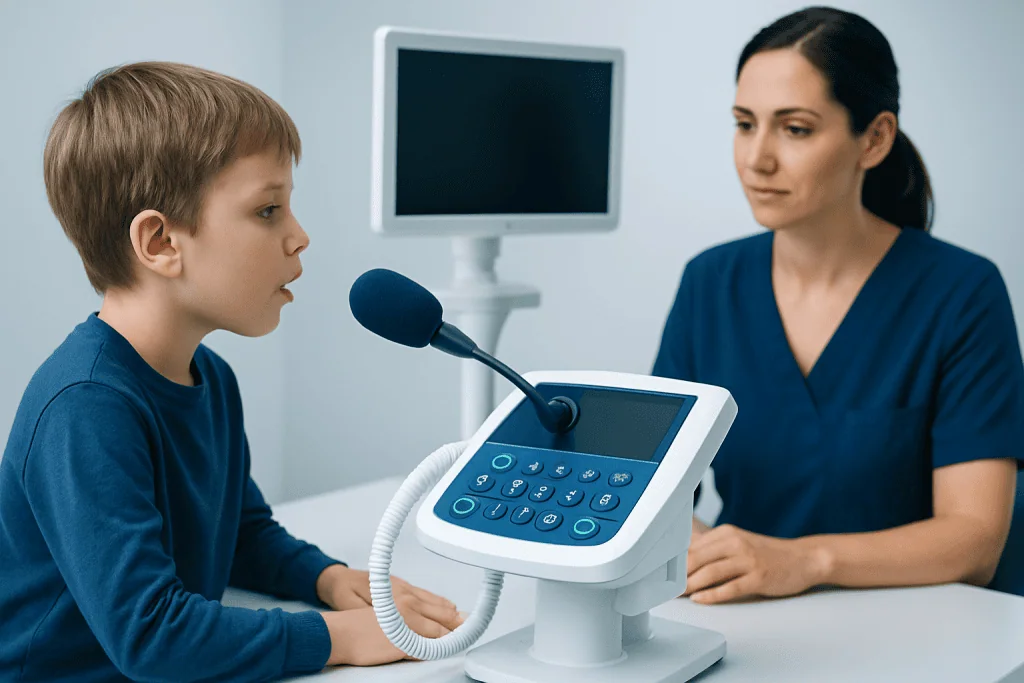
Children may be referred for assessment when they have very limited speech, are hard to understand for their age, make inconsistent errors when trying the same word, or have noticeable difficulty moving between sounds and syllables. Some children may appear to struggle more with longer words, and their speech may have unusual rhythm or stress patterns.
CAS cannot be confirmed with a single laboratory test or scan. An experienced SLP assesses the child’s speech sound production, ability to imitate speech, oral movements, language skills, hearing history and overall communication. The assessment may take more than one visit, especially for young children or children with limited verbal output.
Hearing should be evaluated when speech or language development is a concern, because hearing difficulties can affect speech learning. The clinician may also recommend review by a pediatrician, developmental specialist, neurologist, psychologist or other professionals when the child has broader developmental, feeding, learning or motor concerns.
CAS can occur on its own or alongside other developmental differences. A thorough assessment helps distinguish it from speech sound disorders, language disorders, dysarthria and other conditions that may need different treatment approaches.
What happens during therapy: a step-by-step approach

Therapy begins by identifying useful, achievable speech targets. Depending on the child’s current skills, these may include vowels, simple syllables, familiar words, functional phrases or short sentences. The therapist considers which words matter most in daily life, such as names, requests, greetings and routines.
During sessions, the SLP demonstrates the target, invites the child to watch and listen, and provides many chances to practise. Visual cues, touch cues when appropriate and agreed, rhythm, slowed speech, hand movements or picture prompts may help the child understand the movement sequence. Feedback is adjusted as the child becomes more accurate and independent.
The amount of practice is important, but it should remain positive and age-appropriate. Sessions often use play, conversation, books, games and motivating activities while preserving a clear speech-motor goal. The therapist regularly reviews accuracy and changes targets as skills improve.
Home practice is usually brief and specific rather than long or exhausting. Families receive guidance on which words or phrases to practise, how to model them and when to pause. Parents and caregivers should avoid repeatedly correcting every attempt; calm encouragement and meaningful communication are more helpful than pressure.
Expected results, benefits and possible challenges
The main benefit of therapy is improved functional communication: a child may become easier to understand, gain confidence attempting words and use a broader range of sounds and phrases. Progress can also reduce communication-related frustration and support participation at home, in school and with peers.
Results are individual. They depend on the severity and pattern of CAS, the child’s age, attention and learning profile, coexisting language or developmental needs, consistency of attendance and opportunities for appropriate practice. Improvement is often gradual rather than immediate, and progress may be uneven as new skills are introduced.
Speech therapy is generally low risk. A child may become tired, discouraged or frustrated when practising difficult movements, particularly early in treatment. A skilled clinician responds by adjusting the task, choosing motivating materials, celebrating effort and ensuring that therapy remains emotionally supportive.
There is no recovery period after a therapy visit. Children can return to usual activities straight away. Families may notice that a child is more willing to try speech after successful sessions, while on other days the child may need a break from practice; both experiences can be normal.
How long do kids with apraxia need speech therapy?
Many children with CAS need therapy over an extended period because speech motor skills develop through repeated learning and practice. The exact duration varies substantially. Some children require support for months, while others benefit from services across several years, with the frequency and goals changing over time.
At the beginning, therapy may be recommended more often than for a mild articulation difficulty, particularly when a child has few understandable words. As accuracy, confidence and independent communication improve, the care plan may shift toward less frequent sessions, school-based support, targeted home practice or work on more complex speech and language goals.
Regular reassessment is essential. Rather than focusing only on a fixed end date, families and clinicians can track meaningful goals, such as the number of functional words a child can say reliably, intelligibility in everyday settings and the child’s ability to communicate needs and ideas.
How long does it take to see results from speech therapy?
Some children show early changes within weeks, such as more attempts to speak, better accuracy on a few practiced words or less frustration during communication. For many children, however, clearer speech across many different words and situations takes longer because the new movement patterns must become stable and automatic.
Progress is best measured over time, not from one session to the next. A child may first master a word with cues in the therapy room, then use it with fewer cues, then use it at home and finally use the movement pattern in new words. Each stage represents meaningful learning.
Families should discuss progress openly with the SLP. If gains are limited, the therapist can review the diagnosis, target selection, treatment intensity, sensory or language factors and the usefulness of communication supports. Adjusting the plan is a routine part of personalized care.
Can a child recover from apraxia of speech?
Many children with CAS make substantial progress and become much easier to understand with appropriate therapy, practice and developmental support. Some eventually speak clearly enough that CAS has little impact on everyday life. Others may continue to have subtle speech, literacy, language or learning needs and benefit from longer-term support.
It is more helpful to think in terms of progress and functional communication than a guaranteed cure. Early, individualized intervention can support the development of speech skills, but no clinician can reliably predict one child’s final outcome at the first assessment.
Children should also receive help for related needs when present. For example, language therapy, reading and spelling support, occupational therapy, feeding support or developmental assessment may be appropriate for some children. Coordinated care addresses the whole child rather than speech in isolation.
Is apraxia a type of autism?
No. Childhood apraxia of speech is a motor speech disorder, while autism spectrum disorder is a neurodevelopmental condition that affects social communication and may involve repetitive behaviors, focused interests or sensory differences. A child can have CAS without autism, and autism does not automatically mean a child has CAS.
Some children have both conditions. In those cases, assessment and treatment should consider speech-motor planning as well as the child’s broader communication style, social interaction, sensory needs and preferred ways of learning. An SLP and pediatric developmental team can help clarify the child’s needs.
It is important not to assume that limited speech is caused by one diagnosis alone. Individual assessment helps ensure the child receives the right communication support and avoids unnecessary delays in treatment.
When to seek medical care
Parents or caregivers should arrange an evaluation with a pediatrician or speech-language pathologist if a child is difficult to understand, has very few spoken words, seems unable to imitate simple sounds or words, or becomes increasingly frustrated when trying to communicate. Early assessment can identify speech, language, hearing or developmental needs and guide next steps.
Seek prompt medical advice if a child who previously spoke clearly has a sudden loss of speech, new facial weakness, trouble swallowing, severe headache, seizures, loss of balance or other sudden neurological symptoms. These signs need urgent assessment because they are not typical of developmental CAS.
For children who need multidisciplinary assessment and rehabilitation planning, Acibadem International’s specialists and JCI-accredited hospitals provide diagnosis and treatment support for international patients. Families should work with qualified clinicians to create a plan that fits the child’s communication needs, development and daily routine.
Frequently asked questions
What is the main goal of speech therapy for childhood apraxia of speech?
The main goal is to help the child plan and produce speech movements more accurately and consistently. Therapy also supports practical communication, so the child can express needs, ideas and feelings with less frustration.
How often should a child with apraxia attend speech therapy?
The recommended frequency depends on the child’s speech profile, age, stamina and treatment goals. Many children benefit from regular, frequent opportunities to practise, but the exact schedule should be set by the treating speech-language pathologist.
Can parents practise speech exercises at home?
Yes, when the exercises are selected and demonstrated by the child’s speech-language pathologist. Short, positive practice sessions that focus on a few meaningful targets are usually more useful than lengthy sessions or repeated correction.
Does childhood apraxia of speech affect intelligence?
No. CAS is a difficulty with planning speech movements and does not measure a child’s intelligence. Children with CAS can understand far more than they are able to say, although some may also have separate language or learning differences.
How long do kids with apraxia need speech therapy?
The duration varies from child to child and may range from months to several years. Therapy goals and frequency are reviewed regularly as speech becomes more accurate and the child communicates more independently.
Can a child recover from apraxia of speech?
Many children make major improvements with individualized speech therapy and ongoing practice. Some continue to need support for subtle speech, language, reading or spelling challenges, so follow-up should be based on the child’s changing needs.
Is apraxia a type of autism?
No. CAS is a motor speech disorder, whereas autism is a broader neurodevelopmental condition. They can occur together in some children, but one diagnosis does not mean the other is present.
References
- American Speech-Language-Hearing Association
- National Institute on Deafness and Other Communication Disorders
- American Academy of Pediatrics
- Mayo Clinic
This article is for general information only and is not a substitute for professional medical advice. Please consult a qualified doctor about your individual situation.
Explore treatments in Turkey — costs, top hospitals & a free quote
JCI-accredited · board-certified surgeons · reply within 24h
Add us as a Preferred Source to see more of our trusted health content across Google Search, AI Overviews and Discover.

More from the Health Library



Related Specialists

Çiğdem Ünver
Physical Medicine & Rehabilitation
Asst. Prof. Dr. Özer Öztürk
Orthopedic Surgery & Traumatology
Prof. Dr. Arzu Ertürk
Pulmonary Medicine
Dr. Zafer Bahri Demirel
Otorhinolaryngology