Understanding Flat Back Syndrome: A Complete Patient Guide

Flat back syndrome involves loss of normal lumbar lordosis, the inward curve of the lower spine. The body may compensate by bending the hips or knees, tilting the pelvis, or leaning backward to keep the head balanced over the pelvis.
Key Takeaways
- Flat back syndrome involves loss of normal lumbar lordosis, the inward curve of the lower spine.
- The body may compensate by bending the hips or knees, tilting the pelvis, or leaning backward to keep the head balanced over the pelvis.
- Causes include spinal wear-and-tear, previous spinal fusion, vertebral fractures and certain inflammatory or neuromuscular conditions.
- Assessment usually includes a physical examination and full-length standing spine X-rays to evaluate overall alignment.
- Treatment ranges from targeted rehabilitation and pain management to reconstructive spinal surgery when symptoms and imbalance are severe.
Flat back syndrome is a spinal alignment condition in which the lower back loses some or all of its normal inward curve. This can shift the body forward, making standing and walking tiring or painful, but treatment can often improve symptoms, function and posture.
Overview: What Is Flat Back Syndrome?
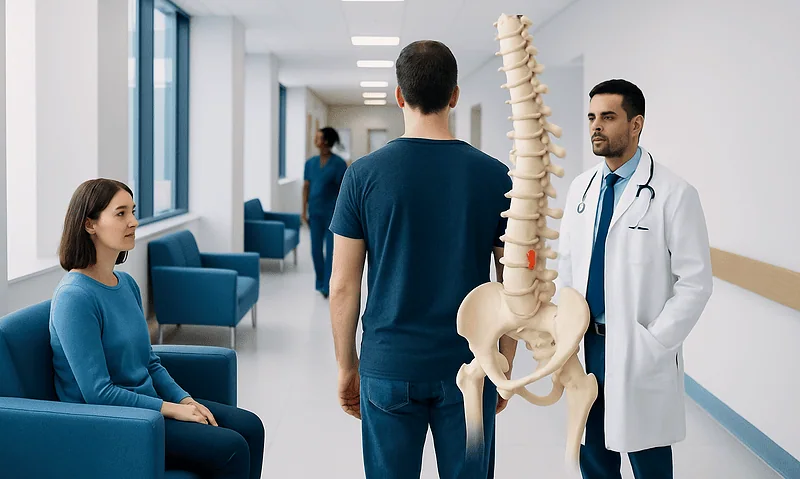
Flat back syndrome is a type of spinal deformity in which the lower back has too little of its usual inward curve. This curve, called lumbar lordosis, is an important part of the spine’s natural side-view alignment. When it is reduced, the trunk may shift forward relative to the pelvis and legs. The condition is sometimes also called flat back deformity or loss of lumbar lordosis.
The spine normally has gentle curves that help distribute body weight and allow efficient standing and walking. In flat back syndrome, the altered curve can make it harder to keep the head centered over the pelvis without effort. A person may compensate by bending the knees, extending the hips, tilting the pelvis, or leaning the upper body backward. These adjustments can be tiring and may lead to discomfort in the back, hips, buttocks, or legs.
Flat back syndrome is not simply a posture habit, and it does not mean that every person with a straighter-looking lower back has a serious condition. Clinicians consider the person’s symptoms, physical function, flexibility and whole-spine alignment. Some cases are flexible and respond well to nonsurgical care, while others are fixed structural deformities that may require more specialized treatment.
How Flat Back Syndrome Can Feel

Symptoms vary considerably. Some people notice gradual low back pain, stiffness or muscle fatigue, particularly after standing or walking for a long time. Others feel that they need to bend their knees or place their hands on their thighs to remain comfortable. Pain often improves with sitting, lying down, or leaning forward because these positions reduce the effort needed to maintain balance.
A common functional concern is reduced walking tolerance. A person may be able to walk only a limited distance before developing aching across the lower back, buttocks, hips or thighs. The upper back and neck can also become sore because they work harder to keep the eyes level and facing forward. Everyday activities such as cooking, shopping, traveling, or waiting in line may become more difficult.
Visible changes can include a forward-stooped posture, a flattened lower back, bent knees while standing, or the sense that the body is leaning forward. However, appearance alone cannot confirm the diagnosis. Similar symptoms may occur with degenerative disc disease, spinal stenosis, hip conditions, or muscle weakness, so a clinical assessment is important.
- Low back aching, stiffness, or muscle exhaustion
- Difficulty standing fully upright for long periods
- Forward-leaning posture or a need to bend the knees
- Reduced walking distance and symptoms relieved by sitting
- Buttock, hip, thigh, upper-back, or neck discomfort
Why Flat Back Syndrome Develops

Flat back syndrome can develop for several reasons. In some people, age-related changes gradually reduce the height and flexibility of the discs between the vertebrae. Arthritis in the small spinal joints, weakening of the back muscles, and degeneration at more than one spinal level may also affect the lumbar curve. These changes can contribute to overall forward imbalance over time.
Previous spinal surgery is another important possible cause. Older forms of spinal fusion sometimes corrected one problem while leaving the lower back too straight. Modern surgical planning places strong emphasis on restoring suitable overall alignment, but loss of lordosis can still occur after surgery in some situations. It may also develop adjacent to an earlier fusion as neighboring spinal segments change over time.
Other causes include vertebral compression fractures, especially in people with osteoporosis; severe disc degeneration; spinal infection or injury; and less commonly, inflammatory or neuromuscular disorders. Ankylosing spondylitis can cause stiffness and structural changes that affect posture. A clinician will review the medical history carefully to identify factors that may be influencing the spine.
Risk is not determined by a single factor. Previous back surgery, low bone density, smoking, poor muscle conditioning, a history of fractures, and progressive spinal degeneration may all be relevant. These factors do not mean a person will develop flat back syndrome, but they can guide prevention and treatment planning.
How Doctors Assess Spinal Alignment
Diagnosis begins with a detailed discussion of symptoms and daily limitations. The clinician may ask when discomfort occurs, whether sitting relieves it, how far the person can walk, and whether there has been prior spine surgery, trauma or a fracture. They will also consider medications, bone health, other medical conditions and any changes in bladder or bowel control.
During the physical examination, the clinician observes standing posture, balance and gait. They assess spinal movement, hip flexibility, leg strength, reflexes and sensation. An important part of the assessment is determining whether the altered posture is flexible. For example, if a person can regain a more natural curve while lying down or extending the hips, rehabilitation may have a more central role than in a rigid deformity.
Full-length standing X-rays that include the spine and pelvis are commonly used to measure sagittal alignment, meaning alignment viewed from the side. These images help the care team assess lumbar lordosis, pelvic position and the relationship of the head and torso to the pelvis. Imaging while standing is useful because imbalance may be more apparent when the body is bearing weight.
MRI or CT scans may be recommended when clinicians need more detail about discs, nerves, bone, previous implants or narrowing around the spinal canal. Bone-density testing may also be appropriate when a compression fracture or osteoporosis is suspected. Imaging findings are interpreted alongside symptoms and function; an X-ray measurement alone does not decide whether treatment is needed.
Treatment Options and Shared Decision-Making
Treatment is individualized. The aim is not only to improve an X-ray measurement, but also to reduce pain, improve endurance, support safe movement and help the person return to meaningful daily activities. The best plan depends on the cause of the deformity, whether it is flexible, the degree of imbalance, nerve symptoms, bone quality, previous procedures and the person’s overall health and goals.
Nonsurgical treatment may be suitable for mild or flexible cases, or for people who prefer to avoid surgery. A structured rehabilitation program can focus on trunk endurance, hip mobility, strengthening of the gluteal and back muscles, balance and movement strategies for standing and walking. physical therapy and rehabilitation should be tailored by a qualified professional, because exercises that are helpful for one spinal condition may not be appropriate for another.
Doctors may also recommend carefully selected pain-relief medicines, treatment for contributing arthritis or osteoporosis, activity modifications, and supportive strategies such as pacing tasks and using walking aids when needed. Bracing has a limited role in many adults with fixed deformity, but may occasionally be considered for short-term support or selected circumstances. Injections can help clarify or manage certain pain sources, but they do not restore a structural spinal curve.
Surgery may be considered when there is substantial, persistent disability despite appropriate nonsurgical care; progressive deformity; significant nerve compression; or a fixed imbalance that markedly limits quality of life. Reconstructive surgery can involve decompression of nerves, spinal fusion, correction of alignment, and in some cases controlled bone cuts called osteotomies. These are major procedures with meaningful risks and recovery demands, so decisions should follow a thorough discussion with a spine specialist.
Daily Care, Prevention and Preparing for Treatment
Not every cause of flat back syndrome can be prevented, particularly when structural degeneration or previous surgery is involved. Still, daily habits can support spinal health and reduce avoidable strain. Regular, low-impact activity within a person’s comfort level helps maintain conditioning. Walking, water-based exercise, and clinician-approved strengthening may be useful, but activity should be adapted if it worsens pain or causes new neurological symptoms.
Good bone health matters, especially after midlife or for anyone with fracture risk. Adequate nutrition, sufficient vitamin D and calcium when advised by a clinician, weight-bearing activity where appropriate, smoking cessation, and assessment for osteoporosis can all be relevant. Falls prevention is also important for people with low bone density, balance difficulties or prior compression fractures.
Practical pacing can make daily life easier. Breaking standing tasks into shorter periods, using a supportive work surface, sitting for meal preparation, planning rest breaks, and avoiding repeated heavy lifting can reduce fatigue. A walking aid may improve stability and endurance for some individuals, but it should be chosen with professional guidance so that it supports rather than worsens posture.
For people considering surgery, preparation often includes optimizing nutrition, physical conditioning, diabetes management if applicable, smoking cessation and bone health. It is reasonable to ask about the purpose of the proposed procedure, alternatives, expected rehabilitation, potential complications and the care needed after discharge. Acibadem International’s multidisciplinary spine specialists in JCI-accredited hospitals assess and treat complex spinal alignment conditions for international patients.
When to Seek Medical Care
A medical evaluation is appropriate for persistent back pain, increasing difficulty standing upright, reduced walking distance, or a noticeable change in posture that affects daily life. Assessment is particularly important after prior spinal surgery, a fall or injury, or a known vertebral fracture. Early review can help identify treatable contributors, including nerve compression, osteoporosis and hip problems.
Urgent medical care is needed for new or worsening leg weakness, numbness in the groin or inner thighs, loss of bladder or bowel control, fever with severe back pain, or sudden severe pain after a fall. These symptoms do not always indicate a serious emergency, but they require prompt assessment to rule out conditions that need timely treatment.
People with unexplained weight loss, a history of cancer, prolonged use of corticosteroid medicines, or signs of infection should also discuss new back pain with a clinician. A doctor can determine whether referral to an orthopedic spine surgeon, neurosurgeon, rehabilitation specialist, pain specialist or bone-health service is appropriate.
Frequently asked questions
Is flat back syndrome the same as poor posture?
No. Poor posture can temporarily make someone appear rounded or forward-leaning, while flat back syndrome involves a reduction in the normal lower-back curve and may reflect structural changes in the spine. Some people have flexible alignment changes, but others have a more fixed deformity that needs medical assessment.
Can flat back syndrome be treated without surgery?
Yes, many people are managed without surgery. Personalized rehabilitation, activity pacing, pain management, treatment of bone-health concerns and support for related conditions can improve comfort and function. Nonsurgical care is less likely to restore a fixed structural curve, but it may still provide meaningful symptom relief.
Does flat back syndrome get worse over time?
The outlook depends on the underlying cause, spinal flexibility, overall health and whether degeneration or fractures continue. Some people remain stable with appropriate care, while others develop increasing imbalance or limitations. Regular follow-up is helpful when symptoms are progressing.
What kind of exercise is safe for flat back syndrome?
The safest exercise plan is individualized after an assessment by a clinician or physical therapist. Programs often emphasize trunk and hip strength, mobility, balance and gradual endurance rather than high-impact or heavily loaded movements. Exercises should be stopped and reviewed if they trigger sharp pain, increasing numbness or weakness.
Can a previous spinal fusion cause flat back syndrome?
It can. A spinal fusion may sometimes leave too little lower-back curvature or contribute to changes in the spinal segments next to the fusion over time. However, not all back symptoms after fusion indicate flat back syndrome, so standing alignment imaging and specialist evaluation are important.
When is surgery considered for flat back syndrome?
Surgery is generally considered when a person has severe, persistent symptoms and functional limitations despite suitable nonsurgical treatment, especially if there is fixed imbalance or nerve compression. The decision also takes account of bone quality, previous operations, general health and the person’s goals. A spine specialist can explain the likely benefits, limitations, risks and recovery process.
References
- Scoliosis Research Society
- American Academy of Orthopaedic Surgeons
- National Institute of Arthritis and Musculoskeletal and Skin Diseases
- American Association of Neurological Surgeons
- International Osteoporosis Foundation
This article is for general information only and is not a substitute for professional medical advice. Please consult a qualified doctor about your individual situation.
Joint and spine care in Turkey — expert assessment & treatment
JCI-accredited · board-certified surgeons · reply within 24h
Add us as a Preferred Source to see more of our trusted health content across Google Search, AI Overviews and Discover.