Stapedectomy: Benefits, Risks, and Recovery — A Complete Guide

Stapedectomy is most often performed to treat conductive hearing loss caused by stapes fixation, usually from otosclerosis. The procedure works by removing part or all of the stapes and replacing it with a tiny prosthesis to restore sound transmission.
Key Takeaways
- Stapedectomy is most often performed to treat conductive hearing loss caused by stapes fixation, usually from otosclerosis.
- The procedure works by removing part or all of the stapes and replacing it with a tiny prosthesis to restore sound transmission.
- Many people notice hearing improvement after healing, but full recovery can take several weeks and results vary by individual.
- Possible risks include dizziness, taste disturbance, persistent hearing loss, tinnitus, and rarely facial nerve or inner ear injury.
- Careful testing with hearing exams and ear evaluation helps determine whether surgery, hearing aids, or observation is the best option.
Stapedectomy is a microsurgical ear procedure used to improve hearing when the stapes bone no longer moves normally, most often because of otosclerosis. For the right candidate, it can offer meaningful hearing improvement, but the benefits, risks, and recovery timeline should be discussed carefully with an ear specialist.
Overview: what stapedectomy is and who it helps
Stapedectomy is a delicate ear operation performed to improve hearing when the stapes, one of the three tiny middle-ear bones, becomes fixed and cannot vibrate normally. This problem prevents sound from being transmitted efficiently to the inner ear. In most cases, the underlying cause is otosclerosis, a condition in which abnormal bone remodeling affects the stapes.
The main goal of stapedectomy is to restore movement in the hearing chain by replacing the diseased stapes with a very small prosthetic device. Some surgeons perform a closely related variation called a stapedotomy, which creates a small opening in the stapes footplate rather than removing it more fully. Patients may still hear the broader term “stapedectomy” used to describe both procedures in general discussion.
This surgery is usually considered for people with conductive hearing loss, meaning sound is blocked from reaching the inner ear effectively. It is not the right treatment for every type of hearing loss. A full hearing assessment helps show whether the hearing problem is due mainly to stapes fixation, inner ear damage, or a combination of both.
For many patients, stapedectomy offers the possibility of improved hearing and reduced dependence on hearing aids in the affected ear. However, it is an elective procedure in many cases, so the decision is often made after comparing the likely benefits with the risks, alternatives, and personal hearing goals.
How stapedectomy works and when it may be recommended
In normal hearing, sound travels through the eardrum and the three middle-ear bones: the malleus, incus, and stapes. The stapes acts like a tiny piston, transmitting vibrations into the inner ear. When the stapes becomes fixed, this motion is reduced or lost, and sound transmission drops significantly.
Stapedectomy works by bypassing the immobile bone. During surgery, the surgeon removes part or all of the fixed stapes and connects a tiny prosthesis between the incus and the inner ear opening. This allows vibrations to pass through the middle ear again more effectively, improving the conductive part of hearing loss.
The procedure is often recommended when testing shows a pattern consistent with stapes fixation and the person has hearing difficulty that affects daily life. Typical candidates have conductive hearing loss, a relatively healthy eardrum and middle ear, and hearing in the inner ear that is good enough to benefit from improved sound conduction.
Not everyone with otosclerosis needs surgery. Some people do well with monitoring or with hearing aids instead of an operation. Surgery may be less suitable when hearing loss is mainly sensorineural, when there is active ear infection, poor balance function, certain anatomic concerns, or only one reliably hearing ear unless the benefits and risks are considered especially carefully.
Candidacy, evaluation, and diagnosis before surgery

Before recommending stapedectomy, an ear, nose, and throat specialist or otologist will review symptoms, medical history, and hearing goals. Common concerns include slowly progressive hearing loss, difficulty hearing low voices, tinnitus, and sometimes a family history of otosclerosis. The doctor will also ask about dizziness, prior ear surgery, infections, and noise exposure.
A hearing test, or audiogram, is central to diagnosis. It helps distinguish conductive hearing loss from inner ear hearing loss and shows whether the gap between air conduction and bone conduction is large enough for surgery to be helpful. Tympanometry and speech testing may also be used to assess middle-ear function and practical hearing ability.
An ear examination checks the eardrum and rules out other causes of hearing loss such as fluid, perforation, or chronic middle-ear disease. Imaging is not always required, but in selected cases a CT scan may be useful if the diagnosis is uncertain, anatomy needs clarification, or another ear condition is suspected.
Because otosclerosis is not the only cause of conductive hearing loss, the evaluation is important. Conditions such as congenital stapes fixation, ossicular problems, or chronic ear disease can sometimes look similar. If another cause is found, treatment may differ and may involve other forms of ear surgery rather than standard stapes surgery.
Step by step: what happens during a stapedectomy
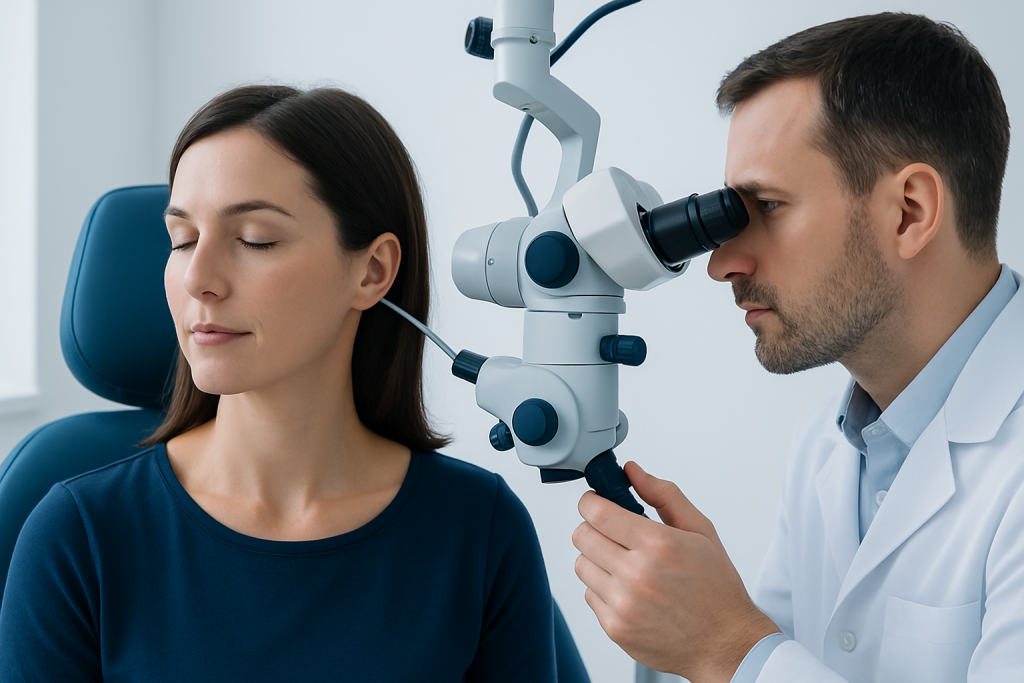
Stapedectomy is usually performed under local anesthesia with sedation or under general anesthesia, depending on the patient, the surgeon, and the treatment setting. The procedure is typically done through the ear canal, so there is often no visible external incision. Using an operating microscope or endoscopic assistance, the surgeon lifts the eardrum gently to reach the middle ear.
Once the middle ear is exposed, the surgeon examines the hearing bones and confirms that the stapes is fixed. The connection between the stapes and the incus is separated, and the upper part of the stapes is removed. In a classic stapedectomy, more of the stapes footplate may be removed; in a stapedotomy, a small opening is made in the footplate instead.
A tiny prosthesis is then positioned to bridge sound vibrations from the incus to the inner ear. The exact technique and prosthesis type vary. The surgeon checks that the device is stable and that the reconstruction is well aligned. Small packing material may be placed in the ear canal to support healing, and the eardrum is returned to its normal position.
The operation commonly takes around one to two hours, though timing varies. Many patients go home the same day. Detailed postoperative instructions are important because the success of healing depends not only on the surgical technique but also on protecting the ear during the recovery period.
Benefits, possible results, and recovery timeline
The main benefit of stapedectomy is improved sound conduction, which can make conversation, phone use, and everyday listening easier. Some patients also feel less dependent on a hearing aid in the treated ear. Improvement is often most noticeable when the hearing loss was largely conductive before surgery.
Hearing does not always improve immediately. Packing in the ear and normal postoperative swelling can temporarily make hearing seem blocked. Many people begin to notice changes over the first days to weeks, but the more meaningful assessment usually comes after the ear has healed and repeat hearing tests are performed.
Recovery is usually gradual. Mild dizziness, a feeling of fullness in the ear, altered taste on one side of the tongue, or brief imbalance can occur early on and often improves with time. Patients are commonly advised to keep water out of the ear, avoid forceful nose blowing, avoid heavy straining, and follow specific activity limits during early healing.
The exact recovery timeline differs, but many people return to light daily activities within several days. More complete healing and a clearer sense of the hearing result may take a few weeks. Follow-up hearing tests help show how much the conductive hearing loss has improved and whether any further support, such as hearing rehabilitation options in more complex cases, should be discussed.
Risks, limitations, and alternatives to surgery
Like any operation, stapedectomy carries risks. Although many people do well, surgery on the middle and inner ear must be approached carefully because these structures are very small and delicate. Important risks include no hearing improvement, incomplete improvement, persistent conductive loss, or worsening hearing, including the rare possibility of severe inner ear hearing loss.
Other possible complications include dizziness, ringing in the ear, a change in taste due to irritation of the taste nerve, infection, eardrum injury, prosthesis displacement, and sensitivity to loud sounds. Very rarely, facial nerve weakness may occur because the facial nerve passes near the surgical area. Most people are counseled thoroughly about these possibilities before deciding on surgery.
Stapedectomy also has limitations. It is designed to improve the conductive component of hearing loss, not to reverse all forms of inner ear damage. If a person has mixed hearing loss, the operation may improve hearing but not restore it fully to normal. This is why realistic expectations are an important part of planning.
Alternatives include observation, especially when hearing loss is mild or stable, and hearing devices for those who prefer to avoid surgery or are not ideal candidates. In some cases, evaluation may reveal a different ear condition, such as cholesteatoma or chronic middle-ear disease, which requires a different treatment pathway altogether.
Self-care after surgery and when to seek medical care
After stapedectomy, careful self-care supports healing. Patients are often told to rest, sleep with the head slightly elevated if advised, keep the ear dry, and avoid sudden pressure changes. Heavy lifting, straining, vigorous exercise, air travel, and forceful nose blowing may need to be limited for a period recommended by the surgeon.
It is also helpful to avoid inserting anything into the ear canal unless specifically instructed. Follow-up appointments matter because the surgeon will check the ear packing, monitor healing, and arrange repeat hearing tests. If hearing seems muffled at first, this is not always a sign that the procedure has failed, since swelling and packing can temporarily affect sound.
Medical care should be sought promptly if there is severe or worsening dizziness, sudden major hearing loss, heavy bleeding, fever, strong ear pain, drainage with a bad odor, facial weakness, or persistent vomiting. These symptoms do not always mean a serious complication, but they should be assessed without delay.
For people considering treatment abroad or seeking specialist input, Acibadem International’s multidisciplinary ENT teams in JCI-accredited hospitals evaluate and treat ear conditions for international patients, including advanced microsurgical ear procedures. A specialist can explain whether surgery is appropriate or whether non-surgical hearing support may be the better first step.
Frequently asked questions
Is stapedectomy the same as stapedotomy?
They are closely related procedures used to treat stapes fixation. In general terms, stapedectomy removes more of the fixed stapes, while stapedotomy creates a small opening and places a prosthesis. Many patients hear the term stapedectomy used broadly for both approaches.
How successful is stapedectomy for hearing improvement?
Many properly selected patients experience meaningful improvement in the conductive part of hearing loss after surgery. However, results vary depending on the cause of hearing loss, inner ear function, surgical anatomy, and healing. A surgeon can best estimate the likely benefit after reviewing hearing tests.
How long does stapedectomy recovery take?
Initial recovery is often measured in days, but fuller healing usually takes several weeks. Hearing may seem blocked at first because of packing and swelling. Follow-up visits and hearing tests help show the final result more accurately.
Can hearing get worse after stapedectomy?
Yes, this is a known but uncommon risk. Most concerns involve incomplete improvement or no improvement, while severe permanent worsening is rare. This is one reason the decision for surgery should be made after careful discussion with an experienced ear specialist.
Will a person still need a hearing aid after stapedectomy?
Some people no longer need a hearing aid in the treated ear, while others still benefit from one. This depends on how much conductive hearing loss improves and whether there is any underlying inner ear hearing loss. Surgery can reduce hearing aid dependence without guaranteeing complete independence from devices.
Is stapedectomy painful?
Most patients describe more pressure, fullness, or mild discomfort than severe pain. Symptoms such as light dizziness or temporary taste change may be more noticeable than pain itself. The surgical team usually provides guidance on how to manage expected postoperative discomfort.
References
- American Academy of Otolaryngology–Head and Neck Surgery
- National Institute on Deafness and Other Communication Disorders
- MedlinePlus
- Merck Manual Professional Edition
- Mayo Clinic
This article is for general information only and is not a substitute for professional medical advice. Please consult a qualified doctor about your individual situation.
Explore treatments in Turkey — costs, top hospitals & a free quote
JCI-accredited · board-certified surgeons · reply within 24h
Add us as a Preferred Source to see more of our trusted health content across Google Search, AI Overviews and Discover.