Stroke Doctor vs Neurologist vs Neurosurgeon: Who Treats What?

A stroke doctor often refers to a specialist focused on emergency stroke diagnosis and treatment. Neurologists diagnose stroke, guide medical treatment, and help prevent future strokes.
Key Takeaways
- A stroke doctor often refers to a specialist focused on emergency stroke diagnosis and treatment.
- Neurologists diagnose stroke, guide medical treatment, and help prevent future strokes.
- Neurosurgeons are involved when bleeding, swelling, or certain blood vessel problems require an operation or procedure.
- The right specialist depends on the type of stroke, how quickly symptoms began, and whether surgery is needed.
- Stroke care commonly involves a multidisciplinary team that may include emergency physicians, neuroradiologists, rehabilitation experts, and intensive care staff.
A stroke is usually treated by a team, not just one doctor. A stroke doctor, neurologist, and neurosurgeon each play different roles depending on whether the priority is rapid diagnosis, clot treatment, brain protection, surgery, or recovery planning.
Overview: Which doctor treats a stroke?
Many people ask whether they need a stroke doctor, a neurologist, or a neurosurgeon. In practice, stroke care is often shared between several specialists. The main goal is to restore or protect brain function as quickly as possible, because early treatment can reduce long-term disability.
The term stroke doctor is commonly used to describe a physician with specific expertise in stroke medicine, often a vascular neurologist or another doctor working in an acute stroke team. This specialist focuses on recognizing stroke symptoms, ordering urgent brain imaging, deciding whether clot-busting medicine or other emergency treatment is appropriate, and coordinating immediate care.
A neurologist is a doctor who diagnoses and treats disorders of the brain, spinal cord, and nerves. Many strokes are managed medically by a neurologist, especially ischemic strokes and transient ischemic attacks. A neurosurgeon, by contrast, is a surgeon who treats structural problems affecting the brain and nervous system, including some cases of brain bleeding, swelling, or blood vessel abnormalities.
Rather than competing roles, these specialists usually complement one another. One doctor may lead emergency decision-making, another may perform a procedure, and another may guide recovery and prevention. Understanding the differences can help patients and families know what to expect during stroke care.
What a stroke doctor does
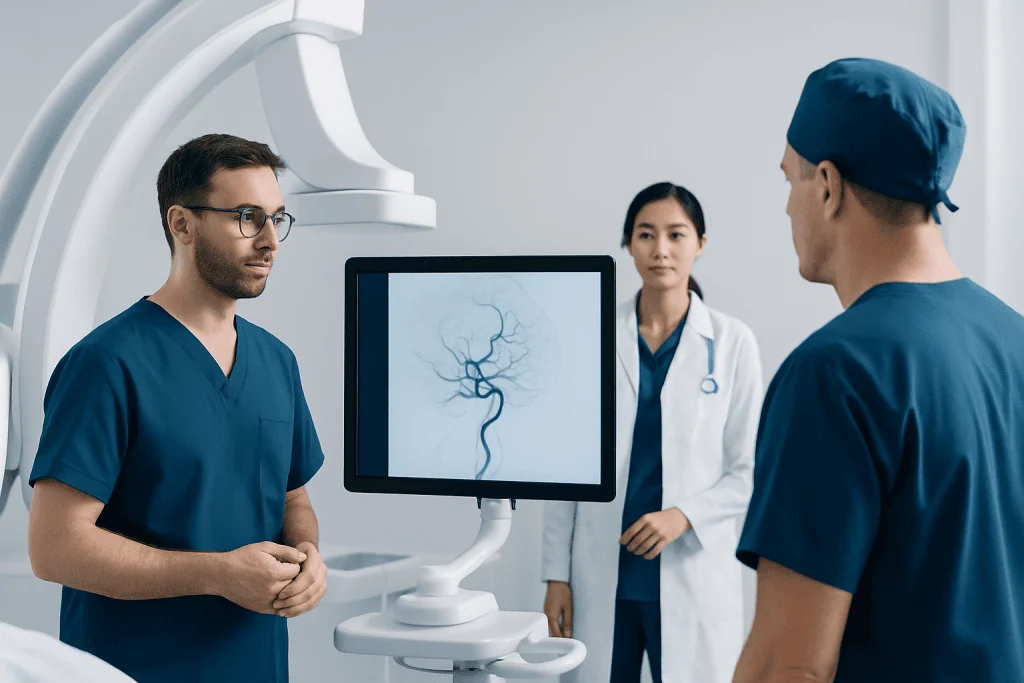
A stroke doctor usually manages the earliest and most time-sensitive part of care. This includes reviewing symptoms such as sudden weakness, facial drooping, trouble speaking, vision changes, imbalance, or severe headache, and determining whether they are likely caused by a stroke. Brain scans and blood tests are arranged quickly to distinguish an ischemic stroke from a hemorrhagic stroke.
If the stroke is caused by a blocked artery, the stroke doctor assesses whether emergency clot-dissolving medication may help and whether the person may benefit from stroke treatment in a specialized center. In some hospitals, this specialist also helps decide whether a patient should be transferred for advanced catheter-based procedures.
Stroke doctors also coordinate care after the first emergency decisions. They help control blood pressure, blood sugar, temperature, and other factors that can affect brain recovery. They monitor for complications such as swallowing difficulty, seizures, or early signs of brain swelling.
In many centers, the stroke doctor is a vascular neurologist. In others, stroke care may be shared with emergency physicians, intensivists, or interventional specialists. The exact title may differ, but the core role is rapid diagnosis and fast, evidence-based treatment.
What a neurologist does in stroke care

A neurologist is often the doctor who confirms the diagnosis, explains the type of stroke, and directs ongoing medical management. This includes identifying whether the event was an ischemic stroke, a hemorrhagic stroke, or a transient ischemic attack. It also involves looking for the cause, such as irregular heart rhythm, narrowing of a neck artery, small vessel disease, or a blood-clotting problem.
Neurologists play a major role in preventing another stroke. They may recommend medicines to reduce clotting risk, improve cholesterol levels, or control blood pressure, depending on the stroke type and the person’s overall health. They also help manage related neurological symptoms such as weakness, numbness, speech difficulty, memory problems, and fatigue.
Longer-term follow-up with a neurologist can be especially important when symptoms persist or when the cause of the stroke is unclear. Further testing may include heart rhythm monitoring, ultrasound of the neck arteries, echocardiography, or additional brain and vessel imaging. Some patients are also evaluated for conditions linked to stroke, such as carotid artery disease.
In short, the neurologist is usually the specialist most involved in understanding why the stroke happened and how to reduce the risk of it happening again. This role often continues well beyond the hospital stay.
When a neurosurgeon becomes involved
A neurosurgeon is not needed for every stroke, but their role can be critical in specific situations. They are most often involved when there is bleeding in or around the brain, severe pressure from swelling, or an underlying blood vessel problem that may need a procedure or operation.
For example, a person with a hemorrhagic stroke may need surgery to remove a blood clot, relieve dangerous pressure, or repair the source of bleeding. A neurosurgeon may also evaluate aneurysms, arteriovenous malformations, or complications from a large stroke that causes life-threatening swelling. In some settings, these problems overlap with brain aneurysm care.
Neurosurgeons may work closely with interventional teams when a blood vessel problem can be treated through a minimally invasive catheter approach rather than open surgery. Depending on the hospital and the case, care may involve brain surgery or other highly specialized techniques chosen after imaging and multidisciplinary review.
Even when surgery is not performed, a neurosurgical opinion may still be valuable. The specialist can help judge whether pressure inside the skull is becoming dangerous and whether close monitoring in intensive care is needed.
How treatment differs by stroke type
The type of stroke strongly influences which doctor leads treatment. An ischemic stroke happens when a blood vessel supplying the brain is blocked. These strokes are commonly led by stroke physicians and neurologists, with urgent evaluation for clot-dissolving medication or catheter-based clot removal when suitable.
A hemorrhagic stroke happens when a blood vessel bursts and causes bleeding in or around the brain. In these cases, blood pressure control, intensive monitoring, and reversal of certain blood thinners may be priorities. Neurosurgeons are more likely to become involved, especially if there is a large bleed, significant swelling, or a correctable structural cause.
A transient ischemic attack, sometimes called a mini-stroke, does not always cause lasting brain injury but still needs prompt medical attention. A neurologist or stroke specialist assesses the risk of a future stroke and may arrange same-day or urgent investigations. This is important because some people have a high early risk of a major stroke after a warning event.
Some patients also need procedures done by endovascular specialists. These doctors use catheters placed through blood vessels to remove clots or treat abnormal vessels. In selected cases, this may overlap with interventional neuroradiology or related vascular procedures performed within a stroke center.
Diagnosis and the hospital stroke team
Stroke diagnosis begins with time. Doctors need to know when symptoms started, what symptoms appeared, and whether the person takes blood thinners or has other medical conditions. Emergency assessment is followed by brain imaging, most commonly a CT scan, to quickly look for bleeding and help guide treatment choices.
Additional tests may include CT angiography or MRI to evaluate the brain and its blood vessels, heart tests to search for a clot source, and blood tests to identify metabolic or clotting issues. These results help determine whether a blocked artery, bleeding vessel, or another condition is causing the symptoms.
The hospital stroke team may include emergency medicine doctors, vascular neurologists, general neurologists, neurosurgeons, neuroradiologists, intensive care specialists, nurses, speech and swallowing therapists, physiotherapists, and rehabilitation physicians. Each member supports a different part of care, from life-saving treatment to safe feeding and mobility.
Modern stroke care is therefore highly collaborative. Patients and families may meet several doctors within the first hours, and this can feel confusing at first. Usually, this reflects a coordinated approach rather than uncertainty, with each specialist addressing a specific need.
Recovery, rehabilitation, and prevention
After the emergency phase, attention turns to recovery. Some people improve quickly, while others need longer rehabilitation for movement, balance, speech, swallowing, memory, or daily activities. A neurologist or stroke specialist often remains involved, but rehabilitation physicians and therapists become central to progress.
Rehabilitation may begin in the hospital and continue as inpatient, outpatient, or home-based care. Depending on the person’s needs, this can include physiotherapy, occupational therapy, speech and language therapy, and cognitive rehabilitation. In many cases, structured stroke rehabilitation helps patients regain independence and adapt to lasting changes.
Prevention is a key part of stroke care. Doctors focus on treating high blood pressure, diabetes, high cholesterol, irregular heart rhythms, smoking, obesity, sleep apnea, and sedentary lifestyle. Patients are usually advised to take medicines exactly as prescribed and attend follow-up visits to monitor recovery and risk factors.
Near the end of treatment planning, some patients seek care at international tertiary centers. Acibadem International’s multidisciplinary specialists and JCI-accredited hospitals diagnose and treat stroke and related neurological conditions for international patients, with coordinated input from neurology, neurosurgery, imaging, and rehabilitation teams.
When to seek urgent medical help
Stroke symptoms should always be treated as a medical emergency. Sudden facial drooping, arm weakness, trouble speaking, severe imbalance, sudden vision loss, confusion, or a new severe headache can all require immediate evaluation. It is safest to call emergency services rather than trying to wait for symptoms to pass.
Even if symptoms improve within minutes, a transient ischemic attack can be a warning sign of a larger stroke. Prompt assessment may allow doctors to identify the cause and start treatment early. Delays can reduce the chance of receiving time-sensitive therapies.
People recovering from stroke should also seek medical advice if they develop worsening weakness, repeated falls, swallowing trouble, new seizures, increasing confusion, chest pain, or shortness of breath. New or changing symptoms should not be assumed to be part of normal recovery.
For families, it can help to remember a simple principle: if symptoms start suddenly and suggest stroke, emergency care comes first. The right specialist will then be brought in based on the scan results, the type of stroke, and the treatments needed.
Frequently asked questions
Is a stroke doctor the same as a neurologist?
Not always. The term stroke doctor often refers to a physician with special expertise in stroke care, commonly a vascular neurologist. A general neurologist may also treat stroke, especially during follow-up and prevention.
Do all stroke patients need a neurosurgeon?
No. Many strokes are treated without surgery, especially ischemic strokes managed with medicines and catheter-based procedures when appropriate. A neurosurgeon is usually involved when there is bleeding, major swelling, or a structural problem that may need an operation.
Who treats an ischemic stroke?
An ischemic stroke is often led by a stroke specialist or neurologist in the emergency setting. If a large artery is blocked, an endovascular specialist may also be involved to remove the clot. The exact team depends on the hospital and the person's condition.
Who treats a hemorrhagic stroke?
A hemorrhagic stroke is typically managed by a team that may include neurologists, intensive care doctors, and neurosurgeons. Treatment focuses on controlling bleeding-related complications, reducing brain pressure, and deciding whether surgery is needed.
Should someone see a neurologist after a mini-stroke?
Yes, prompt medical assessment is important after a transient ischemic attack or mini-stroke. A neurologist or stroke specialist can investigate the cause and start treatment to lower the risk of a future stroke. Even brief symptoms should not be ignored.
Who manages recovery after a stroke?
Recovery is usually shared between neurologists, rehabilitation physicians, therapists, and primary care doctors. The team may include physiotherapists, occupational therapists, and speech therapists depending on the person's needs. Follow-up care often focuses on both rehabilitation and prevention.
References
- World Stroke Organization
- American Stroke Association
- National Institute of Neurological Disorders and Stroke
- Centers for Disease Control and Prevention
- National Health Service
This article is for general information only and is not a substitute for professional medical advice. Please consult a qualified doctor about your individual situation.
Explore treatments in Turkey — costs, top hospitals & a free quote
JCI-accredited · board-certified surgeons · reply within 24h
Add us as a Preferred Source to see more of our trusted health content across Google Search, AI Overviews and Discover.
Check your numbers in seconds
BMI, calories, due date, blood pressure and 30+ more clinical calculators — free, instant, doctor-reviewed ranges.