Synovial Joints Explained: Types, Structure, and How They Move

Synovial joints are freely movable joints found in the shoulders, knees, hips, elbows, and other active areas. Their key parts include cartilage, synovial fluid, a joint capsule, and ligaments that support smooth movement.
Key Takeaways
- Synovial joints are freely movable joints found in the shoulders, knees, hips, elbows, and other active areas.
- Their key parts include cartilage, synovial fluid, a joint capsule, and ligaments that support smooth movement.
- Different synovial joint types allow different motions, such as bending, rotation, and gliding.
- Injury, arthritis, overuse, and inflammation can affect joint comfort and function.
- Maintaining healthy body weight, regular movement, and good muscle strength supports joint health.
Synovial joints are the body’s most mobile joints, allowing actions such as walking, gripping, bending, and turning. Understanding their structure and movement helps explain how healthy joints work and why pain or stiffness can develop.
Overview
Synovial joints are the body’s main freely movable joints. They connect two or more bones in a way that allows smooth motion while helping absorb stress from daily activities such as walking, reaching, lifting, and turning.
These joints are found in areas that need a wide range of movement, including the shoulders, elbows, wrists, hips, knees, and ankles. Their specialized structure reduces friction and helps the bones move with less wear during normal activity.
Although synovial joints are designed for movement, they also need stability. A balance of bone shape, cartilage, fluid, ligaments, and surrounding muscles helps keep them working efficiently and comfortably.
How Synovial Joints Are Built
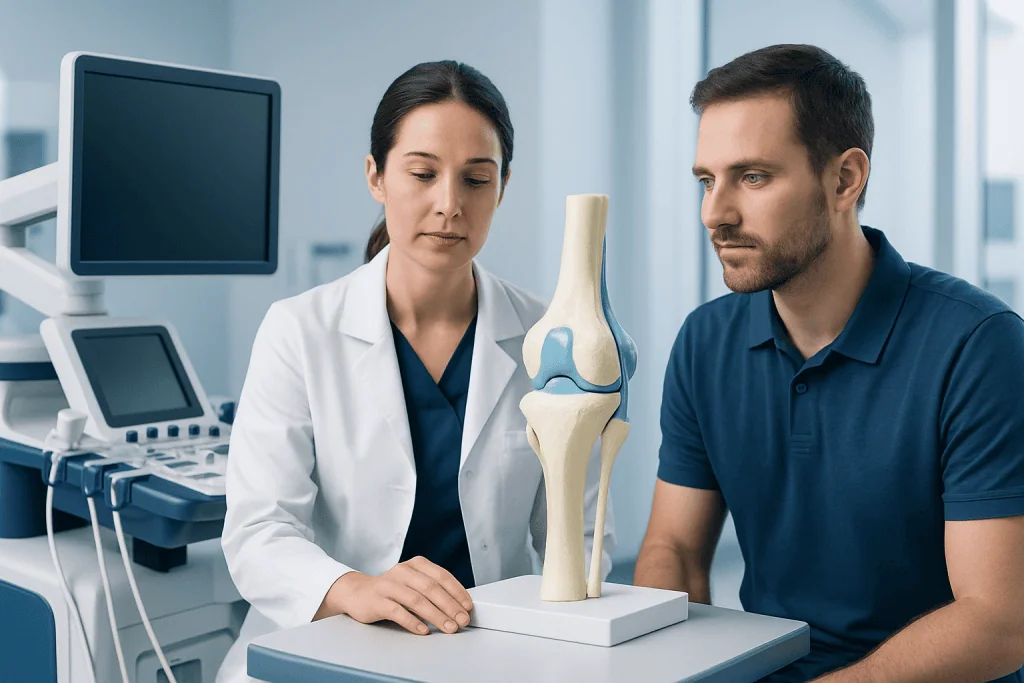
A synovial joint has several parts that work together. The ends of the bones are covered with articular cartilage, a smooth tissue that helps the bones glide against each other with less friction and impact.
Inside the joint is synovial fluid, a slippery liquid produced by the synovial membrane. This fluid lubricates the joint and helps nourish the cartilage, which does not have its own blood supply.
The joint is enclosed by a capsule that holds the bones in place. Ligaments strengthen the capsule and provide stability, while muscles and tendons around the joint help guide movement and protect it during activity.
Types of Synovial Joints
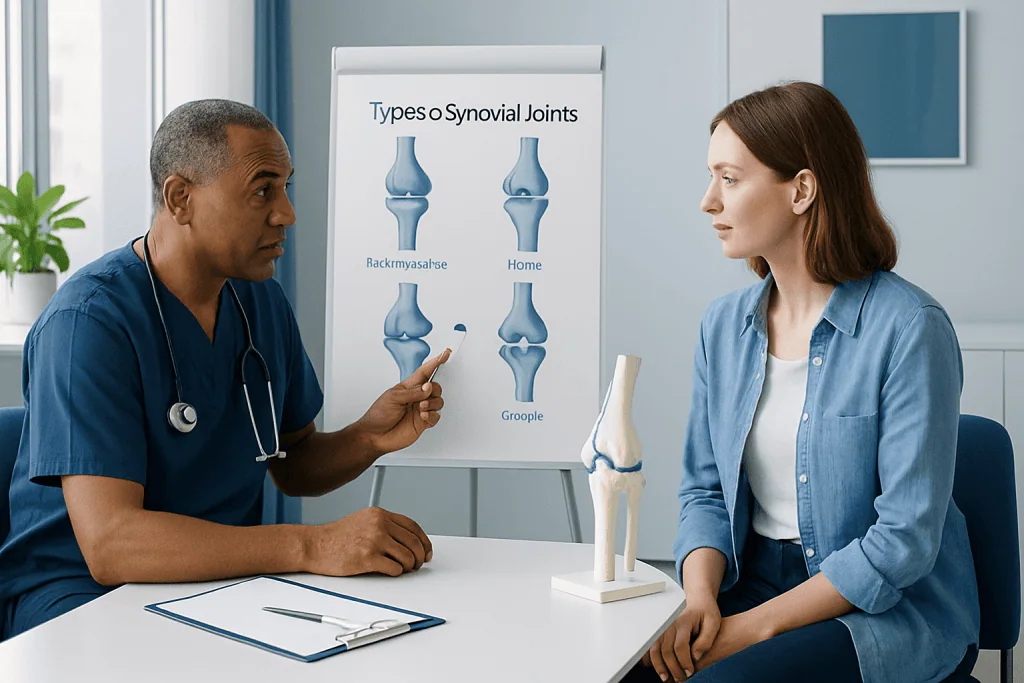
Synovial joints are grouped by the kind of movement they allow. Each type has a different shape, which determines how the bones can move relative to one another.
- Hinge joints allow bending and straightening, as seen in the elbow and knee.
- Ball-and-socket joints allow movement in many directions and rotation, as seen in the shoulder and hip.
- Pivot joints allow rotation, such as the joint between the first two neck bones.
- Condyloid joints allow movement in two directions, such as the wrist.
- Saddle joints allow a wide range of motion, such as at the base of the thumb.
- Gliding joints allow bones to slide past one another, as in parts of the wrist and ankle.
These categories help explain why some joints are built for power and stability, while others are built for flexibility and precision. The structure of the joint closely matches the function it needs to perform.
How Synovial Joints Move
Movement at a synovial joint happens when muscles contract and pull on tendons, which move the bones across the joint surface. The smooth cartilage and synovial fluid help that motion happen with minimal friction.
Depending on the joint type, movement may include flexion and extension, rotation, abduction and adduction, or gliding. For example, the shoulder can move in many directions, while the elbow mainly bends and straightens.
Joint movement is also influenced by the shape of the bones, the tightness of ligaments, and the coordination of surrounding muscles. Healthy movement depends on both flexibility and support, not flexibility alone.
Causes & Risk Factors for Joint Problems
Many everyday and medical factors can affect synovial joints. Common causes include injury, repetitive overuse, poor posture or body mechanics, and age-related wear on cartilage and surrounding tissues.
Inflammatory conditions such as arthritis can also affect synovial joints, leading to pain, swelling, stiffness, and reduced range of motion. In some people, prior fractures, sprains, or ligament injuries may alter joint mechanics over time.
Risk factors for joint trouble may include:
- Previous joint injury
- Repetitive sports or work movements
- Excess body weight
- Poor muscle strength or conditioning
- Inflammatory or degenerative joint disease
- Limited recovery after strain or overuse
Not every joint symptom means a serious problem, but persistent discomfort deserves attention so the cause can be understood properly.
Diagnosis
When a synovial joint is painful, swollen, stiff, or unstable, a doctor usually begins with a medical history and physical examination. They may ask when the symptoms started, what activities worsen them, and whether there was an injury.
Depending on the findings, imaging tests such as X-rays, ultrasound, MRI, or other studies may be used to look at bone alignment, cartilage, soft tissues, and signs of inflammation or injury. In some cases, blood tests or joint fluid analysis may help identify infection or inflammatory disease.
Diagnosis focuses on the underlying cause, because joint symptoms can come from different problems. A clear diagnosis helps guide the safest and most effective treatment plan.
Treatment Options
Treatment depends on the cause and severity of the problem. Many joint conditions improve with rest from aggravating activity, guided exercise, physical therapy, and strategies that reduce stress on the joint.
When inflammation is present, a doctor may recommend therapies to calm symptoms and protect function. If a joint problem is caused by a tear, advanced arthritis, or significant damage, more specialized treatments may be considered. In selected cases, procedures such as shoulder arthroscopy or joint replacement surgery may be discussed, depending on the joint involved and the individual’s needs.
Supportive care often includes improving muscle strength, maintaining mobility, and addressing the activities that trigger symptoms. The goal is not only to reduce pain, but also to restore safe movement and protect the joint over time.
Prevention & Self-care
Healthy habits can support synovial joints throughout life. Regular movement keeps the joints flexible, while strong muscles help stabilize them and reduce excess strain during activity.
Helpful self-care measures include maintaining a healthy body weight, warming up before exercise, using proper lifting and sports technique, and avoiding sudden increases in activity. Rest and recovery are also important, especially after strenuous exercise or repetitive work.
Some people benefit from low-impact activities such as walking, swimming, or cycling because they are easier on the joints. If a specific movement repeatedly causes pain, it is sensible to pause and ask a clinician or physical therapist for guidance before continuing.
When to See a Doctor
A doctor should evaluate joint symptoms that persist, worsen, or limit normal activity. Ongoing swelling, stiffness, instability, or pain that does not improve with simple self-care may point to an underlying condition that needs treatment.
Medical assessment is especially important after a fall, sports injury, visible deformity, inability to bear weight, fever with joint pain, or a joint that becomes hot and very swollen. These findings may indicate a more urgent problem that should not be ignored.
If joint symptoms are interfering with daily life, early evaluation can help preserve function and reduce the chance of long-term limitations. Acibadem International’s multidisciplinary specialists and JCI-accredited hospitals can help diagnose and treat synovial joint conditions for international patients.
Frequently asked questions
What is a synovial joint in simple terms?
A synovial joint is a movable joint where two bones meet and move smoothly against each other. It has cartilage, fluid, and a capsule that help the joint glide with less friction.
Which joints in the body are synovial joints?
Common examples include the shoulders, elbows, wrists, hips, knees, and ankles. Many joints in the fingers, toes, and spine also have synovial features in certain areas.
Why do synovial joints need synovial fluid?
Synovial fluid lubricates the joint so the bones can move more smoothly. It also helps nourish the cartilage that covers the bone ends.
What are the main types of synovial joints?
The main types are hinge, ball-and-socket, pivot, condyloid, saddle, and gliding joints. Each type allows a different range and direction of movement.
Can synovial joints get arthritis?
Yes. Synovial joints are commonly affected by osteoarthritis, rheumatoid arthritis, and other inflammatory conditions. These can cause pain, stiffness, swelling, and reduced movement.
How can someone support healthy synovial joints?
Regular low-impact exercise, muscle strengthening, healthy body weight, and good movement habits can all help. It is also important to treat injuries properly and avoid overusing painful joints.
References
- National Institute of Arthritis and Musculoskeletal and Skin Diseases
- Merck Manual Professional Edition
- Mayo Clinic
- MedlinePlus
This article is for general information only and is not a substitute for professional medical advice. Please consult a qualified doctor about your individual situation.
Joint and spine care in Turkey — expert assessment & treatment
JCI-accredited · board-certified surgeons · reply within 24h
Add us as a Preferred Source to see more of our trusted health content across Google Search, AI Overviews and Discover.