Tese Procedure: An Evidence-Based Patient Guide

TESE retrieves sperm directly from the testicle for use in IVF, most commonly with ICSI. It may be considered for obstructive azoospermia or selected cases of non-obstructive azoospermia.
Key Takeaways
- TESE retrieves sperm directly from the testicle for use in IVF, most commonly with ICSI.
- It may be considered for obstructive azoospermia or selected cases of non-obstructive azoospermia.
- Pain is usually limited and manageable with local anesthesia, sedation, or general anesthesia and short-term recovery care.
- The chance of finding sperm depends mainly on the underlying cause of infertility and the type of retrieval procedure used.
- Costs, including any TESE procedure code or CPT billing details, vary substantially by location, anesthesia, laboratory services, and IVF planning.
A TESE procedure, or testicular sperm extraction, is a minor surgical technique used to retrieve sperm directly from testicular tissue when sperm are not found in the ejaculate or cannot be obtained by other methods. Retrieved sperm may be used fresh or frozen for intracytoplasmic sperm injection (ICSI), a form of IVF.
Overview: What Is a TESE Procedure?
A TESE procedure stands for testicular sperm extraction. It is a surgical sperm retrieval method in which a urologist removes a very small sample of tissue from the testicle and examines it for sperm. When viable sperm are found, an embryology laboratory can prepare them for immediate use or freezing for future fertility treatment.
TESE is most often used when a semen analysis shows azoospermia, meaning no sperm are seen in the ejaculate. It can help some men with a blockage in the reproductive tract and selected men whose testicles produce very limited numbers of sperm. Because surgically retrieved sperm are usually not able to fertilize an egg through conventional IVF alone, they are generally used with ICSI, where one sperm is injected into an egg.
The procedure is part of a broader male infertility assessment rather than a stand-alone solution. A reproductive urologist and fertility team consider hormone results, genetic testing when appropriate, imaging, medical history, the female partner’s fertility assessment, and the couple’s reproductive goals before recommending the most suitable approach.
Who May Be a Candidate for TESE?
TESE may be appropriate for men with obstructive azoospermia, in which sperm production is present but sperm cannot reach the semen because of a blockage. Possible reasons include a previous vasectomy, congenital absence or blockage of the vas deferens, prior infection, injury, or surgery. In this setting, the likelihood of finding sperm is often favorable because sperm production may be normal.
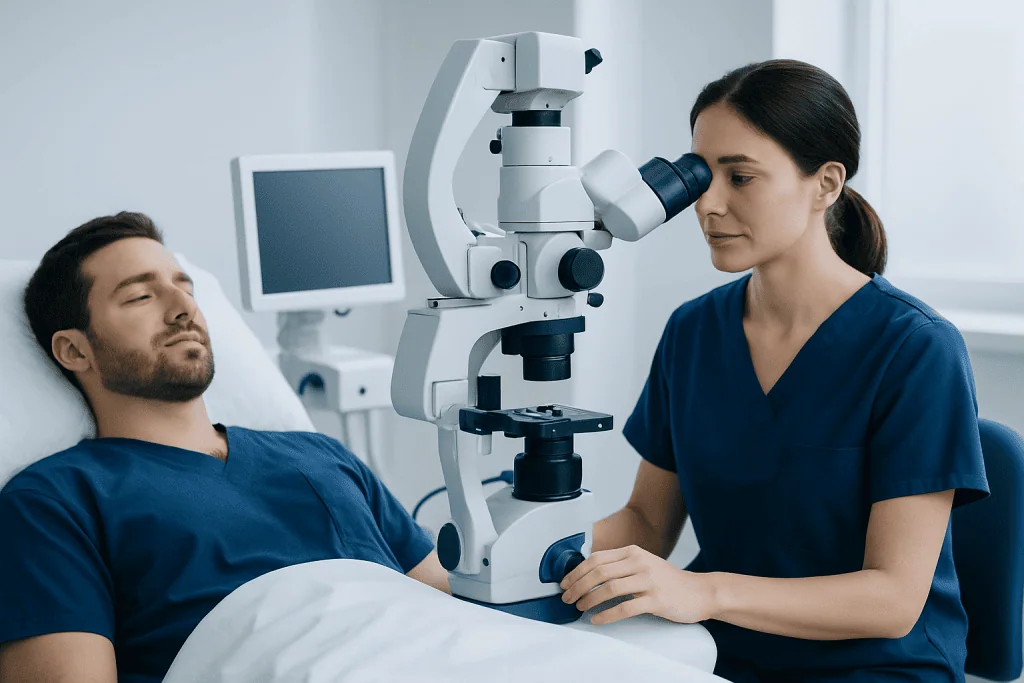
It may also be considered in non-obstructive azoospermia, where sperm production within the testicles is reduced or uneven. In these cases, a specialist may recommend microdissection TESE, often called micro-TESE. This more detailed microsurgical method uses an operating microscope to identify tissue areas more likely to contain sperm while aiming to remove less tissue overall.
Before recommending sperm retrieval, clinicians usually repeat semen testing and review potentially reversible factors, such as certain medications, hormone use, recent fever, or systemic illness. Men using testosterone or anabolic steroids should discuss this with a fertility specialist, because these substances can suppress sperm production and should not be stopped without medical guidance.
- Evaluation may include medical and reproductive history, physical examination, and one or more semen analyses.
- Blood tests may assess reproductive hormones and general health factors.
- Genetic counseling or testing may be recommended in some forms of azoospermia.
- The timing of retrieval may be coordinated with egg collection, or sperm can sometimes be frozen in advance.
TESE Procedure Preparation and Step-by-Step Process

TESE procedure preparation begins with a consultation involving a reproductive urologist and fertility specialists. Patients should disclose all medications, supplements, allergies, bleeding conditions, prior testicular surgery, and any history of anesthesia problems. The care team provides individualized instructions about fasting, medication adjustments, arranging transportation, and whether sperm retrieval will take place on the same day as a partner’s egg retrieval.
The procedure may be performed with local anesthesia and sedation or with general anesthesia, depending on the technique, clinical setting, and patient needs. After the area is cleaned and numbed, the surgeon makes a small incision in the scrotum and testicle. A small amount of tissue is removed and passed to the embryology laboratory, where it is carefully processed to look for sperm.
If sperm are identified, they may be used for IVF treatment with ICSI or cryopreserved if suitable. The surgeon closes the small incision with dissolvable stitches or another appropriate closure method. The procedure length varies, particularly when micro-TESE is needed, but patients commonly return home the same day after recovery from anesthesia.
People may encounter the terms TESE procedure CPT code, TESE procedure code, or TESE procedure CPT when discussing insurance authorization or billing. Coding can differ according to the exact technique, setting, associated laboratory work, and local payer rules. The fertility center and insurer are the best sources for confirming coding and preauthorization requirements before treatment.
Recovery, Benefits, and Possible Risks
Most patients have mild swelling, bruising, tenderness, or a pulling sensation in the scrotal area for several days after TESE. Supportive underwear, rest, cold packs used as directed, and clinician-approved pain relief can improve comfort. The care team will explain when it is safe to shower, return to work, exercise, have sex, or resume other activities; strenuous activity is commonly restricted for a short period.
Recovery timing varies with the extent of surgery and the type of anesthesia. Many people can manage light daily activities within a few days, while soreness and bruising may take one to two weeks to settle. Micro-TESE can involve a somewhat longer recovery than a limited conventional TESE because it is more extensive.
The main benefit is the possibility of obtaining sperm for biological parenthood when none can be collected from semen. However, sperm retrieval is not guaranteed, especially in non-obstructive azoospermia. A fertility specialist can explain whether fresh use or freezing is planned and how the sperm findings may affect the IVF strategy.
Complications are uncommon but can include bleeding, infection, hematoma, ongoing pain, scarring, or temporary effects on testosterone production. The risk of testicular injury may be higher with more extensive tissue removal. Patients should follow postoperative instructions closely and contact their clinical team promptly if concerns arise.
How Painful Is a TESE Procedure?
A TESE procedure is generally not painful during surgery because anesthesia is used. With local anesthesia, patients may notice pressure or movement but should not feel sharp pain. Sedation or general anesthesia may be chosen when a patient is anxious, when a more involved retrieval is planned, or when the clinical team considers it appropriate.
After the procedure, mild to moderate discomfort is common for a few days. Tenderness, swelling, and bruising usually improve with rest, scrotal support, ice as instructed, and recommended pain medication. Pain experiences differ from person to person and may be greater after micro-TESE than after a small conventional tissue extraction.
Severe or worsening pain is not expected and should be assessed. Patients should seek advice from their treating team if they develop increasing swelling, marked redness, fever, drainage from the incision, heavy bleeding, or pain that does not improve with the prescribed recovery plan.
What Is the Success Rate of a TESE Procedure?
The success rate of a TESE procedure can mean different things: finding sperm in testicular tissue, obtaining enough sperm for ICSI, fertilization of eggs, embryo development, pregnancy, or live birth. These outcomes should not be treated as the same measure. The sperm retrieval rate is influenced most strongly by whether azoospermia is obstructive or non-obstructive and by the individual cause of impaired fertility.
In obstructive azoospermia, sperm can often be found because testicular sperm production is usually preserved. In non-obstructive azoospermia, sperm may be present only in small, scattered areas, so retrieval is less predictable. Micro-TESE may improve the chance of locating sperm in appropriately selected patients compared with less targeted sampling, but it does not guarantee retrieval.
Pregnancy outcomes also depend on egg quality, age-related fertility factors, embryo development, laboratory methods, uterine health, and the use of fresh or frozen sperm. A reproductive urologist and IVF team can provide individualized expectations after reviewing the diagnosis, test results, and planned treatment pathway.
Which Is Better, TESE or TESA?
Neither TESE nor TESA is universally better; the appropriate choice depends on why sperm are absent from the semen. TESA, or testicular sperm aspiration, uses a needle to withdraw cells and fluid from the testicle. It is less invasive and may be suitable when sperm production is expected to be normal, particularly in some cases of obstructive azoospermia.
TESE involves making a small incision and removing a tissue sample. It may be preferred when aspiration does not yield sperm, when a larger or more targeted sample is needed, or when non-obstructive azoospermia is suspected. Micro-TESE is a specialized form of TESE used to search for limited sperm production under magnification.
The choice should be made with a reproductive urologist who can balance the likelihood of sperm retrieval, the suspected diagnosis, prior treatment results, the need for IVF timing, and procedure-related risks. Evaluation and treatment of the underlying causes of male infertility are important alongside sperm retrieval planning.
How Much Does a TESE Cost and When to Seek Medical Care
How much a TESE costs varies widely. The total may include the surgeon’s fee, operating facility, anesthesia, laboratory processing, sperm freezing and storage, medications, pre-procedure testing, and IVF or ICSI services. Insurance coverage differs by country, plan, diagnosis, and whether fertility services are considered medically necessary, so patients should request a written, itemized estimate and check authorization requirements directly with their insurer.
Medical review is appropriate when a couple has not conceived after a period of regular unprotected intercourse, when semen analysis shows absent or very low sperm counts, or when there is a history of vasectomy, undescended testes, testicular injury, chemotherapy, pelvic surgery, or reproductive tract infection. A prompt appointment is also sensible for testicular pain, a new lump, swelling, or changes in testicle size, as these symptoms need assessment even when fertility is not the immediate concern.
After TESE, urgent medical advice is needed for fever, worsening redness or swelling, pus-like drainage, heavy bleeding, severe pain, trouble urinating, or symptoms that are not improving as expected. Acibadem International’s multidisciplinary specialists and JCI-accredited hospitals assess male infertility and coordinate surgical sperm retrieval and assisted reproductive care for international patients.
Frequently asked questions
What does TESE stand for?
TESE stands for testicular sperm extraction. It is a procedure in which a small sample of testicular tissue is removed and examined for sperm that may be used in IVF with ICSI.
Can TESE be done after a vasectomy?
Yes. TESE can be an option after vasectomy when sperm are no longer present in the ejaculate because the vas deferens has been interrupted. Depending on individual circumstances, a specialist may also discuss vasectomy reversal or other sperm retrieval approaches.
Is TESE the same as micro-TESE?
No. Conventional TESE removes one or more small tissue samples, while micro-TESE uses an operating microscope to identify tissue areas that may be more likely to contain sperm. Micro-TESE is often considered for selected men with non-obstructive azoospermia.
How long does it take to recover from TESE?
Light activities are often possible within a few days, but bruising and tenderness can last about one to two weeks. Recovery can be longer after more extensive procedures, and the treating team should provide personalized activity guidance.
Can sperm from TESE be frozen?
When suitable sperm are found, they can often be frozen for later use. Whether freezing is possible depends on the number and quality of sperm recovered and on laboratory assessment.
Does TESE affect testosterone?
Most men do not experience a major long-term change in testosterone after a limited procedure, but temporary changes can occur. More extensive surgery and pre-existing testicular dysfunction may increase the risk, so follow-up may include hormone assessment when clinically indicated.
References
- American Society for Reproductive Medicine
- American Urological Association
- European Association of Urology
- National Institute for Health and Care Excellence
- World Health Organization
This article is for general information only and is not a substitute for professional medical advice. Please consult a qualified doctor about your individual situation.
IVF & fertility treatment in Turkey — success rates and costs
JCI-accredited · board-certified surgeons · reply within 24h
Add us as a Preferred Source to see more of our trusted health content across Google Search, AI Overviews and Discover.