Tick Bite Pictures — Explained by Medical Evidence, Not Myths

Many tick bites cause only a small, mild skin reaction that settles on its own. A bull’s-eye rash is one possible sign of Lyme disease, but not every Lyme rash looks like a classic target.
Key Takeaways
- Many tick bites cause only a small, mild skin reaction that settles on its own.
- A bull’s-eye rash is one possible sign of Lyme disease, but not every Lyme rash looks like a classic target.
- Pictures alone cannot confirm the cause of a rash; timing, symptoms, and location of exposure also matter.
- Prompt tick removal reduces the chance of disease transmission.
- Medical care is important if a rash expands, symptoms develop, or the tick was attached for a long time.
Tick bite pictures can be useful for comparison, but they are most helpful when paired with medical facts. A small red spot may be a normal local reaction, while a spreading rash, fever, or flu-like symptoms can suggest an infection that needs medical assessment.
Overview: What tick bite pictures can and cannot show
People often search for tick bite pictures to compare a mark on their skin with examples online. This can be a reasonable first step, because tick bites may look quite different depending on the person, the type of tick, how long it was attached, and whether an infection develops afterward.
Medical evidence shows that many tick bites produce only a small red bump, similar to other insect bites. In some cases, however, the skin changes can suggest a more significant reaction, such as a spreading rash, irritation from retained mouthparts, or an infection carried by the tick.
Pictures are helpful for pattern recognition, but they do not provide a diagnosis on their own. A doctor will also consider where the bite happened, whether the tick was removed completely, how long it may have been attached, and whether symptoms such as fever, headache, fatigue, or joint pain have appeared.
How tick bites usually look at first

In the first hours or days, a simple tick bite often appears as a small red spot or slightly raised bump. It may be mildly itchy, tender, or irritated, but many people notice very little discomfort. Some bites are hard to see, especially if they occur on the scalp, behind the knees, in the groin, or under the arms.
A normal local reaction usually stays small and does not keep expanding. The area may be pink or red, and there can be a tiny central puncture mark where the tick attached. This type of reaction often improves gradually over a few days.
Tick bite pictures online sometimes show dramatic redness, but this can be misleading if the image reflects scratching, a skin allergy, or a separate infection. A larger or worsening reaction does not always mean Lyme disease, yet it should be assessed carefully if it continues to spread or if other symptoms appear.
- Small red bump: often a mild local reaction
- Central puncture point: common after attachment
- Mild itch or tenderness: possible but not specific
- Rapidly enlarging rash: more concerning and worth medical review
What concerning tick bite rashes may look like
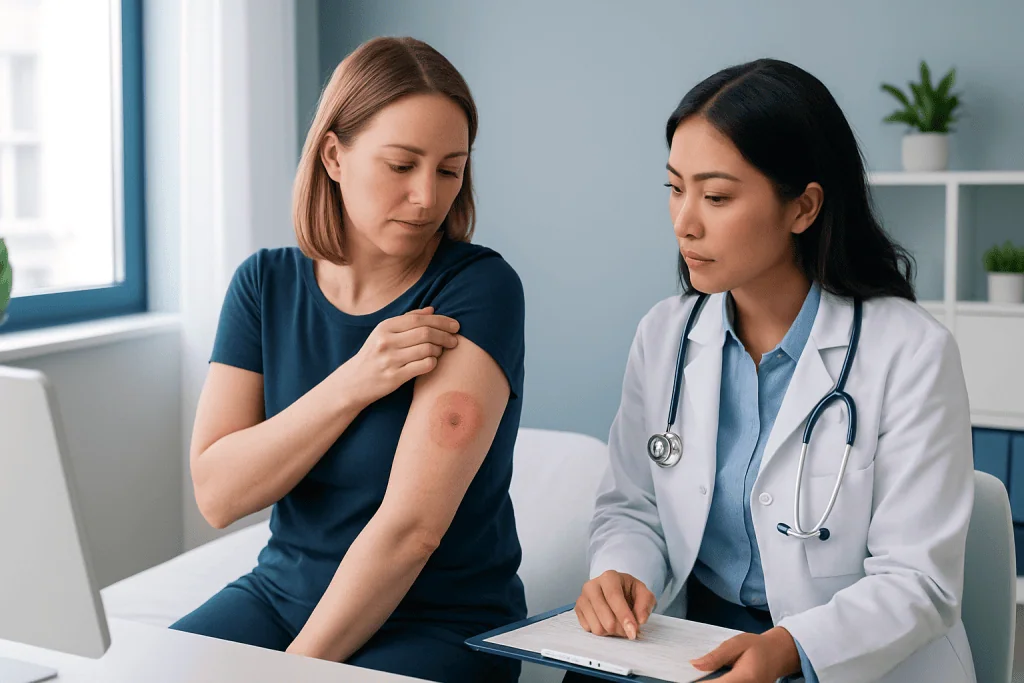
One of the best-known patterns in tick bite pictures is the so-called bull’s-eye rash linked with Lyme disease. This rash, called erythema migrans, may begin as a small red area and slowly expand over days. It can develop central clearing, creating a target-like appearance, but it does not always do so.
Importantly, not every Lyme-related rash looks like a textbook ring. Some are evenly red, oval, bluish-red, or patchy. They are usually larger than a simple bite reaction and tend to expand rather than remain the same size. For readers looking at Lyme disease examples, it helps to remember that timing matters as much as appearance.
Other concerning appearances include widespread hives, increasing warmth and pus that may suggest a skin infection, or dark discoloration and tissue irritation at the bite site. In some regions, ticks may carry infections other than Lyme disease, and these illnesses can cause fever and body symptoms even when the skin findings are limited or absent.
Symptoms that matter more than pictures alone
A photograph captures only one moment, but tick-related illnesses are diagnosed by combining the skin findings with the overall clinical picture. Symptoms that can become important after a tick bite include fever, chills, headache, unusual tiredness, muscle aches, joint pain, swollen lymph nodes, and in some cases a new rash elsewhere on the body.
Some people develop only a mild mark at the bite site and never become ill. Others may not notice a rash at all, especially if the bite was hidden on the scalp or back. For this reason, doctors often advise monitoring for symptoms for several weeks after a known tick exposure.
If neurological symptoms, facial weakness, significant joint swelling, shortness of breath, or palpitations develop, medical review is especially important. These symptoms have many possible causes, but they should not be ignored after a recent tick bite or outdoor exposure.
Why tick bites happen and who is at higher risk
Ticks are most often encountered in grassy, wooded, or brushy areas, although they can also be found in gardens, parks, and on pets that spend time outdoors. Bites are more likely during warmer months in many regions, but local climate affects tick activity.
Risk tends to be higher for hikers, campers, gardeners, hunters, field workers, and children playing outdoors. Clothing that leaves skin exposed, walking through tall vegetation, and not checking the skin after outdoor activities can increase the chance of a bite going unnoticed.
Ticks attach by gripping the skin and feeding slowly. In general, the longer a tick remains attached, the greater the chance of transmitting certain infections. That is why early removal is important, even when the bite site looks minor in pictures or causes no symptoms at first.
Diagnosis and what a doctor may assess
Doctors diagnose tick-related problems by examining the skin and asking about timing, travel, outdoor exposure, symptoms, and the appearance of the tick if it was seen. If possible, it can be useful to note when the tick was found, whether it seemed engorged, and how it was removed. A clear photo of the rash over time may also help, although it does not replace an examination.
Testing is not always needed right away. Early Lyme disease, for example, may sometimes be diagnosed clinically when a typical expanding rash is present, because blood tests can be less reliable in the very early stage. In other situations, blood tests or further evaluation may be considered if symptoms suggest a tick-borne infection.
If the mark is unusual, painful, or difficult to interpret, a clinician may also consider other skin conditions or bites that can resemble tick reactions. Depending on the findings, a patient may be referred for dermatology evaluation or infectious diseases care when a more detailed assessment is needed.
Treatment, safe tick removal, and self-care
The first step is proper tick removal. Fine-tipped tweezers are generally used to grasp the tick as close to the skin as possible, pulling upward steadily without twisting. After removal, the area should be cleaned with soap and water. Folk remedies such as burning the tick or covering it with petroleum jelly are not recommended.
For a simple local reaction, self-care may include gentle cleansing, avoiding scratching, and watching for changes over the next several days. A small red bump often settles without specific treatment. If part of the tick remains in the skin, a doctor may advise whether removal is necessary, particularly if there is growing inflammation.
When an infection is suspected, treatment depends on the illness and the stage at which it is identified. Some patients may need antibiotics after clinical assessment. If symptoms are persistent, complex, or involve other organs, doctors may also coordinate internal medicine input to evaluate the broader health picture.
Near the end of the care pathway, some international patients seek assessment at centers with coordinated expertise. Acibadem International’s multidisciplinary specialists and JCI-accredited hospitals diagnose and treat tick-related conditions, including evaluation of rashes and suspected vector-borne infections.
Prevention and when to seek medical care
Prevention starts before outdoor activity. Wearing long sleeves and long trousers, staying on clear paths, using appropriate insect repellent, and checking the body carefully afterward can lower the chance of a bite. Ticks often hide in warm skin folds, along the waistband, behind the knees, in the scalp, and around the ears.
After time outdoors, showering and examining the skin can help spot ticks before they stay attached for long. Clothing should be washed or dried on suitable heat settings according to garment instructions. Pets should also be checked, as they can carry ticks indoors.
Medical care should be sought if a rash expands over days, especially if it becomes larger than a small local bite reaction, or if fever, fatigue, headache, body aches, or joint symptoms develop. Care is also important if the tick may have been attached for a prolonged period, the bite becomes increasingly painful or drains pus, or there are signs of an allergic reaction such as widespread hives, facial swelling, or breathing difficulty. In some cases, clinicians may also evaluate for related conditions such as tick-borne diseases.
Frequently asked questions
Do tick bite pictures help diagnose Lyme disease?
They can help people recognize patterns, but they cannot confirm Lyme disease by themselves. A doctor also considers the timing, whether the rash is expanding, exposure history, and any symptoms such as fever, headache, or fatigue.
Does every Lyme disease rash look like a bull’s-eye?
No. Some Lyme rashes have a target-like pattern, but others are evenly red or oval and still expand over time. That is why a spreading rash after a tick bite should be checked even if it does not match classic online images.
How long after a tick bite can symptoms appear?
A mild local skin reaction may appear quickly, often within hours to a day. Symptoms of tick-borne illness or a more characteristic rash may develop days to weeks later, depending on the infection.
Should a small red bump after a tick bite be a concern?
A small, stable red bump is often a normal local reaction and may improve on its own. It becomes more concerning if it keeps getting larger, becomes very painful, drains pus, or is followed by fever or flu-like symptoms.
What is the safest way to remove a tick?
A tick is usually removed with fine-tipped tweezers by grasping it close to the skin and pulling upward steadily. Afterward, the skin should be cleaned and monitored for changes. If removal is difficult or the mouthparts remain, medical advice is reasonable.
When should someone see a doctor after a tick bite?
Medical review is sensible if there is an expanding rash, fever, headache, fatigue, muscle aches, joint pain, or signs of skin infection. Immediate care is needed for severe allergic symptoms such as trouble breathing or facial swelling.
This article is for general information only and is not a substitute for professional medical advice. Please consult a qualified doctor about your individual situation.
Explore treatments in Turkey — costs, top hospitals & a free quote
JCI-accredited · board-certified surgeons · reply within 24h
Add us as a Preferred Source to see more of our trusted health content across Google Search, AI Overviews and Discover.

More from the Health Library

Aphasia: An Evidence-Based Guide for Patients

Head Cold: What Patients Need to Know

Agua De Jamaica: What Patients Need to Know

Blood clot in hand: Symptoms, Causes, and Treatment — Complete Patient Guide

Papaya Seeds: A Complete Medical Overview