Unruptured Brain Aneurysm: Coiling vs Clipping vs Monitoring

Many unruptured brain aneurysms can be monitored safely with regular imaging and risk-factor control. Coiling is a minimally invasive endovascular treatment performed through blood vessels rather than open brain surgery.
Key Takeaways
- Many unruptured brain aneurysms can be monitored safely with regular imaging and risk-factor control.
- Coiling is a minimally invasive endovascular treatment performed through blood vessels rather than open brain surgery.
- Clipping is a surgical procedure that closes the aneurysm from the outside and may be preferred for some aneurysm shapes or locations.
- Treatment decisions are individualized and balance rupture risk against the risks of intervention.
- Blood pressure control, not smoking, and regular follow-up are important parts of care.
An unruptured brain aneurysm does not always need immediate treatment. The best approach—monitoring, endovascular coiling, or surgical clipping—depends on the aneurysm’s features and the person’s overall health and risk of rupture.
Overview: what an unruptured brain aneurysm means
An unruptured brain aneurysm is a weak, bulging area in the wall of a brain artery that has not bled. Many are found unexpectedly during imaging done for headaches, dizziness, or other unrelated reasons. Hearing that an aneurysm is present can be frightening, but an unruptured aneurysm is not the same as a rupture, and many people live safely with one for years under medical supervision.
The main question after diagnosis is whether the aneurysm is more safely watched or treated. In general, doctors consider three pathways: careful monitoring with repeat scans, endovascular coiling performed from inside the blood vessel, or surgical clipping performed through an operation on the skull. The choice depends on how likely the aneurysm is to rupture over time and how risky treatment would be for that specific person.
The goal of care is to reduce the chance of future bleeding while avoiding unnecessary risk. This decision is usually made by a multidisciplinary team that may include a neurologist, neurosurgeon, and interventional neuroradiology or neurointerventional specialist. A patient-centered discussion is essential, because the right plan is not identical for everyone.
Symptoms and how unruptured aneurysms are discovered
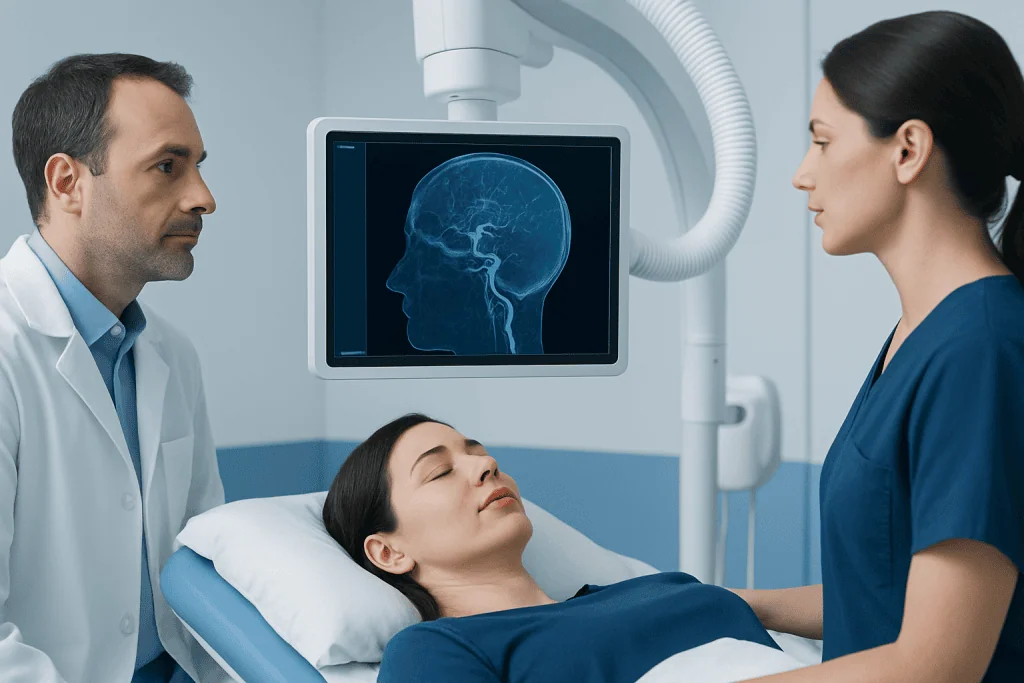
Most unruptured brain aneurysms cause no symptoms at all. They are often discovered incidentally on MRI, CT, or vascular imaging such as CTA or MRA. In these cases, the aneurysm may never have caused a problem, and the next step is understanding its size, shape, and location before deciding what to do.
Some unruptured aneurysms can cause symptoms if they press on nearby nerves or brain structures. Depending on where the aneurysm is, symptoms may include headache, pain around or behind an eye, double vision, drooping eyelid, changes in vision, facial numbness, or less commonly trouble with balance or concentration. These symptoms do not always mean the aneurysm is about to rupture, but they do require specialist evaluation.
Patients should also know the warning signs of a possible rupture. A sudden, extremely severe headache, loss of consciousness, vomiting, neck stiffness, seizures, or sudden neurological symptoms require emergency care immediately. A ruptured aneurysm is a medical emergency and is different from the planned evaluation of an unruptured aneurysm.
Causes and risk factors that affect rupture risk

Brain aneurysms can develop when a section of an artery wall becomes weakened. The exact reason is not always clear, but both inherited and acquired factors may contribute. Some people have a family history of aneurysms, and certain connective tissue or vascular conditions can increase risk. Age, long-term high blood pressure, and smoking are among the most important modifiable factors.
Doctors estimate rupture risk by looking at several features together rather than relying on one factor alone. Important details include aneurysm size, shape, growth over time, and location in the brain circulation. Irregular or lobulated aneurysms, larger aneurysms, and aneurysms in certain higher-risk locations may be more likely to bleed than small, stable aneurysms in lower-risk locations.
Personal medical history also matters. A previous aneurysm rupture, multiple aneurysms, uncontrolled hypertension, smoking, and some family patterns may shift the balance toward treatment rather than observation. At the same time, age, other medical conditions, and a person’s ability to tolerate anesthesia or surgery influence whether intervention is the safer path.
- Risk factors that may increase aneurysm formation or rupture include smoking, high blood pressure, family history, and some inherited disorders.
- Higher-risk aneurysm features may include larger size, growth on follow-up imaging, irregular shape, and certain arterial locations.
- Lower-risk aneurysms are often small, stable, and found in patients without major additional risk factors.
How doctors decide between monitoring, coiling, and clipping
Choosing treatment for an unruptured brain aneurysm is a balance of risks and benefits. If the aneurysm appears low risk and the treatment risk is relatively higher, doctors may recommend monitoring. If the risk of future rupture is meaningful and treatment can be performed with acceptable safety, coiling or clipping may be advised.
Monitoring usually means regular imaging studies, such as MRA, CTA, or occasionally catheter angiography, to watch for growth or change in shape. The schedule depends on the aneurysm and the treating team’s judgment. Monitoring also includes active management of blood pressure, stopping smoking, and reducing cardiovascular risk factors.
Coiling and clipping aim to exclude the aneurysm from circulation so blood no longer puts pressure on the weak area. Coiling is performed from inside the vessel using catheters, while clipping is a neurosurgical operation that places a small clip across the aneurysm neck. Some aneurysms are clearly better suited to one approach, while others may be candidates for either option after discussion by specialists experienced in interventional neuroradiology and neurosurgery.
Modern decision-making often relies on detailed vascular imaging and team review. In selected cases, doctors may also discuss related endovascular options such as stent-assisted techniques or aneurysm embolization strategies if anatomy makes standard coiling more complex. The exact recommendation should be individualized rather than based on a single rule.
Coiling: how it works, benefits, and limits
Endovascular coiling is a minimally invasive treatment used to fill the aneurysm from the inside. A specialist inserts a thin catheter, usually through an artery in the wrist or groin, and guides it to the brain under imaging guidance. Tiny soft coils are then placed into the aneurysm sac so blood flow into it is reduced, promoting clotting within the aneurysm and lowering the risk of rupture.
One advantage of coiling is that it does not require open brain surgery. For many patients, this can mean a shorter hospital stay and a faster early recovery compared with clipping. Coiling may be especially attractive for aneurysms that are difficult to reach surgically or for patients in whom a less invasive approach is preferable.
However, coiling is not ideal for every aneurysm. Wide-necked aneurysms, certain branch patterns, or specific shapes may be technically more difficult and may require additional devices. In some cases, a treated aneurysm can reopen or compact over time, which is why follow-up imaging remains important even after successful treatment.
Possible risks include stroke, blood vessel injury, bleeding, or complications related to contrast dye, anesthesia, or added devices such as stents. These risks vary with the aneurysm’s anatomy and the patient’s health. A doctor can explain whether the expected benefit of coiling outweighs these risks in an individual case.
Clipping: how it works, benefits, and limits
Surgical clipping is a well-established procedure performed by a neurosurgeon. During the operation, the surgeon reaches the aneurysm through an opening in the skull and places a small metal clip across the aneurysm neck. This stops blood from entering the aneurysm while preserving normal flow through the parent artery.
Clipping can offer a durable, long-term solution and may be preferred for aneurysms with anatomy that is less suitable for coiling. In some locations or shapes, clipping gives the surgeon direct visibility and control, which can be an advantage. For younger patients with a long life expectancy, durability may be an important part of the discussion.
The main limitation is that clipping is open surgery, so recovery is usually longer than with endovascular treatment. Hospital stay, postoperative discomfort, and the time needed to return to usual activities may be greater. As with any brain operation, there are risks such as stroke, infection, seizures, bleeding, or neurological deficits, although the individual risk depends heavily on aneurysm location and surgical complexity.
For some patients, clipping remains the best option despite being more invasive. The decision is not about which procedure is universally superior, but which one is safer and more effective for that aneurysm. Patients may benefit from a second opinion if both clipping and coiling appear reasonable.
Diagnosis, follow-up, and prevention through self-care
After an aneurysm is found, doctors use imaging to define its anatomy in detail. MRI and MRA can show the aneurysm without radiation, while CT and CTA are often widely available and very informative. In some situations, catheter angiography provides the most precise detail and helps plan treatment. Imaging results are interpreted alongside age, symptoms, family history, and other health conditions.
If monitoring is chosen, follow-up imaging is essential. The aim is to detect growth, shape changes, or other features that could alter the risk-benefit balance. Patients should ask how often scans are needed, what symptoms to watch for, and what blood pressure goals or lifestyle changes are recommended.
Self-care focuses on lowering overall vascular risk. Stopping smoking is one of the most important steps. Good blood pressure control, regular medical follow-up, healthy eating, physical activity within a doctor’s advice, and treatment of conditions such as high cholesterol are also helpful. Patients should discuss alcohol use and any stimulant or recreational drug use honestly with their doctor, since these can affect vascular health.
Because anxiety is common after diagnosis, emotional support also matters. Reliable information and clear communication with the care team can make decisions feel less overwhelming. Near the end of the care pathway, some international patients seek evaluation at centers such as Acibadem International, where multidisciplinary specialists in JCI-accredited hospitals assess and treat complex cerebrovascular conditions including brain aneurysm.
When to see a doctor and questions to ask
Anyone told they have an unruptured brain aneurysm should see a qualified specialist for a personalized review, even if no treatment is planned right away. Follow-up should not be skipped, because aneurysm behavior can change over time. Patients should also seek prompt reassessment if new neurological symptoms develop, such as changes in vision, facial weakness, severe new headaches, or unexplained eye pain.
Emergency care is needed for symptoms that could suggest rupture, especially a sudden, severe headache unlike usual headaches, fainting, seizure, vomiting, or sudden weakness or confusion. It is better to act quickly and be evaluated than to wait at home with worrying symptoms.
Helpful questions for the appointment include:
- How large is the aneurysm, and where is it located?
- Does its shape or location increase rupture risk?
- Is monitoring appropriate, and how often will imaging be needed?
- If treatment is recommended, why is coiling or clipping the better option in this case?
- What are the short-term and long-term risks of each option for this patient?
These conversations help patients make informed choices that fit their medical needs and personal preferences. Shared decision-making is especially important because there is no one-size-fits-all answer for every unruptured aneurysm.
Frequently asked questions
Does every unruptured brain aneurysm need treatment?
No. Many unruptured aneurysms are small, stable, and found in people whose treatment risk may be higher than the risk of rupture. In these cases, careful monitoring and control of risk factors may be the safest approach.
Is coiling safer than clipping?
Not always. Coiling is less invasive and may allow faster early recovery, but clipping may be more durable or better suited to some aneurysm shapes and locations. The safer option depends on the aneurysm anatomy, the patient’s health, and the experience of the treating team.
Can a monitored aneurysm become dangerous later?
Yes, that is why follow-up imaging is important. If an aneurysm grows, changes shape, or symptoms develop, the treatment plan may need to be reconsidered. Regular review helps doctors respond to these changes early.
How long is recovery after coiling or clipping?
Recovery after coiling is often shorter because it is done through the blood vessels rather than open surgery. Clipping usually involves a longer hospital stay and a slower return to normal activities. Recovery time varies from person to person and depends on the procedure and overall health.
What lifestyle changes help reduce risk?
Stopping smoking and keeping blood pressure well controlled are two of the most important steps. Following medical advice for cholesterol, exercise, and general cardiovascular health can also help. These measures do not remove an aneurysm, but they may lower overall vascular risk.
Can an unruptured aneurysm cause headaches?
It can, but most unruptured aneurysms do not cause symptoms. When symptoms do occur, they are often related to pressure on nearby nerves or structures rather than bleeding. Because headaches are common and have many causes, a doctor must assess whether the aneurysm is actually responsible.
References
- American Heart Association
- National Institute of Neurological Disorders and Stroke
- National Health Service
- European Stroke Organisation
This article is for general information only and is not a substitute for professional medical advice. Please consult a qualified doctor about your individual situation.
Explore treatments in Turkey — costs, top hospitals & a free quote
JCI-accredited · board-certified surgeons · reply within 24h
Add us as a Preferred Source to see more of our trusted health content across Google Search, AI Overviews and Discover.
Check your numbers in seconds
BMI, calories, due date, blood pressure and 30+ more clinical calculators — free, instant, doctor-reviewed ranges.

More from the Health Library



Related Specialists

Dr. Mustafa Engin Çakmakçı
Otorhinolaryngology
Dt. Gülçin Doğusal İşgüder
Dentistry
Dr. Özgür Kabagöz
Emergency Service
Assoc. Prof. Dr. Sevgi Topal
Pediatric Intensive Care Unit