Warts Medicine Over the Counter: An Evidence-Based Guide for Patients

Most over-the-counter wart treatments use salicylic acid or a freezing method. Salicylic acid often works best when used consistently for several weeks.
Key Takeaways
- Most over-the-counter wart treatments use salicylic acid or a freezing method.
- Salicylic acid often works best when used consistently for several weeks.
- Not every skin bump is a wart, so correct diagnosis is important before self-treatment.
- Warts on the face, genitals, or irritated skin should not usually be treated with standard OTC products.
- People with diabetes, poor circulation, or weakened immunity should ask a doctor before treating warts at home.
- Medical care is recommended if the wart is painful, bleeding, spreading, or not improving.
Warts medicine over the counter can be effective for many common and plantar warts, especially products with salicylic acid or home freezing agents. The best choice depends on the wart’s location, the person’s age and skin sensitivity, and whether the diagnosis is certain.
Overview: Do over-the-counter wart medicines work?
Warts medicine over the counter can work well for many people, particularly for common warts on the hands and plantar warts on the feet. The two main evidence-based options are salicylic acid products, which gradually peel away infected skin, and home freezing kits, which aim to destroy wart tissue with intense cold. Neither option works instantly, and both require patience and careful use.
Warts are caused by certain types of human papillomavirus, or HPV, which enters the top layer of skin through tiny breaks. Because warts are viral and grow within the skin, treatment usually needs time. Even when a product is effective, the wart may not disappear for weeks, and some warts can return.
For many patients, the most useful question is not simply whether a product is sold without a prescription, but whether it is appropriate for the wart’s type and location. A rough, well-defined wart on a finger may respond differently than a thick plantar wart on the sole of the foot. A skin lesion on the face, near a nail, or in the genital area needs a different approach and should be medically assessed rather than treated routinely at home.
Which over-the-counter options are available?

The most common over-the-counter wart medicines contain salicylic acid. These products come as liquids, gels, pads, patches, and medicated plasters in different strengths. Salicylic acid softens and removes layers of thickened skin over time, allowing the wart to shrink gradually. It has the best overall evidence base among home treatments for common warts.
Home freezing kits are another option. These are not identical to the liquid nitrogen used in a clinic, but they can still be helpful for some people. They usually contain a propellant that cools an applicator enough to freeze superficial wart tissue. Results vary, and some thicker or deeper warts may not respond fully.
Other products may include combinations of acids, occlusive patches, or formulas marketed as “natural” remedies. These products are not equally supported by medical evidence. In general, a patient-friendly rule is to look first for a clearly labeled salicylic acid product or a reputable freezing kit and to follow the instructions exactly.
- Best-supported OTC ingredient: salicylic acid
- Useful in some cases: home freezing kits
- Use caution with: unproven herbal or caustic products that may irritate healthy skin
- Not for routine self-treatment: warts on the face, genitals, or broken skin
How to choose the right treatment for the wart type
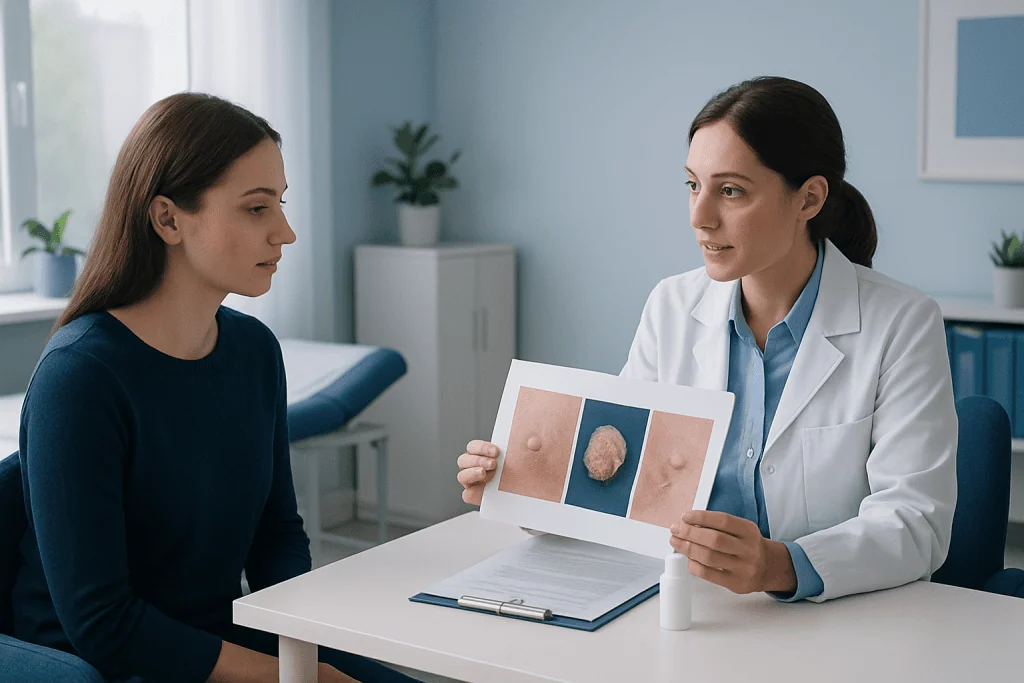
Common warts usually appear on the fingers, hands, knees, or around areas that experience friction. They often have a rough surface and may show tiny black dots, which are small clotted blood vessels. These warts often respond well to salicylic acid, especially if the thick outer layer is gently reduced before each treatment.
Plantar warts grow on the soles of the feet and are often pressed inward by body weight, which can make them painful and harder to treat. They are sometimes mistaken for calluses or corns. A salicylic acid treatment may still help, but treatment often takes longer because the skin on the soles is thicker. Some people also try a freezing kit, though results may be less predictable for deep plantar warts. Patients wanting broader information on foot lesions may find it helpful to read about plantar warts.
Flat warts, filiform warts, and lesions around the nails can be more difficult to manage safely at home. In children, warts may clear on their own over time, but treatment may still be considered if they are bothersome or spreading. If there is any doubt about the diagnosis, a clinician should examine the lesion before home treatment begins.
How to use OTC wart medicine safely and effectively
Correct technique often matters as much as the product itself. For salicylic acid, many clinicians advise soaking the wart in warm water for a few minutes first, then gently filing or rubbing away loose dead skin with an emery board or pumice stone reserved only for that wart. The medicine is then applied carefully to the wart, avoiding surrounding healthy skin. This process is usually repeated regularly for several weeks.
With home freezing kits, the main goal is to treat the wart without injuring nearby skin. The product should be applied only for the time stated in the instructions. Applying longer or more often than directed does not necessarily improve outcomes and may cause blistering, pain, or skin damage. It is also important not to freeze the same area repeatedly without waiting the recommended interval.
General hygiene can help reduce spread. Warts should not be picked or shaved, and tools used on the wart should not be shared. People should wash hands after touching the area, keep plantar warts covered in communal changing spaces, and avoid sharing towels or footwear. If a lesion becomes very painful, inflamed, or starts to bleed significantly, treatment should stop until a doctor reviews it.
- Use the product only on skin areas listed in the instructions.
- Protect surrounding skin if the label recommends it.
- Be consistent; improvement often takes weeks rather than days.
- Do not use multiple aggressive treatments at the same time unless advised by a clinician.
What to expect: timelines, limitations, and common mistakes
Many patients stop treatment too soon. One of the most frequent reasons OTC wart medicine seems to fail is that it is used irregularly or for only a short period. Salicylic acid usually requires steady application over weeks, and sometimes longer for plantar warts. Improvement may begin with thinning, whitening, or peeling of the wart before it fully disappears.
Another limitation is diagnosis. Corns, calluses, skin tags, molluscum contagiosum, and some skin cancers can be mistaken for warts. A painful thick spot on the foot, for example, may be a callus rather than a wart. Self-treatment is less likely to succeed if the lesion is not actually a wart. General information on viral skin lesions may also be relevant in some cases, including human papillomavirus.
People may also use products on areas where they are not intended, such as the face, neck, underarms, or genital region. This can lead to burns, discoloration, or scarring. If a wart is large, clustered, very thick, or located around the nails, medical treatment may be more suitable from the start.
When over-the-counter treatment is not enough
Medical treatment may be needed when home therapy does not work, when the wart is painful, or when the location makes self-treatment risky. A doctor may confirm the diagnosis by examining the skin and, if needed, trimming the surface or using dermoscopy. Once the diagnosis is clear, treatment can be tailored to the wart type and the person’s overall health.
Common in-clinic options include stronger freezing treatment, professional application of peeling or blistering agents, minor procedures, or other dermatologic therapies. Depending on the lesion and body area, some patients may be candidates for cryotherapy or other physician-directed approaches such as dermatology treatment. For lesions that are difficult to classify, a specialist may advise further skin evaluation.
If a wart has an unusual appearance, changes rapidly, or repeatedly returns after treatment, a doctor may consider other diagnoses. Toward the end of the care pathway, some international patients choose centers where dermatology and other specialties work together. Acibadem International’s multidisciplinary specialists and JCI-accredited hospitals diagnose and treat skin conditions for international patients when further assessment or treatment is needed.
When to seek medical care
A person should seek medical care if the lesion is on the face, lips, eyelids, genitals, or inside the mouth or nose. Medical review is also important if the wart is painful, bleeding, infected-looking, rapidly spreading, or interfering with walking or hand use. These situations deserve a more precise diagnosis and a treatment plan that protects healthy skin.
Before using OTC wart medicine, patients with diabetes, nerve damage, poor circulation, or a weakened immune system should ask a healthcare professional for guidance. Home acid or freezing products may injure skin that heals slowly or has reduced sensation. Children may also need supervision or medical advice depending on the wart’s location and the product used.
A doctor should also be consulted if there is no improvement after a reasonable treatment period, if the wart keeps coming back, or if the diagnosis is uncertain. In some cases, referral for dermatology evaluation is the safest next step, especially when lesions are atypical or treatments have failed.
Frequently asked questions
What is the best warts medicine over the counter?
For many common and plantar warts, salicylic acid is the best-supported over-the-counter option. Home freezing kits can also help some people, but they may be less effective for thick or deep warts and need careful use.
How long does over-the-counter wart treatment take to work?
Most OTC wart treatments do not work immediately. Salicylic acid often needs regular use for several weeks, and plantar warts may take longer because the skin on the soles is thicker.
Can a wart go away without treatment?
Yes, some warts go away on their own as the immune system gradually clears the virus. However, this can take months or longer, and treatment may still be chosen if the wart is painful, spreading, or bothersome.
Is it safe to use OTC wart remover on the face or genitals?
Standard over-the-counter wart removers are generally not recommended for the face, genital area, or other sensitive skin. These locations need medical assessment because the lesion may not be a typical wart and the skin can be easily damaged.
Why is my wart not responding to home treatment?
Common reasons include inconsistent use, stopping treatment too early, or treating a skin lesion that is not actually a wart. Thick plantar warts, lesions around the nails, and some long-standing warts may also need professional treatment.
Can children use over-the-counter wart medicine?
Some OTC products may be used in children, but age, skin sensitivity, and the wart’s location matter. A parent or caregiver should read the product instructions carefully and ask a doctor if the child is very young, the wart is painful, or the diagnosis is uncertain.
References
- American Academy of Dermatology
- Centers for Disease Control and Prevention
- National Health Service
- Mayo Clinic
- Merck Manual
This article is for general information only and is not a substitute for professional medical advice. Please consult a qualified doctor about your individual situation.
Explore treatments in Turkey — costs, top hospitals & a free quote
JCI-accredited · board-certified surgeons · reply within 24h
Add us as a Preferred Source to see more of our trusted health content across Google Search, AI Overviews and Discover.