When a Sudden Black Spot on Skin Needs Assessment
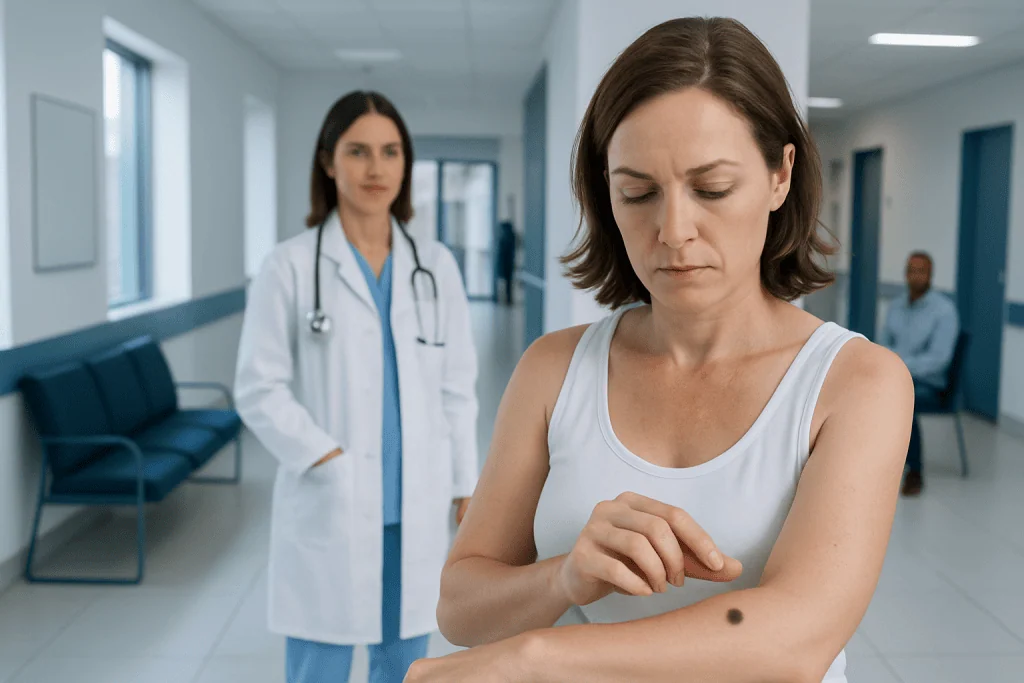
A dark skin spot may result from minor injury, trapped blood, a mole, inflammation, medication effects, or a pigmented skin growth. A spot that appears suddenly may have been present but unnoticed; its changes over time are often more informative than its color alone.
Key Takeaways
- A dark skin spot may result from minor injury, trapped blood, a mole, inflammation, medication effects, or a pigmented skin growth.
- A spot that appears suddenly may have been present but unnoticed; its changes over time are often more informative than its color alone.
- The ABCDE features—Asymmetry, Border irregularity, Color variation, Diameter, and Evolution—can help identify lesions that need medical review.
- Do not cut, scrape, burn, or use strong acids on an unexplained dark spot.
- Urgent assessment is appropriate for a rapidly changing, bleeding, ulcerated, painful, or very dark new lesion, especially in people with a personal or family history of skin cancer.
A sudden black spot on skin can have several explanations, from a minor bruise or blood blister to a new or changing pigmented lesion. Most spots are not dangerous, but a lesion that is new, changing, irregular, painful, bleeding, or unexplained should be checked by a qualified clinician.
What Can a Sudden Black Spot on Skin Mean?
A sudden black spot on skin can be caused by something harmless, such as a small bruise, a blood blister, or a pre-existing mole that has only recently been noticed. However, a new dark lesion can occasionally signal a condition that needs medical assessment, including melanoma and other forms of skin cancer. It is not possible to diagnose a spot reliably by color alone or from a photograph.
The most useful clues are where the spot is located, whether there was recent rubbing or injury, how quickly it appeared, and whether it is changing. A spot that stays stable after an obvious injury is different from one that enlarges, develops uneven colors, becomes raised, crusts, itches persistently, or bleeds without being scratched.
People with darker skin tones can also develop concerning pigmented lesions. In particular, a changing dark mark on the palms, soles, under or around a nail, or on mucosal surfaces should not be ignored. A clinician can examine the lesion closely and decide whether monitoring, dermoscopy, or a biopsy is needed.
Common Non-Cancerous Causes of Dark Spots
Minor trauma is a frequent explanation. A bruise forms when blood collects beneath the skin after an impact, pressure, or unnoticed injury. Small blood blisters may develop after friction from footwear, sports, manual work, or pinching. These marks often feel tender at first and gradually fade or change from dark purple or black to lighter colors over days to weeks.
Another possibility is post-inflammatory hyperpigmentation. After acne, an insect bite, eczema, a rash, or a healed cut, the skin can produce extra pigment and leave a brown, gray, or nearly black mark. These marks are usually flat and may fade slowly, particularly after sun exposure is reduced.
Benign pigmented growths are also common. These include ordinary moles, seborrheic keratoses, and lentigines. Seborrheic keratoses can look tan, brown, or black and often have a waxy or “stuck-on” surface. Although many are harmless, a newly noticed or changing lesion should still be examined rather than assumed to be benign.
Some medicines and medical conditions can contribute to skin discoloration. For example, medications that affect blood clotting can make bruising easier, while some drugs can cause pigmentation changes. A clinician can review medical history, medicines, and the appearance of the spot to identify likely causes safely.
Features That Deserve Closer Attention

A dark spot should be assessed when it is new and continues to change, particularly if there is no clear explanation such as an injury. Melanoma is a type of skin cancer that can appear as a new dark mark or develop within an existing mole. It may be brown or black, but it can also contain shades of tan, pink, red, blue, gray, or white.
The ABCDE guide can support, but not replace, medical assessment. A stands for asymmetry, meaning one half does not match the other. B is for an uneven or poorly defined border. C refers to more than one color or uneven color distribution. D means diameter, especially a lesion larger than about 6 millimeters, although melanomas can be smaller. E stands for evolution: any change in size, shape, color, surface, or symptoms.
- A spot that is noticeably different from a person’s other moles, sometimes called the “ugly duckling” sign
- Bleeding, oozing, crusting, ulceration, or failure to heal
- Persistent itch, pain, tenderness, or a burning sensation
- Rapid growth, increasing elevation, or new color variation
- A dark streak under a nail that widens, becomes irregular, or spreads onto nearby skin
Not every concerning-looking spot is cancer, and not every melanoma follows every ABCDE feature. This is why assessment by a dermatologist or another qualified clinician is important when there is doubt. Related concerns may be evaluated through specialist care for melanoma.
How Clinicians Assess a New Dark Skin Lesion
Assessment starts with a history and skin examination. The clinician may ask when the spot was first noticed, whether it has changed, whether it was injured, and whether there is a history of blistering sunburns, tanning bed use, immune suppression, or skin cancer in the person or their family. They may examine the entire skin surface because people can have lesions in areas they do not routinely see.
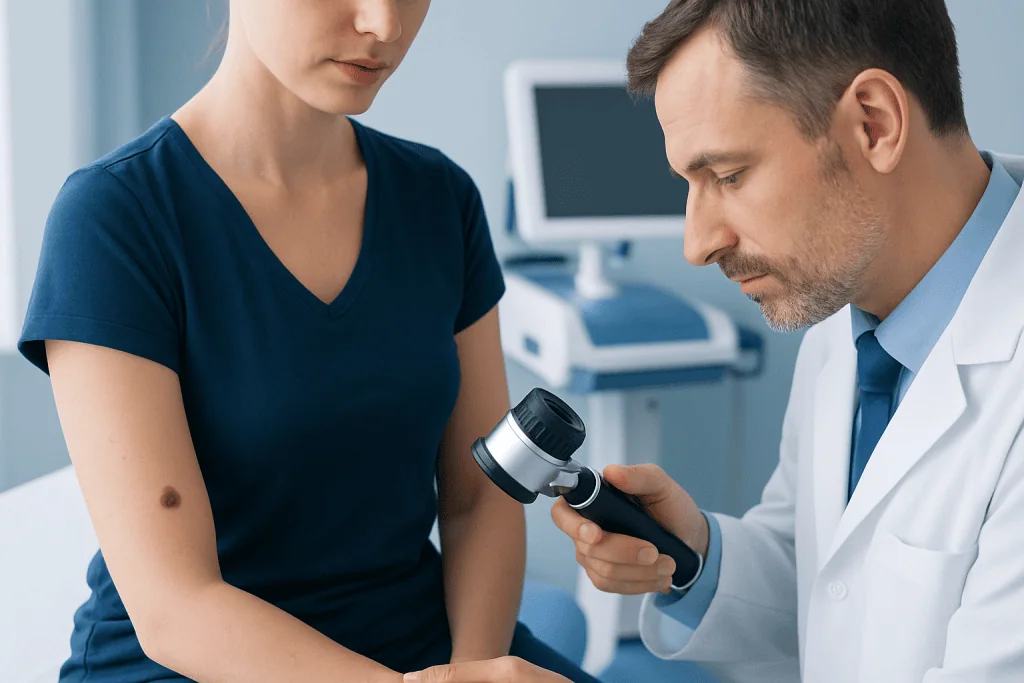
A handheld device called a dermatoscope may be used to view pigment patterns and structures beneath the skin surface. Dermoscopy is painless and can help distinguish many benign lesions from lesions that need further evaluation. It does not involve radiation or breaking the skin.
If the lesion is suspicious or the diagnosis remains uncertain, the clinician may recommend a skin biopsy. This involves removing all or part of the lesion under local anesthetic so that a pathologist can examine it under a microscope. A biopsy is the definitive way to diagnose melanoma and many other skin conditions.
For a lesion that appears low risk, the clinician may recommend clinical monitoring with measurements or standardized photographs. Monitoring should follow the clinician’s advice; it should not delay a biopsy when a lesion has concerning features.
What to Do While Waiting for an Assessment
It is reasonable to take a clear, well-lit photograph of the spot with the date recorded, ideally including a ruler or other size reference. This can help a clinician understand whether meaningful change has occurred. Avoid repeatedly touching, picking, squeezing, or scratching the area, as irritation can cause bleeding and make assessment more difficult.
Do not try to remove an unexplained black spot at home with acids, freezing products, herbal remedies, or cutting tools. These approaches can cause infection or scarring and may destroy tissue that would otherwise be needed for accurate diagnosis. Cosmetic treatment should only be considered after a clinician has identified the lesion.
Protect the skin from ultraviolet radiation. This includes seeking shade when practical, wearing protective clothing and a broad-brimmed hat, and using broad-spectrum sunscreen on exposed skin. Sunscreen is useful for reducing sun damage, but it does not replace regular skin checks or medical review of a changing lesion.
If a mark is clearly consistent with a recent bruise or blood blister, it may be observed while it heals. If it does not improve in the expected period, occurs repeatedly without an apparent cause, or appears alongside unusual bleeding or frequent bruising, medical advice is appropriate.
When to Seek Medical Care
Arrange a prompt appointment with a doctor or dermatologist for a new black or dark spot that has no clear cause, looks different from other moles, or is changing. Assessment is especially important for lesions that grow, become irregular, have multiple colors, or develop persistent itching, pain, bleeding, crusting, or an open sore.
Seek urgent medical advice if a dark spot is associated with severe swelling, rapidly spreading redness, fever, significant pain, or signs of infection after an injury. Urgent evaluation is also sensible for unexplained widespread bruising, bruises appearing without injury, or bleeding from the gums, nose, urine, or stool, as these symptoms may require broader medical assessment.
People with a previous melanoma or other skin cancer, a strong family history, many atypical moles, immune suppression, or substantial ultraviolet exposure should have a lower threshold for requesting review. Acibadem International’s multidisciplinary specialists and JCI-accredited hospitals can assess and treat skin concerns, including suspicious lesions, for international patients.
Reducing Risk and Checking the Skin Regularly
Not all dark spots can be prevented, but reducing ultraviolet exposure helps lower the risk of sun-related skin damage and some skin cancers. Avoid intentional tanning and tanning beds, use shade and protective clothing, and apply broad-spectrum sunscreen as part of a wider sun-protection routine. Reapply sunscreen as directed on the product label, especially after swimming or sweating.
A monthly self-check can help a person become familiar with their own skin. It is useful to inspect the face, scalp, chest, back, arms, legs, feet, palms, soles, and the skin between the toes. A mirror or help from another person can make it easier to view the back, scalp, and other hard-to-see areas.
Self-checks are intended to identify change, not to diagnose lesions. Recording the location and appearance of an unusual mole can be helpful, but any new or evolving spot should be discussed with a qualified clinician. Regular professional skin examinations may be advised for people at increased risk.
Frequently asked questions
Can a black spot on skin appear overnight?
A dark spot may seem to appear overnight because a small bruise, blood blister, or existing mole was not noticed earlier. Some lesions can also change quickly enough to become more noticeable. A new spot that persists or changes should be assessed by a clinician.
Is a sudden black spot always melanoma?
No. Many black or dark spots are caused by bruising, friction, healing inflammation, benign moles, or other non-cancerous conditions. However, melanoma can present as a new or changing dark lesion, so it is important not to dismiss an unexplained spot without assessment.
How can a person tell whether a black spot is a bruise?
A bruise commonly follows a bump, pressure, or injury and may be tender at first. It often changes color and fades over time. If there was no injury, the spot does not improve, or it develops irregular borders or other changes, a clinician should examine it.
What does a concerning mole look like?
A concerning mole may be asymmetrical, have uneven edges, show multiple colors, grow, or look distinctly different from a person's other moles. Bleeding, crusting, persistent itch, or a non-healing surface are also reasons to arrange medical review. Some concerning lesions do not follow the typical pattern, so professional assessment remains important.
Should a black spot under a nail be checked?
A dark mark under a nail may result from trauma, especially if there is a history of injury or pressure. However, a new or widening irregular streak, pigment extending onto the surrounding skin, or a mark without a clear injury should be checked promptly by a dermatologist. Nail changes can require a specialized examination.
Can a doctor remove a suspicious dark spot?
Yes. If a lesion is suspicious or cannot be identified confidently, a clinician may recommend a biopsy that removes part or all of it for laboratory analysis. The exact method depends on the spot's size, location, and appearance. Removing it before a diagnosis is confirmed can provide important information for further care.
References
- American Academy of Dermatology
- American Cancer Society
- National Cancer Institute
- NHS
- World Health Organization
This article is for general information only and is not a substitute for professional medical advice. Please consult a qualified doctor about your individual situation.
Explore treatments in Turkey — costs, top hospitals & a free quote
JCI-accredited · board-certified surgeons · reply within 24h
Add us as a Preferred Source to see more of our trusted health content across Google Search, AI Overviews and Discover.

More from the Health Library

Best Exercises for Heart Health: A Complete Medical Overview

Sustainable Weight Loss: What Patients Need to Know

Nicotine Patches: What Patients Need to Know

Acid Reflux Hurting Back: What Patients Need to Know

Scabies Bites: An Evidence-Based Guide for Patients