White Mole: An Evidence-Based Guide for Patients

A white mole may be harmless, but any new, changing, or unusual mole should be assessed by a clinician. Some white moles are halo nevi, where the immune system causes a pale ring around a mole.
Key Takeaways
- A white mole may be harmless, but any new, changing, or unusual mole should be assessed by a clinician.
- Some white moles are halo nevi, where the immune system causes a pale ring around a mole.
- Skin cancer does not always look dark; some lesions can be pink, white, skin-colored, or scar-like.
- Dermatologists diagnose suspicious moles with skin examination, dermoscopy, and sometimes biopsy.
- Sun protection and regular skin self-checks help reduce risk and support early detection.
A white mole is usually a benign light-colored mole or a mole with a pale ring around it, but color change can sometimes signal a skin condition that needs medical review. The safest approach is to monitor any new or changing white mole and have it examined if it looks different from other spots or develops warning signs.
What a white mole usually means
A white mole is a mole or mole-like skin spot that appears lighter than the surrounding skin, partly white, or surrounded by a pale ring. In many cases, this is not dangerous. It may reflect a naturally light mole, a halo nevus, or loss of pigment around a benign mole. However, a white mole should not be ignored if it is new, changing, growing, bleeding, itching, or clearly different from a person’s other moles.
Patients often expect suspicious moles to be dark brown or black, but that is not always the case. Some skin cancers can be pink, pale, pearly, or white rather than deeply pigmented. That is why doctors assess the whole pattern of a lesion, not just its color. Shape, border, texture, evolution over time, and related symptoms all matter.
The term “white mole” is not a formal medical diagnosis. It is a description that can apply to several different skin findings. A careful clinical exam helps determine whether the spot is a benign mole, a pigment change, a skin growth, or a lesion that requires biopsy.
Common appearances and symptoms
A white mole can look different from one person to another. It may be a small, pale, dome-shaped mole; a flat light patch with a mole in the middle; or a mole that has gradually lost color. Some people notice a white halo around an existing brown mole. Others notice a raised white or flesh-colored bump that resembles a mole.
Many harmless white moles cause no symptoms at all. They may stay the same for years and are often found by chance. A halo nevus, for example, usually appears as a regular mole with a clear ring of lighter skin around it. This can happen when immune cells reduce pigment in the nearby skin.
Symptoms that deserve closer attention include:
- Recent change in size, shape, or color
- Irregular or poorly defined borders
- Asymmetry, where one half looks unlike the other
- Itching, tenderness, crusting, or bleeding
- A pearly, scar-like, or persistent white patch that does not heal
- A spot that looks different from a person’s usual moles
If a white mole is accompanied by other areas of pigment loss, doctors may also consider related skin conditions such as vitiligo. This does not mean the mole is dangerous, but it can help explain why the surrounding skin has become lighter.
Possible causes and risk factors

One common explanation for a white mole is a halo nevus. In this condition, a benign mole develops a ring of pale or depigmented skin around it. Halo nevi are more often seen in children, teenagers, and young adults, but they can occur at any age. The mole may later fade as well, sometimes leaving only a pale patch.
Other benign possibilities include an intradermal nevus that is naturally light, post-inflammatory pigment change after irritation, or a seborrheic keratosis that appears pale. Some inflammatory skin disorders can also affect color. In a few cases, what seems like a white mole is not truly a mole at all, but another type of skin lesion.
Less commonly, a pale or white-appearing lesion may be a warning sign of skin cancer. Some melanomas have little pigment, known as amelanotic melanoma, and can be pink, skin-colored, or whitish. Certain basal cell carcinomas may also look pearly or waxy. Patients with a personal or family history of skin cancer, many atypical moles, fair skin, significant sun exposure, indoor tanning, or a weakened immune system may have a higher risk and should be especially attentive to new or changing lesions.
How doctors evaluate a white mole
Assessment starts with a history and skin examination. The clinician will ask when the spot appeared, whether it has changed, and whether there are symptoms such as itching or bleeding. They will also ask about sun exposure, previous severe sunburns, family history, and any history of unusual moles or skin cancer.
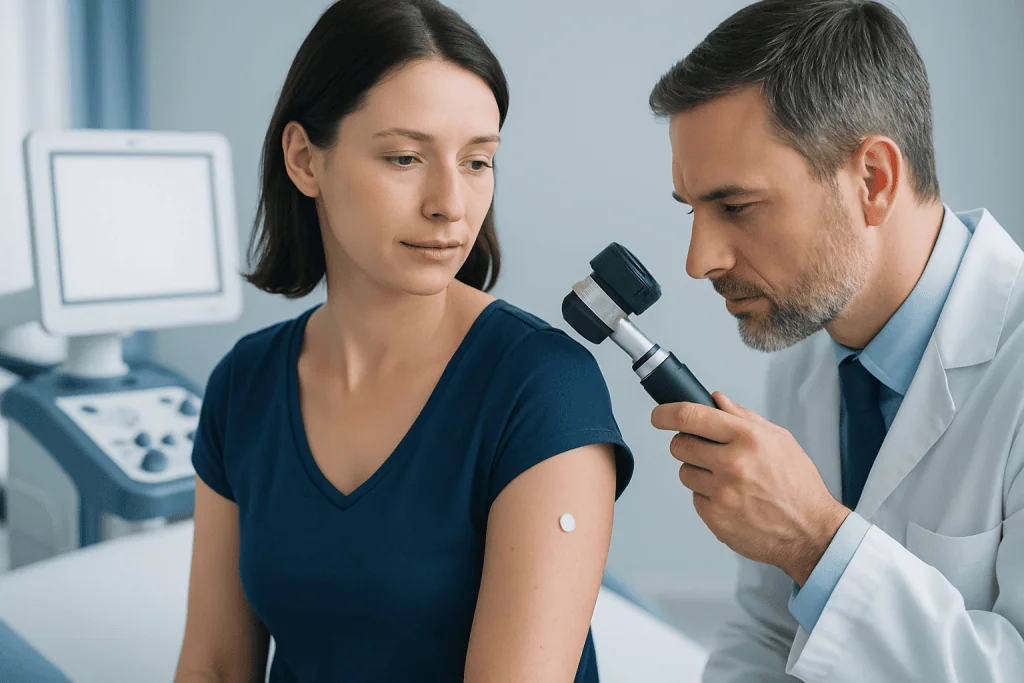
A dermatologist often uses dermoscopy, a magnified lighted device that shows patterns not visible to the naked eye. Dermoscopy can help distinguish benign moles from lesions that require further testing. The doctor may also compare the spot with other moles to see whether it stands out as an “ugly duckling,” meaning it looks clearly different from the rest.
If the lesion appears suspicious, the next step is usually a skin biopsy or complete removal of the lesion for laboratory analysis. This is the only way to confirm whether a mole is benign or cancerous. Patients being assessed for possible melanoma may need review within the broader context of skin cancer evaluation.
Imaging is not usually needed for a simple white mole. The most important tools are clinical inspection, dermoscopy, and pathology when necessary. Early assessment is valuable because skin cancers are generally easier to treat when found at an earlier stage.
Treatment and what happens next
Treatment depends entirely on the cause. If the white mole is benign and stable, no treatment may be needed beyond observation. Some patients choose removal for cosmetic reasons or because the spot is frequently irritated by clothing or shaving. In these situations, the doctor can advise whether removal is appropriate and how it may affect scarring.
If the lesion is suspicious, doctors usually recommend removal or biopsy rather than simple monitoring. A confirmed cancerous or precancerous lesion is treated according to its type, size, depth, and location. This may include minor surgical excision or, in selected cases, other dermatologist-directed procedures. For patients who need lesion sampling or removal, skin biopsy is often the key diagnostic step.
When a white mole is part of a broader pigment disorder, treatment may focus on the underlying condition rather than the mole itself. If there is concern about a cancerous lesion, treatment may involve skin cancer treatment planned by dermatology and other specialists as needed.
Near the end of the care pathway, patients may also benefit from a specialist skin review if they have many moles or repeated changes over time. Acibadem International’s multidisciplinary specialists in JCI-accredited hospitals diagnose and treat skin lesions for international patients, including cases that require dermatology, pathology, and surgical assessment.
Self-checks, prevention, and protecting skin health
Not every white mole can be prevented, but healthy skin habits reduce risk and make changes easier to spot. Regular self-checks are useful, especially for people with many moles, fair skin, or a personal or family history of skin cancer. A good habit is to examine the skin once a month in a well-lit room, using a mirror for hard-to-see areas.
During self-checks, patients can look for the ABCDE warning signs of melanoma: asymmetry, border irregularity, color variation, diameter that is increasing, and evolution over time. The “ugly duckling” rule is also practical: a spot that looks different from a person’s usual pattern deserves attention even if it does not meet every ABCDE criterion.
Sun protection remains one of the most important prevention steps. Helpful measures include:
- Using broad-spectrum sunscreen regularly
- Wearing protective clothing, hats, and sunglasses
- Seeking shade during peak sunlight hours
- Avoiding indoor tanning
- Checking the scalp, back, feet, and nails as part of skin exams
Photographing moles can sometimes help track change over time, but photos should not replace medical review. If a lesion is changing or uncertain, a clinician should examine it in person.
When to seek medical care
A white mole should be checked promptly if it is new in adulthood, changing in any way, or associated with bleeding, crusting, pain, or persistent itching. Medical review is also important if the spot becomes raised quickly, develops uneven borders, or starts to look scar-like or ulcerated.
Patients should also seek care if the white mole stands out from their other moles, appears after significant sun exposure, or is accompanied by enlarged nearby lymph nodes or a sore that does not heal. Any concern is a valid reason to book a skin assessment; it is better to clarify a benign lesion than to miss an early skin cancer.
Those who already have a diagnosis of atypical moles, melanoma, or other skin cancer may need ongoing dermatology follow-up. In some cases, the doctor may recommend lesion removal or referral for dermatology care to guide monitoring and treatment.
Frequently asked questions
Is a white mole always cancer?
No. Many white moles are benign, including naturally light moles or halo nevi. Still, a new or changing white lesion should be checked because some skin cancers are pale or have very little pigment.
What is a halo nevus?
A halo nevus is a mole surrounded by a ring of lighter or white skin. It often happens when the immune system affects pigment cells around the mole. Many halo nevi are harmless, but a doctor may still examine them, especially in adults.
Can melanoma be white or skin-colored?
Yes. Some melanomas are amelanotic, which means they have little or no dark pigment and may look pink, white, or flesh-colored. Because of this, doctors do not rely on color alone when assessing a suspicious spot.
Should a child with a white ring around a mole see a doctor?
A white ring around a mole in a child is often a benign halo nevus, but it is still reasonable to have it examined. A clinician can confirm whether it looks typical and advise whether monitoring is enough.
How is a suspicious white mole diagnosed?
Doctors usually start with a skin exam and dermoscopy, which magnifies surface details. If the lesion looks concerning, a biopsy or removal is done so a pathologist can make a definite diagnosis.
Can a white mole go away on its own?
Sometimes. In halo nevus, the surrounding pale ring may persist for a while, and the central mole may fade over time. Even so, any lesion that is changing should be evaluated rather than assumed to be harmless.
References
- American Academy of Dermatology
- National Cancer Institute
- American Cancer Society
- British Association of Dermatologists
- DermNet
This article is for general information only and is not a substitute for professional medical advice. Please consult a qualified doctor about your individual situation.
Explore treatments in Turkey — costs, top hospitals & a free quote
JCI-accredited · board-certified surgeons · reply within 24h
Add us as a Preferred Source to see more of our trusted health content across Google Search, AI Overviews and Discover.