Wrist Fusion Plate: Procedure, Recovery and Results

A wrist fusion plate and screws stabilize the wrist while the bones heal into one solid unit. Wrist fusion permanently stops bending at the wrist, but finger, thumb and elbow movement are usually preserved.
Key Takeaways
- A wrist fusion plate and screws stabilize the wrist while the bones heal into one solid unit.
- Wrist fusion permanently stops bending at the wrist, but finger, thumb and elbow movement are usually preserved.
- Recovery commonly involves immobilization, follow-up imaging and hand therapy over several months.
- The main aim is to reduce disabling pain and improve the ability to use the hand for selected daily activities.
- Possible complications include infection, delayed bone healing, hardware irritation and persistent pain.
A wrist fusion plate is a metal implant used during wrist fusion surgery to hold the wrist bones in a stable position while they permanently join together. The operation is usually considered for severe, persistent wrist pain when other treatments no longer provide enough relief, trading wrist movement for stability and pain reduction.
Overview: What Is a Wrist Fusion Plate?
A wrist fusion plate is a specially shaped metal plate used in wrist fusion surgery, also called wrist arthrodesis. The plate is attached with screws to hold the wrist bones in a fixed, functional position. This stability allows the bones to grow together over time and form one solid structure.
Wrist fusion is generally used when severe arthritis, injury-related damage, collapse of the wrist bones or a previous unsuccessful operation causes ongoing pain and poor hand function. It is not designed to restore normal wrist movement. Instead, its purpose is to create a stable, less painful wrist that can support useful hand and finger movement.
Depending on the cause of symptoms, a hand and orthopedic surgeon may discuss other options before recommending fusion. These may include splinting, medication, injections, therapy, partial fusion, joint-preserving procedures or wrist replacement surgery for carefully selected patients.
How Wrist Fusion Works and Who May Be a Candidate
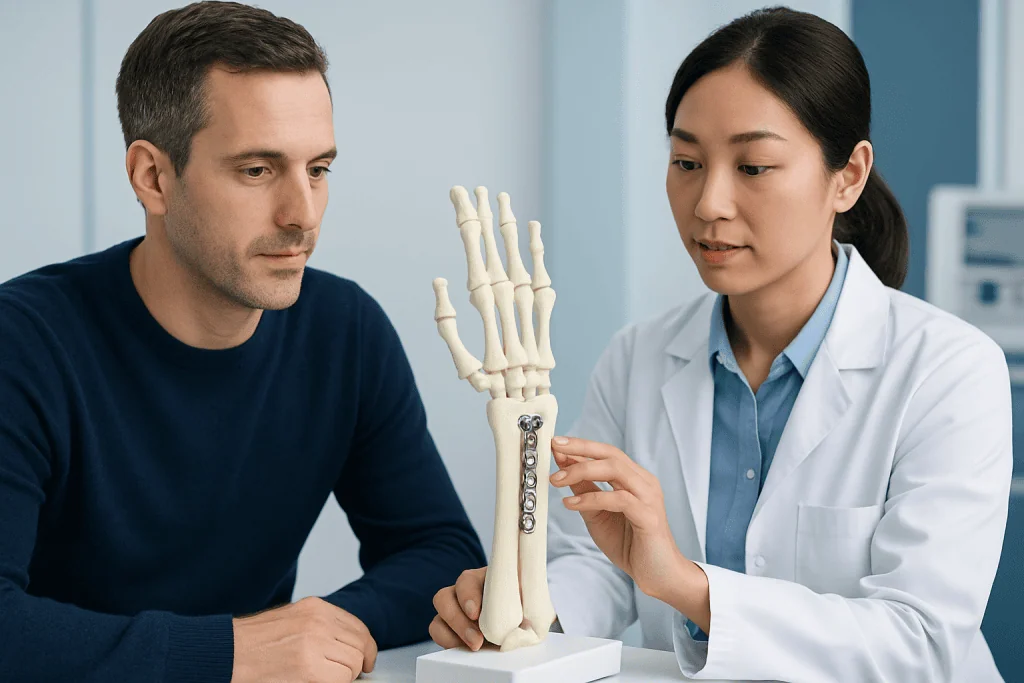
The wrist contains several small bones that work together to allow bending, extension and side-to-side movement. In a total wrist fusion, the surgeon prepares the joint surfaces and positions the bones so they can unite. Bone graft, taken from the patient or another appropriate source, may be used to support healing.
A wrist fusion plate is commonly placed along the back of the hand and wrist. It usually spans from the forearm bone to one or more hand bones, keeping the wrist in the planned position while fusion occurs. The exact implant and technique depend on bone quality, previous surgery, the pattern of arthritis and the surgeon’s assessment.
Possible candidates include people with advanced inflammatory arthritis, severe post-traumatic arthritis, major wrist instability, bone collapse or painful failure of a prior wrist reconstruction. The decision is individualized. A surgeon will consider pain severity, hand dominance, occupation, recreational needs, smoking status, medical conditions and whether preserving some motion remains realistic.
Fusion may be less suitable when infection is active, circulation is poor, bone healing is unlikely without addressing risk factors, or the person depends heavily on wrist motion for essential activities. A detailed discussion helps ensure that the expected trade-off between pain relief and lost wrist movement is understood before surgery.
Wrist Fusion Plate Procedure: Step by Step

Before surgery, the care team reviews medical history, medications, allergies and imaging such as X-rays. Additional scans may be useful in complex cases. Patients are usually advised about fasting, medication adjustments and practical plans for help at home during the early recovery period.
The operation is performed under anesthesia. The surgeon makes an incision, usually on the back of the wrist, and carefully exposes the affected joints. Damaged cartilage is removed and the bone surfaces are prepared to encourage them to join. Bone graft may then be placed where needed.
The wrist is positioned to support practical hand use, then the wrist fusion plate is secured with screws. The surgeon checks alignment and implant placement, often with X-ray imaging during the procedure. The incision is closed, and a bulky dressing, splint or cast is applied to protect the wrist.
Most people need a period of observation after surgery before going home, although the length of stay varies with individual health needs and the type of surgery performed. The team provides instructions for pain control, wound care, activity restrictions and follow-up appointments.
Recovery Timeline After Wrist Fusion
Recovery after wrist fusion occurs in stages because the bones need time to unite. In the first days and weeks, swelling, bruising and discomfort are expected. Keeping the hand elevated, moving the fingers as advised and protecting the splint or cast can help manage swelling and stiffness.
Follow-up visits are important to check the wound, remove stitches when appropriate and review X-rays. The surgeon may change the splint or cast and will advise when it is safe to begin more structured hand therapy. Therapy commonly focuses on finger, thumb and forearm movement, scar care, swelling control and gradual strengthening rather than restoring wrist motion.
Bone healing can take several months, and the timing of return to driving, office work, household tasks or heavier work varies. People whose work involves lifting, vibration, repetitive force or manual labor often need a longer period of restrictions. The treating surgeon should confirm when specific activities are safe.
Smoking and nicotine exposure can reduce bone healing. Following nutrition guidance, attending appointments and reporting concerns promptly can support recovery. Acibadem International’s multidisciplinary specialists and JCI-accredited hospitals can assess and treat complex wrist conditions for international patients.
Benefits, Risks and Expected Results
The main potential benefit of wrist fusion is meaningful reduction in pain from a severely damaged wrist. A stable wrist may make it easier to grip, push, pull and use the fingers for selected daily activities. For many people, the improvement in comfort and stability outweighs the loss of wrist movement.
However, no surgery can guarantee complete pain relief or a particular functional result. Grip strength may improve compared with a painful, unstable wrist, but it may not return to normal. Activities requiring a flexible wrist, such as some sports, manual occupations or tasks involving forceful bending, can remain difficult.
Potential complications include infection, bleeding, nerve or tendon irritation, stiffness in nearby joints, delayed healing or nonunion, poor alignment, ongoing pain and irritation from the plate or screws. In some cases, additional surgery may be needed, including hardware removal after the fusion is solid if the implant causes symptoms.
Patients should contact their surgical team promptly for increasing redness, drainage, fever, worsening pain not controlled by the prescribed plan, new numbness, a blue or cold hand, or a cast or splint that feels excessively tight. Early assessment can help address problems safely.
What Is Life Like After Wrist Fusion?
Life after wrist fusion is usually defined by a stable wrist with no bending at the fused joint. Finger, thumb, elbow and shoulder movement remain available, and the forearm can generally continue to rotate so the palm can turn upward and downward. Many people adapt by using these joints more and by changing how they position the hand for everyday tasks.
Daily activities such as eating, typing, grooming, using a phone and light household tasks may become easier once surgical pain has settled and the bones have healed. Tasks that require wrist flexibility may need different techniques, adaptive equipment or occasional assistance.
Adjustment is both physical and practical. An occupational or hand therapist can suggest safe ways to dress, cook, work at a keyboard, lift objects and protect the hand during recovery. Discussing work duties and hobbies before surgery helps create realistic goals for return to activity.
Can You Bend Your Wrist After a Wrist Fusion?
No. A successful total wrist fusion permanently prevents bending, straightening and side-to-side movement at the wrist because the bones have been joined into one unit. This is the intended effect of the operation and is what creates the stability needed to reduce pain from a severely damaged joint.
Some nearby movement remains. The fingers and thumb should still move, and the forearm usually retains rotation through the joints between the two forearm bones. People may also use elbow and shoulder movement to compensate for the fixed wrist position.
For patients who may benefit from retaining limited motion, a surgeon may discuss alternatives such as partial fusion or selected joint-replacement approaches. These options are not appropriate for every type of wrist damage, so imaging findings and personal activity goals are important in planning.
What Can I Expect After Wrist Surgery With Plate and Screws?
After wrist surgery with a plate and screws, the hand and wrist are usually protected in a dressing, splint or cast. Swelling, aching and temporary finger stiffness are common early on. The care team will explain how to care for the wound, manage pain safely and move the fingers within the limits recommended.
Regular appointments and X-rays help confirm that the plate remains in position and that bone healing is progressing. It is important not to lift, push, pull or bear weight through the hand until the surgeon says the fusion is sufficiently stable. The exact restriction period differs between patients.
The plate is generally intended to remain in place. If the fusion heals and the hardware later causes irritation, a surgeon may consider removal, but this is not routinely necessary. New or worsening swelling, numbness, drainage, fever or severe pressure in the cast or splint should be assessed without delay.
What Can't You Do After Wrist Fusion?
After wrist fusion, a person cannot bend or extend the fused wrist. This can limit movements such as doing push-ups, placing the palm flat for some exercises, forcefully twisting tools, or performing activities that rely on repeated wrist flexion and extension.
Heavy lifting, impact activities and weight-bearing through the hand should be avoided until bone healing is confirmed. Even after healing, some high-demand activities may be uncomfortable or impractical because the wrist is fixed and the load is transferred differently to the hand, forearm and elbow.
Limitations vary with the dominant hand, the reason for surgery, recovery progress and the demands of work or sport. A hand surgeon and therapist can give individualized guidance, including whether workplace modifications or adaptive tools may help preserve independence and comfort.
When to Seek Medical Care
Medical assessment is appropriate for wrist pain that persists, follows a significant injury, repeatedly interrupts sleep, causes weakness or limits normal hand use. A clinician can identify whether arthritis, tendon problems, nerve compression, bone injury or another condition is contributing to symptoms.
Urgent care is important after a wrist injury if the wrist looks deformed, pain is severe, the hand is numb, pale, blue or cold, or a person cannot move the fingers normally. After wrist fusion, prompt contact with the surgical team is needed for signs of infection, circulation changes, worsening numbness or a sudden increase in pain or swelling.
Wrist fusion is usually considered only after careful evaluation and discussion of less invasive options. A qualified orthopedic hand surgeon can explain whether fusion, reconstruction or another approach is most appropriate for the individual’s diagnosis and functional goals.
Frequently asked questions
How long does a wrist fusion plate stay in place?
A wrist fusion plate is usually designed to stay in place permanently. Once the bones have fully fused, the plate may only be removed if it causes symptoms such as irritation or pain, or if another surgical reason develops. The surgeon uses examinations and X-rays to guide this decision.
Is wrist fusion painful?
There is expected pain and swelling after surgery, particularly in the first days and weeks. The surgical team provides a pain-management plan and instructions for elevation, splint care and finger movement. The longer-term aim of fusion is to reduce pain caused by the damaged wrist joint.
How long does it take for a wrist fusion to heal?
Bone healing commonly takes several months, although the exact timeline varies with the condition being treated, bone quality, smoking status and overall health. X-rays at follow-up visits help confirm that the bones are joining. Full adaptation to daily activities and strength recovery may continue beyond the initial bone-healing period.
Will I be able to use my fingers after wrist fusion?
Yes, wrist fusion is intended to preserve finger and thumb movement. Early swelling and temporary stiffness can affect hand use, which is why guided exercises and hand therapy may be recommended. The final level of function also depends on any pre-existing tendon, nerve or finger-joint problems.
Can a wrist fusion plate break?
Plate or screw problems are uncommon but can occur, particularly if bone healing is delayed or the wrist is stressed before fusion is complete. Follow-up imaging helps the surgeon monitor healing and implant position. Patients should follow activity restrictions and report a sudden change in pain, swelling or function.
Can you drive after wrist fusion surgery?
Driving should wait until the person is no longer using sedating pain medicines, has adequate hand control and can safely manage the vehicle in an emergency. A splint or cast and activity restrictions may delay return to driving. The treating surgeon should provide individualized clearance.
References
- American Academy of Orthopaedic Surgeons
- American Society for Surgery of the Hand
- National Institute of Arthritis and Musculoskeletal and Skin Diseases
- NHS
- Mayo Clinic
This article is for general information only and is not a substitute for professional medical advice. Please consult a qualified doctor about your individual situation.
Joint and spine care in Turkey — expert assessment & treatment
JCI-accredited · board-certified surgeons · reply within 24h
Add us as a Preferred Source to see more of our trusted health content across Google Search, AI Overviews and Discover.