Wrist Joint: An Evidence-Based Guide for Patients

The wrist includes multiple small bones, joints, ligaments, tendons, nerves and blood vessels rather than one simple hinge joint. Pain, swelling, weakness, stiffness, clicking and numbness can have different causes and should be assessed in context.
Key Takeaways
- The wrist includes multiple small bones, joints, ligaments, tendons, nerves and blood vessels rather than one simple hinge joint.
- Pain, swelling, weakness, stiffness, clicking and numbness can have different causes and should be assessed in context.
- A fall onto an outstretched hand can cause fractures or ligament injuries even when swelling or pain initially seems mild.
- Many wrist problems improve with activity changes, splinting, rehabilitation and targeted medical treatment.
- Sudden deformity, severe pain, loss of sensation or an inability to use the hand requires prompt medical attention.
The wrist joint is a complex, mobile structure that connects the forearm to the hand and makes gripping, lifting, typing and many daily movements possible. Wrist symptoms can result from overuse, injury, nerve compression or arthritis, and appropriate evaluation helps identify the cause and guide care.
Wrist Joint Overview
The wrist joint is the flexible connection between the forearm and hand. It allows the hand to bend forward and backward, move from side to side, and rotate in coordination with the forearm. These movements are essential for practical tasks such as opening a door, holding a cup, writing, using a phone, and supporting body weight during exercise.
Although it is commonly called a single joint, the wrist is a network of linked joints. It includes the ends of the radius and ulna, eight small carpal bones, strong ligaments, tendons that move the fingers and thumb, and nerves that provide sensation and muscle control. This detailed design allows precision and mobility, but it also means that pain in the wrist can arise from several different structures.
Wrist discomfort is common and is not always a sign of serious damage. Repetitive hand use, an awkward position, a minor sprain, inflammation around a tendon, arthritis, or pressure on a nerve can all contribute. However, pain after a fall or direct impact deserves particular attention because some fractures and ligament injuries are not immediately obvious.
How the Wrist Is Built and Moves
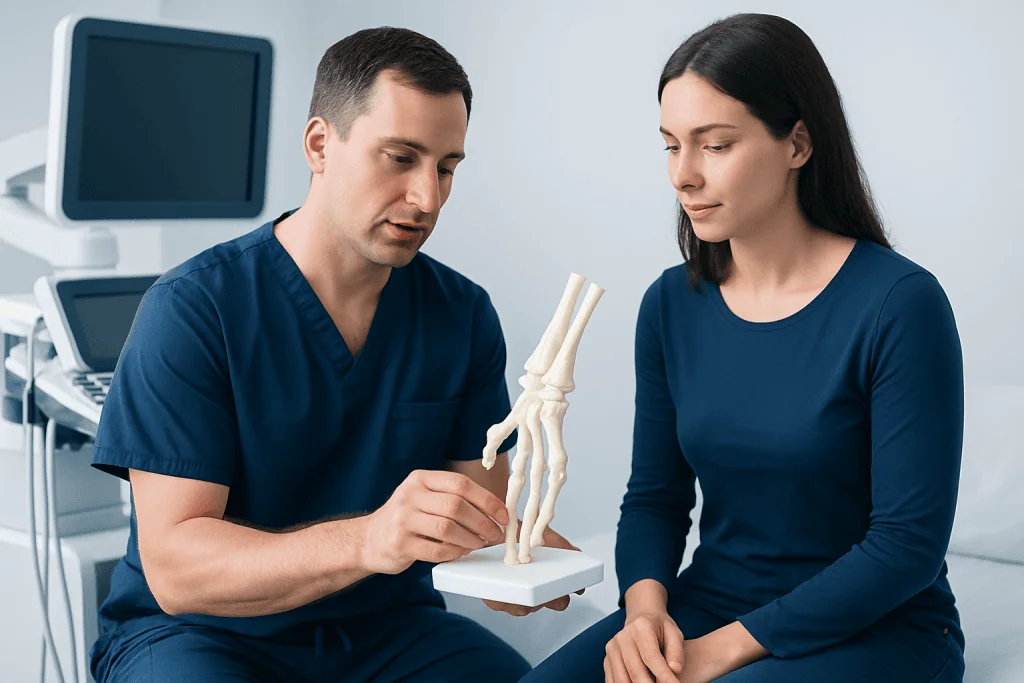
The forearm contains two long bones: the radius on the thumb side and the ulna on the little-finger side. The radius forms the main connection with the carpal bones at the wrist. The ulna does not directly articulate with most carpal bones in the same way; a cartilage-and-ligament structure helps support and stabilize the ulnar side of the wrist.
The eight carpal bones are arranged in two rows. Their small, closely fitted surfaces permit controlled motion in several directions. Ligaments join these bones together and keep them aligned, while tendons pass through the wrist from the forearm to control movement in the fingers and thumb. A fluid-filled lining called the synovium helps joints move smoothly.
Important nerves also travel through the wrist. The median nerve passes through the carpal tunnel on the palm side and supplies sensation to much of the thumb, index, middle, and part of the ring finger. The ulnar and radial nerves contribute sensation and muscle function on other areas of the hand. Pressure or irritation affecting these nerves may produce tingling, burning, numbness, or weakness rather than pain alone.
- Flexion: bending the palm toward the inner forearm.
- Extension: bending the back of the hand toward the outer forearm.
- Radial and ulnar deviation: moving the hand toward the thumb side or little-finger side.
- Forearm rotation: turning the palm upward or downward, coordinated by joints near the wrist and elbow.
Common Wrist Symptoms and What They May Mean

Wrist symptoms vary according to the affected tissue. Aching after repetitive work may reflect tendon irritation or joint strain. Localized tenderness and swelling after a fall can suggest a sprain, fracture, or injury to cartilage or a ligament. Stiffness that is more noticeable in the morning or after inactivity may occur with arthritis or inflammation.
Numbness, tingling, or pain that travels into the thumb and fingers can occur when the median nerve is compressed in the carpal tunnel. Symptoms may be more noticeable at night, when gripping a steering wheel, or during activities that hold the wrist in one position. This pattern may be associated with carpal tunnel syndrome, although a clinician should confirm the diagnosis because symptoms may also originate elsewhere in the arm or neck.
Clicking, catching, a sense that the wrist is unstable, or pain during pushing activities may point to a ligament, tendon, or cartilage-related problem. Pain at the base of the thumb is often linked to overuse or arthritis in the thumb joint rather than the central wrist itself. The location, timing, triggering movements, and presence of swelling all help a clinician narrow down the possibilities.
Symptoms that persist, recur, or interfere with sleep, work, sport, or self-care should not simply be ignored. Early assessment can help prevent an injury from becoming more difficult to manage and can support a safe return to normal activity.
Causes and Risk Factors for Wrist Problems
Acute wrist injuries commonly occur when a person falls onto an outstretched hand. This mechanism can lead to a bone fracture, a ligament sprain, dislocation, or injury to the cartilage structures that stabilize the wrist. Sports, cycling accidents, contact injuries, and motor vehicle collisions can also affect the wrist. A visible deformity is not always present, so continuing pain after trauma should be evaluated.
Repetitive movement can contribute to overuse problems, particularly when activities involve frequent gripping, forceful wrist motion, vibration, or prolonged positions. Examples include manual work, racquet sports, weight training, playing instruments, gardening, and extended computer or mobile-device use. Repetition alone does not always cause injury, but insufficient rest, abrupt increases in training, poor technique, and inadequate ergonomic support can increase strain.
Arthritis may develop after prior injury, with aging, or as part of inflammatory conditions such as rheumatoid arthritis. Osteoarthritis can affect the wrist, although it is less common there than in some other joints unless there has been previous trauma or instability. Inflammatory arthritis may cause pain, warmth, swelling, and prolonged morning stiffness and can affect both wrists.
Other factors may influence risk or recovery. These include osteoporosis, diabetes, thyroid disease, pregnancy, smoking, certain occupations, and medications or health conditions that affect bone strength or inflammation. Risk factors do not establish a diagnosis, but they can inform a clinician’s assessment and treatment plan.
How Wrist Conditions Are Diagnosed
A clinician begins by asking about the symptoms, including when they started, whether there was an injury, which activities make them worse, and whether numbness or weakness is present. They also consider medical conditions, medication use, prior wrist injuries, work demands, and recreational activities. This history helps distinguish a sudden injury from an overuse or inflammatory problem.
The physical examination may include checking for swelling, bruising, tenderness, warmth, range of motion, grip strength, and hand circulation. Specific maneuvers can help assess ligaments, tendons, thumb structures, and nerve function. Comparing both wrists is often useful. If there has been trauma, the clinician may examine the elbow and hand as well because pain can occasionally be referred or occur in more than one location.
Imaging is selected based on the suspected problem. X-rays are often the first test after injury and can identify many fractures or signs of arthritis. Some fractures, including certain scaphoid fractures near the base of the thumb, may not be clearly visible on early X-rays. Repeat imaging, CT, MRI, or ultrasound may then be appropriate depending on the symptoms and examination findings.
Blood tests are not routinely needed for every painful wrist. They may be considered when inflammatory arthritis, infection, gout, or another systemic condition is suspected. Nerve conduction studies or electromyography can help evaluate suspected nerve compression and clarify the severity of nerve involvement.
Treatment Options and Recovery
Treatment depends on the diagnosis, severity, lifestyle needs, and whether there is structural damage. For a minor strain or overuse problem, a clinician may recommend temporarily reducing painful activity, modifying technique or ergonomics, using a wrist support for a limited period, and gradually restoring movement. Applying a cold pack wrapped in cloth may help ease short-term pain or swelling after an acute injury. Medication choices should be discussed with a healthcare professional, especially for people with kidney disease, stomach ulcers, heart disease, pregnancy, or regular medication use.
Hand therapy or physiotherapy can be an important part of recovery. Guided exercises may improve mobility, strength, grip control, and tolerance for daily activity while avoiding reinjury. Therapy may also address posture, workstation setup, sports technique, and the stepwise return to loading. Immobilization should be used only as advised, since prolonged unnecessary splint use may contribute to stiffness and weakness.
Fractures, significant ligament tears, tendon injuries, or severe nerve compression may require more specialized care. Options can include a cast or custom brace, reduction of a displaced bone, injection treatment for selected inflammatory conditions, or surgery when appropriate. Surgical decisions are individualized and are generally considered when non-surgical measures are unlikely to restore stability or function, or when there is an urgent structural concern.
Recovery time differs widely. A mild soft-tissue injury may settle over weeks, whereas fractures, complex ligament injuries, or surgery can require months of healing and rehabilitation. Acibadem International’s multidisciplinary specialists and JCI-accredited hospitals diagnose and treat wrist conditions for international patients, with care plans based on the individual’s diagnosis and functional goals.
Protecting Wrist Health in Daily Life
Not every wrist condition can be prevented, but sensible habits can reduce avoidable strain. During repetitive tasks, varying hand positions, taking brief movement breaks, and avoiding sustained forceful gripping can be helpful. Workstations should allow the forearms to rest comfortably, with wrists kept near a neutral rather than sharply bent position whenever practical.
For exercise and sport, gradual progression is important. Increasing training volume, resistance, or frequency too quickly can overload tendons and joints. Proper equipment, appropriate technique, and rest between demanding sessions may reduce risk. Wrist guards may be useful in activities with a higher chance of falls, such as skating or snowboarding, although they do not eliminate all injuries.
Maintaining overall bone and muscle health also supports the wrist. Regular weight-bearing and strengthening activity, adequate nutrition, not smoking, and addressing conditions that affect bone density can be beneficial. People at risk of osteoporosis can ask a clinician whether bone health assessment is appropriate.
After pain improves, returning to activity in stages is safer than immediately resuming the same workload. If symptoms return during a particular task, reducing intensity and seeking professional guidance may help identify a modifiable trigger rather than repeatedly pushing through pain.
When to Seek Medical Care
Urgent medical assessment is appropriate after a fall, blow, or twisting injury if there is severe pain, obvious deformity, rapidly increasing swelling, an open wound, or an inability to move the wrist or use the hand. Prompt care is also important when the fingers become pale, blue, cold, numb, weak, or unusually painful, as these symptoms can indicate problems requiring immediate evaluation.
A person should arrange a non-urgent medical appointment for wrist pain that lasts more than a few days after an injury, does not improve with rest and activity modification, or repeatedly returns. Evaluation is also advisable for persistent tingling, nighttime numbness, reduced grip strength, clicking with pain, or loss of motion.
Warmth, marked redness, fever, or feeling generally unwell alongside a painful swollen wrist should be assessed promptly because infection, while uncommon, needs timely treatment. New pain and swelling in more than one joint, especially with long morning stiffness, also warrants medical advice to assess for an inflammatory condition.
Until medical assessment is available after a suspected injury, avoid activities that load the wrist, remove rings if swelling is developing, and keep the hand elevated when comfortable. Do not attempt to force a visibly misaligned wrist back into position.
Frequently asked questions
What is the wrist joint made of?
The wrist is made of the ends of the radius and ulna, eight small carpal bones, cartilage, ligaments, tendons, muscles, nerves, and blood vessels. These structures work together to provide both stability and a wide range of hand movements. Because the wrist is complex, symptoms can come from several different tissues.
Why does my wrist hurt without an obvious injury?
Wrist pain without a single injury can occur because of repetitive use, tendon irritation, joint strain, nerve compression, arthritis, or other inflammatory conditions. The timing and location of pain, along with activities that trigger it, provide useful clues. A clinician can assess persistent or recurrent symptoms and recommend appropriate care.
Can a wrist fracture be missed on an X-ray?
Some wrist fractures may not be visible on an initial X-ray, particularly soon after an injury. If examination findings and symptoms suggest a fracture, a clinician may recommend a splint and repeat X-rays or arrange CT or MRI imaging. Ongoing pain at the thumb side of the wrist after a fall should not be dismissed.
Is it safe to exercise with wrist pain?
It is generally best to avoid movements that cause sharp pain, worsening swelling, numbness, or weakness until the cause is clearer. Some people can continue modified lower-body exercise or activities that do not load the wrist. A physiotherapist or clinician can advise on safe exercises and a gradual return to activity.
How is carpal tunnel syndrome different from a wrist sprain?
Carpal tunnel syndrome involves pressure on the median nerve and commonly causes tingling, numbness, or burning in the thumb, index, middle, and part of the ring finger. A wrist sprain is an injury to ligaments, often following a fall or twist, and typically causes pain, swelling, and tenderness around the joint. The two conditions need different assessment and treatment approaches.
When does wrist pain require urgent care?
Urgent care is needed for deformity, severe pain after trauma, an open wound, loss of feeling, weak finger movement, or fingers that appear pale, blue, or cold. Prompt assessment is also important when redness, warmth, swelling, and fever occur together. These symptoms may indicate a fracture, circulation or nerve problem, or infection.
References
- American Academy of Orthopaedic Surgeons
- American Society for Surgery of the Hand
- National Institute of Arthritis and Musculoskeletal and Skin Diseases
- National Health Service
- Mayo Clinic
This article is for general information only and is not a substitute for professional medical advice. Please consult a qualified doctor about your individual situation.
Joint and spine care in Turkey — expert assessment & treatment
JCI-accredited · board-certified surgeons · reply within 24h
Add us as a Preferred Source to see more of our trusted health content across Google Search, AI Overviews and Discover.