Wrist Tendon Anatomy — Explained by Medical Evidence, Not Myths

Flexor tendons run along the palm side of the wrist, while extensor tendons run along the back of the wrist. Tendon sheaths and retinacula help tendons glide smoothly and stay close to the bones during movement.
Key Takeaways
- Flexor tendons run along the palm side of the wrist, while extensor tendons run along the back of the wrist.
- Tendon sheaths and retinacula help tendons glide smoothly and stay close to the bones during movement.
- Pain near the wrist may arise from tendons, joints, ligaments, nerves or bone, so a clinical assessment is important when symptoms persist.
- Repetitive loading, sudden increases in activity and inflammatory conditions can contribute to tendon irritation.
- Urgent assessment is needed after a significant injury, for severe swelling or weakness, or if infection is possible.
Wrist tendon anatomy consists of strong, cord-like tissues that carry force from muscles in the forearm to the wrist, fingers and thumb. Understanding where these tendons travel and how they are protected can help explain common overuse symptoms without assuming that all wrist pain is a tendon problem.
Wrist tendon anatomy: an evidence-based overview
Wrist tendon anatomy refers to the tendons that cross the wrist and connect muscles in the forearm to the bones of the hand and fingers. Tendons are dense bands of connective tissue. When a forearm muscle contracts, its tendon transfers that pull across the wrist, helping a person bend or straighten the wrist, move the fingers and control thumb motion.
The wrist is a compact area, so tendons share space with bones, ligaments, blood vessels and nerves. They travel through defined channels and beneath supportive bands of tissue. This arrangement allows efficient movement, but it also means swelling or crowding in one structure can sometimes affect another.
A useful distinction is that tendons are not ligaments. Tendons attach muscle to bone and create movement; ligaments connect bone to bone and help stabilize joints. Wrist discomfort can involve either structure, as well as the joints themselves, so location alone does not provide a diagnosis.
The two main tendon groups at the wrist
The flexor tendons are found on the palm side of the wrist. They are responsible for bending the wrist and fingers, and several contribute to thumb movement. Major flexor tendons pass through a narrow passage called the carpal tunnel together with the median nerve. The flexor carpi radialis tendon follows its own nearby channel, while the flexor carpi ulnaris tendon lies toward the little-finger side of the wrist.
The extensor tendons run over the back of the wrist. They straighten the wrist, fingers and thumb. Near the wrist, these tendons pass through six separate compartments beneath the extensor retinaculum, a firm band that holds them close to the bones. The compartments guide tendon motion and reduce bowstringing, which would otherwise make movement less efficient.
Thumb tendons are particularly relevant to everyday tasks such as gripping, pinching, opening containers and lifting a child. Tendons controlling thumb extension and abduction pass along the thumb side of the wrist. Irritation in this region may be associated with De Quervain’s tenosynovitis, although similar pain can have other causes.
How tendons glide and stay protected

Many wrist tendons are surrounded by a tendon sheath, a thin, lubricated covering that helps the tendon slide with low friction. The inner lining produces a small amount of fluid that supports smooth movement. Repeated motion is normally well tolerated when loading, recovery and tendon health are balanced.
Retinacula are strong fibrous bands that form a roof over groups of tendons. On the palm side, the flexor retinaculum contributes to the roof of the carpal tunnel. On the back of the wrist, the extensor retinaculum creates the tendon compartments. These structures are normal parts of anatomy, not signs of disease.
Tendons also depend on their surrounding tissues for blood supply and nutrition. They can adapt gradually to regular physical demands, but abrupt changes in intensity, duration or technique may temporarily exceed their capacity. This may lead to tendon pain or inflammation of the surrounding sheath, though not every painful tendon is inflamed.
Why wrist tendons may become painful
Wrist tendon symptoms commonly develop after repetitive gripping, typing, racquet sports, lifting, manual work or a sudden increase in a new activity. Pain can occur because of tendon overload, irritation of the tendon sheath, a strain, or less commonly a partial or complete tendon injury. Poorly fitted equipment, awkward wrist positioning and insufficient recovery may contribute.
Age-related tissue changes, previous injury, diabetes, thyroid disease and inflammatory arthritis can also influence tendon health. Some medicines have been associated with tendon problems in certain settings; a person should not stop prescribed medicine without first speaking with the clinician who prescribed it.
It is important not to self-diagnose all wrist pain as tendonitis. Nerve compression, including carpal tunnel syndrome, joint arthritis, ligament injury, ganglion cysts and fractures can cause overlapping symptoms. Numbness or tingling, for example, may point more toward nerve involvement than an isolated tendon condition.
- Palm-side pain may involve flexor tendons, the carpal tunnel or nearby joints.
- Back-of-wrist pain may involve extensor tendons, joints or a prior injury.
- Thumb-side pain may involve thumb tendons, the thumb joint or a ligament-related problem.
- Little-finger-side pain can have several causes, including tendons, cartilage and joint structures.
How clinicians assess wrist tendon concerns
A clinician usually begins by asking about the onset of symptoms, recent activities, injury, work demands and any medical conditions. The examination may include checking swelling, tenderness, range of motion, grip strength, sensation and specific movements that reproduce symptoms. Comparing both wrists can provide useful context.
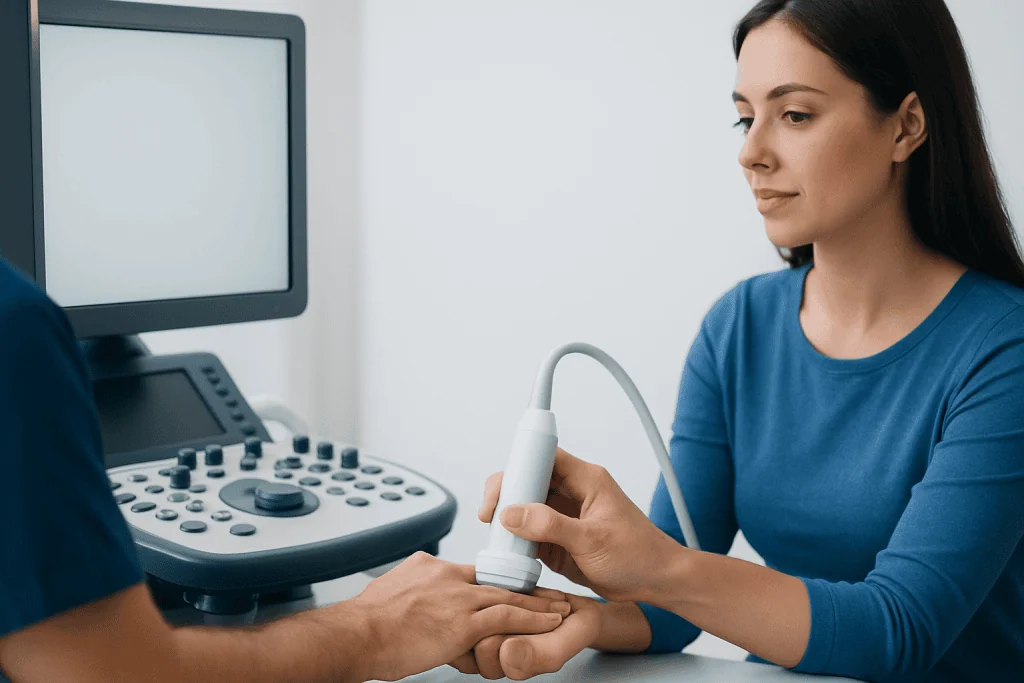
Imaging is not always necessary for mild, improving symptoms. However, an X-ray may be useful after trauma or when a bone or joint problem is suspected. Ultrasound can show moving tendons, thickening, fluid around a tendon sheath or tears in some cases. MRI may be considered when the diagnosis remains unclear or when deeper soft-tissue injury is suspected.
The goal is to identify the source of symptoms rather than rely only on a label. This helps guide treatment and avoids overlooking conditions that need different care. For persistent or complex hand and wrist problems, referral to an orthopedic, hand or rehabilitation specialist may be appropriate.
Treatment and self-care principles
For many mild tendon-related symptoms, temporary modification of the activity that triggers pain is a reasonable first step. This does not always mean complete rest. A clinician or physiotherapist can help a person find a level of movement and loading that protects the area while maintaining function.
Other measures may include a short period of splinting or bracing, cold or heat according to comfort, and supervised exercises that restore motion and build tendon capacity gradually. Over-the-counter pain relief may help some people, but suitability depends on medical history, allergies and other medicines. A pharmacist or clinician can advise safely.
If symptoms do not improve, targeted rehabilitation, ultrasound-guided assessment, injection treatment in selected conditions, or surgery may be considered. Surgery is not routine for most overuse tendon problems, but it may be used for a significant tear, tendon rupture or persistent narrowing around a tendon. Appropriate hand surgery planning is based on the diagnosis, daily function and the person’s goals.
Acibadem International’s multidisciplinary specialists and JCI-accredited hospitals assess and treat hand and wrist conditions for international patients, with care plans tailored to the confirmed cause of symptoms.
Supporting healthy wrist tendon function
Preventive care focuses on sensible loading rather than avoiding normal hand use. When starting a new exercise program, hobby or work task, gradual increases in duration and resistance give tendons time to adapt. Varying tasks, taking short movement breaks and using tools that reduce unnecessary gripping may also be helpful.
Good technique matters in activities that repeatedly load the wrist. Keeping the wrist near a neutral position when practical, using an appropriate grip size and avoiding prolonged forceful pinching can reduce strain. Strength and mobility exercises may be useful, especially after symptoms settle, but should be progressed gradually.
People with diabetes, inflammatory arthritis or thyroid disease should continue regular medical care, as well-managed underlying conditions may support overall musculoskeletal health. Persistent symptoms should not be managed solely with repeated self-treatment, particularly if function is declining.
When to seek medical care
Medical assessment is advisable when wrist pain lasts more than a short period despite reducing aggravating activities, keeps returning, limits work or daily tasks, or is associated with visible swelling. Evaluation is also sensible if there is clicking, locking, loss of grip strength, finger movement difficulty, numbness or tingling.
Prompt care is important after a fall, direct blow, cut or sudden forceful injury, especially if the wrist looks deformed or a person cannot move a finger normally. A tendon injury after a cut can sometimes be less obvious than expected but still needs timely assessment.
Urgent medical attention is needed for increasing redness, warmth, marked swelling, fever, drainage from a wound, a cold or pale hand, or severe pain after an injury. These signs can indicate infection, circulation problems or a significant injury that requires prompt treatment.
Frequently asked questions
What are the main tendons in the wrist?
The main groups are flexor tendons on the palm side and extensor tendons on the back of the wrist. They connect forearm muscles to the wrist, fingers and thumb, making controlled hand movement possible. Individual tendons have different paths and roles.
Are tendons and ligaments the same thing?
No. Tendons connect muscle to bone and transmit muscle force to create movement. Ligaments connect bones to each other and help stabilize joints. Both can be involved in wrist injuries, but they are different tissues.
Where do wrist flexor tendons travel?
Most finger flexor tendons travel through the carpal tunnel on the palm side of the wrist alongside the median nerve. Other wrist flexor tendons pass through nearby channels or attach close to the wrist. Their position helps them bend the wrist, fingers and thumb.
What causes pain on the thumb side of the wrist?
Thumb-side wrist pain can result from irritated thumb tendons, thumb joint arthritis, ligament injury or other conditions. Repetitive gripping and lifting may aggravate tendon-related pain in this area. A clinician can distinguish between these causes through examination and, when needed, imaging.
Can wrist tendon pain heal without surgery?
Many mild tendon-related problems improve with activity modification, appropriate support and gradual rehabilitation. The recovery time varies according to the cause, severity and ongoing demands placed on the wrist. Surgery is generally reserved for selected problems such as significant tears, rupture or symptoms that do not respond to appropriate non-surgical care.
When is wrist pain an emergency?
Urgent evaluation is appropriate after a serious injury, a deep cut, obvious deformity, inability to move the fingers, or severe and rapidly worsening pain. Redness, heat, swelling and fever can also suggest infection and should be assessed promptly. If the hand becomes pale, blue, cold or numb, emergency care is needed.
This article is for general information only and is not a substitute for professional medical advice. Please consult a qualified doctor about your individual situation.
Joint and spine care in Turkey — expert assessment & treatment
JCI-accredited · board-certified surgeons · reply within 24h
Add us as a Preferred Source to see more of our trusted health content across Google Search, AI Overviews and Discover.

More from the Health Library

Lip Filler: An Evidence-Based Guide for Patients

Hims Review: What Patients Need to Know

Koebner Phenomenon — Explained by Medical Evidence, Not Myths

White Rice: An Evidence-Based Guide for Patients

Ma Huang — Explained by Medical Evidence, Not Myths

Sternum: An Evidence-Based Guide for Patients
Orthopedic Surgery & Traumatology Specialists at Acibadem

Dr. Ali Osman Çiçek
Orthopedic Surgery & Traumatology
Assoc. Prof. Dr. Ali Şahin
Orthopedic Surgery & Traumatology
Dr. Alp Er Tunga Bölükbaşı
Orthopedic Surgery & Traumatology
Dr. Alper Gölpınar
Orthopedic Surgery & Traumatology