

Drains, Catheters, and Tubes Before Discharge in Turkey

Many patients leave hospital in Turkey with a drain, catheter or tube still in place. Discharge happens once you are stable, the device is working properly, and you or a companion can care for it. You should leave with instructions in a language you understand, a follow-up plan, and a written summary stating when the device is expected to come out and who will remove it.
Leaving hospital with a tube still attached can feel unsettling, especially when your next stop is a hotel room and, after that, an airport. You are not the first patient to worry about it. It is a routine part of recovery after many procedures, and with clear instructions it is usually manageable.
This guide explains what to expect if you are managing drains, catheters, and tubes before discharge in Turkey. It covers the main device types, how care teams decide when discharge is safe, catheter valves and night bags, bladder training before removal, travel planning, and how a treatment quote handles device-related care. It explains: it does not replace the individual instructions your treating team gives you.
At a glance
- Procedure type: Discharge planning and aftercare for temporary medical devices
- Purpose: To support drainage, urinary function, nutrition, medication delivery or wound healing after treatment
- Anesthesia: Not needed for discharge education itself; device placement depends on the original procedure
- Hospital stay: Varies by operation, condition and whether the device can be safely managed outside hospital
- Estimated recovery: Depends on the underlying treatment and the reason the device is needed
- Return to daily life: Often possible with activity limits and clear care instructions
- Final result timeline: Removal timing is individual and confirmed by your treating physician
- Suitable department: Your treating surgical or medical department, supported by nursing and wound care teams
- International patient support: Interpreter assistance, discharge coordination, documentation for onward care, and remote follow-up
What drains, catheters and tubes actually do
Drains, catheters and tubes are temporary devices that support your body while it heals. Depending on the type, they remove fluid, blood, urine or air; deliver nutrition or medication; protect a surgical repair; or take over a function your body cannot manage for a short time.
The question most international patients ask about drains, catheters, and tubes before discharge in Turkey is simple: is it normal to leave hospital with one? Often, yes. Keeping you in a hospital bed purely because a drain is still collecting fluid is not always necessary. If you are stable, the device is working, and you or a companion can follow the care steps, discharge with the device in place can be part of the plan rather than a setback.
What matters is the quality of the handover. Before you leave, you should know the device’s name, what it is doing, what normal output looks like, which changes need medical review, and, critically for a patient who will board a plane, when and by whom it will be removed.
When is it recommended?
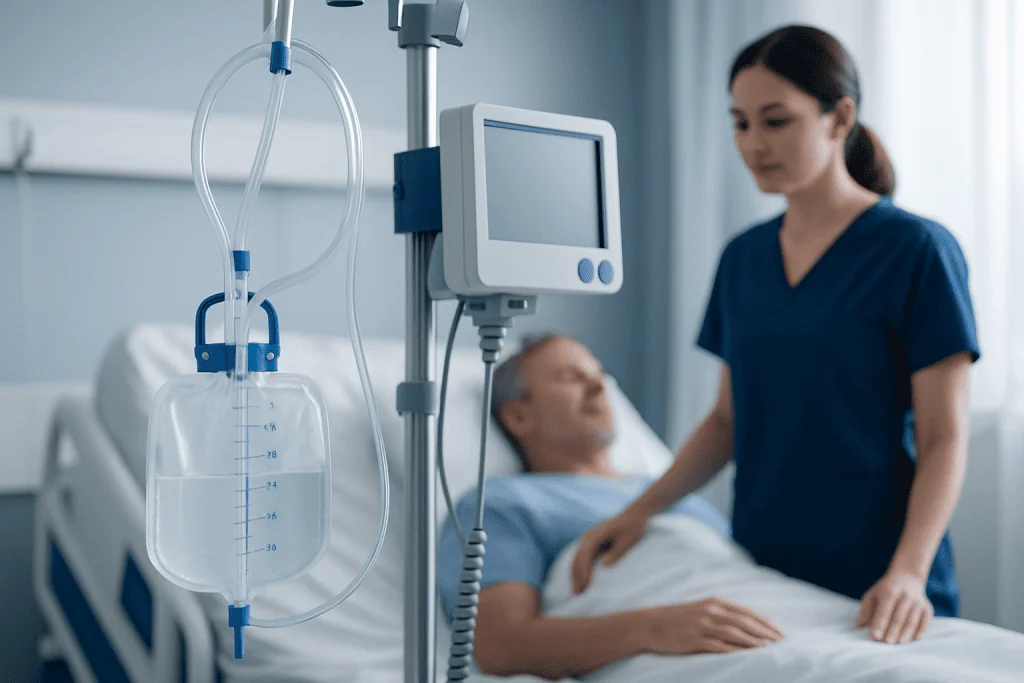
Discharge with a device is considered when the device is still medically useful but your overall condition no longer requires inpatient care. This is common after abdominal surgery, urological procedures, breast and reconstructive surgery, thoracic care, orthopaedic operations and some cancer-related treatments.
Typical examples: a surgical drain still collecting a modest volume of fluid each day; a urinary catheter resting the bladder or a fresh surgical join in the urinary tract; a feeding tube used while eating is limited; a wound drainage system supporting a healing site. Some devices are expected out within days. Others stay for weeks and are handed over to a doctor in your home country.
The decision is individual. Your team weighs your diagnosis, the operation performed, daily drainage output, infection risk, pain control, mobility, test results, your travel dates, and whether you have reliable support at your accommodation. Drains, catheters, and tubes before discharge in Turkey are managed the same way they are in any careful hospital system: the device leaves with you only when the team is satisfied you can manage it.
Who is a good candidate?

You are usually suitable for discharge with a device if you are medically stable, your pain is controlled, you can move safely, and you or a companion can understand and perform the care steps. You also need clean storage for supplies, a way to reach your care team, and a written plan for follow-up or removal.
In practice, that means being able to keep the device secured, empty or observe drainage if asked, record volumes when requested, and protect the device while dressing, sleeping, showering and travelling. For international patients, the team also considers whether you can manage the device through transfers, hotel stays, airport security and the flight itself. If you are travelling with someone, it helps if they attend the discharge teaching too: there is practical guidance in our guide on bringing a companion to Turkey for treatment.
Discharge is generally not appropriate with uncontrolled fever, unstable vital signs, heavy bleeding, severe uncontrolled pain, confusion, significant mobility problems without support, or a device that needs hospital-level monitoring. Your physician decides what is safe in your specific case.
The main device types, explained
Surgical drains. Closed suction drains (a soft tube ending in a squeezable bulb or bottle) gently pull fluid away from an operation site; you empty and re-compress them on a schedule and often record the output. Passive drains let fluid escape by gravity into a dressing. Drain output typically falls day by day, and removal is usually decided on volume and appearance.
Urinary catheters. A urethral catheter drains the bladder through the urethra; a suprapubic catheter enters through a small opening in the lower abdomen. Both connect to a leg bag, a larger night bag, or, for some patients, a catheter valve instead of a bag. These options are covered in detail below.
Kidney and biliary drainage. A nephrostomy tube drains a kidney directly through the back; biliary drains manage bile after certain liver, gallbladder or pancreatic procedures. These need particular care with securing and dressing, and clear instructions on flushing only if you have been specifically trained.
Feeding and gastric tubes. Nasogastric tubes, gastrostomy (PEG) tubes and jejunostomy tubes deliver nutrition or medication, or drain the stomach, while eating is limited. Care centres on hygiene, positioning, flushing routines taught by the team, and skin care around the site.
Wound systems. Negative pressure wound therapy uses a portable pump, canister and sealed dressing. If you leave with one, you need instructions for alarms, canister changes, dressing schedules and charging the device.
Vascular access. Certain central lines and implanted ports remain in place for ongoing medication or chemotherapy. The priorities are a clean, intact dressing and protecting the line from pulling or moisture.
Chest tubes. These are rarely managed outside hospital. Discharge with a chest drainage system is considered only in specific circumstances, with a portable valve system and careful specialist planning.
Whatever you leave with, ask for the exact device name in writing. “A drain” is not enough information for the doctor who sees you next.
Urinary catheters: valves, bags and bladder training
Can a catheter valve be used instead of a drainage bag?
Often, yes. A catheter valve is a small tap fitted to the end of the catheter in place of a bag. The bladder fills as normal, and you open the valve at regular intervals, and before bed, to empty it. Many patients prefer a valve because it is discreet, avoids carrying a bag of urine, and lets the bladder keep filling and emptying in a more natural rhythm.
A valve is not suitable for everyone. It generally requires reasonable bladder capacity and sensation, the hand strength and awareness to open it on schedule, and a bladder that is safe to let fill, which is not the case after some bladder or urinary tract operations, or with certain kidney conditions. Whether you use a valve, a bag, or a valve by day with a bag connected at night is a decision for your treating team, based on why the catheter was placed.
What are common problems with catheter night bags?
Night bags are larger-capacity bags connected to the leg bag or valve overnight, so you can sleep without waking to empty. The problems patients report are practical and mostly preventable:
- Kinked or trapped tubingunder a leg, mattress or bed rail, which blocks flow.
- The bag sitting too high. A drainage bag must stay below bladder level; on the mattress beside you, it can stop draining or allow backflow.
- Tension on the catheter when you turn in your sleep, if the tubing is not given slack and secured.
- Overfilling when the bag is not emptied before connecting or is left too long in the morning.
- Loose or contaminated connections, which cause leaks and raise infection risk. Hands should be washed before and after handling connections.
- Reusing single-use bags. Some night bags are designed for one night only; others are reusable for a limited period. Your discharge instructions should state which type you have.
A simple bag stand, tubing routed with slack over the edge of the bed, and a fixed emptying routine solve most of these issues.
Is bladder training recommended before catheter removal?
Practice varies, and it is worth understanding why. Some teams clamp the catheter for set periods before removal, sometimes called bladder training or a clamping trial, with the aim of letting the bladder regain its normal filling-and-emptying pattern. Other teams remove the catheter directly, and research has not shown a consistent advantage for routine clamping after short-term catheterisation. Clamping also carries a risk of overstretching the bladder if it is not supervised properly.
The honest answer is that this is a decision for your treating team, based on how long the catheter has been in and why. What you should not do is clamp the catheter on your own initiative. If a clamping schedule is part of your plan, it will be given to you explicitly, with timings.
Online evaluation before travel
A pre-travel medical review typically covers your diagnosis, planned treatment, previous surgeries, existing devices, current medications, allergies and recent imaging or laboratory results: our guide on how medical records are reviewed before a treatment plan explains the process.
For patients who already have a device before travelling, the details that matter most in such a review are when and why it was placed, how it is cared for, and any history of blockages, leaks or infections. Clear, well-lit photos of visible wounds, stomas or tubes give a reviewing team useful context. Online review cannot replace examination, but it shapes realistic planning: interpreter support, expected length of stay, supplies, accommodation needs and whether a companion is advisable.
Before the treatment
Before your procedure, ask directly: might I leave hospital with a device in place? If the answer is yes or maybe, ask for the likely device name, how long it typically stays, and whether removal would happen in Turkey or at home. You can ask to practise emptying, securing and checking the device under nurse supervision before discharge, repetition is normal, not a nuisance.
Prepare practical items: loose clothing, a small clean bag for supplies, hand hygiene products, and a phone note or notebook for recording output if asked. If you will stay in a hotel between discharge and your control visit, choose somewhere you can rest and reach appointments without long transfers.
Tell your team about blood thinners, diabetes medicines, immune-suppressing medicines, allergies to adhesives or antiseptics, and any difficulty with vision, grip, walking or understanding instructions. None of this disqualifies you; all of it shapes how your discharge teaching is delivered.
What happens during the treatment
The device is usually placed during your main operation, or sometimes at the bedside or in an interventional radiology unit under imaging guidance. Depending on the device, placement may involve general anaesthesia, local anaesthesia, sedation or sterile bedside technique: your physician will explain what applies to you.
Once in place, the device is checked for position and function. Nurses monitor drainage colour and volume, urine output, dressing condition and your comfort, alongside any blood tests or imaging the team needs. Before discharge, the team decides whether the device comes out in hospital or stays. If it stays, hands-on education follows: hygiene, securing, emptying or measuring, dressing protection and activity limits. Ask for any step to be repeated or demonstrated again until you are genuinely confident: that confidence is part of the discharge criteria, not an optional extra.
Hospital stay and discharge
Length of stay depends on the underlying procedure, your general health and how the device behaves. Some drains come out before discharge once output falls. Others stay because early removal could risk fluid build-up, urinary problems or delayed healing.
Treat discharge as a planned transition, not a moment. The handover should cover medications, wound and device care, bathing, sleeping position, activity limits, diet, pain control and appointment times. Ask which supplies you are given and which you should obtain before leaving Turkey. Our guides on preparing for hospital discharge before you leave your room and managing wound care and dressings after discharge cover the wider checklist.
If a doctor at home will continue your care, ask for a written summary that names the device, states the placement date, describes the care routine and sets out the removal plan. Our guide to what your discharge summary should include before you fly home lists the details worth checking line by line.
Recovery timeline
Recovery with a device is highly individual: it tracks the underlying condition, not the tube itself. The table below is orientation only; your physician’s instructions always take priority.
| Timeframe | What to expect |
|---|---|
| First 24 hours | Monitoring of drainage, urine output, pain and device position. If discharge with the device is likely, teaching begins now. |
| First week | Dressing checks, emptying and recording output, careful hygiene, limited activity. A first control visit often decides whether the device comes out or stays longer. |
| Weeks 2–4 | Many temporary devices are removed in this window if healing allows; some remain longer. Fitness to fly and handover to local follow-up are reviewed. |
| Months 1–3 | Longer-term catheters, feeding tubes, ports or wound systems become routine to manage, usually with a local doctor monitoring alongside remote contact. |
| End point | Reached when the device is no longer needed, the underlying condition is stable, and your physician confirms progress is appropriate. |
Removal timing can change in both directions. A device may stay longer than first expected if it is still doing useful work, or come out sooner if your physician confirms it is safe.
What to avoid after treatment
Do not pull, twist, cut, clamp, flush or disconnect any drain, catheter or tube unless your team has specifically trained you to do so. Keep the device secured as shown, especially when walking, dressing, sleeping and using the bathroom, and keep drainage bags below the level they drain from.
Avoid soaking in baths, pools, hot tubs or the sea until your physician confirms it is safe. Showering rules vary by device and dressing, ask whether the site must stay dry, whether it can be covered, and how to manage the dressing afterwards. Do not apply creams, powders, alcohol or antiseptics around the insertion site unless they were prescribed.
During travel, do not run luggage straps or tight belts over the device. Keep supplies, spare dressings and your medical summary in hand luggage, never in checked baggage. On long flights, follow your team’s advice on movement and positioning, and give tubing slack before you stand.
Risks and possible complications
Most patients manage temporary devices without serious trouble, but every device carries risks worth knowing plainly: infection, skin irritation, leakage, blockage, bleeding, pain, accidental dislodgement and movement of the device from its intended position.
The pattern varies by device. Urinary catheters are associated with urinary discomfort, bypassing leakage and infection risk that rises the longer the catheter stays. A surgical drain may stop draining, suddenly increase output or change colour in a way that needs review. Feeding and gastric tubes can block or leak at the skin. Vascular lines demand strict cleanliness and an intact dressing. None of this is cause for alarm: it is the reason discharge teaching exists, and the reason your follow-up plan is written down rather than left to memory.
Warning signs your discharge team will explain
Part of every device discharge is a briefing on which changes need medical review and who is responsible for that review at each stage, during your hotel stay in Turkey, and after you return home. The signs discharge instructions typically ask patients to watch for include:
- Fever, chills or feeling suddenly unwell
- Increasing redness, warmth, swelling, odour or discharge at the insertion site
- Pain that worsens rather than settles on the prescribed plan
- A sudden change in drainage colour or volume, or heavy bleeding
- No drainage or urine flow when flow is expected
- Leakage around the tube, persistently wet dressings, or fluid collecting under the skin
- A device that slips, breaks, disconnects or is pulled out
Your discharge paperwork should state, in writing, the contact route for each stage of your journey and which local services apply once you are home. Make sure those lines are filled in before you leave the ward, not discovered blank at the airport.
International patient travel planning
If you may fly with a device, the sequence matters. First, your physician confirms fitness to travel and whether a control visit is needed before departure, some patients are advised to stay in Turkey a few extra days so the device can be checked or removed first. Build that flexibility into your ticket if you can.
Second, documentation. Carry a discharge summary in English or the language of your next care team, naming the device, the placement date, care instructions, medications and the removal plan. At airport security, a visible device or drainage bag may prompt additional screening; a written medical summary makes this quicker and calmer. Our overview of what international patients receive at discharge before returning home describes the document set in detail.
Third, practicalities. Wear loose clothing that allows access to the device. Pack supplies and medications in hand luggage. If you need assistance with mobility or transfers, arrange it with your airline in advance rather than at the gate.
Cost and package information
The scope of device-related care depends on the underlying treatment, length of stay, device type, nursing needs, dressings and supplies, imaging or laboratory checks, follow-up visits, and whether removal or replacement happens in Turkey or at home. Unexpected complications can extend that scope.
A treatment quotation for international patients typically covers the planned procedure, related hospital accommodation, standard nursing care, routine in-hospital medications and scheduled physician assessments. If discharge with a device is likely, the useful questions are structural: are initial supplies included? Are dressing changes and control visits between discharge and departure part of the quote or billed separately? Is device removal included if it happens before you fly?
Items commonly listed separately include additional consultations, extra tests, extended hospital stay, non-routine supplies, hotel accommodation, companion expenses, flights, travel insurance and any care needed after you return home. Ask for the inclusions and exclusions in writing before you travel, so nothing about the device pathway is assumed.
Why choose Acibadem
When a drain, catheter or tube is part of your recovery, the quality of communication matters as much as the procedure itself. Acibadem International supports patients from many countries with coordinated care that treats discharge as a planned handover: interpreter-supported teaching on the ward, written instructions you can actually use, and documentation prepared for the doctor who sees you next.
Depending on your condition, your care may involve surgeons, physicians, nurses, wound care professionals, physiotherapists, dietitians and interventional specialists, alongside international coordinators who handle appointment scheduling, transfer guidance, accommodation advice and remote follow-up. The aim is straightforward: a recovery pathway you understand, with no gap between leaving the ward and reaching your next point of care.
Medical review and disclaimer
This guide has been reviewed by the Acibadem International medical team. It provides general information for international patients who may be discharged with a drain, catheter or tube after treatment in Turkey.
It does not replace an in-person consultation, physical examination, diagnosis or individualised medical advice from your physician. Device care, removal timing, travel clearance and follow-up requirements must be determined by your treating medical team based on your condition, and instructions may differ from one patient to another.
Step by step
- Initial contact. You contact Acibadem International with your diagnosis or planned treatment. The international patient team identifies the relevant department and explains what information is needed for review.
- Medical record / photo submission. You share reports, test results, imaging, medication lists, allergy information and clear photos of any existing wound, drain, catheter or tube through the recommended secure channels.
- Preliminary medical review. The medical team reviews your information to understand your condition and whether a device may be part of your recovery, so the right questions are ready for your consultation.
- Treatment plan and quotation. You receive a proposed care plan with the expected hospital pathway and general follow-up needs. The final plan may change after examination and tests in Turkey.
- Travel planning. The team assists with scheduling, transfer guidance, accommodation advice, interpreter planning and estimated length of stay. If device care may be needed, extra time is built into the schedule.
- Arrival. You are guided to your appointment or admission, with interpreter support arranged so you can communicate comfortably.
- In-person consultation. Your physician examines you, reviews your records and explains whether a drain, catheter or tube may be needed, including care, removal timing and travel implications.
- Pre-operative tests. Blood tests, imaging and anaesthesia evaluation confirm safety and personalise the plan.
- Treatment. Your procedure is performed; if a device is needed, it is placed during or after the procedure according to your condition.
- Hospital stay. Nurses and physicians monitor recovery, drainage, urine output or tube function as relevant. Device teaching begins on the ward if the device will stay in.
- First control. Healing and device function are checked, and the physician decides whether the device can be removed, adjusted or kept longer.
- Discharge / travel clearance. You receive written instructions, prescriptions if needed, device care guidance, the warning-sign briefing and follow-up recommendations. Your physician advises whether and when you are fit to travel.
- Remote follow-up. After discharge or return home, remote communication helps you share updates and coordinate with your local physician when appropriate.
Your checklist
- Passport and travel documents
- Current diagnosis and reason for treatment
- Medical history, including chronic conditions
- List of all medications and supplements
- Allergy information, especially to medicines, latex, adhesives or antiseptics
- Previous surgeries and anaesthesia history
- Current symptoms, including pain, fever, drainage, urinary issues or wound concerns
- Recent laboratory results and imaging reports
- Photos of wounds, swelling, stomas or existing tubes when relevant
- Details of any current drain, catheter, tube, port or medical device
- Contact information for your local doctor or hospital
- Travel dates, accommodation details and companion information
Key takeaways
- Leaving hospital with a drain, catheter or tube can be a planned, safe part of recovery when you are stable and understand the care steps.
- Get the device name, care routine, warning signs and removal plan in writing before you leave the ward: the doctor who sees you next will need them.
- Catheter valves, leg bags and night bags each have their place; which you use is a clinical decision, and clamping trials before removal happen only on your team’s explicit instruction.
- Build flexibility into travel plans: a control visit or removal before flying may be advised, and supplies belong in hand luggage.
- Never pull, cut, clamp or flush a device on your own initiative; keep it clean, secured and positioned as instructed.
Frequently asked questions
Can catheter valves be used instead of a drainage bag?
For many patients, yes. A catheter valve is a small tap fitted in place of a bag, opened at regular intervals to empty the bladder. It suits patients with reasonable bladder capacity and sensation and the dexterity to use it on schedule. It is not appropriate after some bladder or urinary tract operations, so the choice between a valve, a bag, or a valve by day with a night bag rests with your treating team.
What are some common problems with catheter night bags?
The usual culprits are kinked tubing trapped under a leg or mattress, the bag sitting above bladder level so it stops draining, tension on the catheter during sleep, an overfilled bag, and loose or contaminated connections. A bag stand, slack in the tubing, hand hygiene at every connection and a fixed emptying routine prevent most of these. Check whether your night bag is single-use or reusable, instructions differ.
Is bladder training recommended before catheter removal?
Practice varies. Some teams clamp the catheter for set periods before removal to let the bladder resume a filling-and-emptying pattern; others remove it directly, and research has not shown a consistent benefit for routine clamping after short-term catheterisation. Unsupervised clamping can overstretch the bladder, so follow a clamping schedule only if your team gives you one explicitly.
Will I be able to fly home with a medical device in place?
Some patients can, but fitness to fly must be confirmed by the treating physician, based on the procedure, device type, mobility and flight duration. You may be advised to stay in Turkey for a control visit, or removal, before departure, so flexible travel bookings are sensible.
How long will the device stay in place?
It varies widely with the reason it was placed and how healing progresses. Some drains come out within days once output falls; some catheters, feeding tubes or ports stay for weeks or longer. Ask your physician for the specific criteria for removal and who will remove it if you are back in your home country.
Can I shower with a drain, catheter or tube?
It depends on the device and dressing. Some sites must stay dry; others can be protected with a waterproof cover. Soaking in baths, pools or the sea should wait until your physician confirms it is safe. Ask for your specific showering instructions before discharge, including how to handle the dressing afterwards.
Can I manage the device by myself?
Many patients manage basic care after nurse education, depending on the device and on your vision, grip, mobility and confidence. You should feel able to perform each step before discharge, asking for another demonstration is normal. A companion who has also seen the teaching is a genuine asset in the first days.
What cost factors should I consider?
The scope of care is shaped by the underlying treatment, length of stay, device type, dressings and supplies, tests, follow-up visits, and whether removal happens in Turkey or at home. Travel, hotel, companion expenses and care after returning home are usually separate. Ask for a written breakdown of inclusions and exclusions before you travel.
Add us as a Preferred Source to see more of our trusted health content across Google Search, AI Overviews and Discover.

Update history
- PublishedJune 22, 2026
- Medical review approvedSeptember 13, 2026
- Last content updateSeptember 12, 2026
References2
- NHS: Urinary catheters nhs.uk
- MedlinePlus: Closed suction drain with bulb medlineplus.gov
More Patient Guides

HoLEP in Turkey: How It Compares With TURP and What Recovery Involves
HoLEP in Turkey treats enlarged prostate tissue with laser enucleation; learn how it compares with TURP, recovery, travel and follow-up.

Porcelain Veneers in Turkey: Who Is Suitable and How Many Visits Are Needed?
Porcelain veneers in Turkey can enhance tooth shape and colour in two visits for suitable patients after a personalised dental assessment.

How to Prepare for a Sedation Procedure in Turkey
Prepare safely for a sedation procedure in Turkey with guidance on fasting, medicines, travel, recovery and follow-up.

Treatment Delays in Turkey: What Happens If Tests or Recovery Change Your Schedule
Treatment delays in Turkey can happen if tests or recovery change your plan. Learn how to manage appointments, travel, accommodation and follow-up.