

Flying Home After Sedation or Anesthesia: When Is It Safe?

There is no fixed safe interval that applies to everyone. Most people should not fly on the day of sedation or general anesthesia, and many procedures need longer. Readiness depends on the type of anesthesia, the procedure itself, your general health and the flight you have planned. Your treating clinician confirms fitness to fly individually, so keep your return booking flexible until you have that confirmation.
Your return ticket is booked, you feel awake, and the airport does not seem far away. Feeling awake is not the same as being ready. Flying home after sedation or anesthesia depends on more than how alert you feel in the hour after discharge. Before you travel, your treating team should confirm that you are medically stable, that pain and nausea are controlled, and that the journey you have planned actually suits your procedure and your recovery so far.
At a glance
- Most important step: individual travel clearance from your treating clinician before you board, discharge alone is not a fitness-to-fly decision.
- Same-day travel: usually not appropriate after sedation, general anesthesia or an invasive procedure, particularly if you would travel alone.
- Why flying matters: cabin pressure, drier air, long sitting, dehydration, pain and clot risk all place extra demands on early recovery.
- Companion: a responsible adult is often advised for the first period after sedation or anesthesia, including any onward travel.
- Before departure: confirm medications, wound care, follow-up arrangements, medical documents and airline assistance in advance.
Why there is no universal timeline
People searching for a rule about flying home after sedation or anesthesia usually want a number: six hours, twenty-four hours, three days. No honest single number exists. Your readiness depends on the type of anesthesia you had, the procedure it supported, your general health, the length and complexity of the flight, and how your recovery has actually gone, including pain, dizziness, nausea, bleeding, breathing symptoms or reduced mobility.
Two people can have the same anesthetic on the same day and be given different travel advice. One had a brief diagnostic procedure and lives a short flight away. The other had abdominal surgery, takes blood-thinning medication, and faces a long-haul journey with a connection. The anesthesia is only one input into the decision; the procedure and the journey often matter more. That is why guides organised procedure by procedure give ranges rather than promises, and why the final word always belongs to the clinician who treated you.
For international patients, the practical consequence is simple: build flexibility into your itinerary. A booking that can absorb an extra night or a rescheduled flight costs you far less stress than a rigid schedule that recovery cannot meet.
What sedation and anesthesia actually do to your body
Understanding the different categories helps you interpret the advice you are given, because the travel implications are not the same.
- Local anesthesia numbs a small area while you stay fully awake. On its own, it rarely restricts travel, any restriction usually comes from the procedure, not the anesthetic.
- Sedation ranges from mild relaxation to a deep, sleep-like state. Even light sedation can dull reaction time, memory and judgment for hours after you feel normal. Deeper sedation behaves more like general anesthesia in its after-effects.
- Regional anesthesia, such as a spinal or nerve block, numbs a larger region of the body. Sensation and strength return gradually, and until they do, walking through an airport safely may not be realistic.
- General anesthesia renders you fully unconscious. Afterwards, tiredness, unsteadiness, nausea and slowed thinking are common and can persist beyond the point at which you feel subjectively fine.
The common thread is that sedation and anesthesia can temporarily affect alertness, balance, coordination and decision-making even after the obvious drowsiness has passed. The procedure itself may then add separate considerations: a need for observation, wound care, activity limits, or protection against blood clots. Both layers feed into the question of when flying home after sedation or anesthesia becomes reasonable for you.
Sedation, general anesthesia, and the first 24 hours
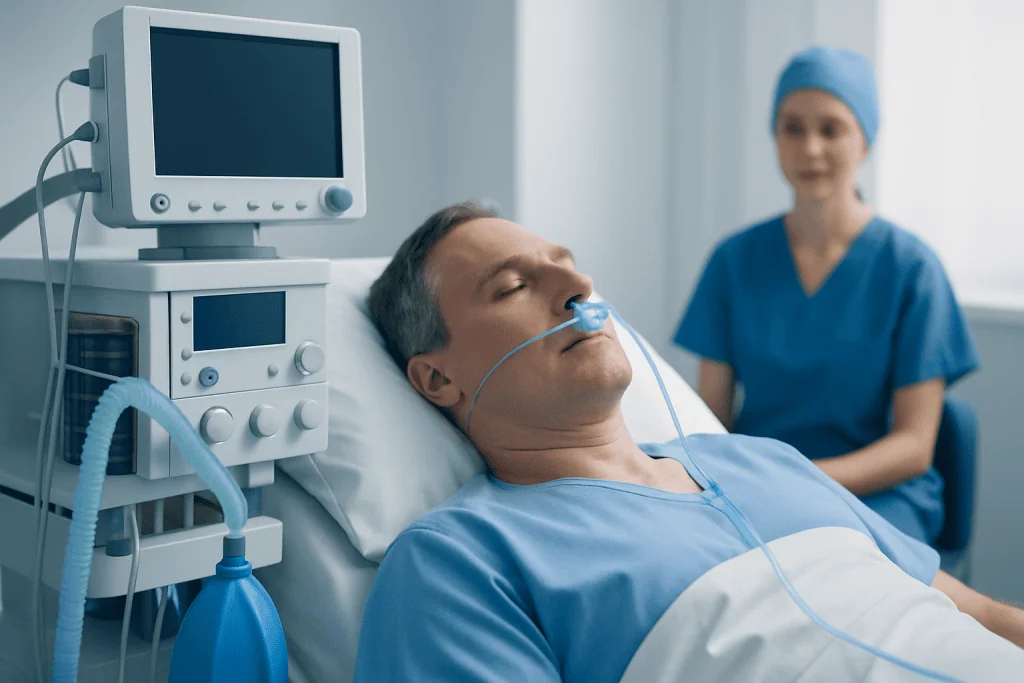
The first day is the period in which after-effects are most likely to surface. Even when discharge criteria are met, you may still be tired, less steady on your feet, or slower to notice and respond to a problem. Discharge instructions therefore often advise that a responsible adult stays with you for a defined period, commonly through the first night. There is a separate guide on when you need someone with you after sedation or anesthesia if you are arranging this from abroad.
Standard early-recovery precautions apply whether you are resting in a hotel or moving through a terminal: no driving, no operating machinery, no signing of important documents, no major decisions, no alcohol, and no medicines beyond those your clinician has approved for this period. An airport intensifies all of these demands. Security queues, gate changes, luggage, announcements in another language, each one asks for the exact faculties that sedation temporarily blunts.
Ask your team specifically about your flight rather than assuming that discharge equals fitness to fly. A short transfer and a long-haul international journey place very different loads on your body. After an outpatient procedure, planning a recovery night close to the hospital before any onward travel is often the sensible middle path.
What your care team considers before clearing you to fly

Travel clearance is a whole-picture judgement, not a check of the clock. Your clinician typically looks at whether you are awake and oriented, drinking fluids, passing urine where relevant, and moving safely. They weigh whether pain, nausea, dizziness, bleeding or swelling are manageable with the travel plan you actually have, not an idealised one.
The nature of your procedure carries particular weight. Surgery involving the abdomen, chest, brain, eyes, bones, blood vessels or air-filled body spaces may come with specific flying restrictions, because pressure changes in the cabin can affect trapped air and healing tissue. Procedures that limit mobility, raise clotting risk or require close early follow-up may mean travel is delayed or modified even when the anesthesia itself has long worn off.
The assessment works best when your team knows everything relevant. Tell them about heart or lung disease, sleep apnoea, a history of blood clots, anaemia, pregnancy, diabetes, or use of blood-thinning medication. Share the exact route: flight duration, layovers, whether a companion travels with you, and where you will stay after landing. Generic advice fits a generic journey; specific information gets you advice that fits yours.
- Ask whether you are fit for a short flight, a long-haul flight, or both.
- Ask whether airport wheelchair assistance or extra legroom would help you.
- Ask whether compression stockings, movement breaks or preventive medicines are appropriate in your case.
- Ask whether your airline requires a medical certificate, some do after recent procedures. The guide on when you need fit-to-fly clearance explains how these forms work.
How the cabin environment affects early recovery
It helps to understand why a flight is treated differently from a car journey of the same length. Aircraft cabins are pressurised to the equivalent of a moderate altitude rather than sea level, which means slightly less oxygen is available. A healthy passenger barely notices. A person recovering from anesthesia, blood loss or a chest or heart condition may feel it more.
Cabin air is also dry, which encourages dehydration, unhelpful when your body is healing and when clot risk is already a consideration. Seats restrict movement for hours at a time. Toilets are small and involve queuing. Help, if you need it, is limited to what crew can provide at altitude, and a diversion is a serious undertaking. None of this makes flying after treatment inherently dangerous; it explains why clinicians think carefully about timing, flight length and support before saying yes.
Planning a safer journey home
Once your clinician has cleared travel, make the trip as simple and low-effort as you can. Avoid tight connections, long walks between terminals, heavy luggage and a schedule with no slack. Request wheelchair assistance from the airline in advance even if you can walk short distances, airports routinely involve more standing and walking than travellers expect, and assistance also moves you through queues with less strain.
Keep the essentials in your hand luggage: prescribed medicines, a current medication list, your discharge summary, clinician contact details, any approved dressings or supplies, and a change of clothing. Never put essential medication in checked baggage. Keep medicines in their original labelled containers and check airline and border rules before departure, some countries have restrictions on specific substances. The broader guide to discharge, follow-up and flying home covers the paperwork side in more detail.
During the flight, follow your team’s instructions on movement, hydration, food, pain control and wound care. If it is safe for you, flex your ankles and calves regularly while seated and walk briefly when the seatbelt sign allows. Avoid alcohol, which interacts poorly with early recovery and with many medicines. Sleeping tablets and additional sedatives are a question for your treating doctor, not something to add on your own for the journey.
Blood clot prevention and comfort on longer flights
Long periods of sitting can increase the risk of a blood clot in the deep veins of the legdeep vein thrombosis. Recent surgery, reduced mobility, dehydration, certain medical conditions and a personal or family history of clots can raise this risk further. This is one of the main reasons flight length features so heavily in travel clearance decisions.
Simple measures suit most travellers: an aisle seat for easier movement, loose clothing, suitable fluids, regular foot and calf exercises, and short walks where possible. Some people are additionally advised to use compression stockings or preventive medication, but these are individual decisions with correct timing and technique attached, and they belong to your treating clinician, not to a general guide.
Comfort supports recovery too. A small pillow or approved support can protect an incision or make sitting easier, as long as nothing interferes with your seatbelt. Allow generous time at the airport so you can use the toilet, take prescribed medication on schedule and board without rushing. Fatigue managed early is easier than fatigue pushed through.
When your doctor may say wait
Sometimes the answer to your planned departure date is simply: not yet. Clinicians delay flights when recovery is behind schedule, when a wound or symptom needs review, when observation or an early follow-up appointment matters more than the itinerary, or when the flight itself would work against healing. A postponed flight is an inconvenience; a complication managed in the air or far from your treatment team is considerably more than that.
Two companion guides cover this ground in depth: when your doctor may say wait, and the warning signs worth reporting before flying home. If your itinerary does slip, treat the extra time as part of the treatment rather than an interruption to it: the medical decision about fitness to fly always stays with your treating clinician.
Step by step
- Discuss your return date before treatment. Tell your care team your intended flight date, route, connections and flight duration before your procedure. Keep the booking flexible where possible; clearance should follow your actual recovery, not a fixed itinerary.
- Receive and review discharge instructions. Before leaving the hospital, ask for written instructions covering medications, activity, wound care, eating and drinking, and follow-up. Make sure you know who your contact point is during your stay and after you return home.
- Ask directly whether you are fit to fly. Confirm whether procedure-specific restrictions apply, whether you need a companion, mobility assistance, compression stockings, preventive medication or airline documentation.
- Plan recovery accommodation and airport support. If advised, stay locally for observation or early follow-up rather than travelling immediately. Arrange wheelchair assistance, a low-stress transfer and help with luggage in advance.
- Prepare a hand-luggage recovery kit. Carry all essential medicines, your discharge summary, contact numbers, insurance information and approved supplies in your cabin bag, with enough medication to cover delays.
- Travel with sensible precautions. Hydrate as advised, avoid alcohol, move your legs regularly if it is safe for you, and follow the pain and nausea plan you were given.
- Leave room for the plan to change. If your team recommends delaying, treat that as part of the treatment, not an interruption to it.
Your checklist
- Ask your clinician for individual fitness-to-fly advice.
- Keep your flight schedule flexible if possible.
- Arrange a responsible adult companion if advised after sedation or anesthesia.
- Request airline wheelchair or special assistance before departure.
- Carry your discharge summary and treatment contact details in hand luggage.
- Pack all prescribed medication in original labelled containers.
- Bring enough medication and supplies to cover possible delays.
- Know your individual clot-prevention plan for the flight.
- Avoid alcohol during early recovery and take only approved medicines.
- Save your care team’s contacts and your contacts at home.
Key takeaways
- Only your treating clinician can confirm when flying home after sedation or anesthesia is appropriate for you.
- The procedure, your recovery, your health history and the flight length all shape the timing: the anesthesia is only one factor.
- Plan for flexibility, a companion when advised, and airport assistance to reduce physical strain.
- Keep medicines and medical documents in hand luggage and follow your individual clot-prevention plan.
- A delayed flight is part of good aftercare, not a failure of planning.
Frequently asked questions
Can I fly home on the same day after sedation?
Same-day flying after sedation is often not appropriate, particularly if you would be travelling alone or taking a long flight. Sedation can affect alertness, balance and judgment for hours after discharge, and the procedure itself may need a period of observation. The decision is individual and rests with your treating clinician.
How long after general anesthesia can you fly?
There is no universal interval, because general anesthesia is only one part of the picture. The procedure, your symptoms, mobility, medical history and flight duration all feed into the decision. Some people are cleared within a day or two of a minor procedure; others are advised to stay nearby for early recovery or follow-up first.
Does local anesthesia have the same travel restrictions?
Usually not. Local anesthesia on its own rarely limits travel, because you remain fully awake and its effects are confined to a small area. Any restriction after a local-anesthetic procedure normally comes from the procedure itself, for example wound care, swelling or activity limits, rather than from the anesthetic.
Do I need someone to travel with me after anesthesia?
A responsible adult is often advised after sedation or general anesthesia, especially through the first stage of recovery. A companion can help with transport, luggage, medication timing and general support on the journey. Confirm the recommendation with your discharge team before finalising travel plans, and consider a medical escort for longer or more complex journeys.
Does flying affect anesthesia recovery?
The flight itself does not undo an anesthetic, but the cabin environment adds demands: slightly lower oxygen levels, dry air, dehydration and long periods of sitting. These matter more in early recovery, which is why clinicians consider flight length and timing rather than treating all journeys as equal.
What should I carry in my cabin bag after a procedure?
Carry prescribed medicines, a medication list, your discharge summary, contact numbers, insurance details and any clinician-approved care supplies. Keep medicines in original labelled packaging, never in checked luggage, and bring enough to cover delays as well as the journey itself.
Can flying increase the risk of blood clots after surgery?
Long periods of sitting contribute to clot risk, and recent surgery or reduced mobility can increase it further. Depending on your circumstances, your clinician may recommend movement routines, hydration, compression stockings, preventive medication or delayed travel. Compression garments and preventive medicines should only be used on individual advice, with the correct timing explained.
Add us as a Preferred Source to see more of our trusted health content across Google Search, AI Overviews and Discover.

Update history
- PublishedAugust 22, 2026
- Medical review approvedSeptember 13, 2026
- Last content updateSeptember 12, 2026
References2
- General anaesthesia: NHS nhs.uk
- Anesthesia: MedlinePlus medlineplus.gov
More Patient Guides

Flying After a C-Section: Timing for New Mothers
A C-section is real abdominal surgery that happens to come with a newborn attached, so the flying question has two clocks…

When Can You Drive After Anesthesia or Sedation?
You feel fine an hour after the procedure. You are chatting, you walked to the car unaided, you could obviously drive it.…

Flying After Hip Replacement: When Is It Safe?
Hip replacement recovers famously well, many patients walk further at three weeks than they had in three years. Flying is part…

Flying After Knee Replacement: When Is It Safe?
The knee is new, the physio is going well, and there is a boarding pass with your name on it. Flying after…