

How Long Before Flying Home Can You Travel After Treatment in Turkey?

It depends on your treatment. After light sedation, some people fly within a day or two; after major surgery, teams often advise a week or more in Turkey before a long flight, and some procedures need several weeks. Your treating doctor sets the date based on your procedure, wound healing, mobility and flight length: that assessment overrides any general figure.
Your treatment is finished, and one question sits above all the others: how long before flying home can you travel after treatment in Turkey? There is no single answer, and anyone who gives you one number for every patient is guessing. The safe waiting time depends on what was done, how you are recovering, and how long and complicated your journey home will be.
This guide explains what the waiting time depends on, gives you the ranges that general aviation-medicine guidance uses for common types of treatment, and walks through the practical side, documents, airport assistance and the flight itself, so you can plan your return with fewer surprises.
At a glance
- Who sets the date: Your treating doctor and discharge team, not your original ticket
- Main factors: Type of procedure, anaesthesia, wound status, mobility, clot risk and flight length
- Rough range: A day or two after minor procedures; a week or more after major surgery; several weeks after some eye, chest and cardiac procedures
- Long-haul flights: Usually need a longer wait than short direct flights, plus hydration and movement precautions
- Paperwork: Discharge summary, medication list and, for some patients, fit-to-fly clearance for the airline
- Flexibility: A changeable return ticket and extendable accommodation absorb a moved travel date
Why there is no single answer
The honest answer to how long before flying home you can travel after treatment in Turkey is: it depends, and your treating team is the only reliable source of a date. That is not evasion: it reflects how differently a body responds to a dental implant, a knee replacement or abdominal surgery, and how differently a two-hour direct flight compares with a long-haul journey through two airports.
Flying adds real physical load to a recovering body. Cabin air pressure at cruising altitude is lower than at ground level, which causes any gas trapped inside the body, in the gut after abdominal surgery, in the sinuses after some dental or facial procedures, or deliberately placed in the eye after certain retinal operations, to expand. Cabin air is also dry, long periods of sitting slow the circulation in the legs, and an airport day involves queues, lifting, walking distances and fatigue that a hotel room does not.
None of this makes flying after treatment dangerous by default. It means the timing is a clinical decision, made by looking at your procedure, your examination findings and your progress. Feeling well enough to leave the hotel is not the same as being ready for security lines, boarding and several hours in a pressurised cabin. The safest approach is to treat the journey home as the last stage of your treatment plan, not as a separate travel day.
What determines when you can fly home
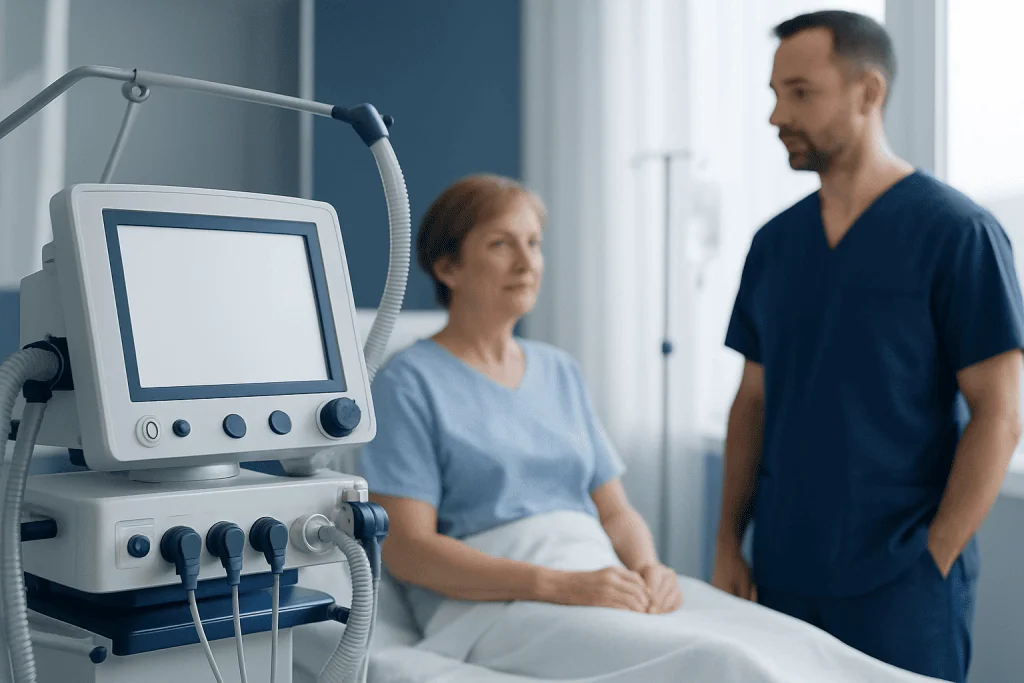
The biggest single factor is the type of treatment. A diagnostic procedure under light sedation and a major operation under general anaesthesia sit at opposite ends of the scale. Between them lie dental surgery, cosmetic procedures, orthopaedic operations, abdominal surgery and cardiac or thoracic procedures, each with its own considerations. If you had sedation or general anaesthesia, that alone adds a short waiting period before independent travel makes sense: our guide on flying home after sedation or anaesthesia covers this in detail.
Your individual recovery matters as much as the procedure name. Before agreeing a travel date, doctors typically check whether pain is controlled with oral medication, whether you can walk, eat, drink and use the bathroom normally, and whether the wound is healing as expected. They also weigh bleeding risk, swelling, any drains or dressings still in place, and, for longer flights, the risk of blood clots in the legs, which rises with immobility after surgery.
The journey itself is the third variable. A short direct flight home is a very different proposition from twelve hours in the air with a connection and a long transit walk. For long-haul routes, teams sometimes advise a later departure than they would for a short hop, or add precautions such as compression stockings, aisle seating and scheduled movement. These are exactly the situations covered in our guide on when you may need extra recovery time in Turkey before flying home.
- Type and extent of the treatment
- Whether sedation or general anaesthesia was used
- Pain control, mobility and general strength
- Bleeding risk, swelling and clot risk
- Drains, dressings, casts or stitches still in place
- Flight duration, stopovers and airport walking distances
Typical waiting times by type of treatment
General guidance published by bodies such as the NHS, and used by airline medical departments, gives broad ranges for common situations. Treat the figures below as orientation only. They describe typical practice, not your case, and your surgeon’s advice always overrides them, sometimes in either direction.
| Situation | Commonly discussed waiting period | Why |
|---|---|---|
| Light sedation, no surgery (e.g. endoscopy) | Around 24 hours | Time for sedative effects to clear fully |
| General anaesthesia, minor procedure | Roughly 24–48 hours | Recovery from anaesthesia, early check for complications |
| Dental implants and oral surgery | A few days for routine cases; longer if the sinuses were involved | Bleeding control, pressure changes affecting sinuses |
| Keyhole abdominal surgery | Around four to five days | Trapped gas from the procedure, early wound healing |
| Open abdominal surgery | Often around ten days | Larger wound, higher strain from pressure changes and lifting |
| Cosmetic facial surgery (facelift, rhinoplasty) | Often about a week in Turkey, sometimes longer | Swelling settling, dressing or splint removal, surgical review before departure |
| Orthopaedic surgery, casts or limited mobility | Variable; airlines have their own rules for fresh casts | Swelling under the cast, seating and mobility needs on board |
| Chest, cardiac or eye surgery involving a gas bubble | Often several weeks; gas in the eye means no flying until it has been absorbed | Trapped gas expands at cabin altitude and can cause serious harm |
Two points are worth underlining. First, these ranges answer the general question of how long after surgical treatment you can fly: they do not tell you when you can fly. Second, some procedures fall well outside the ranges: patients who have had eye surgery with an intraocular gas bubble, a collapsed lung, or major cardiac surgery follow their own timelines set by the specialist. If dental work brought you to Turkey, the specifics are covered in our guide on flying after dental surgery and dental implants.
Questions to ask your doctor before booking or changing your flight

Raise the travel question early, ideally before treatment, and again before discharge. Ask directly: “When do you expect it will be safe for me to fly home?” If the answer is a range rather than a date, ask what would move you towards the earlier end and what would push the date back. Knowing both sides of that range lets you book sensibly instead of gambling on the earliest possible flight.
Ask whether your treatment carries specific travel restrictions. Common examples include avoiding heavy lifting for a period, not sitting still for long stretches without moving, not driving yourself, and keeping dressings in place until a set review. If you are taking anticoagulants, painkillers, antibiotics or any regular medication, ask your doctor how to schedule doses across the travel day and any time-zone change: this is a decision for the treating team, not something to work out alone at the departure gate.
Finally, ask whether your airline will want written clearance. Some carriers require a medical information form or a fit-to-fly letter after recent surgery, particularly within a set number of days of the operation or when you are travelling with a cast, oxygen or other equipment. Our guide on when you need fit-to-fly clearance explains which situations typically trigger this requirement and how the paperwork works. If you need interpreter support for any of these conversations, ask for it while you are still in the hospital.
Passports, entry rules and the current travel picture for Turkey
Two questions come up constantly from patients planning the trip in the first place, so it is worth answering them plainly.
Can you travel to Turkey with three months left on your passport? For many nationalities, no. Turkey generally requires that your passport be valid for at least 150 days from your date of arrival, with at least one blank page: a stricter rule than the three-month or six-month conventions used elsewhere. Requirements vary by nationality and can change, so check your own government’s official travel advice for Turkey before booking. Renewing a passport takes far less effort than rescheduling treatment.
Is travel to Turkey restricted right now? There is no general restriction on travel to Turkey, and Istanbul remains one of the world’s busiest international hubs. Government travel advisories, such as those published by the UK Foreign, Commonwealth & Development Office and the US State Department, are updated regularly and may carry region-specific notes, typically concerning areas near the Syrian border, far from the cities where international patients are treated. Reading the current advisory for your nationality shortly before you travel is the reliable way to answer this question at any given moment.
Getting ready for the airport and the flight
Once your doctor confirms a travel date, preparation becomes practical. Keep the essentials in your hand luggage, never in the hold: passport, tickets, discharge summary, treatment reports, imaging discs or digital access details if provided, prescriptions, medicines in their original packaging, spare dressings, and any medical or fit-to-fly letters. If you will need a wheelchair, priority boarding or help with bags, book airport assistance with the airline in advance: it is free on most carriers but works far better when arranged days ahead rather than on the morning of the flight.
Dress for recovery, not for style. Loose clothing that does not press on the treatment area, footwear you can remove without deep bending, and layers for a cold cabin all make the day easier. If your doctor has recommended compression stockings, put them on exactly as instructed before the journey begins. Arrive with enough time to move through the airport calmly, but avoid long periods of standing if standing causes pain or swelling, assistance services exist precisely for this.
In the air, the priorities are circulation and hydration. Sip water regularly unless your doctor has told you to limit fluids, keep alcohol to a minimum or skip it, and move your feet and ankles often. On longer flights, walk the aisle periodically if your team has said this is appropriate for you; an aisle seat makes this much easier. If you are travelling with a cast, brace or restricted mobility, seating and boarding need extra planning: our guide on flying home with a cast, brace or limited mobility covers the details airlines will ask about.
Documents, medicines and follow-up after you leave Turkey
Before you leave the hospital, confirm you are carrying everything your doctors at home will need: a discharge summary, a full medication list, wound-care instructions, activity restrictions and a written follow-up plan. If stitches, dressings, drains or rehabilitation are involved, the plan should say exactly when and where each should be reviewed after you return.
Carry enough of each prescribed medicine for the whole journey plus a few extra days in case of delays, and keep everything in your cabin bag with the prescriptions. If a medicine can cause drowsiness, nausea or constipation, ask your doctor before departure how best to manage that on a travel day, planning ahead is far easier than troubleshooting at 11,000 metres. Never adjust doses on your own; medication changes belong to your treating doctor.
Follow-up usually continues after you land. Depending on your treatment, this may mean remote review with your team in Turkey, a handover to your local doctor, or both. Ask for the arrangement in writing while you are still in Turkey, so the handover does not depend on your memory after a tiring journey.
How teams decide you are ready, and why dates sometimes move
A travel date agreed at discharge is a plan, not a guarantee, and clinical teams treat it that way. Before an international patient flies, doctors typically look for stable observations, controlled pain, a wound that is healing as expected, adequate eating and drinking, and safe independent mobility for the journey ahead. Certain findings, new or increased bleeding, fever, worsening swelling or pain, breathing difficulty, calf swelling, dizziness or confusion, are the kinds of changes that lead a team to reassess and, where needed, postpone a flight. Our guide on warning signs to report before flying home explains what clinicians look for in that final assessment.
Recovery is rarely a perfectly straight line, and a date that moves by a day or two is a normal part of safe international care, not a sign that something has gone wrong. This is one reason experienced patients build a small buffer into their plans: a flexible or changeable return ticket, accommodation that can be extended, and a schedule at home that does not collapse if the flight shifts. A short delay in Turkey is an inconvenience; it is a far smaller one than travelling before the body is ready.
Step by step
- Ask about travel timing early. Raise your expected return date at the start of treatment, not on your last hospital day, so your doctor can say whether it is realistic and what might change it.
- Book a flexible return window. Avoid the earliest conceivable flight. A changeable ticket and extendable accommodation absorb a moved date without drama.
- Get clear written discharge instructions. Medicines, wound care, activity limits, follow-up dates and the follow-up contact details, all on paper before you leave.
- Check whether your airline needs clearance. Recent surgery, casts and medical equipment can trigger a fit-to-fly requirement. Confirm this before travel day, not at check-in.
- Arrange practical travel support in advance. Wheelchair assistance, priority boarding and baggage help are far easier to book days ahead than at the airport.
- Pack for recovery, not just for travel. Medicines, reports, dressings, water and comfort items go in hand luggage; clothing and seating choices should protect the treatment area.
- Follow in-flight precautions consistently. Hydration, regular leg movement, walking when appropriate and compression measures if recommended, for the whole flight, not just the first hour.
- Know your follow-up plan at home. Confirm before departure who continues your care locally, what they will need from you, and when the first review should happen.
Your checklist
- Agree a travel date, and its flexibility, with your treating doctor
- Check passport validity against Turkey’s entry rules for your nationality
- Collect your discharge summary, reports and medication list
- Confirm whether your airline requires fit-to-fly clearance
- Pack all medicines in original packaging in hand luggage
- Book wheelchair or airport assistance if you may need it
- Note wound-care, dressing and activity instructions in writing
- Keep follow-up contact details with your travel documents
Key takeaways
- There is no universal answer to how long before flying home you can travel after treatment in Turkey: the procedure, your recovery and your flight length all shape the date.
- General guidance ranges from about a day after light sedation to a week or more after major surgery, with some eye, chest and cardiac procedures needing several weeks.
- Your treating doctor’s assessment overrides any general figure, in either direction.
- Long-haul flights usually justify a longer wait and extra precautions such as hydration, movement and compression measures where recommended.
- Discharge documents, a full medicine supply and a written follow-up plan are as important as the flight itself.
- A flexible return ticket turns a moved travel date from a crisis into a footnote.
Frequently asked questions
How long before flying home can you travel after treatment in Turkey?
It depends on the treatment, your recovery and your flight. Light sedation may mean waiting about a day; minor surgery under general anaesthesia often means one to two days; abdominal, orthopaedic or cosmetic surgery commonly means several days to a week or more in Turkey; and some eye, chest and cardiac procedures need several weeks. Your treating doctor sets the actual date after examining you.
How long after surgical treatment can you fly?
General aviation-medicine guidance suggests roughly 24–48 hours after minor surgery under general anaesthesia, around four to five days after keyhole abdominal surgery, and around ten days after open abdominal surgery. Procedures involving trapped gas, some eye and chest operations, can rule out flying for weeks. These are orientation figures only; the surgeon who treated you gives the answer that applies to your case.
How long after surgery can you fly overseas on a long-haul flight?
Usually later than you could take a short flight. Long-haul journeys add hours of immobility, which raises clot risk after surgery, plus connections, transit walking and fatigue. Teams often advise a later departure for long routes and add precautions such as compression stockings, aisle seating, regular movement and steady hydration. The procedure-specific waiting period still applies as the minimum.
Can I travel to Turkey with 3 months left on my passport?
For most nationalities, three months is not enough. Turkey generally requires a passport valid for at least 150 days from your arrival date, with at least one blank page. Rules vary by nationality and can change, so check your own government’s official travel advice for Turkey before booking, and renew your passport early if it is close to the limit.
Is travel to Turkey restricted right now?
There is no general restriction on travel to Turkey. Government advisories, such as those from the UK FCDO and the US State Department, are updated regularly and may include region-specific notes, usually about areas near the Syrian border rather than the major cities where international patients are treated. Check the current advisory for your nationality shortly before travelling.
Can I fly a few days after dental treatment in Turkey?
Often, yes. Routine dental implant placement and straightforward extractions frequently allow travel within a few days once bleeding is controlled and any sedation has worn off. Procedures involving the sinuses, such as sinus lifts, can need a longer wait because cabin pressure changes affect the sinuses. Your dental surgeon confirms the timing for your specific procedure.
What documents should I carry when flying home after treatment?
Carry your discharge summary, medication list, prescriptions, treatment reports, imaging records if provided, and any fit-to-fly or airline medical letters. Keep everything in hand luggage so airline staff, airport medical services or a doctor at home can review them without delay. Medicines should stay in their original packaging alongside the prescriptions.
What happens if my travel date needs to move?
Dates move for ordinary reasons, slower wound healing, swelling that has not settled, or a final review the team wants to repeat. A short postponement is a normal part of safe international care, not a sign of a problem. A changeable return ticket, extendable accommodation and a flexible schedule at home turn a moved date into a minor adjustment rather than a crisis.
Add us as a Preferred Source to see more of our trusted health content across Google Search, AI Overviews and Discover.

Update history
- PublishedAugust 1, 2026
- Medical review approvedSeptember 13, 2026
- Last content updateSeptember 12, 2026
References1
More Patient Guides

Flying After a C-Section: Timing for New Mothers
A C-section is real abdominal surgery that happens to come with a newborn attached, so the flying question has two clocks…

When Can You Drive After Anesthesia or Sedation?
You feel fine an hour after the procedure. You are chatting, you walked to the car unaided, you could obviously drive it.…

Flying After Hip Replacement: When Is It Safe?
Hip replacement recovers famously well, many patients walk further at three weeks than they had in three years. Flying is part…

Flying After Knee Replacement: When Is It Safe?
The knee is new, the physio is going well, and there is a boarding pass with your name on it. Flying after…