

How to Arrange Wheelchair-Friendly Transport and Hotels in Turkey

To arrange wheelchair-friendly transport and hotels in Turkey, define your exact mobility needs first, request airline wheelchair assistance early, book a transfer vehicle that matches your chair rather than a standard taxi, and confirm hotel accessibility details, entrance, lift, bathroom, in writing with photos. Start at least one to two weeks before travel, earlier for power wheelchairs or complex needs.
Will the taxi at the airport actually fit your wheelchair? Will the hotel bathroom really be step-free when you arrive tired after a long flight? These are fair questions, and the honest answer is that in Turkey, as in most countries, the word “accessible” is used loosely. Some providers deliver exactly what they promise. Others use the label for a room with one grab rail and a shower tray you cannot roll into. Careful, specific planning removes most of that uncertainty.
This guide explains how to arrange wheelchair-friendly transport and hotels in Turkey step by step: what to ask airlines, transfer companies and hotels, what to get in writing, how Turkish cities actually behave for wheelchair users, and how to plan around hospital appointments if your trip is for treatment.
At a glance
- Best time to arrange: At least one to two weeks before travel; earlier for power wheelchairs or complex needs
- Most important step: Confirm accessibility details in writing, with photos where possible, not just by phone
- Key bookings: Airline wheelchair assistance, an accessible ground transfer, an adapted hotel room
- What to double-check: Door widths, roll-in shower, step-free entrance, lift size, vehicle type (ramp, lift or large boot)
- Realistic expectation: Newer hospitals, airports and hotels are generally well equipped; older streets and public transport are uneven
- Helpful support: Hospital international patient teams, interpreters, and a companion who knows the full plan
Start with your real mobility needs
Before you try to arrange wheelchair-friendly transport and hotels in Turkey, define exactly what “accessible” has to mean for you. The term covers very different situations: a person who uses a folding manual chair and can transfer into a car seat has completely different requirements from someone who needs to remain seated in a power wheelchair throughout the journey. Providers cannot give you accurate answers unless you give them accurate details.
Think through the trip from your own front door to the hotel bed. That chain includes the departure airport, the aircraft, the arrival terminal, the transfer vehicle, the hotel entrance, the lift, the room door, the bathroom, and, if you are travelling for treatment, the route to your appointments. A single weak link, such as three steps at a hotel entrance or a bathroom door a few centimetres too narrow, can undo an otherwise well-planned trip.
Write down the practical facts before you book anything:
- Wheelchair type: manual, power, or scooter
- Dimensions when in use and, if it folds, when folded
- Total weight, including batteries for a power chair
- Whether you can transfer independently, with help, or not at all
- Whether you need a ramp, a lift-equipped vehicle, or simply a large boot
- Any other equipment travelling with you: walker, cushion, shower chair, charger
If you are bringing your own equipment, read the separate guide on bringing a wheelchair or walker to Turkey for treatmentairlines have specific rules about batteries, gate-checking and reassembly on arrival, and those rules affect the rest of your plan.
How to book wheelchair-friendly airport and city transport

Your transport plan should cover every stage of the journey, not only the flight. Request airport wheelchair assistance from your airline as soon as your booking is confirmed: this covers help from check-in to the aircraft door, and from the arrival gate through passport control to baggage claim. Turkish airports, including Istanbul Airport and Sabiha Gökçen, run assistance services, but they work far more smoothly when notified in advance. The guide on airport wheelchair and mobility assistance in Turkey explains exactly how to request it and what happens at each stage.
If you use a power wheelchair, confirm the airline’s battery rules well before departure. Lithium batteries in particular have documentation and handling requirements, and sorting them out at the check-in desk is stressful and sometimes impossible.
For ground transport, do not assume a standard taxi will work. Turkish city taxis are often compact saloons; a folded manual chair may fit in some, a power chair will not fit in any. Be explicit about what you need:
- A larger vehicle with boot space for a folding chair, if you can transfer into a car seat
- A ramp- or lift-equipped van with tie-down points, if you need to remain seated in your wheelchair
- Enough space for a companion and your luggage, including any medical items
When booking, share your flight number, expected arrival time, wheelchair dimensions and transfer ability, and ask for the exact pickup point at the terminal. Keep a local contact number for the driver or company on travel day. Dedicated services exist for exactly this situation, see wheelchair-accessible transfers in Turkey for medical patients for how they work and what to confirm.
If you are travelling for treatment, hospital international patient teams routinely coordinate transfer timing with appointment schedules and interpreter support. That coordination is worth using: after a long flight, the difference between a matched, pre-briefed transfer and an improvised one at the taxi rank is considerable.
Getting around Turkish cities: an honest picture
Is Turkey good for wheelchair users? The fair answer is: mixed, and improving. Modern infrastructure, new airports, metro lines, shopping centres, private hospitals and recently built hotels, is generally designed with accessibility in mind. Older infrastructure is not. Historic districts in Istanbul, Antalya and other cities feature steep hills, cobblestones, high kerbs and pavements interrupted by parked cars or café tables. Plan for both realities rather than either extreme.
| Transport option | What to expect | Practical note |
|---|---|---|
| Pre-booked accessible transfer | The most reliable option; vehicle matched to your chair in advance | Confirm ramp/lift, tie-downs and pickup point in writing |
| Standard city taxi | Usually a compact saloon; suitable only if your chair folds and you can transfer | Not bookable by accessibility feature at the kerb |
| Metro and modern tram lines | Newer stations have lifts and level boarding; older stations vary | Check the specific stations on your route, not the network in general |
| City buses | Many newer buses have ramps; deployment depends on the stop and the driver | Workable for confident users; less predictable with a power chair |
| Intercity coach or domestic flight | Domestic flights are usually the easier choice for longer distances | Airport assistance applies to domestic flights too, request it |
For a medical trip, the practical conclusion is simple: pre-booked, door-to-door transfers beat public transport, because they remove the unpredictable links in the chain. Public transport can work well for a confident wheelchair user on a known route with newer stations; it is a poor plan for the day of a hospital appointment.
One more honest note: lists of “the world’s most wheelchair-friendly cities” tend to name places like flat, uniformly modern European cities, and no Turkish city would claim that title. That does not make Turkey unworkable: it means the difference between a smooth trip and a frustrating one is planning, not luck.
Choosing a genuinely accessible hotel room

Do not rely on the “accessible room” label on a booking site. It is applied inconsistently, and booking platforms rarely verify it. Contact the hotel directly, email is better than phone, because it produces a written record, and ask for concrete details:
- Is the route from street to reception to room completely step-free?
- What are the widths of the room door and bathroom door?
- Is the shower roll-in, or is there a raised edge or fixed screen?
- Are there grab rails by the toilet and shower? Can a shower chair be provided?
- What is the bed height, and is there clear space beside the bed for transfers?
- Is the lift large enough for your wheelchair’s dimensions?
Ask for recent photos of the room and bathroom. Pictures reveal what descriptions omit: narrow corridors, heavy doors, furniture blocking the turning space, a “walk-in shower” with a ten-centimetre lip. If the hotel cannot or will not send photos, treat that as information in itself.
Location matters as much as the room. A technically accessible room on a steep cobbled street, or an hour’s drive from your hospital, may still make every day harder. If treatment is the purpose of your trip, staying near the hospital usually beats staying near the sights, shorter journeys conserve energy and make it realistic to return to your room between appointments. Ask whether the restaurant, reception and any terrace are step-free too, not only the bedroom. The guide on choosing a recovery-friendly hotel in Turkey after treatment covers the post-treatment side of this decision in more depth.
Plan around appointments, recovery and daily comfort
If you are coming to Turkey for medical care, your transport and hotel decisions should serve your treatment schedule, not compete with it. Some days will involve tests, waiting time and follow-up visits; a long or complicated commute on top of that becomes exhausting quickly, especially if fatigue, pain or swelling already limit your stamina.
Build slack into the schedule. Traffic in Istanbul and other large cities is heavy and unpredictable, and moving with mobility equipment always takes longer than standard travel. Avoid booking a flight that lands just before a consultation, or a return departure immediately after a demanding appointment. If your treatment involves a hospital stay, note that hospitals themselves provide wheelchairs, stretchers and porter support internally: you do not need to solve in-building transport yourself; see in-hospital patient transport in Turkey for how that works.
If a companion travels with you, plan their logistics too: their transport on your appointment days, their meals during long hospital days, and where they wait or rest. A companion who knows the full plan, routes, contact numbers, backup options, is one of the most valuable accessibility arrangements you can make.
Questions to ask before you confirm anything
The safest way to avoid surprises is to ask direct, specific questions and get the answers in writing. Written confirmation gives you something to point to if there is confusion on arrival, and the act of answering precise questions tends to filter out providers who were guessing.
For transport, ask whether the vehicle has a ramp, a lift, a low floor, or simply a large boot; whether you can stay in your wheelchair during the ride or must transfer to a seat; and whether the driver has experience assisting wheelchair users. For hotels, ask about steps, door widths and the shower threshold in centimetres rather than in adjectives.
- Is the hotel entrance fully step-free from street to reception?
- Are all lifts on the route to the room large enough for your wheelchair?
- Can the bathroom be entered and used independently?
- Is there enough clearance beside the bed for transfers?
- Can the transfer provider accommodate medical equipment and a companion?
- Is there a direct contact person if plans change at short notice?
Useful backup plans for a smoother stay
Even careful preparation cannot control everything. A flight is delayed, a room does not match its photos, a driver arrives with the wrong vehicle. Backup plans turn these from crises into inconveniences.
Save every confirmation, hotel emails, transfer messages, hospital appointment details, on your phone and on paper. Carry essentials in hand luggage: medications, charger cables for your mobility equipment, a small repair kit if you use one, and key medical documents. If your own equipment is damaged in transit or proves unsuitable, wheelchairs, walkers and crutches can be rented locally; the guide on renting mobility aids in Turkey explains where and how.
If a hotel room turns out not to match its written description, ask for a different room or, if none is suitable, use your written confirmation to negotiate a cancellation and move: this is exactly why email beats phone. If you are in Turkey for treatment, your hospital’s international patient coordinators can often help you communicate with a hotel or transfer company and reorganise urgent arrangements, particularly when language is a barrier.
Step by step
- List your accessibility requirements. Write down exactly what you need for transport, the hotel room and hospital visits: wheelchair type and dimensions, transfer ability, bathroom needs, and whether a companion is travelling with you.
- Book airline assistance early. Request airport wheelchair support as soon as your flight is confirmed. If you use a power wheelchair, sort out battery rules, check-in procedure and arrival assistance well in advance.
- Arrange the right transfer vehicle. Do not assume a regular taxi will do. Specify whether you need extra boot space, a ramp, a lift, or a vehicle that lets you remain seated in your chair with tie-downs.
- Verify the hotel room in detail. Email the hotel directly for measurements, photos and bathroom details. Make sure the room is accessible in practice, not just in name.
- Coordinate hotel and hospital locations. Choose accommodation with realistic travel times to your appointments. Shorter journeys reduce fatigue and keep the schedule workable.
- Get written confirmation of everything. Have the hotel and transfer provider confirm accessibility features by email or message. Written proof settles disputes on arrival.
- Prepare a simple backup plan. Keep booking references, local contacts and rental options for mobility equipment easy to reach, so a change of plan stays manageable.
Your checklist
- Wheelchair dimensions and weight noted down
- Airline airport assistance requested
- Power wheelchair battery rules checked, if relevant
- Accessible transfer vehicle confirmed in writing
- Hotel room photos or measurements reviewed
- Step-free entrance and lift access verified
- Bathroom layout confirmed, including shower threshold
- Hospital-to-hotel travel time checked at realistic traffic hours
- Companion’s logistics planned for appointment days
- Important contacts saved on phone and printed
- Medications and mobility essentials packed in hand luggage
Key takeaways
- Define your exact mobility needs before booking flights, transport or accommodation, providers can only match what you specify.
- Pre-booked, door-to-door transfers are more reliable than taxis or public transport for wheelchair users, especially on appointment days.
- Ask hotels for measurements and photos, and get accessibility features confirmed in writing rather than trusting labels.
- Match your hotel location and transfer plan to your treatment schedule to reduce fatigue.
- Carry confirmations, contacts and equipment essentials with you, and know where mobility aids can be rented locally if something goes wrong.
Frequently asked questions
How far in advance should you arrange wheelchair-friendly transport and hotels in Turkey?
Start as soon as your travel dates are reasonably firm, at least one to two weeks before departure. Book earlier if you use a power wheelchair, need a lift-equipped vehicle, or are travelling during summer or holiday periods, when adapted vehicles and genuinely accessible rooms are booked first.
Is Turkey good for wheelchair users?
It is mixed and improving. New airports, metro lines, private hospitals and recently built hotels are generally well designed for wheelchair access. Older districts have steep streets, cobblestones and high kerbs. With pre-booked transfers and a properly verified hotel, most trips work well; spontaneous, unplanned travel is harder.
What is the best way to get around in Turkey as a wheelchair user?
Pre-booked accessible transfers are the most reliable option for door-to-door journeys, because the vehicle is matched to your chair in advance. Newer metro and tram lines can work on routes with lift-equipped stations. For longer distances, domestic flights with airport assistance are usually easier than intercity coaches.
Is medical care free in Turkey for tourists?
No. Visitors are not covered by the Turkish public health system, so tourists and international patients pay for the care they receive, either directly or through travel or health insurance. Planned treatment is normally quoted by the hospital in advance, based on the specific procedure and your medical records; emergency care is billed to the patient or their insurer.
Can you rely on a hotel’s website description of an accessible room?
Treat it as a starting point only. Booking platforms rarely verify accessibility claims, and standards vary widely. Email the hotel directly for door widths, shower details, bed height and photos, and keep the written replies with you when you check in.
What should you tell a transfer company before arrival?
Share your wheelchair type, its dimensions and weight, whether it folds, whether you can transfer into a car seat, how much luggage you have, and whether a companion is travelling with you. Add your flight number and a contact method in case the pickup point or timing changes.
What if your accessible room or vehicle is not what was promised?
Refer to your written confirmation and ask the provider for an immediate solution: a different room, a replacement vehicle, or a cancellation without penalty. If you are in Turkey for treatment, your hospital’s international patient team can often help you communicate with the provider and reorganise arrangements quickly.
Add us as a Preferred Source to see more of our trusted health content across Google Search, AI Overviews and Discover.

Update history
- PublishedJuly 8, 2026
- Medical review approvedSeptember 1, 2026
- Last content updateSeptember 1, 2026
References2
More Patient Guides

Airport Wheelchair Assistance: How to Book It for a Medical Trip
Airport wheelchair assistance is free, it exists at every commercial airport, and airlines are legally required to provide it, yet half…

Travelling With a Stoma: Flights, Supplies and Airport Screening
Traveling to Turkey with a stoma is manageable with the right supplies, airport screening plan, and recovery support in Istanbul or Turkey.
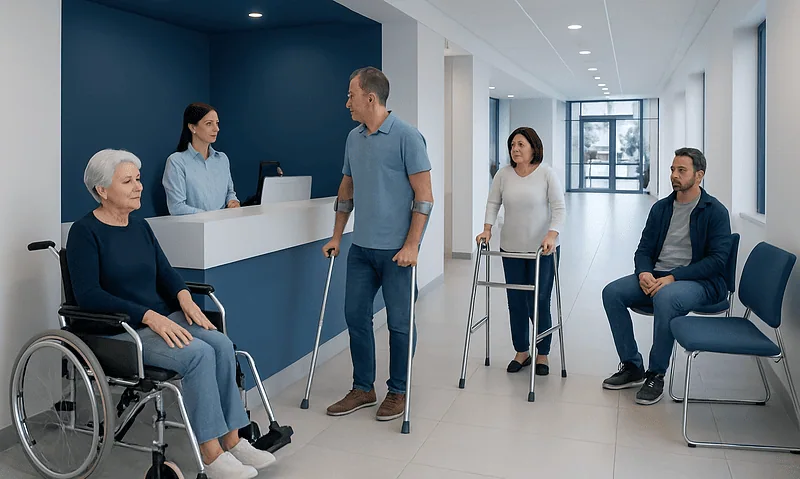
Mobility Aids in Turkey: Renting a Wheelchair, Walker, or Crutches
Mobility aids in Turkey can be rented through medical suppliers, pharmacies, and hospital-linked services in Istanbul and other cities.

Traveling to Turkey with Food Allergies or Special Diet Needs
Traveling to Turkey with food allergies or special diet needs is manageable with planning, translated allergy cards, and hotel and hospital support…