LASIK Eye Surgery in Turkey: Treatment Guide
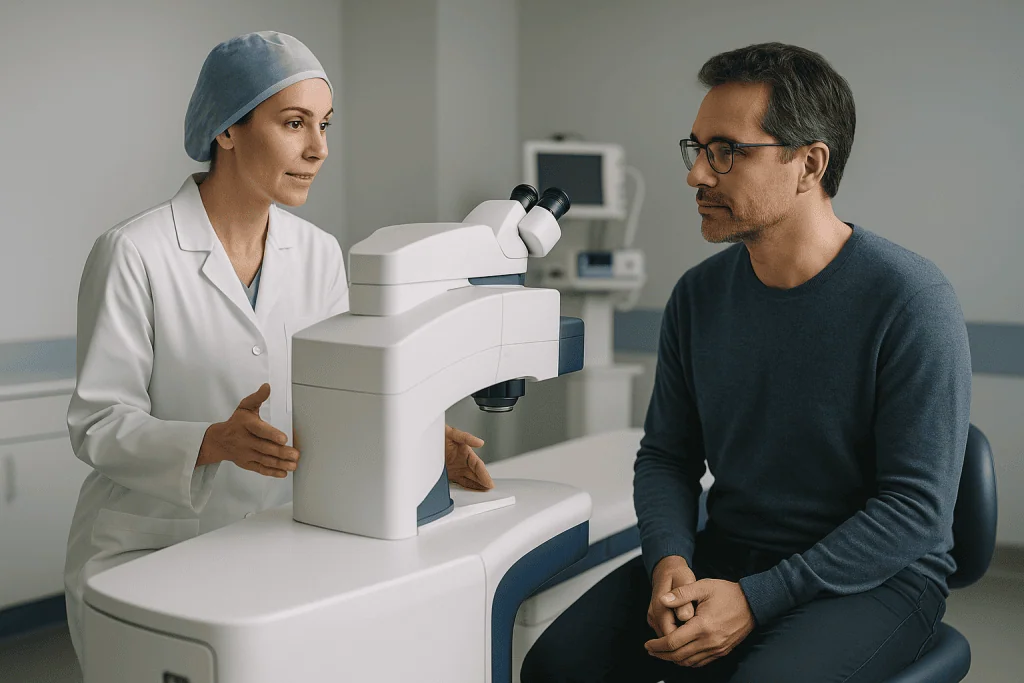
LASIK eye surgery is a laser procedure that reshapes the cornea to correct refractive errors such as myopia, hyperopia, and astigmatism, reducing dependence on glasses or contact lenses. At Acibadem in Turkey, care begins with a detailed eye evaluation to confirm suitability, followed by a short outpatient procedure and postoperative follow-up to support recovery and visual outcomes.
This guide explains what LASIK eye surgery involves, who may be suitable, how to prepare for treatment in Turkey, and what to expect during recovery. It also outlines international patient support at Acibadem International, including evaluation, travel coordination and follow-up.
At a glance
- Procedure type: Outpatient laser refractive eye surgery
- Purpose: To reduce dependence on glasses or contact lenses for suitable patients
- Anesthesia: Local anesthetic eye drops
- Hospital stay: Usually no overnight stay
- Estimated recovery: Vision often improves within days; stabilization may take weeks to months
- Return to daily life: Often within 1 to 3 days, depending on your eye comfort and your doctor’s advice
- Final result timeline: Typically assessed after 1 to 3 months, sometimes longer if dryness or healing changes occur
- Suitable department: Ophthalmology / Refractive Surgery
- International patient support: Online coordination, interpreters, transfers, accommodation guidance and remote follow-up
What is this treatment?
LASIK, short for laser-assisted in situ keratomileusis, is a laser vision correction procedure designed to reshape the cornea, the clear front surface of the eye. By changing the corneal shape, LASIK can help light focus more accurately on the retina, which may reduce your dependence on glasses or contact lenses.
The treatment is most commonly used for myopia, also called short-sightedness, hyperopia, also called long-sightedness, and astigmatism. It is performed using highly controlled laser technology after detailed measurements of your eyes, including corneal thickness, corneal shape, pupil size, tear film and prescription stability.
LASIK is usually a short outpatient procedure performed with anesthetic eye drops. Although many people notice clearer vision quickly, the healing process continues over time, and your final result depends on your eye structure, prescription, healing response and suitability for the procedure.
When is it recommended?

LASIK may be recommended when you want to reduce reliance on glasses or contact lenses and your ophthalmologist confirms that your eyes are medically suitable. It can be considered for daily convenience, sports, professional needs or contact lens intolerance, provided the expected benefits are balanced against possible risks.
Your prescription should generally be stable before treatment. If your vision has continued to change, your doctor may advise waiting, repeating measurements or considering another option. Eye health is just as important as prescription strength, so screening for dry eye, keratoconus risk, cataract, glaucoma and retinal conditions is part of responsible planning.
LASIK is an elective treatment, meaning it is not urgent in most cases. This gives you time to ask questions, understand alternatives and make a decision after a proper examination rather than relying only on online eligibility or general information.
Who is a good candidate?

A good candidate is typically an adult with a stable refractive error, realistic expectations and healthy eyes. Adequate corneal thickness and a regular corneal shape are essential because LASIK involves creating a corneal flap and reshaping tissue with a laser.
You may be less suitable for LASIK if you have significant dry eye, thin or irregular corneas, suspected keratoconus, uncontrolled eye disease, certain autoimmune conditions, uncontrolled diabetes, active eye infection, pregnancy-related vision changes or unrealistic expectations of perfect vision in every situation. Your ophthalmologist will assess these factors carefully.
Being a good candidate is not only about whether LASIK can be performed, but whether it is the safest and most appropriate option for you. At Acibadem International, the ophthalmology team evaluates your measurements, eye health and lifestyle needs before recommending LASIK or another refractive approach.
Treatment options
LASIK may be performed using different planning and laser technologies depending on your eye measurements. In femtosecond LASIK, a femtosecond laser is used to create a thin corneal flap, after which an excimer laser reshapes the cornea. Some treatment plans may use wavefront-guided or topography-guided mapping to address individual optical characteristics when appropriate.
Not every patient is best served by LASIK. If your cornea is thinner, your occupation has a higher risk of eye trauma, or your measurements suggest a better safety profile with another approach, your doctor may discuss PRK, LASEK, transepithelial PRK, SMILE or implantable contact lens options. For patients with age-related lens changes or cataract, lens-based surgery may be more relevant than corneal laser treatment.
Presbyopia, the age-related need for reading glasses, requires special discussion. Some patients may be considered for monovision, where one eye is adjusted more for distance and the other for near tasks, but this is not suitable for everyone and may require a trial with contact lenses before surgery.
Online evaluation before travel
Before you travel to Turkey, an online evaluation can help the medical team understand your goals and identify whether LASIK is worth exploring in person. You may be asked to share your current glasses or contact lens prescription, previous eye surgery history, medical conditions, medications and any available eye test results.
For refractive surgery, online review is helpful but cannot replace an in-person examination. Critical measurements such as corneal tomography, corneal thickness, tear film assessment, dilated retinal examination and precise refraction need to be completed at the hospital before a final treatment decision is made.
Acibadem International’s patient coordinators can guide you on which documents to send, how to schedule your appointments and how long you may need to remain in Turkey. If the preliminary review suggests that LASIK may not be the best option, you can still be directed toward an appropriate consultation for alternatives.
Before the treatment
Your preparation begins with a comprehensive eye examination. This may include vision testing, refraction, corneal mapping, eye pressure measurement, tear film evaluation, pupil assessment and retinal examination. Your doctor may use dilating drops, which can make your vision temporarily blurry and light-sensitive on the day of testing.
If you wear contact lenses, you may be asked to stop wearing them for a period before measurements because contact lenses can temporarily alter corneal shape. The exact timing depends on the type of lenses you use and your doctor’s advice. You should also inform the team about allergies, pregnancy, breastfeeding, chronic illnesses, previous eye infections and any history of dry eye.
On the day of treatment, you should avoid eye makeup, perfume, heavy creams or products around the eyes unless your care team gives different instructions. Arrange for someone to accompany you after the procedure, as you should not drive immediately following LASIK.
What happens during the treatment
LASIK is usually performed while you are awake, using anesthetic eye drops to keep the eye comfortable. A device gently helps keep your eyelids open, and you will be asked to look at a fixation light. It is normal to feel pressure at certain moments, but the procedure is generally brief.
During femtosecond LASIK, the surgeon creates a thin flap in the cornea. The flap is lifted, and an excimer laser reshapes the underlying corneal tissue according to your personalized treatment plan. The flap is then repositioned, where it begins to adhere naturally without stitches.
Both eyes may often be treated on the same day if your ophthalmologist considers it appropriate. After treatment, your vision may be hazy, watery or light-sensitive, and you will receive instructions about eye drops, protective measures and your first control visit.
Hospital stay and discharge
LASIK is usually an outpatient treatment, so an overnight hospital stay is not typically required. You will spend time at the clinic or hospital for preparation, the procedure itself and early post-treatment checks. The medical team will make sure you understand your eye drop schedule and immediate precautions before you leave.
You should rest your eyes after discharge and avoid driving, reading for long periods or using screens intensively on the first day unless your doctor advises otherwise. Mild burning, watering, a gritty sensation and light sensitivity can be expected early on, but these symptoms should gradually improve.
International patients should plan to stay long enough for at least the first post-treatment control. Your doctor will advise whether you are fit to travel and whether any additional local checks are needed before you return home.
Recovery timeline
Recovery after LASIK is usually faster than many other eye surgeries, but each person heals differently. Your vision may fluctuate during the first days and weeks, especially with dryness, screen use, night driving or long flights.
| Timeframe | What to expect |
|---|---|
| First 24 hours | Watery eyes, light sensitivity, mild burning or gritty feeling may occur. Rest, use prescribed drops and avoid rubbing your eyes. |
| First week | Vision often becomes clearer, but dryness and fluctuation are common. You may attend early control visits and follow activity restrictions. |
| Weeks 2-4 | Most daily activities become easier. Dryness, glare or halos may continue, especially at night or with prolonged screen use. |
| Months 1-3 | Vision typically becomes more stable. Your doctor may reassess tear film, refraction and healing progress. |
| Final result | Final visual outcome is usually judged after healing has stabilized. Some patients need more time, and a small number may need further management or enhancement if medically suitable. |
Your recovery plan may include lubricating drops, medicated drops and temporary activity limitations. Follow the schedule exactly as provided, and do not restart contact lenses, eye makeup or swimming until your ophthalmologist confirms it is safe.
What to avoid after treatment
After LASIK, the most important early precaution is to avoid rubbing your eyes. Rubbing can irritate the healing surface and, in the early period, may disturb the corneal flap. You may be given protective shields or guidance for sleep during the first nights.
You should avoid swimming pools, hot tubs, saunas, dusty environments and eye makeup until your doctor allows them. It is also wise to limit heavy screen use during the first day or two and take frequent breaks afterward, because reduced blinking can worsen dryness.
Contact sports and activities with a risk of eye impact should be postponed according to medical advice. When outdoors, sunglasses can help with light sensitivity and wind exposure, especially during travel.
Risks and possible complications
LASIK is widely performed, but it is still a medical procedure and has potential risks. Temporary dryness, glare, halos, starbursts, light sensitivity, fluctuating vision and reduced night vision comfort can occur, particularly during the healing period.
Less commonly, patients may experience infection, inflammation, delayed healing, under-correction, over-correction, regression, flap-related problems or changes in corneal stability. Some effects may require additional treatment, more frequent follow-up or, in selected cases, enhancement surgery if it is medically safe.
A careful pre-operative assessment helps reduce risk but cannot eliminate it completely. Your surgeon will discuss your individual risk factors, explain alternatives and help you decide whether LASIK is appropriate for your eyes and expectations.
Warning signs: when to contact a doctor
Mild discomfort, tearing and temporary blur can be part of early healing, but certain symptoms require prompt medical advice. If you are an international patient, keep your Acibadem International contact details easily available and share any concerns early rather than waiting.
- Severe or worsening eye pain that does not improve with the recommended plan
- Sudden decrease in vision or a new dark shadow in your vision
- Increasing redness, swelling or discharge from the eye
- New flashes, many new floaters or curtain-like visual changes
- Eye trauma, rubbing injury or anything striking the eye after surgery
- Marked light sensitivity with worsening discomfort
- Persistent nausea, severe headache or eye pressure symptoms
- Any symptom that feels unusual or significantly worse than what you were told to expect
If you have already returned home, you may be advised to attend a local ophthalmologist urgently while also updating the Acibadem team. Timely evaluation is important for protecting your eye health.
Results and expectations
The aim of LASIK is to reduce dependence on glasses or contact lenses, especially for distance vision. Many patients are pleased with improved practical vision, but results vary based on prescription, corneal characteristics, age, healing response and lifestyle needs.
LASIK does not stop natural eye changes over time. Presbyopia may still develop with age, meaning reading glasses may be needed later, and cataracts can still occur in older adulthood. Some patients may still prefer glasses for night driving, fine detail work or prolonged screen use.
Occasionally, residual prescription or regression may lead to consideration of enhancement surgery, but this depends on corneal safety and eye health. Your doctor will explain what level of correction is realistically expected for you before treatment.
International patient travel planning
Planning LASIK abroad is usually straightforward when your appointments are coordinated in advance. You should allow time for in-person testing, physician consultation, the treatment itself and at least one early post-treatment control before flying home.
Because your pupils may be dilated during examination and your vision may be blurry after treatment, avoid scheduling important meetings, long sightseeing days or self-driving immediately around your appointments. Bring sunglasses, any current glasses, prescription records and enough time flexibility in case your doctor recommends additional evaluation.
Acibadem International can help coordinate airport transfers, interpreter support, appointment scheduling and accommodation guidance. Remote follow-up can also be arranged when appropriate, although urgent symptoms after returning home may still require local ophthalmic care.
Cost and package information
The cost of LASIK in Turkey can vary depending on the type of laser technology used, whether one or both eyes are treated, the complexity of your prescription, the need for additional diagnostic testing, the surgeon’s treatment plan and whether alternative procedures are recommended instead of LASIK.
A typical international patient plan may include the ophthalmology consultation, pre-operative eye measurements, the LASIK procedure, standard hospital services related to the treatment, interpreter coordination and early follow-up visits. The exact inclusions should always be confirmed in your written quotation.
Items not always included may involve flights, accommodation, personal expenses, travel insurance, additional consultations for unrelated eye conditions, extra medications beyond the standard plan or further treatment if another diagnosis is found. Acibadem International provides individualized quotations after reviewing your information and confirming medical suitability.
Why choose Acibadem
Acibadem International supports patients who travel to Turkey for medical care through JCI-accredited hospitals, experienced ophthalmology teams and coordinated international patient services. For LASIK, careful screening and appropriate patient selection are central to safe planning.
Your care pathway may include online coordination before travel, interpreter support during appointments, transfer organization, accommodation guidance and assistance with follow-up communication after you return home. This is especially helpful when you are making decisions in a different country and may need clear explanations in your preferred language.
The focus is on recommending the right treatment for your eyes, not simply performing LASIK for every patient. If your examination shows that another option is safer or more suitable, the medical team will discuss alternatives and help you understand the reasons.
Medical review and disclaimer
This guide has been reviewed by the Acibadem International medical team to provide general information for international patients considering LASIK eye surgery in Turkey. It is intended to help you understand the patient journey, common expectations and questions to discuss with your doctor.
The information here does not replace a personal consultation, eye examination or medical advice from a qualified ophthalmologist. LASIK suitability depends on detailed measurements, eye health, medical history and your individual goals.
No treatment result can be guaranteed, and recovery experiences vary from person to person. Your physician will explain the benefits, risks, alternatives and follow-up plan that apply specifically to you.
Step by step
- Initial contact. You contact Acibadem International and share that you are interested in LASIK eye surgery in Turkey. A patient coordinator explains the general process and the information needed for a preliminary review.
- Medical record / photo submission. You send your glasses or contact lens prescription, previous eye test results if available, medical history, medication list and any relevant eye reports. Photos are usually less important for LASIK than accurate prescriptions and diagnostic records.
- Preliminary medical review. The ophthalmology team reviews your information to assess whether LASIK may be worth evaluating in person. This review cannot confirm eligibility because corneal mapping and other tests must be performed at the hospital.
- Treatment plan and quotation. If LASIK appears potentially suitable, you receive an outline of the expected pathway and an individualized quotation based on available information. Final confirmation is made only after your in-person examination.
- Travel planning. Your coordinator helps you plan appointment dates, airport transfers, accommodation guidance and interpreter support. You are advised to allow enough time in Turkey for testing, treatment and early control.
- Arrival. When you arrive in Turkey, international patient services can assist with transfer arrangements and help you reach your hotel or hospital appointment smoothly.
- In-person consultation. You meet the ophthalmologist, discuss your goals and undergo a detailed eye examination. Your doctor explains whether LASIK or another refractive option is most suitable.
- Pre-operative tests. Your eyes are measured with diagnostic tests such as refraction, corneal mapping, corneal thickness assessment, tear film evaluation and retinal examination when indicated.
- Treatment. If you are medically cleared and choose to proceed, LASIK is performed using anesthetic eye drops. The laser treatment is usually brief, and both eyes may be treated on the same day if appropriate.
- Hospital stay. LASIK usually does not require an overnight stay. You remain under observation for a short period and receive instructions about drops, eye protection and activity limits.
- First control. Your first post-treatment control checks early healing, vision and eye comfort. The doctor confirms your next steps and whether your travel plan remains appropriate.
- Discharge / travel clearance. Before returning home, your doctor advises whether you are fit to travel and explains precautions for the flight, screen use, eye drops and warning signs.
- Remote follow-up. After you return home, Acibadem International can help with remote follow-up communication when appropriate. If urgent symptoms occur, you should also seek prompt local ophthalmology care.
Your checklist
- Valid passport and travel documents
- Current glasses prescription and, if available, contact lens prescription
- Previous eye examination reports or laser surgery records
- List of current medications, supplements and eye drops
- Known allergies, especially medication or eye drop allergies
- History of eye disease, infections, dry eye, trauma or previous eye surgery
- Medical history, including diabetes, autoimmune disease or pregnancy status where relevant
- Information about contact lens type and wearing schedule
- Current symptoms such as dryness, glare, halos, fluctuating vision or eye pain
- Relevant imaging or test results, such as corneal topography or tomography, if previously performed
- Travel insurance details and emergency contact information
Key takeaways
- LASIK may suit adults with stable glasses or contact lens prescriptions, healthy corneas and realistic expectations.
- A detailed eye examination is essential; not everyone is suitable for LASIK, and alternatives such as PRK, SMILE or lens-based options may be recommended.
- Most patients do not need an overnight hospital stay, but you should plan enough time in Turkey for consultation, testing, treatment and early control visits.
- Temporary dryness, glare, halos or fluctuating vision can occur during healing and should be discussed with your ophthalmologist.
- You should contact your doctor promptly if you notice severe pain, sudden vision loss, increasing redness, discharge or a new injury to the eye.
Frequently asked questions
Am I suitable for LASIK eye surgery?
Suitability depends on your prescription stability, corneal thickness, corneal shape, tear film, age, eye health and expectations. An online review can help guide planning, but only an in-person ophthalmology examination can confirm whether LASIK is appropriate for you.
How long should I stay in Turkey for LASIK?
Many patients plan a short stay that includes consultation, diagnostic testing, treatment and at least one early control visit. Your exact length of stay depends on appointment availability, your eye findings and whether the doctor recommends additional monitoring before travel.
Is LASIK painful?
LASIK is performed with anesthetic eye drops, so sharp pain is not expected during the procedure. You may feel pressure and, afterward, temporary burning, watering, light sensitivity or a gritty sensation during early healing.
When can I fly after LASIK?
Flying may be possible after your early post-treatment control if your ophthalmologist confirms that healing is satisfactory. Airplane cabins can worsen dryness, so you should use drops as instructed and avoid touching or rubbing your eyes.
When can I return to work?
Many people return to desk-based work within a few days, depending on vision comfort and dryness. If your job involves dust, chemicals, heavy physical work or risk of eye injury, your doctor may recommend a longer break or specific eye protection.
Will I still need glasses after LASIK?
The goal is to reduce your dependence on glasses or contact lenses, but perfect spectacle-free vision in every situation cannot be guaranteed. Some patients may still need glasses for night driving, fine detail tasks or reading as they age.
What affects the cost of LASIK in Turkey?
Cost can be influenced by the technology used, whether one or both eyes are treated, the complexity of your case, required diagnostic testing and the overall care package. A personalized quotation is provided after your information is reviewed and suitability is assessed.
Is LASIK safe?
LASIK is widely performed, but it has risks like any medical procedure. Careful screening, modern diagnostic testing and an experienced ophthalmology team help reduce risk, but your individual suitability must be confirmed before treatment.
What if I am not suitable for LASIK?
If LASIK is not the best option, your doctor may discuss alternatives such as PRK, LASEK, SMILE, implantable contact lenses or lens-based procedures depending on your eye structure and age. The safest recommendation is based on your examination, not on a single preferred procedure.
Can both eyes be treated on the same day?
Both eyes are often treated on the same day when the patient is suitable and the doctor considers it appropriate. In some cases, treatment may be staged or postponed if measurements, dryness or eye health findings require caution.
How long do LASIK results last?
The corneal correction is intended to be long lasting, but your eyes can still change naturally over time. Age-related reading vision changes, cataracts or shifts in prescription may occur later and may require glasses or other treatment.
How does Acibadem support international patients after they return home?
Acibadem International can assist with remote follow-up communication and help you understand your post-treatment instructions. If urgent symptoms occur after you return home, you should seek local ophthalmology care promptly while also informing the Acibadem team.
Add us as a Preferred Source to see more of our trusted health content across Google Search, AI Overviews and Discover.

More Patient Guides

Day Surgery in Turkey: Can You Leave Hospital the Same Day?
Day surgery in Turkey often lets you go home the same day if your procedure and recovery are suitable and your doctor…
11 min read
General Anesthesia in Turkey: How to Prepare and What Happens Before You Sleep
General anesthesia in Turkey helps you sleep safely through surgery. Learn preparation, recovery, risks, and travel planning in Istanbul.
11 min read
Choosing Between Outpatient and Inpatient Treatment in Turkey: What Affects the Decision
Choosing Between Outpatient and Inpatient Treatment in Turkey depends on your procedure, health, recovery needs and travel plans.
11 min read