

Managing Hospital Room Temperature and Air Conditioning in Turkey

Patient rooms in Turkish private hospitals are climate-controlled, usually through a central system with some room-level adjustment. If your room feels too hot or too cold, tell your nurse: this is a routine request, and staff can adjust settings, change bedding or call maintenance. Do not use personal heaters or fans without approval, and pack light layers, because hospital areas are cooled differently.
It is 2am, the room feels freezing, and you cannot work out whether the panel on the wall does anything. This is one of the most common first-night questions international patients ask, and the answer is usually simpler than you expect: press the call button and ask. Adjusting room comfort is a routine part of nursing work, not an imposition.
Managing hospital room temperature and air conditioning in Turkey is mostly a matter of knowing how the system works, what you can change yourself, and who to ask for everything else. Hospital rooms in Turkey are climate-controlled, but your comfort still depends on the season, the room’s position, central system settings and your own preferences. This guide explains all of it: how hospital air conditioning differs from what you have at home, what temperature ranges hospitals aim for, how to ask for changes, and what not to do.
At a glance
- Best first contact: your nurse, or your international patient coordinator if language is a barrier
- Common setup: central HVAC with room-level controls in many patient rooms; some areas are fixed for clinical reasons
- Typical patient room range: roughly 20–24°C, though individual rooms vary
- What you can request: temperature adjustment, vent redirection, extra or lighter bedding, a maintenance check
- What to avoid: blocking vents, opening sealed windows, or using personal heaters, fans or humidifiers without approval
- Companion comfort: the sofa bed area may feel different from the patient bed, ask early about bedding
What to expect from hospital room temperature in Turkey
Hospital room temperature in Turkey is managed through heating, ventilation and air conditioning (HVAC) systems that run year-round. In private hospitals, patient rooms are designed to hold a steady indoor environment while still allowing reasonable adjustment for comfort. A hospital room will never feel exactly like a hotel room, and there is a reason for that: the building has to balance your comfort against hygiene requirements, the needs of medical equipment, staff workflow and the patients in neighbouring rooms.
Turkey’s climate matters more than many patients expect. Istanbul is humid in summer and cold and damp in winter. Ankara has hot, dry summers and genuinely cold winters. Coastal cities such as Izmir and Antalya can be very hot from June to September. Indoors, hospitals hold a stable temperature regardless of season, but there are practical effects. A room with large windows and afternoon sun may warm up in the evening. A room adjusted after you arrive from 35°C outdoor heat may take time to feel right. And the contrast between outdoor heat and cooled interiors can make a normal room temperature feel cold on your first day.
The most useful thing you can know in advance is this: managing hospital room temperature and air conditioning in Turkey is not something you are expected to solve alone. If you feel too warm, too cold or bothered by airflow, tell your nurse. The team can check the thermostat, adjust bedding, redirect vents, contact technical services or suggest simple measures that fit your care plan. Nobody expects you to shiver quietly until morning.
Is there air conditioning in Turkey? A short answer for first-time visitors
Yes. Air conditioning is standard in Turkish hospitals, hotels, airports, shopping centres and most modern buildings, and it is used heavily in summer. In hospitals it is not a seasonal luxury but part of the building’s engineering: the same system that cools in July heats in January and ventilates all year. If you are recovering in a hotel after discharge, the room will almost certainly have its own air conditioning unit with a remote control: our hotel recovery room setup checklist covers how to arrange that space for the days after treatment.
The difference worth understanding is that hotel air conditioning is built for comfort alone, while hospital air conditioning is built for comfort, air quality and infection control at the same time. That difference explains most of what you will notice during your stay, so the next section walks through it.
How air conditioning works in many Turkish hospital rooms
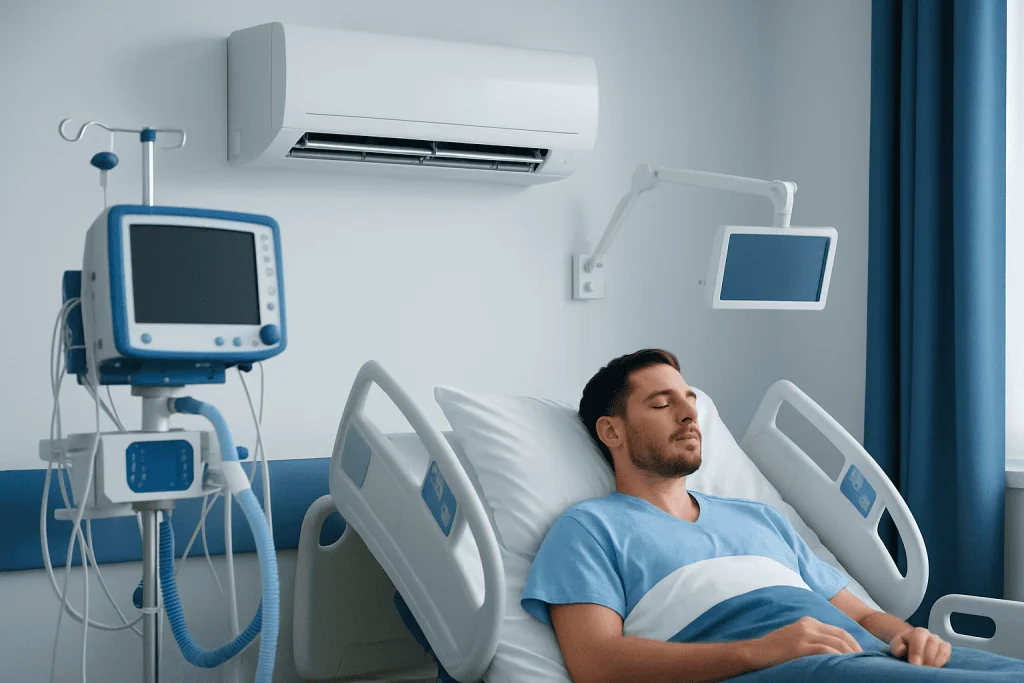
Hospital HVAC is a central system, not a collection of independent wall units. Air is drawn in, filtered, heated or cooled, and distributed through ducts to each area of the building. Used air is extracted and either exhausted or filtered and recirculated. The system also manages how many times per hour the air in a room is fully exchanged, and in some areas it manages air pressure, certain rooms are kept at slightly higher or lower pressure than the corridor so that air flows in a controlled direction. This is part of how hospitals limit the spread of airborne particles between spaces.
What this means for you in practice:
- Your room may have a wall panel or bedside control that adjusts temperature within a set range. The range is deliberately limited so one room cannot unbalance the system or drift outside safe limits.
- Some rooms have no visible control at all. The temperature is set centrally and changed by facility staff on request. This is not a fault, ask the nurse and the request goes to the right team.
- Operating theatres, intensive care and some treatment areas are tightly controlled for temperature, humidity, filtration and air changes. Patients and visitors cannot adjust these areas, and staff will not either, because the settings are clinical, not personal.
- Windows in patient rooms are often sealed or restricted. Opening a window can disrupt the pressure and filtration balance of the whole floor, so ventilation runs through the system instead.
You will also notice that corridors, imaging units, examination rooms and patient rooms feel slightly different from each other. Each area has different occupancy, equipment heat loads and ventilation requirements, so this is normal. If you move between departments during the day, common when you are managing time between appointmentscarry a light layer or ask for a blanket, especially if cool air bothers you.
What is the ideal temperature for a hospital room?
There is no single number, but there are recognised ranges. General patient rooms in modern hospitals are typically held somewhere around 20–24°C, which balances patient comfort against the needs of staff who are physically active and often wearing layers. Operating theatres are usually kept cooler, commonly in the high teens to low twenties, because surgical teams work under gowns and lights and because temperature and humidity are managed together for equipment and sterility reasons. Neonatal and some specialist units run warmer.
Humidity is controlled as well as temperature, usually kept in a moderate band, because very dry or very damp air affects both comfort and infection control. This is why hospital air can feel drier than you are used to, lip balm, a water bottle within reach and moisturiser are small items worth packing.
Within your own room, “ideal” is whatever lets you rest, within the range the system allows. Some patients sleep best at 21°C under a blanket; others want 24°C and a sheet. Neither is wrong. The point of asking early is that the team can usually get your room close to your preference before it starts costing you sleep.
Who to ask when you feel too hot or too cold

Your first point of contact is your nurse. Nursing staff can judge whether a temperature change fits your situation, make basic adjustments, bring bedding, and escalate anything technical. As an international patient, you can also ask your patient coordinator or an interpreter to help you phrase the request in English or another supported language, useful when you are tired, groggy after a procedure, or simply not sure how to describe the problem.
For simple comfort requests, the response is usually immediate: an extra blanket, a lighter cover, a thermostat change, or a check that vents and windows are positioned correctly. For technical problems, no cool air, unusual noise, dripping water, air blowing continuously and strongly, or a panel that does not respond: the nursing team contacts the hospital’s facility and maintenance department, whose job includes exactly this.
When you ask, be specific. “The room is uncomfortable” gives staff little to work with. These descriptions do:
- “The vent blows directly on my bed.”
- “The room is fine in the day but gets warm after sunset.”
- “The companion sofa area is much colder than the patient bed.”
- “The panel shows 22 but the room feels far colder than that.”
Specific detail tells the team whether the answer is a quick adjustment, a vent redirection, different bedding or a maintenance visit. And ask early, before you are exhausted, not after two sleepless hours. Rest matters during a hospital stay, and staff would rather fix a room at 10pm than hear about a bad night at breakfast.
Practical comfort tips for day and night
Small adjustments do most of the work. If the air conditioning feels strong, ask whether the vent direction can be changed or whether your bed can be repositioned safely. If the room warms in the afternoon, closing curtains against direct sun often helps more than lowering the thermostat.
Pack for flexibility rather than for a single climate. Hospital interiors in Turkey often feel cooler than the street in summer and warmer than the street in winter, so layers beat heavy single garments in every season:
- A light cardigan or zip-up layer you can add or remove without effort.
- Soft socks, floors and lower air layers feel colder than the room reading suggests.
- Breathable sleepwear rather than heavy fleece, so bedding can do the adjusting.
- A robe or wrap for corridor walks, since corridors are often cooled differently from rooms.
- Lip balm and a water bottle, because conditioned air runs dry.
At night: ask for an extra blanket before bedtime if you tend to run cold, request lighter bedding if you wake up warm, and keep the call button within reach so you never have to choose between discomfort and getting out of bed unassisted. If you want to know what else the room typically includes before you arrive, see our guide to hospital room amenities in Turkey.
After surgery, tests or treatment: why your comfort range shifts
Temperature perception changes after procedures. Many patients feel cold in the hours after general anaesthesia, because anaesthetic drugs affect the body’s temperature regulation and operating theatres are kept cool; recovery teams expect this and use warmed blankets routinely. Others feel warm and restless once they are moving again, or become newly sensitive to airflow across dressings, drains or a wound site. Our guide to what happens after general anaesthesia explains that first stretch in more detail.
In this period, let the team manage the environment rather than improvising. Do not move the bed, block ventilation points or plug in personal appliances if you are connected to oxygen, monitors or infusion pumps: the room layout around clinical equipment is deliberate, and staff can almost always find a comfort solution that does not disturb it.
Small personal comfort items, a shawl, an eye mask, a light scarf, are generally fine and worth bringing. Items that generate heat, produce strong airflow or release fragrance may not be permitted near clinical equipment or in shared air systems. If a particular item matters to you, raise it with your coordinator before admission so you know what is suitable.
Companions, children and shared comfort needs
If someone is staying with you, their sleeping area may sit closer to a window, a vent or an exterior wall than your bed does, and it can genuinely feel several degrees different. Encourage your companion to speak up rather than tough it out: a companion who has slept is far more useful to you than one who has not. Extra bedding for the sofa bed is a normal request, and it is easier to arrange in the evening than at 1am. If you are still planning the stay, our guide to booking a companion room in Turkey covers what to check in advance.
Families arriving from very hot or very cold home climates often need a day or two to recalibrate. Children and older adults tend to feel drafts more; other family members may find a closed, conditioned room stuffy. Nursing staff are used to balancing competing preferences in one room: the rule they work to is simple: the patient’s clinical needs come first, and everything else is negotiated around that. For a broader view of room choices before admission, see hospital room options in Turkey for international patients.
Technical problems worth reporting straight away
Most temperature issues are comfort matters, but some things should be reported promptly because they point to a fault rather than a preference: water dripping from a ceiling unit or vent, a burning or electrical smell, persistent unusual noise, a thermostat that ignores input, or air blowing hard and continuously with no response to settings. Report these and let staff handle them, do not attempt to repair, unplug, cover or tape anything yourself, however tempting the quick fix looks. Hospital systems are interconnected, and a covered vent in one room can affect airflow elsewhere on the floor.
One more distinction is worth keeping in mind. Feeling cold because the room is cold is a comfort issue; feeling suddenly different in yourself is something the nursing team should hear about rather than something to attribute to the air conditioning. Mention any change in how you feel and let the clinical team decide what, if anything, needs checking: that is part of what they are there for.
If a request seems not to have landed, repeat it politely and ask for an interpreter or your international patient coordinator. Clear communication is part of safe care, and staff who work with international patients handle practical concerns like this every day.
Step by step
- Work out what is actually bothering you. Is the room too warm or too cold overall, or is the problem direct airflow, heavy bedding, afternoon sun or a night-time shift? Naming the real issue gets the right fix first time.
- Use the call button or speak to your nurse. Nursing staff are the correct first contact for room comfort. They adjust what can be adjusted, bring bedding, and call technical support when the system itself needs checking.
- Describe the problem in practical terms. “The vent blows on my bed” or “the room warms up after sunset” is far more useful than “the room is uncomfortable”. Specifics decide whether the answer is a setting, a vent, bedding or maintenance.
- Ask for an interpreter if language is a barrier. Your international patient coordinator or an interpreter can put the request into the right words. This matters most when you are tired or recovering and least able to negotiate in a second language.
- Take the bedding option while the room is reviewed. If a temperature change cannot happen instantly, an extra blanket or lighter cover keeps you resting in the meantime. The two solutions are not either-or.
- Do not use unapproved devices. Personal heaters, plug-in fans and humidifiers can raise electrical, airflow and infection-control problems near medical equipment. Ask before using anything that changes the room environment.
- Keep comfort and health separate in your own mind. A cold room is a comfort request; feeling suddenly unwell is something to mention to the nursing team in its own right, whatever the thermostat says.
Your checklist
- Pack light layers, soft socks and breathable sleepwear, whatever the season.
- On arrival, ask your nurse how the room’s thermostat or bedside control works and what range it allows.
- Tell staff if air blows directly onto your face, bed, dressing or the companion sleeping area.
- Request extra blankets or lighter bedding before bedtime, not after a bad night has already started.
- Use curtains against direct sun before asking for a lower thermostat setting.
- Keep the call button within reach overnight.
- Do not block vents, open sealed windows, move equipment or plug in personal climate devices without approval.
- Ask for an interpreter or your coordinator if a request is not being understood.
- Report drips, smells, noises or unresponsive controls promptly and leave the fix to staff.
Key takeaways
- Managing hospital room temperature and air conditioning in Turkey is a shared job: the system is centrally run, so some adjustments need staff or technical support, asking is the system working as designed, not a complaint.
- Patient rooms typically sit around 20–24°C; theatres and some clinical areas are set differently and are not adjustable on request.
- Your nurse is the right first contact for temperature, airflow and bedding; your coordinator can help you say it clearly.
- Layers beat heavy clothing, because rooms, corridors and departments are cooled differently.
- Personal fans, heaters and humidifiers need hospital approval before use.
- Comfort requests and changes in how you feel are two different conversations, have both with the nursing team, but do not merge them.
Frequently asked questions
What is the ideal temperature for a hospital room?
General patient rooms are typically held around 20–24°C, with humidity kept in a moderate band. Operating theatres run cooler and some specialist units run warmer, because their settings serve clinical and equipment needs rather than personal comfort. Within your own room, the ideal is whatever lets you rest inside the range the system allows.
Can I control the air conditioning in my hospital room in Turkey?
Often partly. Many rooms have a wall panel or bedside control that adjusts temperature within a set range, while the system remains connected to central hospital settings. Some rooms have no visible control and are adjusted centrally on request. If a panel is unclear or unresponsive, ask your nurse rather than repeatedly changing it.
Is there air conditioning in Turkey?
Yes. Air conditioning is standard in Turkish hospitals, hotels, airports and modern buildings, and it is used heavily in summer. Hospitals run HVAC year-round for heating, cooling and ventilation, and hotel rooms used for post-discharge recovery almost always have their own unit with a remote control.
What is the HVAC system in a hospital?
It is a central system that filters, heats or cools and distributes air through ducts, while extracting used air. Beyond temperature, it manages humidity, the number of air changes per hour and, in some areas, air pressure between rooms and corridors. This is why some spaces have limited or no user adjustment and why windows are often sealed.
What is the healthcare system like in Turkey?
Turkey has both public and private hospitals, and international patients are usually treated in the private sector, where modern facilities in major cities are common and international patient departments handle interpreting and coordination. Standards vary between institutions, as anywhere, so it is reasonable to ask a hospital directly about its facilities and services before you commit.
What should I do if my room feels too cold or too warm at night?
Use the call button and describe the problem specifically, for example, that the room warms after sunset or that a vent blows on the bed. Staff may adjust the setting, redirect airflow, change your bedding or call maintenance. Avoid opening windows or moving equipment unless staff confirm it is safe.
Can I bring my own fan, heater or humidifier?
Not without hospital approval. Personal climate devices can raise electrical, airflow and infection-control concerns, particularly near medical equipment. If a specific comfort item matters to you, raise it before admission so you know what is permitted.
Why does the corridor feel colder than my room?
Different areas have different ventilation requirements, occupancy levels and equipment heat loads, so corridors, imaging units and treatment areas are often set differently from patient rooms. Keep a light layer or robe nearby for moving around the building.
Add us as a Preferred Source to see more of our trusted health content across Google Search, AI Overviews and Discover.

Update history
- PublishedJune 22, 2026
- Medical review approvedSeptember 13, 2026
- Last content updateSeptember 12, 2026
More Patient Guides

When a Hospital Stay in Turkey Becomes Longer Than Planned: What to Arrange
If your hospital stay in Turkey is longer than planned, arrange medical updates, accommodation, travel changes, insurance and support for your companion.

Waiting for Test Results in Turkey: How to Use Time Between Appointments
Waiting for test results in Turkey is easier with a clear plan for appointments, rest, records, questions and support in Istanbul.

Unexpected ICU Stay in Turkey: What Patients and Families Should Expect
Unexpected ICU stay in Turkey: learn what patients and families can expect, from communication and visiting to care updates and travel support.

How to Manage Special Diets During Medical Travel in Turkey
Special diets during medical travel in Turkey are easier to manage when you share your needs early, confirm meals and carry safe…