

Hospital Room Amenities in Turkey: Wi-Fi, TV, Phones, and Comforts
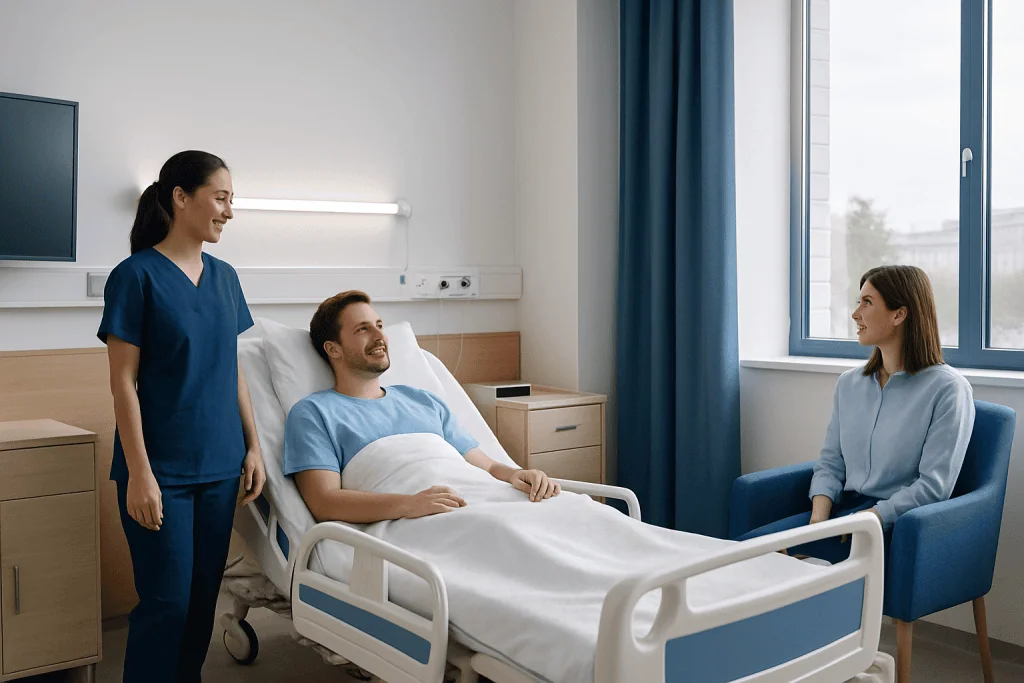
Private hospital rooms in Turkey typically include Wi-Fi, a TV, a nurse call system, an adjustable bed, a private bathroom, storage and visitor seating. Details vary by hospital, unit and room category, and stricter rules apply in intensive care. Confirm Wi-Fi access, companion arrangements and interpreter support with your international patient coordinator before admission, and bring your own chargers, adapters and entertainment.
Will there be Wi-Fi? Can your husband sleep in the room? Is there a TV you can actually understand? Patients ask these questions in the days before they fly, and they are fair ones. Your hospital room is not just a place to rest. It is your base for communication, recovery, family support and daily routine while you are far from home.
This guide explains what hospital room amenities in Turkey usually include, where they vary, what to bring yourself, and which details are worth confirming before admission. It also answers the broader questions international patients search for: what Turkish hospitals are like, and whether foreigners can be treated in them.
At a glance
- Typical room features: Wi-Fi, TV, nurse call system, adjustable bed, private bathroom, storage and visitor seating in most private rooms
- Varies by hospital and unit: Channel languages, phone rules, companion space and climate controls differ; intensive care has stricter rules
- Bring yourself: Phone, chargers, a Type C or F plug adapter (Turkey runs on 230V), downloaded entertainment and personal toiletries
- Companions: Overnight stays depend on room type, department and your clinical condition, confirm before travel
- Language help: Interpreter support can be arranged for admission, daily routines and discharge discussions
- Main advice: Ask your international patient coordinator what is included before admission, not at the bedside
What hospital room amenities in Turkey usually include
When you travel for treatment, your room becomes part of your care environment. It is where you rest, talk to your care team, call family at home, prepare for tests and start recovering. A well-organised room lowers stress for a simple reason: you know where your things are, how to call for help, and how to stay in contact with the people supporting you.
In private hospitals serving international patients, hospital room amenities in Turkey commonly include Wi-Fi, a television, telephone access, a nurse call button, bedside controls for the bed and lighting, a private bathroom, a wardrobe or cabinet, and seating for a visitor. Higher room categories may add a sofa bed for a companion, a small fridge, or more living space, though what counts as a standard room differs between hospitals.
Two honest caveats belong at the top of this guide. First, amenities vary, by hospital, by department, by unit and by room category. What is standard on a surgical ward may not apply in a monitoring unit. Second, clinical needs come before comfort. If your doctor recommends care in intensive care or an isolation room, amenity and visitor rules change to protect safety and infection control. Our recovery room and ICU guide for international patients explains what to expect in those settings.
If the choice between room categories matters to you, read our companion guide on choosing a hospital room in Turkey before you confirm your admission plan.
What are hospitals like in Turkey, and can foreigners be treated there?
Turkey has a mixed healthcare system of public and private hospitals. International patients travelling for planned treatment are usually admitted to private hospitals, many of which run dedicated international patient departments that handle admission paperwork, interpreter scheduling and practical questions in English and other languages. Foreigners can absolutely be treated in Turkish hospitals: private facilities admit international patients routinely, and you will typically be asked for your passport, appointment details and payment or insurance documentation at admission.
Physically, private hospitals in Turkey tend to look and function much like modern private hospitals elsewhere in Europe: reception desks with queue systems, lifts, signage in Turkish and often English, cafés or kiosks, and waiting areas near outpatient clinics. Typical waiting room amenities include seating, screens showing queue numbers or information, water dispensers or nearby vending, accessible toilets, and Wi-Fi coverage in many public areas. If you are waiting for a relative in surgery, staff can usually direct you to a designated family waiting area.
How good is the healthcare system? That is a question this guide will not answer with rankings or statistics, because no honest logistics guide can. What can be said plainly is that quality varies between institutions, as it does in any country, and that the practical experience of your stay, communication, room comfort, companion support, depends heavily on the specific hospital and unit. Ask specific questions of the specific hospital treating you. That is more useful than any general claim.
Wi-Fi, phones and staying connected
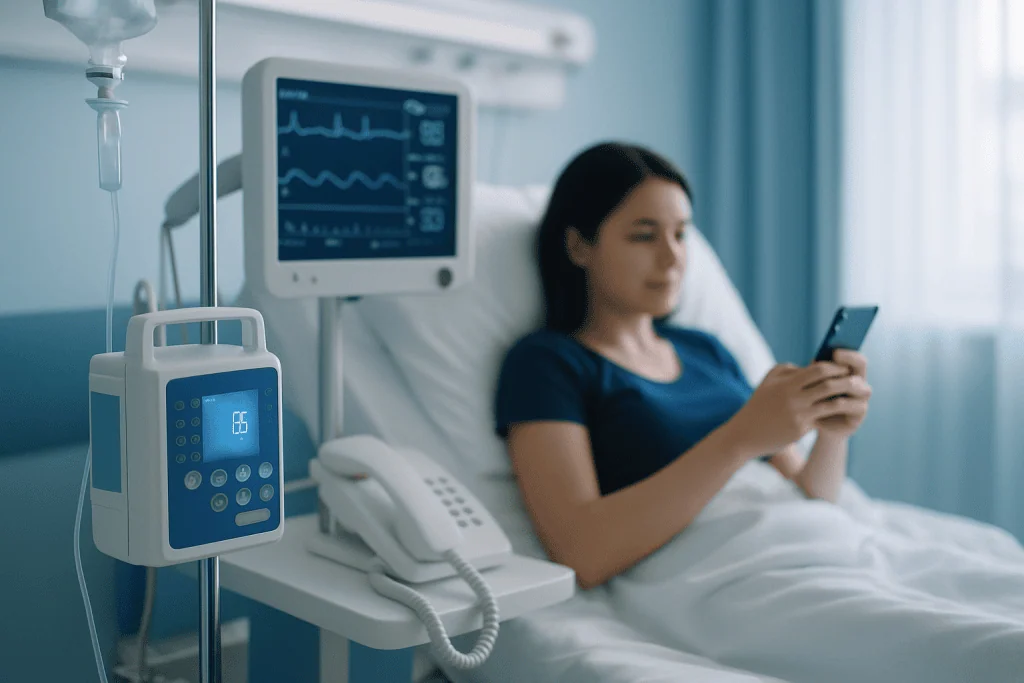
Reliable communication is the first thing most international patients ask about, and rightly so. Hospital Wi-Fi is commonly available in patient rooms and public areas, but access details differ between facilities. Some hospitals give you login details at admission; on others, the ward team or patient services desk provides them on request. If internet access is essential, for work, for video calls with children at home, do not rely on hospital Wi-Fi alone. Have a backup.
That backup is usually mobile data. Before you fly, check with your provider what roaming in Turkey costs, or arrange an eSIM. For longer stays, a local SIM bought at the airport or in the city works well, though you will need your passport to register it. For international calls, most patients use internet-based apps rather than dialling directly, because app calls work over Wi-Fi even when roaming is switched off.
Bring your own charging setup. Turkey uses Type C and Type F plugs at a standard 230V, so travellers from the UK, North America and several other regions need an adapter. If you carry several devices, phone, tablet, laptop, e-reader, or a CPAP machine, a compact multi-port charger saves sockets. Keep cables coiled and off the floor near the bed; loose cables are a genuine fall risk, especially after surgery or sedation.
Room telephones, where present, are usually for internal hospital calls; external calling depends on hospital policy, so ask rather than assume. If language is a barrier, Acibadem International can coordinate interpreter support in many common languages. Interpreters matter most during admission, consent discussions and discharge planning, but they also help with everyday room routines, meal timing, nurse call use, visitor rules, where small misunderstandings cause outsized frustration.
TV, entertainment and quiet recovery time
A television is a standard comfort feature in most private patient rooms in Turkey. What varies is the channel list. Some hospitals carry international news and entertainment channels; others carry mainly Turkish programming. No hospital can promise your preferred channels in your preferred language, so plan around it: download shows, films, podcasts, audiobooks or music onto a tablet or laptop before you travel, and pack headphones. This is the single most reliable way to have entertainment you actually want during recovery.
Hospitals balance comfort with clinical work and rest. Nurses will enter for medication rounds, observations, cleaning and meal delivery, sometimes at night. Keep TV volume moderate, use headphones where you can, and dim screens in the evening, good habits for your own rest as much as for anyone nearby. If you are recovering from anaesthesia, choose calm, familiar content that does not demand concentration; many patients find screens tiring in the first day or two. Our guide on what happens after general anaesthesia, from the recovery room back to your room, explains why that period feels the way it does.
If you feel unusually dizzy, confused or very sleepy, put the screen down and press the nurse call button. Practical symptoms during a hospital stay belong to the ward team, not to guesswork.
Comfort features: bed, bathroom, storage and climate
Patient rooms are arranged around safety and access to care first, comfort second. Expect an adjustable hospital bed with bedside controls, a nurse call button within reach, a bedside table, lighting controls and clear space for the clinical team to work. Most private rooms add a private bathroom, a wardrobe or cabinet, and a chair or sofa for a visitor.
Use the storage you are given, and keep the floor clear. Shoes, luggage, cables and shopping bags become trip hazards quickly, particularly after surgery or on medication that affects balance. Keep only frequently used items within reach: phone, glasses, tissues, lip balm, water if your care team permits it. If you want to bring familiar things from home, a pillow, a blanket, photographs, read our short guide on using your own comfort items in a Turkish hospital room first, because some items need a quick check with the ward team.
Room temperature and ventilation may be adjustable, but the controls depend on the ward and the building’s system, and some panels connect to equipment you should not touch. If you are too cold or too warm, ask the nurse rather than adjusting anything yourself. A light cardigan or easy layers keep you comfortable without getting in the way of examinations or IV lines.
One firm point about bathrooms. En-suite bathrooms are designed for safe movement, with grab rails in many rooms, but do not assume you can get up alone after treatment. If the team has told you to call before standing, press the nurse call button before every bathroom trip. This is routine hospital practice, not an imposition, and it matters most after anaesthesia, sedation, pain medication or long periods in bed.
Meals, drinks and daily routines in your room
Hospital meals are coordinated with your medical plan, not ordered like room service. Your doctor or dietitian may prescribe a specific diet, liquid, soft, diabetic, low-salt, high-protein, or a fasting period before a test or procedure. Even if you feel hungry, do not eat outside food or snacks unless your care team confirms it is safe for your condition and schedule. A well-meant delivery from a relative can delay a test.
Meal times, water permission and tea or coffee availability vary by department. If you have religious, cultural, allergy-related or personal dietary needs, tell your international patient coordinator before admission and repeat them to the ward team when you arrive. The earlier the kitchen knows, the more it can do within your medical restrictions.
Your day in the room will include vital sign checks, medication rounds, doctor visits, cleaning, and possibly physiotherapy, imaging or laboratory tests. Keep a small notebook or a notes app for questions as they occur to you; ask your companion to write instructions down when you are tired, and request an interpreter for any discussion that is important or detailed. Any question about your medicines, timing, doses, what to continue, goes to your treating doctor, not to this guide.
Companions, visitors and personal support
Many international patients travel with a spouse, adult child, friend or carer, and a companion in the room can be genuinely steadying in a country where you do not speak the language. Whether a companion can stay overnight depends on your room type, your clinical condition and hospital policy. Many private rooms include a sofa bed or fold-out chair for exactly this purpose; intensive care, isolation rooms and some specialised units restrict access for safety reasons. The rules are detailed enough that we cover them separately in overnight companion rules in Turkish hospital roomsread it before your companion books flights on assumptions.
Before arrival, ask what companion amenities exist: bedding, meal options, bathroom access, and how to enter the hospital after hours. Ask separately if a child is the patient, since paediatric rooming-in usually follows its own rules.
Choose one main family contact who receives updates and relays them to relatives at home. This spares you repeated phone calls and lets you rest. With your permission, your Acibadem International coordinator can guide your family through the practical side: visiting procedures, nearby accommodation, local transport and interpreter scheduling.
- Your companion should keep their passport or ID available for hospital entry checks.
- Agree quiet hours between you so you can sleep between clinical checks.
- Keep valuables to a minimum and use secure storage where the hospital offers it.
- Ask visitors to stay away if they have a fever, cough, stomach illness or other contagious symptoms.
What to confirm before admission
The best way to avoid disappointment is to ask precise questions before your stay, because hospital room amenities in Turkey are consistent in outline but variable in detail. Your admission plan may also change if your doctor recommends monitoring in a different unit, so hold your expectations lightly.
Ask your coordinator: Will I be in a private room? Can my companion stay overnight, and on what? How does Wi-Fi access work on my ward? Is interpreter support scheduled for admission and discharge? What should I bring, and what does the hospital provide? If you have mobility needs, hearing or vision support needs, sleep apnoea equipment, dietary requirements or strong preferences around privacy and family presence, raise them early: they are far easier to arrange before you arrive than at the bedside.
Think ahead to the end of the stay too. Discharge day involves documents, medicines, imaging files and written instructions, and it goes far more smoothly with a little preparation; our guide on how to prepare for hospital discharge in Turkey walks through it. While the medical team focuses on your care, the international patient services team can handle the practical layer, transfers, hotel options for relatives, appointment timing and communication support. Knowing who to ask makes the whole stay feel more manageable from the first day.
Step by step
- Ask for room details before you travel. Contact your international patient coordinator and ask what room type is planned, which amenities are usually included, and whether a companion can stay. Room assignment depends on clinical needs and availability, so treat the answer as guidance, not a promise.
- Prepare your communication setup. Pack your phone, chargers, Type C or F plug adapters, and any devices you use for video calls or entertainment. Sort out roaming, an eSIM or a local SIM before admission so you are not troubleshooting connectivity while tired.
- Pack for comfort without overpacking. Soft, easy-to-wear clothing, non-slip slippers, basic toiletries, glasses or hearing aids, and a few small familiar comforts. Skip large valuables and excess bags; the room needs clear floor space for safe movement and clinical care.
- Set expectations with your companion. Decide who stays with you, who updates family at home, and how you will handle quiet time. Your companion should expect nurses to ask visitors to step out during examinations, procedures or rest periods.
- Learn how to call for help. On arrival, ask the nurse to show you the call button, bed controls and bathroom safety features. Call before getting up whenever you feel weak, dizzy or sleepy, or when you are connected to equipment.
- Clarify meals and restrictions. Ask whether you may drink water, eat snacks or accept outside food, especially before tests or after treatment. Repeat allergies, religious dietary needs and medical diet requirements clearly at admission.
- Plan for discharge day. Gather chargers, documents, medicines, imaging files and written instructions before you leave the room, and ask for an interpreter if any warning sign, medication schedule or follow-up plan is unclear.
Your checklist
- Passport, ID, insurance or payment documents, and hospital appointment details
- Phone, charger, power bank, and a Turkey-compatible plug adapter (Type C or F)
- Tablet or laptop with downloaded entertainment, plus headphones
- Comfortable clothing that is easy to put on and take off
- Non-slip slippers or shoes for walking safely in the room
- Personal toiletries, lip balm, glasses, hearing aids, and their cases
- List of medications, allergies, medical devices, and dietary needs
- A small amount of local currency or a payment card for incidental needs
- Contact details for your companion and your main family contact at home
- A notebook or notes app for questions, instructions, and discharge reminders
Key takeaways
- Hospital room amenities in Turkey commonly include Wi-Fi, TV, phone access, a nurse call system, a private bathroom and visitor seating, but details vary by hospital, unit and room category.
- Bring your own chargers, adapters, downloaded entertainment and toiletries rather than assuming every item will be provided.
- Foreigners are routinely treated in Turkish private hospitals, which usually run international patient departments for admission, interpreters and practical questions.
- Companion stays and visitor access depend on hospital policy, room type and your clinical condition, confirm arrangements before travel, not on arrival.
- Use the nurse call button whenever you need help moving, adjusting the room, or understanding instructions. That is what it is for.
Frequently asked questions
Will I have Wi-Fi in my hospital room in Turkey?
Most private hospitals provide Wi-Fi in patient rooms and public areas, but login processes and coverage vary. Ask at admission for the network details, or ask the ward team or patient services desk. If internet access is essential, keep mobile data or an eSIM as a backup rather than relying on hospital Wi-Fi alone.
What are hospitals like in Turkey?
Turkey has both public and private hospitals; international patients are usually treated in private facilities with dedicated international patient departments. Private hospitals typically resemble modern European hospitals, with signage often in Turkish and English, waiting areas with seating and queue screens, and private patient rooms with en-suite bathrooms. Standards vary between institutions, so ask specific questions of the hospital treating you.
Can foreigners go to hospital in Turkey?
Yes. Private hospitals in Turkey routinely admit international patients for both planned treatment and unexpected illness. You will normally need your passport, appointment details and payment or insurance documentation at admission. International patient departments can help with interpreters, paperwork and practical arrangements before and during your stay.
Can my companion stay overnight with me?
It depends on the hospital, room category, department and your medical condition. Many private rooms include a sofa bed or fold-out chair for a companion, while intensive care and specialised units restrict overnight access. Confirm arrangements with your international patient coordinator before travel so your companion can plan bedding, meals and, if needed, nearby accommodation.
Are hospital TVs in Turkey available in English or other languages?
Some hospitals carry international channels, but availability varies by room and hospital, and your preferred language may not be offered. The reliable solution is to bring a tablet or laptop with downloaded content and headphones, so you have entertainment you actually want during recovery without depending on the channel list.
Can I bring food or order meals from outside the hospital?
Not without checking first. Hospital meals are coordinated with your medical plan, and diet restrictions, fasting periods before tests and post-treatment instructions can all affect what you may eat and drink. Ask your care team before accepting any outside food, and state dietary preferences or religious requirements before admission and again on arrival.
Are hospital rooms private in Turkey?
International patients in private hospitals are often accommodated in private rooms when clinically appropriate and available, but confirm this in advance rather than assuming it. Some units use different arrangements for monitoring or safety reasons, and your room plan can change if your care pathway changes.
What if the room is too hot, too cold, noisy, or uncomfortable?
Tell the nurse or patient services team rather than adjusting unfamiliar systems yourself, because some controls connect to medical or building equipment. Staff can advise on temperature, bedding, quiet hours or another practical solution. Comfort concerns are legitimate, rest and clear communication make the whole stay easier.
Add us as a Preferred Source to see more of our trusted health content across Google Search, AI Overviews and Discover.

Update history
- PublishedJune 8, 2026
- Medical review approvedAugust 30, 2026
- Last content updateAugust 30, 2026
References1
- Turkey: Traveler Information (CDC Travelers' Health) wwwnc.cdc.gov
More Patient Guides

When a Hospital Stay in Turkey Becomes Longer Than Planned: What to Arrange
If your hospital stay in Turkey is longer than planned, arrange medical updates, accommodation, travel changes, insurance and support for your companion.

Waiting for Test Results in Turkey: How to Use Time Between Appointments
Waiting for test results in Turkey is easier with a clear plan for appointments, rest, records, questions and support in Istanbul.

Unexpected ICU Stay in Turkey: What Patients and Families Should Expect
Unexpected ICU stay in Turkey: learn what patients and families can expect, from communication and visiting to care updates and travel support.

How to Manage Special Diets During Medical Travel in Turkey
Special diets during medical travel in Turkey are easier to manage when you share your needs early, confirm meals and carry safe…