

Using Your Own Comfort Items in a Turkish Hospital Room
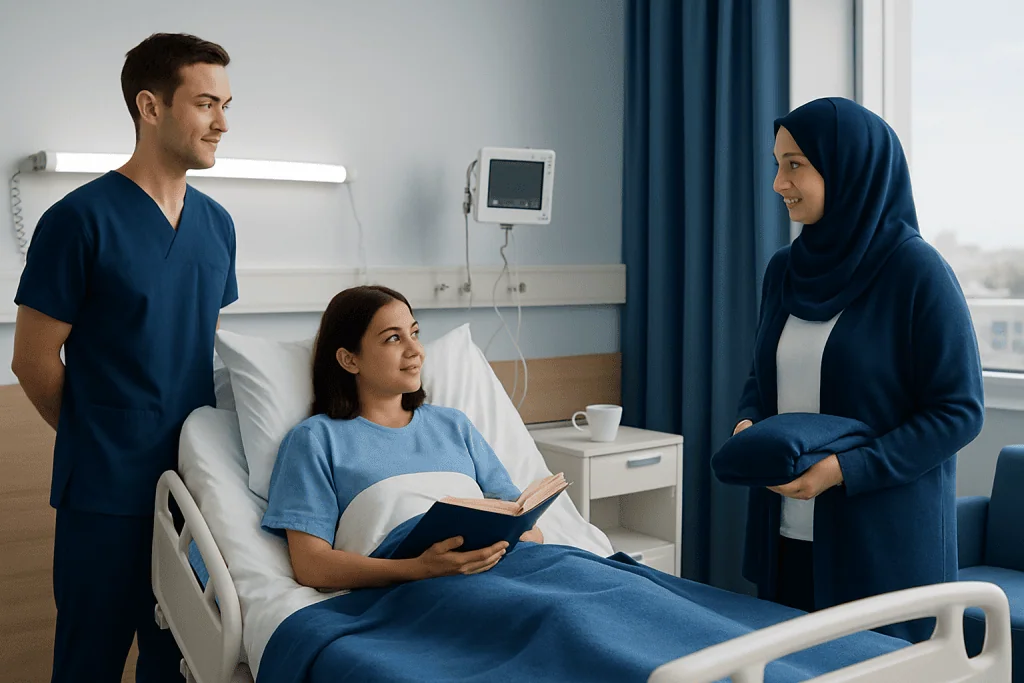
Yes, you can usually bring your own comfort items to a Turkish hospital room. Small, clean, washable things work best: soft clothing, non-slip slippers, a pillowcase, headphones, chargers and personal or religious objects. Anything that plugs in, produces heat or scent, or involves food needs a quick check with the ward team first, because electrical, fire and infection-control rules apply inside hospital buildings.
Wondering whether you can bring your own pillowcase, prayer beads, or the cardigan you always sleep in? In most cases you can. Using your own comfort items in a Turkish hospital room is normal and expected, and a few familiar things can make an unfamiliar room feel settled far more quickly than any upgrade can.
This guide explains what usually travels well, what needs a quick check with the ward team before you use it, and how to keep your room easy for nurses to work in. It covers bedding, clothing, electronics, food, fragrance, religious items and companion belongings, and it is honest about where the limits sit. If your stay will last several nights, it pairs well with our guide on staying comfortable during a multi-day hospital stay in Turkey.
At a glance
- Usually fine: Soft front-opening clothing, non-slip slippers, a pillowcase or light shawl, headphones, chargers, unscented toiletries, photos, and small religious or cultural items
- Ask first: Anything that plugs in (heating pads, electric blankets, kettles, diffusers), outside food and herbal teas, strong fragrances, and personal medical devices
- Keep it small: One bag of clean, washable, easy-to-move items works better than a full suitcase at the bedside
- Rooms come equipped: Bed, bedding, bathroom, storage, call bell, TV and Wi-Fi are typically already provided, so pack around them rather than duplicating them
- The one rule: Comfort items must never block infection control, monitoring equipment, safe walking space, or staff access to you
Why using your own comfort items in a Turkish hospital room helps
A hospital room can feel foreign even when the care team is attentive and the room itself is well equipped. You are sleeping in a bed that is not yours, on a schedule that is not yours, often in a country you have only just arrived in. A few personal objects restore a small piece of routine: the pillowcase you recognise, the beads you reach for, the playlist that helps you fall asleep, the cardigan that keeps your shoulders warm during quiet hours.
Private rooms in Turkish hospitals are generally designed for rest, privacy and a companion’s presence, but every hospital also runs on hygiene, fire-safety and clinical-access rules. Using your own comfort items in a Turkish hospital room works well as long as those items are clean, compact, and never in the way when staff need to reach you or your equipment quickly. That balance, personal but not cluttered, is the theme of everything below.
There is also a practical reason to plan this before you fly. Some items are simply not worth the suitcase space because the hospital already provides them, and others need approval you can secure in advance rather than discovering a restriction on admission day. If you are still deciding between room types, the guide on choosing a hospital room in Turkey covers what to check about space and companion arrangements before you pack.
Comfort items that are usually practical to bring
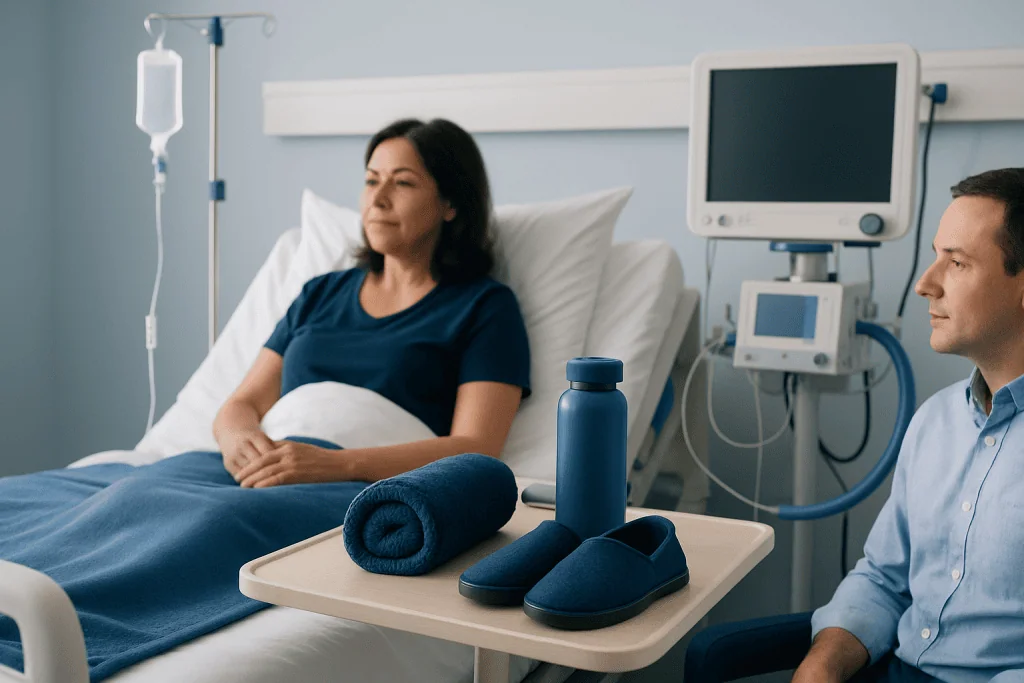
The easiest items to bring are small, familiar and simple to clean. Think in five categories: what helps you sleep, what helps you wash, what helps you communicate, what helps you move safely, and what keeps you emotionally grounded. The goal is not to recreate your bedroom. It is to bring a handful of things that make the room feel manageable on your first night.
Reliable choices include loose front-opening clothes, a light robe, underwear and socks, non-slip slippers, lip balm, unscented moisturiser, your own toothbrush and toothpaste, reading glasses, a phone charger with a plug adapter, headphones, and a small notebook for questions and instructions. A sleep mask, earplugs, a travel pillow and a lightweight shawl all earn their place too, especially if you are adjusting to a new time zone.
- Fit everything into one small suitcase or overnight bag: you may be moved for imaging or observation, and light packing makes transfers straightforward.
- Label important belongings with your name and phone number.
- Favour washable fabrics over delicate or expensive ones.
- Keep your passport, insurance papers and medical documents in a separate folder, never mixed with comfort items.
If you will spend several days in Istanbul or another city before or after treatment, pack in layers. Hospital rooms may feel warmer or cooler than your hotel, and your own temperature comfort can shift after tests, treatment or medication. A shawl or zip-front layer solves this without asking the whole room’s thermostat to change.
Items to ask about before using in your room
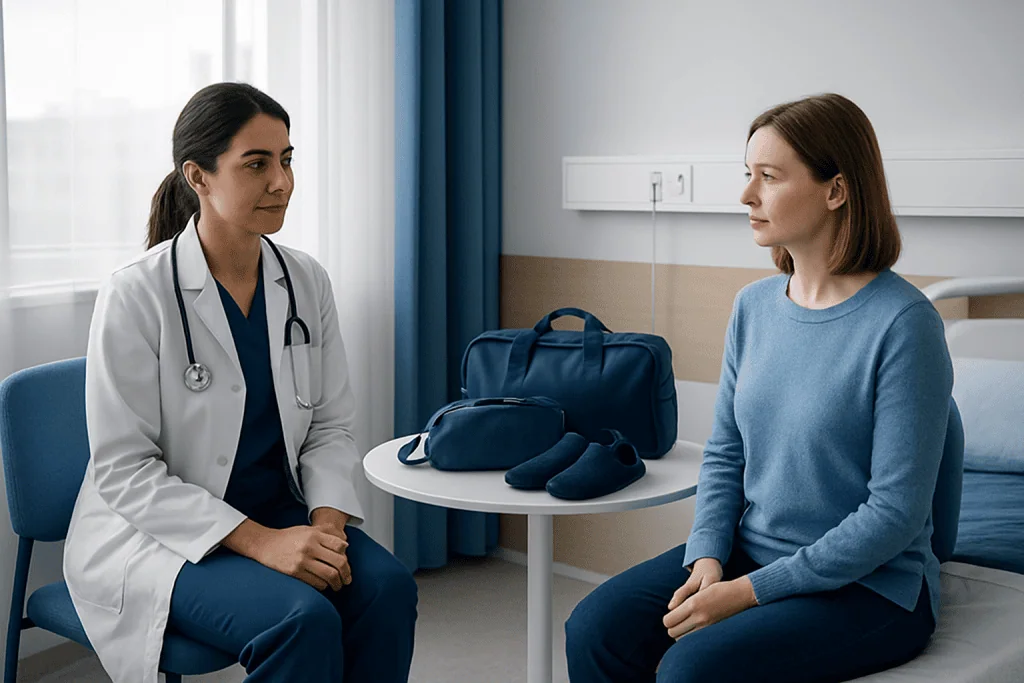
Some things that feel comforting at home are restricted in a hospital room, and the reasons are consistent everywhere: infection control, fire safety, electrical safety, allergies, and the need for staff to reach you and your equipment without obstruction. None of this is about strictness for its own sake: it is about keeping a clinical space workable.
Before plugging anything in, ask the ward team. That covers heating pads, electric blankets, extension cords, humidifiers, aroma diffusers, kettles, coffee machines, fans, and any personal medical device the hospital has not already reviewed. An item that works safely in your home may still fall outside hospital electrical and oxygen-safety rules, and the ward nurse can tell you in seconds rather than you finding out mid-stay.
Food and drink need the same quick check. Depending on fasting plans, tests, surgery, medication, diabetes care, digestive needs or allergy risk, outside food may be limited for part or all of your stay. If a companion wants to bring a favourite snack, a traditional dish or a herbal tea, the nurse can confirm whether it fits your care plan and how it should be stored. This is not about the food itself; it is about timing and your treatment.
Fragrance deserves a gentle mention. Perfumes, scented candles, incense and essential oils can affect other patients, staff, or your own breathing comfort, and open flames are not permitted in hospital rooms at all. Unscented and flameless alternatives are almost always the easier path, and even those are worth a quick question if you plan to use them regularly.
Bedding, pillows, clothing and personal textiles
Many patients sleep better with a familiar pillowcase, a small blanket or a shawl, and after a long journey these can matter more than any electronic device. Keep textiles limited, clean, and easy for staff to lift aside when sheets are changed or clinical checks are done.
Two swaps make this simpler. Bring a pillowcase rather than a full pillow, and a lightweight throw rather than a heavy blanket. Hospital bedding is provided and changed on hygiene routines, so your personal textiles sit on top of the system rather than replacing it. If you have allergies or very sensitive skin, tell the nursing team so they can guide you on fabrics and laundry.
Choose clothing for access, not just comfort. Loose trousers, button-up shirts, zip-front tops and robes are far easier than anything tight if you have an IV line, dressing, drain, cast or movement restriction: your nurse can suggest what works around your specific care. Front openings mean you can dress without lifting arms over your head, which matters more after some procedures than most people expect.
Non-slip slippers or closed-back house shoes are strongly recommended. Hospital floors are smooth, and you may feel unsteady after medication, anaesthesia, imaging or long periods in bed. Every comfort choice should support safe movement first; a beautiful pair of backless slippers is not comfort if it makes a corridor walk risky.
Technology, entertainment, and dealing with boredom
Your phone or tablet may be the single most useful comfort item you bring. It carries family calls, translation tools, prayer apps, music, audiobooks, travel documents and messages from your coordinator. Pack a charger with the right adapter, Turkey commonly uses Type C and Type F plugs, and consider a long cable so the socket’s position never dictates where you rest.
Headphones do double duty: they give you privacy for calls and films, and they keep the room calm while your companion rests. Keep the volume low enough that you can hear a nurse enter or call your name.
Boredom in hospital is real, and it is worth planning for honestly. The trick is to bring entertainment that does not demand concentration. After a procedure or during medication changes, a complex novel may be beyond you, while a familiar podcast, a downloaded film, a light puzzle book or a playlist is exactly right. Download things in advance so busy Wi-Fi or a low-energy day never leaves you with nothing. A notebook helps too, writing down questions for the doctor, small observations, or messages home gives shapeless hours a little structure. Short, approved walks along the corridor, when your team says movement is fine, break the day up better than any screen.
For medical communication, interpretation is arranged through the hospital’s international patient services; your own translation app is fine for everyday comfort, but medical instructions should always go through the team or an interpreter rather than an app.
What the room already provides, so you don’t pack it twice
Half of smart packing is knowing what will be waiting for you. A typical private room in a Turkish hospital includes an adjustable bed with managed bedding, a nurse call bell, a private bathroom with basic supplies, a wardrobe or storage unit, a television, Wi-Fi, and usually a sofa or fold-out bed for a companion. Meals arrive on a clinical schedule matched to your care plan.
That means you generally do not need to bring towels, full bedding, a water kettle or bulk toiletries. What the hospital cannot provide is familiarity, and that is precisely the gap your own items fill. For a detailed room-by-room picture of connectivity, television, phones and in-room services, see hospital room amenities in Turkey.
If a family member is staying overnight, their belongings share the same limited storage as yours. The practical rules for who can stay, where they sleep and what they should bring are covered in overnight companion rules in Turkish hospital rooms. Agree together which items belong at the bedside and which stay at the hotel, two people’s full luggage in one clinical room makes cleaning harder and creates obstacles if staff need to move equipment quickly.
Cultural, spiritual and emotional comfort
Comfort is not only physical. Many international patients bring items that support prayer, reflection, family connection or cultural routine: a folded prayer mat, a rosary or prayer beads, scripture, a meditation object, a family photo, a card with meaning. These are small, quiet items, and they are welcome when they are clean, compact and stored where they do not interfere with care: a bedside drawer is ideal.
Turkish hospital teams care for people from many countries and are used to a wide range of religious and cultural routines. If you need quiet time, a particular visiting arrangement, or support with a specific practice, say so plainly to your nurse or coordinator; clear communication lets the team respect your needs while keeping care routines safe. You do not need to explain or justify a comfort item: you only need to keep it out of the way of clinical work.
Keeping your room safe, tidy and easy for care
A calm hospital room is usually a simple one. Keep walkways clear, store suitcases away from the bed, and avoid placing belongings on clinical equipment, window ledges or the floor. If something is out of reach, use the call bell or ask your companion rather than stretching or standing suddenly: the guide to using the nurse call system in Turkish hospitals explains how the bell works and when to use it.
Keep valuables to a minimum. Bring only the jewellery, cash, electronics and documents you truly need, and ask where they can be stored securely. When you remove glasses, hearing aids, dentures or jewellery before a test or procedure, put them in a labelled case, never wrapped in a tissue, which is exactly how small essentials end up in a bin by accident.
Cleanliness protects your comfort items as much as it protects you. Wash your hands before handling personal things, keep toiletries in a washable pouch, and don’t share towels or grooming tools. If an item falls on the floor or becomes soiled, ask whether it should be cleaned, bagged, or sent to the hotel with your companion.
Finally, remember that your care plan can change. You may be moved for imaging, observation or a different level of care, and using your own comfort items in a Turkish hospital room stays effortless only when everything you brought fits back into one bag in a few minutes. When discharge approaches, some of these same items, the travel pillow, the shawl, the noise-cancelling headphones, go straight into your post-surgery flight home comfort kit, so nothing is packed in vain.
Step by step
- Make a comfort list before you travel. Write down what helps you sleep, wash, communicate, pray, move safely and feel calm. Then cut the list to what fits in one small bag, keeping clean, lightweight, replaceable items and dropping anything precious or bulky.
- Check special items in advance. Electrical items, food, supplements, mobility aids and personal medical devices are the categories most likely to need approval. Raising them with your coordinator before you pack prevents disappointment on admission day.
- Pack comfort items separately from documents. Passport, reports, medication list, insurance papers and hospital correspondence live in one folder. Comfort items live in the bag. Never mix the two.
- Label and organise small essentials. Use pouches for chargers, toiletries, hearing aids and glasses, and label cases with your name, especially if a companion will be moving your belongings between hospital and hotel.
- Ask the nurse before setting up the room. On arrival, ask where the suitcase, charger, slippers and personal items should go. The nurse will help you keep the call bell, bed controls and walking space clear.
- Confirm food and drink before consuming them. Even a familiar snack or herbal tea may not suit the timing of tests, surgery or medication. Check with your nurse first, and make sure your companion knows the same rule applies to anything they bring in.
- Repack daily. Each evening, return unused items to the suitcase or send them to the hotel with your companion. A tidy bedside makes cleaning easier and keeps staff access clear.
Your checklist
- Loose, comfortable clothing that is easy to put on and remove
- Non-slip slippers or safe indoor shoes
- Phone, charger, plug adapter for Turkey, and headphones
- Travel-size toiletries, preferably unscented
- Glasses, hearing aids, dentures or retainers in labelled cases
- A small comfort object, photo, prayer item, book or shawl
- Downloaded films, podcasts or playlists for low-energy days
- Medication list and allergy information, kept with your documents
- Reusable bag for laundry or items going back to the hotel
- Notebook and pen for questions, instructions and reminders
Key takeaways
- Bring a few familiar comfort items, but keep the room simple, clean and easy to move around in.
- Anything electrical, edible, fragranced, or medical needs a quick approval before use: the ward team can answer in moments.
- Soft front-opening clothing, non-slip footwear, chargers, headphones and small personal objects are the most reliably useful items.
- The hospital provides bedding, towels, meals, TV and Wi-Fi, so pack around what is already there rather than duplicating it.
- Staff may need quick access to you and your equipment, so keep the floor, the call bell area and the bedside free of clutter.
Frequently asked questions
How can I make my hospital room more comfortable?
Start with sleep and warmth: your own pillowcase, a light shawl, a sleep mask and earplugs. Add non-slip slippers, headphones, a charger with a long cable, and one or two personal objects such as a photo or prayer item. Then keep everything tidy: a clear, simple room is genuinely more restful than a crowded one, and it lets staff work around you smoothly.
What would you find in a Turkish hospital room?
A typical private room includes an adjustable bed with managed bedding, a nurse call bell, a private bathroom, storage, a television, Wi-Fi, and often a sofa or fold-out bed for a companion. Meals are provided on a schedule matched to your care plan. This is why full bedding, towels and kettles are rarely worth packing.
How do I deal with boredom in hospital?
Plan for low-concentration entertainment: downloaded films, podcasts, playlists, audiobooks and simple games work better than demanding books when you are tired or on new medication. A notebook, video calls with family, and short approved corridor walks all help break up the day. Download content in advance so busy Wi-Fi never leaves you empty-handed.
Can I bring my own pillow or blanket to a Turkish hospital room?
You can usually bring a small, clean pillowcase, shawl or lightweight blanket, but keep bedding minimal. Hospital bedding is provided and changed on hygiene routines, so personal textiles sit on top of it rather than replacing it. Ask your nurse before using anything bulky, especially if you have dressings, lines or movement restrictions.
Can I use my own heating pad, electric blanket or diffuser?
Not without approval. Hospitals apply strict electrical, oxygen, allergy and fire-safety rules, and an item that is safe at home may not meet them. If warmth, dry air or relaxation is the underlying concern, tell your nurse: there is usually a safe alternative the ward can offer.
May my family bring homemade food to my room?
Sometimes, but always check first. Your diet may be restricted because of fasting, tests, surgery, medication, allergies, diabetes or digestive recovery, and the restriction can change during your stay. If food is allowed, ask how it should be stored and whether it needs labelling.
Can I bring religious or cultural items?
Yes. Small items such as prayer beads, a folded prayer mat, scripture, a photo or a meaningful card are generally welcome when they are clean, compact and stored where they do not interfere with care. If you need privacy or support for a specific practice, tell your nurse or coordinator so the team can accommodate it within safe routines.
Will there be space for my companion’s belongings?
Private rooms often include a companion sofa or fold-out bed, but storage is limited and shared with your own things. Companions should pack lightly, keep bags out of walkways and clinical areas, and store spare luggage at the hotel. Agreeing in advance which items stay at the bedside keeps the room easy to clean and safe to move through.
Add us as a Preferred Source to see more of our trusted health content across Google Search, AI Overviews and Discover.

Update history
- PublishedJune 22, 2026
- Medical review approvedAugust 31, 2026
- Last content updateAugust 31, 2026
More Patient Guides

When a Hospital Stay in Turkey Becomes Longer Than Planned: What to Arrange
If your hospital stay in Turkey is longer than planned, arrange medical updates, accommodation, travel changes, insurance and support for your companion.

Waiting for Test Results in Turkey: How to Use Time Between Appointments
Waiting for test results in Turkey is easier with a clear plan for appointments, rest, records, questions and support in Istanbul.

Unexpected ICU Stay in Turkey: What Patients and Families Should Expect
Unexpected ICU stay in Turkey: learn what patients and families can expect, from communication and visiting to care updates and travel support.

How to Manage Special Diets During Medical Travel in Turkey
Special diets during medical travel in Turkey are easier to manage when you share your needs early, confirm meals and carry safe…