

Using the Nurse Call System in Turkish Hospitals
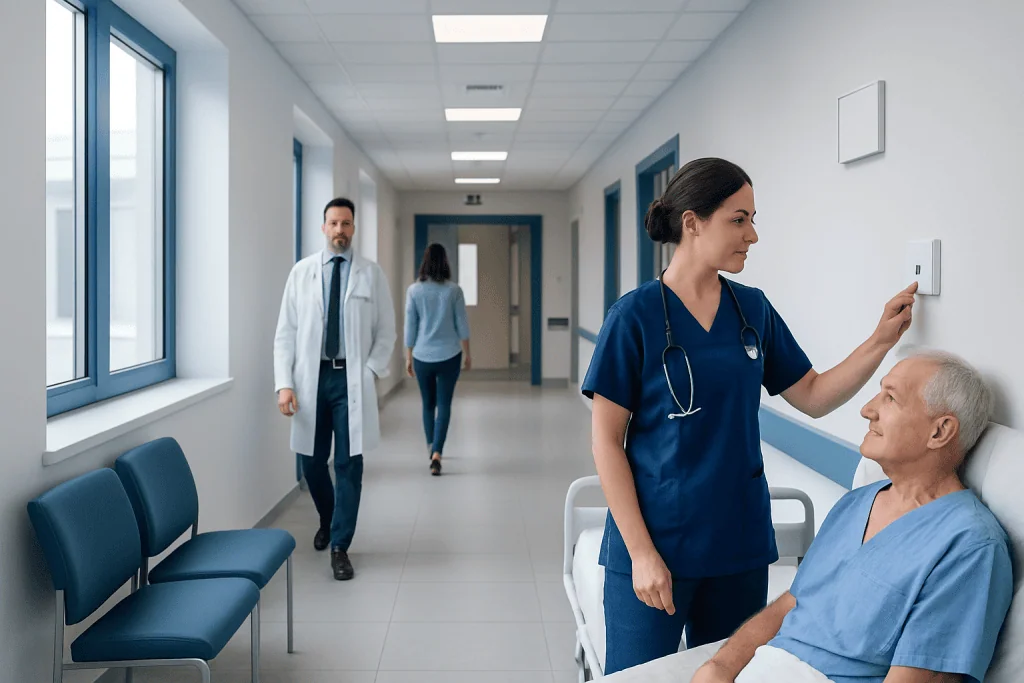
Press the handheld button by your bed, or the separate button or pull cord in the bathroom. An alert reaches the nursing station, and a nurse comes to your room or answers by intercom. Use it for any need, pain, nausea, help standing, questions about equipment. If language is a barrier, use simple words and ask for an interpreter.
It is 3 a.m. on your first night in a hospital room in Turkey. You feel dizzy, you need the bathroom, and the corridor outside is quiet. This guide explains what to do: how the nurse call system works, where the buttons usually are, what happens after you press one, and how language support fits in when you do not speak Turkish.
One honest note before we start. Call systems differ between hospitals, wards and sometimes between rooms on the same floor. What follows describes typical arrangements in modern Turkish hospitals, including Acibadem hospitals. The orientation your nurse gives you on admission is the final word for your specific room, and it is worth asking for it explicitly if it does not happen on its own.
At a glance
- Procedure type: Not a procedure: a bedside communication and safety system
- Purpose: To reach the nursing team from your bed or bathroom for help, questions or urgent concerns
- Anaesthesia: Not applicable
- Hospital stay: Available throughout inpatient stays, day procedures and observation periods
- Where you will find it: A handheld bedside controller, wall panels near the bed, and a separate button or pull cord in the bathroom
- What happens when you press it: An alert reaches the nursing station; the order of response depends on urgency and ward workload
- Suitable department: All inpatient wards, recovery areas and observation units
- International patient support: Interpreter coordination, patient relations assistance and a room orientation on admission
What the nurse call system is
The nurse call system is the fixed communication link between you and the nursing team. It is not a treatment, but it shapes how safe your treatment feels. Press a button, and an alert reaches the staff responsible for you: you do not need to shout, walk to the corridor or wait for the next scheduled check.
Using the nurse call system in Turkish hospitals works much as it does in the rest of Europe. The most common setup is a handheld controller attached to the bed by a cable, within reach of your pillow. Depending on the room, the same controller may also operate the bed position, reading light or television, so it helps to know which button is which before you need it in the dark.
Bathrooms almost always have their own call point: a button or a pull cord near the toilet or shower. This matters more than it sounds. Dizziness and falls tend to happen when patients stand or walk too soon after surgery, sedation or certain medicines, and the bathroom is where most of that standing and walking happens.
When is it recommended?
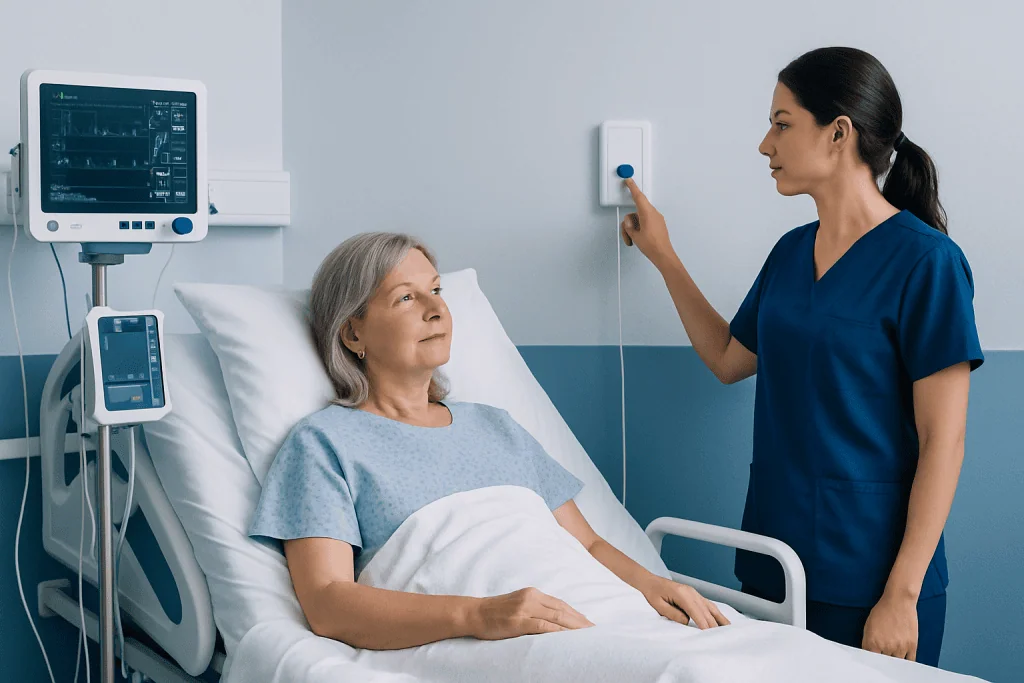
Use the system whenever you need nursing help or are unsure what to do. There is no minimum threshold. Patients typically press the button for pain, nausea, help before standing up for the first time after a procedure, questions about an IV line or drain, help reaching the bathroom safely, or simply because something feels different and they cannot name it. That last reason is as valid as any other.
You can also use it for practical needs: adjusting your position, reaching personal items, understanding an instruction you did not fully catch, or asking for an interpreter. Nursing teams expect all of these calls. The system exists to keep you safe and supported between scheduled checks, not only to handle dramatic moments.
A useful rule for the whole stay: if you have been told not to get out of bed without help, the call button is how you get that help. Pressing it is not an imposition. It is the system working as designed.
Who should pay particular attention?

Every admitted patient uses the same system, but it carries more weight for some. If you are travelling alone, recovering from anaesthesia, using a walking aid, elderly, at risk of falling, or simply anxious in an unfamiliar building in an unfamiliar country, the call button is your most reliable line to help.
It also matters more if you do not speak Turkish. Most nursing staff in hospitals that treat international patients speak some English, but levels vary by shift and ward. Knowing in advance how to reach an interpreter, and mentioning early in your stay that you may need one, removes a layer of stress. Our guide to interpreter support in Turkish hospitals covers when and how to request this.
If you have visual, hearing, mobility or cognitive needs, tell the nursing team early. They can position the controller where you can reach it, explain the buttons in a way that suits you, and note your needs for the following shifts.
Types of call system you may see
Different areas of a hospital use different equipment, and it helps to recognise the main types:
- Handheld bedside controller. The standard setup in patient rooms. One clearly marked button, often red, or marked with a nurse symbol, sends the call. Other buttons operate comfort features.
- Wall-mounted panels. Some rooms have a fixed call button on the wall near the bed, in addition to or instead of the handheld unit.
- Bathroom button or pull cord. A separate call point placed so you can reach it from the toilet or from the floor. Pull cords are deliberately long for this reason.
- Staff emergency buttons. Wards also have buttons that staff use to summon urgent help. Your nurse will tell you if any button in your room is not for patient use.
- Monitored areas. In intensive care and recovery units, continuous monitoring means staff are alerted automatically by equipment as well as by calls, and nurses are physically closer to patients.
- Wireless and pendant systems. Some hospitals use wireless call units or pendants in specific areas. From your side, the principle is identical: press, and an alert is sent.
You do not need to know which brand or generation of system a hospital has installed. What matters is knowing which button in your room calls a nurse, and confirming you can reach it from the bed.
What happens after you press the button
Pressing the button sends an alert to the nursing station for your ward. Depending on the system, staff see your room and bed number, and in many hospitals a light above your door signals the active call to anyone in the corridor. Some systems distinguish between a routine room call and a bathroom call, and treat bathroom calls with higher priority because of the fall risk.
What happens next takes one of a few forms. A nurse may come directly to your room. In rooms with an intercom, a staff member may answer through the speaker first and ask what you need, so the right person comes, clinical staff for pain, medication timing, IV lines or wound questions; support services for room comfort or housekeeping requests. Once your need is handled, the staff member cancels the call at the room unit.
If your concern feels urgent, say what is happening in short, plain words: “I cannot breathe well”, “I am bleeding”, “I feel faint”, “I need help standing”. If language fails, point to the problem area. You do not need to decide in advance whether your situation counts as serious, describe what you feel and let the team triage. Nurses would much rather answer a call that turns out to be minor than miss one that was not.
How urgent calls are prioritised
Response time is the question every patient asks, and the honest answer is that it varies. Wards handle calls in order of urgency, not in order of arrival. Calls involving breathing difficulty, bleeding, chest symptoms, a fall or a sudden change in condition are treated as immediate priorities; requests for an extra blanket wait behind them. Workload also matters: a ward at 3 p.m. and the same ward at 3 a.m. run with different staffing patterns, though nursing cover continues around the clock.
If your situation worsens while you are waiting, press the button again, or ask a companion to walk to the nursing station. Repeating a call is normal and expected. It is not rude, and no one in a Turkish hospital will read it that way.
Common problems, and how to avoid them
The weaknesses of nurse call systems are well known, and most of them are avoidable from the patient’s side:
- The button is out of reach. The single most common problem. Controllers slip off beds or get moved during cleaning. Check its position every time you settle back into bed, and ask staff to reposition it whenever it drifts.
- Confusion over which button does what. On combined controllers, the light switch and the call button live side by side. Ask for a demonstration on day one rather than working it out at night.
- Hesitation. Many patients delay calling because they do not want to bother anyone. This is the reflex to unlearn. Late calls make problems harder to manage, not easier.
- Language barriers. A call that cannot be understood is a call half made. Learn the simple English or Turkish words for your likely needs, keep a translation app to hand, and know how interpreter support is arranged on your ward.
- Relying on a companion instead of the system. Companions help, but they sleep, step out and cannot perform clinical tasks. The call button should remain your primary route.
Before your stay: online evaluation and preparation
If you are arranging treatment from abroad, the evaluation before travel focuses on your condition and the planned procedure, but it is also the right moment to raise anything that affects how you will manage in a hospital room: mobility limits, previous falls, hearing or vision difficulties, anxiety about hospitalisation, or the likelihood that you will need an interpreter. These details let the team prepare rather than improvise. Our guide on preparing for a pre-treatment video consultation explains what that conversation usually covers.
On admission, before any procedure or sedation, do three things. First, ask the nurse to show you the call button and the bathroom call point, and physically test that you can reach the controller from your resting position. Second, keep glasses, hearing aids and anything you need for communication within reach: our guide on using your own comfort items in a Turkish hospital room covers what you can bring. Third, if a companion is staying with you, walk them through the same buttons.
Understand, too, that after anaesthesia or sedation you may feel drowsy, weak or disoriented even if you normally walk without a second thought. The instruction “call before getting up” applies to you specifically in those hours, not just to frailer patients.
Using the system during your stay
The practical side of using the nurse call system in Turkish hospitals comes down to three habits: keep the controller in reach, call early rather than late, and describe your need simply. During the first hours after a procedure, overnight, and whenever your companion is out of the room, the button is your default route to help.
Expect the nurse who responds to confirm who you are before giving medication or performing clinical tasks, checking your wristband and asking your name and date of birth is standard practice, not doubt about your identity. Our guide to patient identification checks in Turkish hospitals explains why this happens at every step. You can also use the button for practical questions about your day on the ward, from medication timing to meal arrangements, see what international patients can expect from meals in Turkish hospitals for that side of the stay.
As recovery progresses, your team will encourage more independence, walking to the bathroom alone, showering, dressing. Let that happen on their instruction rather than your own estimate. If you are unsure whether you are cleared to do something, one call settles it.
Before discharge, ask what to expect in the days after leaving, how your medications are to be managed, and who to contact once you are back at your hotel or home. The call button’s job ends at the ward door; a clear discharge conversation takes over from there. Our guide on pain, swelling and fever after surgery in Turkey covers that next phase in detail.
Timeline: how your use of the system changes
| Timeframe | What to expect |
|---|---|
| First 24 hours | The period of heaviest use. Drowsiness, weakness and discomfort are common after treatment or anaesthesia. Call before getting out of bed, before using the bathroom, and for pain, nausea or anything that feels wrong. |
| Days 2–3 | You may still need help with movement, wound care and medication timing. Nurses begin encouraging supervised independence; keep calling first until they tell you otherwise. |
| Rest of the stay | Calls typically become fewer and more practical. Continue using the button for questions rather than guessing, especially at night. |
| Discharge day | The conversation shifts from the call button to written instructions: expected symptoms, medication guidance from your treating doctor, follow-up plans and contact routes. |
| After discharge | Follow-up happens through the channels your team gives you, appointments, remote follow-up where appropriate, and the written instructions you carry home. |
What to avoid
Do not get out of bed unassisted if you have been told to call first: the advice is tied to fall risk in the hours after anaesthesia, sedation, pain medication or blood loss, and it applies even when you feel fine sitting up.
Do not adjust, disconnect or untangle IV lines, drains, catheters, oxygen tubing, dressings or monitoring equipment yourself. If something is uncomfortable, leaking or beeping, that is a call, not a DIY task. Alarms exist to summon trained staff; silencing or ignoring them helps no one.
And do not sit on a concern to avoid “bothering” the team. Early reporting is what the system is for, and it makes the nursing team’s job easier, not harder.
What the system can and cannot do
Used well, the call system shortens the gap between something happening and someone knowing about it. It reduces uncertainty, supports safe movement and gives you a voice between scheduled checks. That is its full job description.
It does not replace physician rounds, nursing observations or scheduled monitoring, and it does not change the medical outcome of your treatment. It also does not come with a fixed response time, urgency and ward workload determine the order in which calls are answered. Knowing these limits is part of using the nurse call system in Turkish hospitals confidently: you know what to expect, so a two-minute wait for a blanket does not feel like a failure.
International patient travel planning
Treatment abroad is more than the procedure. Admission, communication on the ward, companion arrangements, transfers, accommodation, discharge planning and follow-up all shape the experience, and each is easier when discussed before you fly.
Acibadem International coordinates practical arrangements for travelling patients, interpreter services, airport transfers where arranged, accommodation guidance, appointment planning and communication with medical departments. Special needs shared before travel can be prepared for; needs discovered on arrival can only be reacted to. Before you leave home, confirm what to bring, whether your companion can stay overnight in the room, roughly how many days to plan in Turkey, and what follow-up is expected afterwards.
Cost and package information
The nurse call system is part of the hospital environment, not a billable item. What you pay for a hospital stay depends on the treatment itself: diagnosis, planned procedure, physician evaluations, length of stay, room category, tests, imaging, medications, anaesthesia and any additional consultations.
A quotation for international patients typically covers the planned procedure, the physician services attached to it, nursing care during the included stay, and certain routine tests or medications, depending on the treatment plan. Exclusions vary but often involve extended hospitalisation, unplanned intensive care, extra consultations, companion expenses, hotels, flights and treatment of unrelated conditions. Because plans can change after in-person evaluation, the personalised quotation, not any general description, defines what is included in your case.
Why choose Acibadem
Acibadem International coordinates the practical side of treatment for patients travelling to Turkey: clinical appointments, hospital admission, interpreter assistance and travel logistics. On the ward, nursing teams, physicians and patient relations staff work together so that a pressed call button leads to the right person, in a language you can follow.
The culture behind the call system is straightforward: you are expected to speak up. Asking questions, reporting symptoms early and requesting help before moving are treated as part of good care, not as interruptions to it.
Medical review and disclaimer
This guide has been reviewed by the Acibadem International medical team. It provides general information about nurse call systems and ward communication during a hospital stay in Turkey.
It does not replace consultation with a physician, nurse or other qualified healthcare professional. Equipment, room layouts and ward procedures vary by hospital, department and unit, and your care instructions, including anything relating to movement, activity or medication, come from your treating team, not from this page. Always follow their guidance.
Step by step
- Initial contact. You contact Acibadem International or the relevant hospital team with your medical need, preferred dates, and any communication, mobility or accessibility concerns.
- Medical record submission. You share available reports, test results, imaging, medication lists, allergies and photos where relevant, so the team understands your situation before travel.
- Preliminary medical review. The relevant department reviews your information and may request additional documents. This is the moment to mention interpreter needs or extra support during hospitalisation.
- Treatment plan and quotation. A preliminary plan and quotation are prepared. The final plan may change after in-person evaluation.
- Travel planning. Dates, expected length of stay, transfer options, accommodation guidance and the appointment schedule are coordinated.
- Arrival. Arranged transfers and reception processes guide you to your hotel or the hospital; international patient services help with orientation.
- In-person consultation. You meet your physician and care team for examination and discussion of the plan and the hospital stay.
- Pre-operative tests. If your treatment involves a procedure, you may have blood tests, imaging and an anaesthesia evaluation, with nurses explaining each preparation step.
- Treatment. Your treatment is performed according to your physician’s assessment, followed by monitoring in the recovery area or ward.
- Hospital stay. Keep the call button within reach and use it whenever you need help or are unsure about movement, medication timing, devices or personal care.
- Discharge and travel clearance. You receive discharge instructions, medication guidance from your doctor, activity advice and your physician’s assessment of when travel is appropriate.
- Remote follow-up. Where appropriate, follow-up is coordinated after you return home. Keep your reports and contact details accessible.
Your checklist
- Passport and travel documents
- Medical history summary, including current diagnosis and previous conditions
- List of current medications and supplements
- Known allergies, especially to medications, latex or contrast agents
- Previous surgeries and anaesthesia history
- Recent test results, imaging and specialist notes
- Glasses, hearing aids or assistive devices you rely on to communicate
- Mobility, hearing, vision or communication needs to declare on admission
- Emergency contact details and companion information
- Insurance or payment documents if applicable
- A translation app or phrase list for basic ward requests
- Questions about the call system, interpreter access, discharge and follow-up
Key takeaways
- The call button is your direct line to the nursing team, one press from bed or bathroom, and an alert reaches the station.
- There is no threshold for calling. Practical requests, questions and vague unease all count.
- Test the button’s reach on day one, learn which control does what, and re-check its position each time you return to bed.
- Calls are answered by urgency, not order. Repeating a call is normal if things change while you wait.
- Language support is arrangeable, say early in your stay that you may need an interpreter, and keep simple words ready in the meantime.
- The system supports your care; it does not replace scheduled rounds, monitoring or your team’s instructions.
Frequently asked questions
How does the nurse call system work?
Pressing the button sends an alert to the nursing station showing your room and bed. In many hospitals a light above your door also marks the active call. A nurse comes to your room or answers first through an intercom, and the call is cancelled at the room unit once your need is handled. Bathroom call points often carry higher priority because of fall risk.
What is the healthcare system like in Turkey?
Turkey has both public and private hospitals. International patients are usually treated in private hospitals, many of which run dedicated international patient departments with interpreter and coordination services. Facilities and processes vary by institution, so questions about your specific hospital and ward are worth asking before travel.
What are the common problems with nurse call systems?
From the patient’s side: a controller that has slipped out of reach, confusion between the call button and comfort controls, hesitation to “bother” staff, language barriers when explaining a need, and over-reliance on a companion instead of the system. All five are largely preventable with a proper orientation on admission and a habit of checking the button’s position.
What is the best nurse call system?
For a patient, the brand and technology matter far less than familiarity. Wired, wireless and intercom-based systems all do the same job from your side of the bed. The “best” system is the one in your room once you know exactly which button calls a nurse, where the bathroom call point is, and that you can reach the controller without stretching.
What if I do not speak Turkish?
Say what you can in simple English words, point to the problem area, or use a translation app. Hospitals treating international patients can arrange interpreter support, and it helps to request this early in your stay rather than mid-crisis. Staff are used to working across languages; short, plain words carry further than full sentences.
Can my companion call the nurse for me?
Yes: a companion can press the button or walk to the nursing station if you cannot. But clinical tasks, mobility assistance after procedures and anything involving lines or devices belong to trained staff, so the call system should stay your primary route even with a companion present.
How long does it take for someone to come after I press the button?
There is no fixed time, and any page that gives you one is guessing. Calls are handled by urgency, and ward workload varies by hour and shift. If your situation changes while you wait, press again or have a companion alert staff directly, repeat calls are expected, not resented.
Can I use the call system in the bathroom?
Yes. Hospital bathrooms have their own button or pull cord, positioned to be reachable from the toilet, the shower and, deliberately, from the floor. If you feel unsteady in the bathroom, use it and wait for help rather than trying to walk back alone.
Add us as a Preferred Source to see more of our trusted health content across Google Search, AI Overviews and Discover.

Update history
- PublishedJune 22, 2026
- Medical review approvedSeptember 13, 2026
- Last content updateSeptember 12, 2026
References1
- Preventing falls in the hospital: MedlinePlus medlineplus.gov
More Patient Guides

HoLEP in Turkey: How It Compares With TURP and What Recovery Involves
HoLEP in Turkey treats enlarged prostate tissue with laser enucleation; learn how it compares with TURP, recovery, travel and follow-up.

Porcelain Veneers in Turkey: Who Is Suitable and How Many Visits Are Needed?
Porcelain veneers in Turkey can enhance tooth shape and colour in two visits for suitable patients after a personalised dental assessment.

How to Prepare for a Sedation Procedure in Turkey
Prepare safely for a sedation procedure in Turkey with guidance on fasting, medicines, travel, recovery and follow-up.
Treatment Delays in Turkey: What Happens If Tests or Recovery Change Your Schedule
Treatment delays in Turkey can happen if tests or recovery change your plan. Learn how to manage appointments, travel, accommodation and follow-up.