

Meals in Turkish Hospitals: What International Patients Can Expect
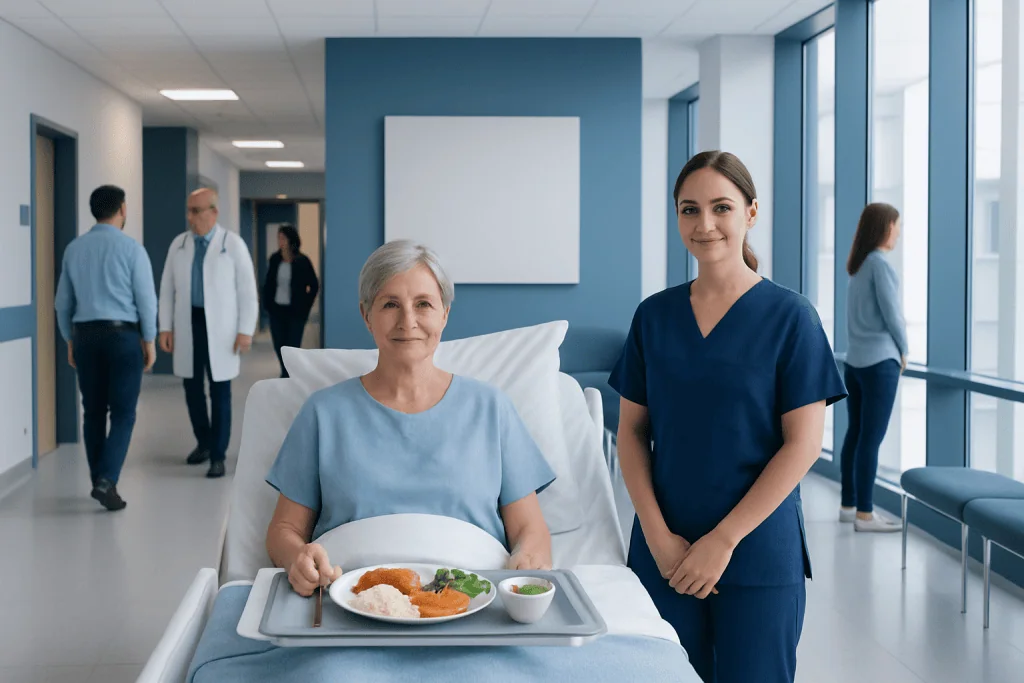
Meals in Turkish hospitals are planned around your treatment, not around preference. Expect scheduled trays, often soup, a main dish, bread, yoghurt and fruit, adjusted for fasting orders, allergies and medically required diets. Special and religiously appropriate diets are usually possible with advance notice, and outside food normally needs your care team's approval before you eat it.
You are probably not worried about the food itself. You are worried about being misunderstood: that nobody will know about your allergy, that a tray will arrive with something you cannot eat, or that you will be left hungry before a procedure without knowing why. These are reasonable concerns before an inpatient stay abroad. In practice, meals in Turkish hospitals are organised around your treatment plan, your recovery stage, and the dietary information you give your care team, which means the most useful thing you can do is share that information early and clearly.
This guide explains what typically arrives on the tray, how your treatment changes what you are allowed to eat, how special diets and allergies are handled, and what the rules usually are when family members want to bring food in. It also covers the eating guidance you should expect before discharge.
At a glance
- Best for: International patients preparing for an inpatient stay in a Turkish hospital
- What meals depend on: Your procedure, fasting orders, medications, allergies, and the diet your doctor approves each day
- Typical service: Breakfast, lunch and dinner at set times, sometimes with snacks; trays are ward-delivered, not restaurant-style
- Special diets: Usually possible with advance notice, diabetic, low-salt, soft, pureed, allergy-aware, vegetarian and other modified plans
- Religious needs: Pork is generally absent from Turkish hospital kitchens; state other requirements explicitly rather than assuming
- Outside food: Often restricted, especially after surgery, always ask before eating anything a companion brings
- Key step: Document allergies, intolerances and medical diet needs before admission, then repeat them at check-in
What meals in Turkish hospitals are actually like
Meals in Turkish hospitals are practical, scheduled and closely tied to your medical care. This is not hotel dining, and it is not meant to be. The kitchen’s job is to support recovery, hydration and digestion while respecting any restrictions your doctor has set for that day. If you arrive expecting clinical catering rather than cuisine, the reality will usually sit somewhere pleasantly in between: simple, recognisable food, served warm, on a predictable schedule.
Breakfast, lunch and dinner arrive at set times on the ward, and in many hospitals a light snack is offered between meals. What lands on your tray depends less on what you would choose and more on what is safe for you on that particular day, whether you are recovering from surgery, waiting for a test, taking medication that needs food, or preparing for discharge. In larger private hospitals, including Acibadem hospitals, meal planning is coordinated between your treating team and the hospital’s nutrition service, so the menu reflects your clinical orders rather than a fixed weekly rotation. You can read more about how wards, rooms and daily routines work in our overview of what international patients can expect across the Acibadem network.
One honest note: meals in Turkish hospitals vary between facilities, wards and even days of the week. Two patients on the same corridor can receive different trays because they are on different diets. Treat everything in this guide as the general pattern, and treat your own team’s instructions as the rule.
What a typical tray looks like: Turkish hospital food day by day
If you are on a regular, unrestricted diet, hospital food in Turkey tends to follow the shape of everyday Turkish home cooking, simplified for a clinical kitchen.
- Breakfast is usually light and savoury: bread, white cheese, olives, egg, honey or jam, and tea. This mirrors a standard Turkish breakfast, scaled down.
- Lunch and dinner commonly include a soup (lentil, vegetable or chicken soups are frequent), a main dish such as grilled or stewed chicken, meat or a vegetable dish, a side of rice or bulgur, bread, and often yoghurt or ayran, a plain yoghurt drink.
- Dessert or fruit may appear as seasonal fruit, compote, or a light milk-based pudding, depending on your diet orders.
Soup deserves a special mention. It is central to Turkish food culture and central to hospital menus, partly because it is gentle, hydrating and easy to tolerate after treatment. If you are moving from liquids back towards solid food, soup will very likely be the bridge.
Portions are moderate rather than generous, seasoning is deliberately mild, and spice levels are kept low: a hospital kitchen cooks for the most sensitive stomach on the ward, not the most adventurous one. If you find the food plainer than what you eat at home, that is by design, and it is usually temporary.
How your treatment affects what you can eat
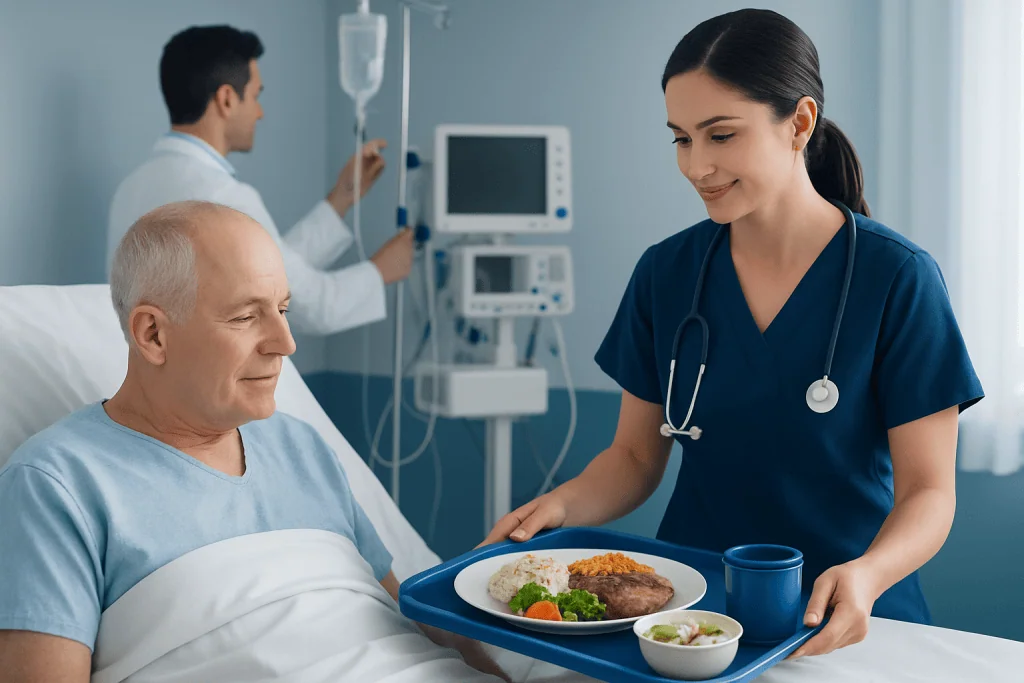
Your allowed diet can change several times during a single stay. Before a procedure, you may be told not to eat or drink for a set number of hours: this is standard practice before general anaesthesia, sedation and some imaging or laboratory tests. Afterwards, eating usually restarts in stages: water first, then clear liquids, then soft foods, then a light diet, and finally regular meals. How quickly you move through those stages depends on your procedure and how your body responds, not on a fixed timetable.
This staged approach can feel restrictive when you are tired and hungry, but each step has a reason. Anaesthesia affects your airway and stomach. Nausea, swallowing comfort, blood sugar control, bowel recovery and medication timing all shape when and what you can safely eat. The pattern is broadly the same on surgery day everywhere in the world; Turkey is no exception.
- Fasting may apply before surgery, sedation, endoscopy and some scans or blood tests
- Liquids may be limited even when you feel well enough to drink
- Certain foods may be withheld to reduce nausea or digestive strain
- Your doctor approves each step back towards a normal diet as you recover
If an instruction seems different from what you expected, a longer fast, a delayed tray, a plainer meal than yesterday, ask your nurse or coordinator to explain it in simple terms. Diet orders are written per patient, per day, and there is almost always a specific reason behind yours. It also helps to know that fasting rules vary in detail: whether plain water is allowed up to a certain hour, whether chewing gum counts, whether your usual tablets should be taken with a sip of water. Confirm these specifics for your own case rather than relying on what another patient was told.
Special diets, allergies and cultural preferences
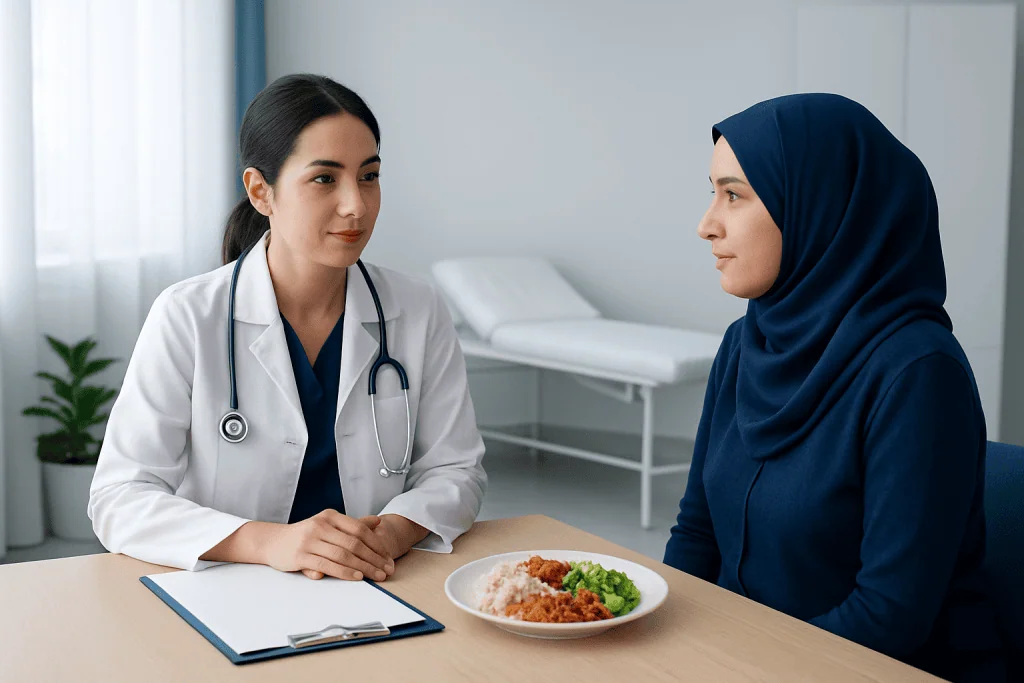
If you have food allergies, intolerances, diabetes, coeliac disease, kidney-related restrictions or any other nutrition need, the hospital should know before your first tray is prepared. Ideally this information goes into your file before you travel, and you repeat it again at admission so it is documented twice. Admission days are busy; repetition is not rudeness, it is good practice.
Hospitals in Turkey can usually accommodate medically necessary diets and common restrictions when informed in advance. Depending on the facility’s nutrition protocols and your condition, this may include low-salt, diabetic-friendly, soft, pureed, gluten-aware, lactose-adjusted or vegetarian meal plans. The key phrase is in advance: a kitchen that knows on Monday can plan; a kitchen that hears about it when the tray arrives can only apologise and start again.
Religious and cultural needs are generally well understood in Turkey. Pork does not typically appear in Turkish hospital kitchens, and halal expectations are broadly the norm rather than the exception. Still, do not leave anything to assumption. If you avoid specific ingredients, need meals prepared within particular boundaries, or observe fasting periods for religious reasons, say so explicitly through the international patient team or an interpreter. Religious fasting in particular should be discussed with your doctor, because it may interact with your treatment. Our guide to religious, cultural and quiet space support in Turkish hospitals covers the wider picture.
For severe allergies, bring a written card listing the allergen and the seriousness of your reaction, in English and, if you can arrange it, in Turkish. Show it at admission and keep it visible at your bedside. Where cross-contact is a genuine risk, say that plainly; “I cannot eat peanuts” and “traces of peanut can harm me” are two different instructions, and the kitchen needs to know which one applies.
Can your companion bring food or order from outside?
Sometimes, but never by default. Whether outside food is allowed depends on your doctor, the ward’s rules, and where you are in your recovery. After surgery, during infection-control precautions, or while your digestive system is being monitored, outside food may be discouraged or temporarily prohibited altogether.
This matters more than it sounds. A well-meant snack can break a fasting order before a rescheduled test, upset blood sugar management, or strain a digestive system that is only just restarting. Your team cannot account for food they do not know about. So the rule is simple: before you eat anything a companion brings, a home-cooked meal, restaurant food, fruit, even a hot drink, someone should check with the nurses first.
- Ask before bringing homemade meals or restaurant food onto the ward
- Check whether hot drinks, fruit or packaged snacks are permitted for you specifically
- Confirm restrictions after anaesthesia or any gastrointestinal treatment
- Do not assume that “light” or “healthy” foods are automatically allowed
Companions staying with you overnight should also plan their own meals, hospital trays are prepared for the patient, though cafeterias and nearby options usually cover the rest. If your stay was unplanned, our guide to an unexpected overnight stay in Turkey covers what companions should be ready for.
Making meals easier when you do not speak Turkish
Language is usually the biggest source of meal anxiety for international patients, and it is also the most solvable. In hospitals with international patient departments, interpreters and coordinators handle everyday practical questions, meal timing, missed trays, diet clarifications, not only major treatment discussions. Use them for the small things. That is what they are there for.
Before admission, write a short note covering your allergies, strong dislikes, religious boundaries, usual meal pattern, and anything that affects how you eat: dentures, swallowing difficulty, reflux, nausea. Handing over one clear written summary works better than explaining piece by piece while tired.
During your stay, ask practical questions early rather than when the tray arrives. When are meals served on this ward? Are snacks available between meals? What happens if I miss lunch because of a test, is a tray kept for me? Who do I tell if I cannot tolerate what I am given? These are entirely normal hospital questions, and nurses answer them all day. If you need something between rounds, the bedside call button is the right channel, see our guide to using the nurse call system in Turkish hospitals.
Two situations are worth flagging in advance. First, if a test or procedure is added or moved, your fasting and meal schedule may shift with it, sometimes at short notice. Second, if you are nauseated or in discomfort after treatment, eating may be genuinely difficult; tell the team rather than quietly leaving the tray untouched, because there are often medically appropriate alternatives, texture changes or timing adjustments. Appetite and comfort are also connectedpain control after surgery plays a bigger role in whether you feel like eating than most patients expect.
What to expect before discharge
As discharge approaches, your team will usually give you eating and drinking guidance for the first days afterwards. Patients often underestimate this part. After surgery, digestive procedures, dental work, bariatric-related care, or any treatment affecting swallowing, appetite, hydration or bowel habits, what you eat in the first days matters to how comfortable your recovery is.
A discharge plan may cover fluid intake, suitable soft foods, meal frequency, foods to avoid for a defined period, and the expected pace of returning to a normal diet. If you will be recovering in a hotel or travelling soon after discharge, ask for practical examples: what you can realistically order from a hotel menu, what to choose at an airport, what to carry for a long transfer. Concrete examples beat abstract rules when you are away from the hospital kitchen.
Before you leave, make sure you understand whether reduced appetite is expected in your case, what your written discharge notes say to watch for, and how your follow-up is arranged. Ask for the instructions in plain language, and ask again if anything is unclear: a two-minute clarification at the bedside saves days of guesswork at the hotel.
Step by step
- Share your dietary needs before you arrive. Have your allergies, intolerances, medical diet needs and religious or cultural food boundaries recorded in your file ahead of admission where possible. Then repeat them at check-in so nothing is lost in a busy admission process.
- Confirm fasting rules early and in detail. If you are having surgery, sedation, imaging or tests, ask exactly when you must stop eating and drinking, and whether water, gum, tea, coffee or your usual tablets are included in the restriction. The details vary and they matter.
- Ask what diet you are on each day. Your allowed foods can change quickly after treatment. Knowing whether today is clear liquids, soft foods or a regular diet spares you confusion when the tray arrives.
- Check before eating outside food. Nothing brought by family or ordered in should be eaten before the care team confirms it is appropriate for your current diet and medications.
- Speak up if you cannot manage your meals. Nausea, swallowing discomfort or an intolerable texture are things the team can work with, but only if they know. Untouched trays tell them less than a sentence does.
- Get discharge eating instructions in simple language. Before leaving, ask what to eat and drink over the coming days, especially if you will be recovering in a hotel, travelling soon, or taking medications that should be taken with food.
Your checklist
- List all food allergies and how serious your reactions are
- Note intolerances, diabetes, coeliac disease or kidney-related diet needs
- State vegetarian, halal or other religious and cultural boundaries explicitly
- Confirm fasting rules, including water, gum and tablets, before procedures
- Check whether companions may bring food onto the ward
- Carry a written allergy card, translated into Turkish if possible
- Ask what happens to your meal if a test overruns lunch
- Get your post-discharge eating plan in writing before you leave
Key takeaways
- Meals in Turkish hospitals follow your treatment plan first and your preferences second, expect scheduled, simple, mildly seasoned food.
- Typical trays reflect Turkish home cooking: soup, a main dish, rice or bulgur, bread, yoghurt and fruit, adjusted to your diet orders.
- Fasting, liquid diets and staged returns to normal eating are routine around procedures and are usually temporary.
- Special, allergy-aware and religiously appropriate diets are generally possible: the earlier the hospital knows, the better they work.
- Outside food needs your team’s approval; a well-meant snack can interfere with fasting orders, medications or recovery.
- Ask for clear, written eating guidance before discharge, especially if you are recovering in a hotel or travelling soon.
Frequently asked questions
What are the typical meals served in hospitals in Turkey?
On a regular diet, expect a light savoury breakfast with bread, cheese, olives and egg, then lunches and dinners built around soup, a main dish such as chicken or a vegetable stew, rice or bulgur, bread, and yoghurt or fruit. Portions are moderate and seasoning is mild. Restricted diets, liquid, soft, diabetic, low-salt, replace this pattern when your doctor orders them.
What are some typical meals in Turkey more generally?
Everyday Turkish food centres on soups (lentil soup is a national staple), grilled or stewed meats, rice and bulgur dishes, vegetable dishes cooked in olive oil, fresh bread, and yoghurt in many forms. Hospital menus draw on the same tradition in a simplified, gentler form suited to recovery.
Can Turkish hospitals accommodate allergies or special diets?
Many can support medically necessary diets and common restrictions when told in advance, including diabetic, low-salt, soft, pureed, gluten-aware and vegetarian plans, depending on the facility. Repeat your needs at admission, make sure severe allergies are clearly documented, and carry a written allergy card, ideally translated into Turkish.
Why am I not allowed to eat even when I feel hungry?
Usually because of fasting orders before procedures, or staged eating after anaesthesia, when your airway, stomach or digestion needs protecting. It is frustrating but temporary, and the restrictions exist to reduce medical risk. Ask your nurse to explain the reason and the expected timing for your case.
Can my family bring me food from outside the hospital?
Sometimes, but only if your doctor and the ward rules allow it. After surgery, during infection-control precautions, or while your digestion is being monitored, outside food may not be appropriate. Your companion should always check with the nurses before you eat anything brought in.
What if I do not speak Turkish and need help explaining food restrictions?
Ask for interpreter support or help from the hospital’s international patient team. These services exist for practical day-to-day needs, allergies, meal timing, diet questions, not only for major treatment discussions. A short written summary of your food needs makes their job, and yours, much easier.
Will hospital food in Turkey match what I eat at home?
Probably not exactly. Hospital meals are simple, mildly seasoned and medically guided, so they may feel plainer and more structured than your usual diet, particularly right after treatment. The food is designed around recovery first and familiarity second.
Do I need eating instructions before I leave the hospital?
Yes, especially if your treatment affected your stomach, mouth, swallowing, digestion or appetite. Ask what to eat and drink in the first days, what to avoid and for how long, and get the guidance in writing so you can follow it at your hotel or during travel.
Add us as a Preferred Source to see more of our trusted health content across Google Search, AI Overviews and Discover.

Update history
- PublishedAugust 1, 2026
- Medical review approvedSeptember 13, 2026
- Last content updateSeptember 12, 2026
References2
- Clear liquid diet: MedlinePlus medlineplus.gov
- Food allergy: NHS nhs.uk
More Patient Guides

When a Hospital Stay in Turkey Becomes Longer Than Planned: What to Arrange
If your hospital stay in Turkey is longer than planned, arrange medical updates, accommodation, travel changes, insurance and support for your companion.

Waiting for Test Results in Turkey: How to Use Time Between Appointments
Waiting for test results in Turkey is easier with a clear plan for appointments, rest, records, questions and support in Istanbul.

Unexpected ICU Stay in Turkey: What Patients and Families Should Expect
Unexpected ICU stay in Turkey: learn what patients and families can expect, from communication and visiting to care updates and travel support.

How to Manage Special Diets During Medical Travel in Turkey
Special diets during medical travel in Turkey are easier to manage when you share your needs early, confirm meals and carry safe…