

Power Plugs and Device Charging for Patients in Turkey

Turkey uses Type C and Type F sockets at 230 volts and 50 hertz, the same standard as continental Europe. Most modern phone, tablet and laptop chargers accept this voltage, so a simple plug adapter is usually all you need. Check the 'Input' line on every charger label before you fly, and treat any medical device charger as a separate, more careful check.
Will your phone charger work in your hospital room in Istanbul? It is a small question until it matters, at 2 a.m., when you want to message your family, open your appointment details or power a device you rely on to sleep. This guide covers power plugs and device charging for patients in Turkey: which sockets you will find, what the voltage means for your chargers, which adapters to buy and how charging works during a hospital stay.
At a glance
- Procedure type: Travel preparation and hospital-stay logistics, not a medical procedure
- Purpose: To keep your phone, documents and approved personal devices powered safely throughout your trip
- Anesthesia: Not applicable
- Hospital stay: Determined by your treatment; bedside sockets are Type C/F, 230 V, 50 Hz
- Estimated recovery: Not applicable; preparation is best finished before departure
- Return to daily life: Compatible devices can be used throughout travel and, where appropriate, in hospital according to staff guidance
- Final result timeline: Check charger labels and buy adapters at home; confirm arrangements on arrival
- Suitable department: International Patient Services, the ward nursing team and hospital technical staff where relevant
- International patient support: Acibadem International coordinates practical arrival guidance, interpreters, transfers and accommodation advice
Power plugs and device charging for patients in Turkey: the essentials
Turkey uses Type C and Type F power sockets. The mains supply is 230 volts at 50 hertz: the same standard as most of continental Europe. If you are travelling from the UK, the US, Canada, Australia or most of the Gulf, the plugs on your chargers will not fit a Turkish socket without an adapter. The shape is only half the story, though. The voltage is the part that can actually damage equipment, so both need a moment of your attention before you pack.
What Turkish plugs and sockets look like
A Turkish wall socket is round and slightly recessed into the wall. A Type C plug, often called a Europlug, has two thin round pins and no earth connection; it is the plug fitted to phone chargers and other low-power devices across Europe. A Type F plug, known as a Schuko plug, also has two round pins but is thicker, with two metal earthing clips on its top and bottom edges that press against matching strips inside the socket. Type C plugs fit into Type F sockets, so in practice one socket standard serves both plug types everywhere you will go: airport, hotel, hospital room.
Flat-pin plugs from North America, three-rectangular-pin plugs from the UK and angled-pin plugs from Australia do not fit. They cannot be forced in, and trying is a bad idea.
Does Turkey use the same plugs as the US?
No. The United States uses Type A and Type B plugs with flat pins on a 120-volt supply. Turkey uses round-pin sockets on 230 volts. That difference matters twice. You need an adapter for the shape, and you need to confirm that each charger accepts 230 volts before plugging it in. Most modern electronics do. Some single-voltage devices, often hair dryers, straighteners and older chargers, do not, and those are the ones that fail.
The charger label answers everything
Every charger carries small printed or moulded text that includes a line beginning with the word Input. That line is the only reliable answer to whether the charger will work in Turkey. Read it on each charger you plan to bring.
- “Input: 100–240 V ~ 50/60 Hz”dual voltage. The charger works in Turkey with a plug adapter alone. Nearly all phone, tablet and laptop chargers made in the last decade carry this marking.
- “Input: 220–240 V ~ 50 Hz”already matched to Turkish mains. You only need the adapter for the plug shape.
- “Input: 100–120 V”single voltage and not compatible. Connecting it through a shape adapter can destroy the charger or the device and can create a safety hazard. You would need a voltage converter or, more practically, a replacement charger rated for 230 volts.
Checking labels takes five minutes at home. It is the single most useful step in power plugs and device charging for patients in Turkey, because it tells you exactly what to buy and what to leave behind.
Adapter or converter: not the same thing
A plug adapter changes the shape of the pins so your plug fits a Turkish socket. It does nothing to the electricity. A voltage converter actually transforms 230 volts down to a lower voltage for devices that cannot accept it. Converters are heavier, cost more and are unnecessary for dual-voltage equipment, which is why the label check comes first. Most patients only ever need adapters, usually two or three, since phone, laptop and companion devices tend to want charging at the same time.
What you need, by home country
| Travelling from | Plug type at home | What you need in Turkey |
|---|---|---|
| UK and Ireland | Type G (three rectangular pins) | A Type C/F adapter. Voltage is the same as Turkey, so almost all your equipment works with the adapter alone. |
| USA and Canada | Type A/B (flat pins, 120 V) | A Type C/F adapter plus a label check on every charger. Dual-voltage chargers are fine; single-voltage devices need a converter or replacement. |
| Continental Europe | Type C/F | Usually nothing. Your plugs fit Turkish sockets directly. |
| Australia and New Zealand | Type I (angled flat pins) | A Type C/F adapter. Voltage matches Turkey, so most devices work with the adapter alone. |
| Gulf states, Malaysia, Singapore | Type G in most cases | A Type C/F adapter. Voltage matches, so a shape adapter is normally sufficient. |
When to sort this out
Before you leave home. Adapters are sold in Turkish airports, electronics shops and supermarkets, but shopping for one on arrival, tired, possibly unwell, possibly with a phone at four per cent, is the situation this guide exists to prevent. Buying at home also lets you test the adapter with your actual chargers rather than hoping the airport shop stocks the right kind.
Preparation matters most if you will stay in hospital, attend several appointments across different days or remain in Turkey for a recovery period. Your phone tends to become the hub of a medical trip: appointment messages, translated instructions, digital copies of records, banking confirmations, transfer arrangements and family updates all run through it. A dead battery does not create a medical problem, but it reliably creates a logistical one at the worst possible moment.
Who should plan most carefully

Everyone bringing electronics benefits from a label check and a spare adapter. Two groups should go further.
First, patients who depend on a powered device for health, comfort or independence: CPAP machines, rechargeable hearing aids, electric wheelchair or scooter chargers, portable nebulisers, glucose-related devices and personal monitors. These devices often have manufacturer-specific power supplies, and manufacturer-approved accessories are the safest choice, improvised converters and third-party chargers are exactly where problems start. If you use a CPAP machine, the dedicated CPAP travel checklist for hospital patients covers this in detail, and there is a broader guide to battery-powered medical devices during travel to Turkey.
Second, patients travelling from 100–120 volt countries. Your risk is not the missing adapter: that is obvious the moment a plug will not fit. The risk is the single-voltage charger that physically connects through an adapter and then fails on 230 volts. This is why the label check is done device by device, not assumed.
Suitability of any medical device for use during hospitalisation is a clinical and technical question, not just an electrical one. Bring the device information, charger details and manufacturer instructions with you so that the hospital team has what it needs to advise.
Charging in the hospital
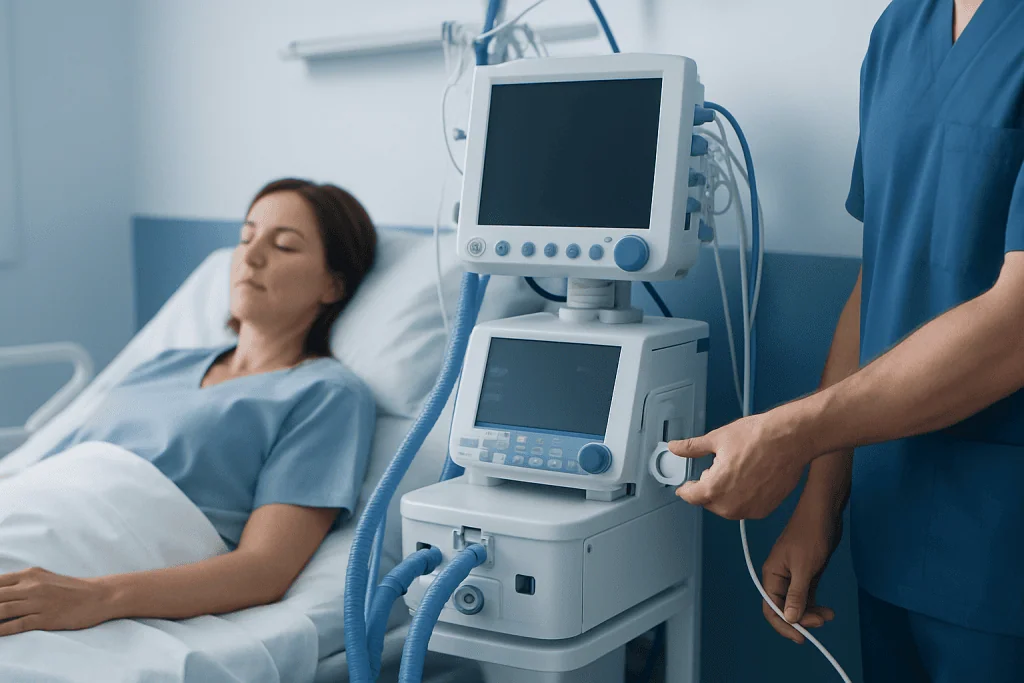
Turkish hospital rooms have standard Type C/F wall sockets, and charging everyday personal devices such as phones and tablets in patient rooms is routine. The nursing team can point out which sockets are free for personal use; some bedside outlets are reserved for clinical equipment, and hospital equipment is never unplugged to make room for a phone.
A few practical points make the ward easier for everyone. A cable of two metres or more lets you use the phone in bed without stretching, which matters more than you expect after surgery. Cables kept off the floor stay clear of IV stands, walking frames and the staff who move around your bed many times a day. Bulky multi-plug extension blocks do not belong in clinical areas unless staff have approved them, and a visibly damaged cable or an adapter that runs hot belongs in the bin, not the wall.
During procedures, imaging and time in treatment areas, personal electronics are usually set aside, kept with a companion or left in your room. Staff explain what stays with you; it is a routine part of keeping clinical areas safe rather than anything specific to your case. Personal medical devices are handled differently again: staff need to know about any device you intend to use at the bedside, because some are appropriate, some need review by the technical team and some are replaced by hospital equipment for the duration of monitoring or observation.
Packing and the pre-travel routine
Keep one adapter, your phone charger, the essential cable and a charged power bank in your hand luggage. A second adapter in checked baggage is cheap insurance. This split means a delayed suitcase does not take your communication down with it during arrival, transfer and admission: the hours when you use the phone most.
Airlines require power banks and spare lithium batteries in hand luggage rather than checked baggage, and rules on capacity and quantity vary by carrier and change over time, so check your airline’s current policy before flying. Medical device batteries often have their own airline notification requirements; the guide on packing medical devices and supplies for treatment travel walks through those steps.
Charging sits naturally on the same pre-travel checklist as your paperwork. While you are checking charger labels, it is worth reviewing the documents international patients should bring for hospital admission, since the phone that stores your digital copies is only useful if it is charged, and printed backups are only useful if you made them.
If you have surgery planned, charge everything fully before admission. You may not move freely for a day or two afterwards, and a full battery plus a long cable removes one small frustration from a period that has enough of them.
Discharge and the trip home
Discharge day involves written instructions, appointment times, transport and often a hotel or airport within hours. A charged phone and a charged power bank before you leave the ward keep all of that manageable. Save important files offline as well as online, connectivity between hospital, hotel and airport is usually fine, but “usually” is not a plan.
If a companion travels with you, split the responsibilities: one person carries the adapters, one keeps the power bank topped up, and both know where the cables live. Companions staying overnight can charge their own devices in the room; the guide to booking a companion room in Turkey covers what to check about the accommodation itself.
What can go wrong, honestly
The risks here are practical, not medical, and they are all preventable. An incompatible charger can fail or overheat. A forgotten adapter leaves you unpowered at arrival or discharge. A single-voltage device connected through a shape adapter can be permanently damaged. A power bank packed in checked luggage can be confiscated at the airport.
For medical devices, the concern is continuity: a wrong accessory or an unplanned power interruption can disrupt a routine you depend on. That is the reason device details belong in your pre-travel preparation rather than in an improvised fix at the bedside. In hospital, electrical faults, a hot adapter, a burning smell, sparking, are handled by unplugging the item if it is safe to do so and telling ward staff, who involve the technical team. Nobody repairs equipment at the bedside, including you.
Finally, a flat battery is also an information problem. If your phone holds your only copy of the appointment schedule, discharge instructions and emergency contacts, its battery level becomes more important than it should be. Printed or offline copies remove that dependency entirely.
What preparation costs depends on
This is inexpensive preparation, and what you spend depends on structure rather than any fixed figure: how many devices you bring, whether simple plug adapters cover everything or a replacement dual-voltage charger is needed, whether you add a power bank or multi-port charger, and whether a medical device requires manufacturer-approved accessories, which cost more than generic travel gear. Hospital rooms provide the sockets; the accessories are your own travel items unless something specific has been arranged. The broader guide to hidden costs in a medical travel budget puts small items like these in context.
A practical timeline
| Timeframe | What to expect |
|---|---|
| Before departure | Check every charger label, buy Type C/F adapters, test them with your actual chargers, and confirm airline rules for power banks and device batteries. |
| First 24 hours | After arrival or admission, confirm where personal devices can be charged. Keep cables tidy and raise any bedside medical device with the nursing team before using it. |
| First week | Your phone works hardest now, appointments, translations, transport, family. Keep the power bank charged and retire any adapter that feels loose or runs warm. |
| Weeks 2–4 | If you stay in Turkey for recovery, review the charging setup in your accommodation and keep following clinical guidance on any device linked to your care. |
| After returning home | For remote follow-up, keep the device you use for video calls and records access reliable, and replace worn cables and adapters before the next trip. |
Why choose Acibadem
Acibadem International works with patients from many countries and treats practical details, language, transfers, accommodation, staying connected, as part of an organised medical journey rather than an afterthought. International Patient Services coordinates interpreters, airport transfer arrangements and accommodation guidance, and acts as the channel through which practical questions, including device and power questions, reach the right hospital team.
The aim is straightforward: that you arrive informed, that the ward knows what you depend on, and that logistics never compete with your treatment for attention.
Medical review and disclaimer
This guide has been reviewed by the Acibadem International medical team. It provides general information for international patients preparing to travel to Turkey and does not replace individual consultation with a physician or qualified healthcare professional.
Electrical compatibility and device use vary by device, manufacturer, hospital area and medical situation. Whether a personal medical device is suitable for use during hospitalisation is decided by the treating physician and hospital team. Always follow your physician’s instructions, the device manufacturer’s guidance and hospital safety rules.
Step by step
- Initial contact. Device needs, anything supporting breathing, mobility, hearing, monitoring or communication, are naturally raised during the first coordination conversations, alongside medical records.
- Practical review. Photos of a device, its plug and its charger label make compatibility questions easy to resolve before travel rather than at the bedside.
- Treatment planning. The treatment plan concerns your medical care; adapters, chargers and power banks remain personal travel items unless something specific is arranged.
- Label check at home. Read the “Input” line on every charger. Dual-voltage (100–240 V) means adapter only; 100–120 V only means converter or replacement.
- Purchase and test. Buy Type C/F adapters before departure and test them with your actual chargers.
- Packing. One adapter, essential cables and a charged power bank in hand luggage; a spare adapter in checked baggage; power banks never in the hold.
- Arrival. A charged phone carries you through transfers, hotel check-in and coordinator messages on day one.
- Consultation and admission. Regularly used medical devices are mentioned to the physician and nursing team, who advise on use during the stay.
- Tests and treatment. Personal electronics are set aside in imaging, operating and treatment areas as staff direct; hospital-approved equipment handles clinical monitoring.
- Hospital stay. Personal devices charge in the sockets staff indicate; cables stay off the floor and away from clinical equipment.
- Discharge. Phone and power bank fully charged before leaving the ward, with written and offline copies of discharge instructions.
- Remote follow-up. A reliable, charged device supports video calls, photo sharing on request and follow-up communication after you return home.
Your checklist
- Passport and travel documents
- Medical history, current diagnosis and relevant test results
- Medication list, including supplements and regularly used health devices
- Charger labels checked on every device you plan to bring
- Type C or Type F plug adapters, at least two, tested at home
- Long charging cable for bedside use
- Power bank in hand luggage, packed according to airline rules
- Manufacturer instructions and accessories for CPAP, hearing, mobility or monitoring devices
- Photos of any medical device, plug and charger label where compatibility is uncertain
- Offline and printed copies of appointments, contacts and key documents
- Accommodation and transfer details saved digitally and in print
Key takeaways
- Turkey uses Type C and Type F sockets at 230 V and 50 Hz; a Type C/F adapter covers every socket you will meet.
- The “Input” line on each charger label is the definitive compatibility check, dual-voltage chargers need only an adapter, single-voltage devices need a converter or replacement.
- US, UK, Australian and Gulf plugs do not fit Turkish sockets; continental European plugs fit directly.
- Keep one adapter, essential cables and a power bank in hand luggage; power banks belong in the cabin, never in checked baggage.
- Medical devices deserve a separate, earlier check with manufacturer-approved accessories, and their use in hospital is guided by the clinical team.
- Damaged chargers, hot adapters and overloaded sockets are retired immediately; ward staff handle electrical faults in hospital.
Frequently asked questions
Does Turkey use the same plugs as the US?
No. The US uses flat-pin Type A and B plugs on a 120-volt supply; Turkey uses round-pin Type C and F sockets on 230 volts. American travellers need a plug adapter for the shape and should check each charger label to confirm it accepts 230 volts, since single-voltage US devices are not compatible.
What plug adapter do I need for Turkey?
An adapter for Type C or Type F sockets, often sold as a “European” or “Schuko” adapter. One design covers both, because Type C plugs fit Type F sockets. Adapters from the UK, US, Australia and the Gulf all convert to the same round-pin format for Turkey.
What do Turkish plugs and sockets look like?
The socket is round and recessed into the wall. Type C plugs have two thin round pins; Type F (Schuko) plugs have two thicker round pins plus metal earthing clips on the top and bottom edges. Flat-pin and rectangular-pin plugs from other regions do not fit.
Will my phone charger work in Turkey?
Almost certainly, with an adapter. Nearly all phone chargers made in the last decade are marked “Input: 100–240 V ~ 50/60 Hz”, which covers Turkey’s 230-volt supply. Confirm this on the label of your specific charger before travelling: the check takes seconds.
Do I need a voltage converter?
Only if a device’s label shows an input range that excludes 230 volts, such as “100–120 V”. This is more common with hair dryers, straighteners and older electronics than with modern chargers. For medical devices, a manufacturer-approved power supply is safer than a generic converter.
Can I charge my phone in my hospital room?
Yes, in most patient areas this is routine. The nursing team can show you which sockets are free for personal use, since some bedside outlets are reserved for clinical equipment. Keep cables tidy and off the floor, and avoid unapproved extension blocks in clinical areas.
Can I bring my CPAP machine or another medical device?
Personal medical devices can generally travel with you, but their use during a hospital stay is decided by the treating physician and hospital team. Bring the device, its manufacturer-approved power supply and its instructions, and raise it during pre-travel preparation rather than on the ward. Check the charger label for 230-volt compatibility like any other device.
Are power banks allowed when flying to Turkey?
Airlines require power banks and spare lithium batteries in hand luggage, not checked baggage, and limits on capacity and quantity vary by carrier and change over time. Check your airline’s current policy before departure, and declare medical device batteries where the airline requires it.
Add us as a Preferred Source to see more of our trusted health content across Google Search, AI Overviews and Discover.

Update history
- PublishedJune 22, 2026
- Medical review approvedSeptember 13, 2026
- Last content updateSeptember 12, 2026
References1
- CDC Travelers' Health: Türkiye wwwnc.cdc.gov
More Patient Guides

HoLEP in Turkey: How It Compares With TURP and What Recovery Involves
HoLEP in Turkey treats enlarged prostate tissue with laser enucleation; learn how it compares with TURP, recovery, travel and follow-up.

Porcelain Veneers in Turkey: Who Is Suitable and How Many Visits Are Needed?
Porcelain veneers in Turkey can enhance tooth shape and colour in two visits for suitable patients after a personalised dental assessment.

How to Prepare for a Sedation Procedure in Turkey
Prepare safely for a sedation procedure in Turkey with guidance on fasting, medicines, travel, recovery and follow-up.

Treatment Delays in Turkey: What Happens If Tests or Recovery Change Your Schedule
Treatment delays in Turkey can happen if tests or recovery change your plan. Learn how to manage appointments, travel, accommodation and follow-up.