

Traveling to Turkey with X-Rays, MRI, and CT Scans: What to Bring

Bring both the original image files, ideally DICOM on CD, DVD or USB, and the written radiology reports, and keep everything in your hand luggage with a digital backup. Add a one-page timeline of scan dates and body areas. Test every file before you fly, and understand that some imaging may still be repeated after you arrive.
That stack of CDs from your last MRI is worth packing. If you are traveling to Turkey with X-rays, MRI, and CT scans from previous care, bringing them in the right format can shorten your first consultation and reduce the chance of unnecessary repeat imaging.
This guide explains exactly what to bring, how to organise it, what happens to discs and films at the airport, what imaging is called in Turkish, and why a specialist may still order a new scan even when your records are complete.
At a glance
- Best to bring: Original image files in DICOM format, the written radiology reports, and a secure digital backup
- Most useful carriers: CD or DVD from the imaging centre, a clearly labelled USB drive, patient portal downloads, and printed reports
- Do not forget: Your full name and date of birth on every record, plus the date of each scan
- At the airport: Keep all imaging in hand luggage; cabin security scanners do not damage discs, USB drives, or digital files
- If reports are not in English: Bring the originals anyway: the image files themselves need no translation
- Be realistic: Some scans are repeated on arrival for technical or timing reasons, and your old images still help as a comparison
Why your previous scans matter
When you travel abroad for medical care, your imaging history is often as important as your appointment confirmation. X-rays, MRI scans, CT scans, and ultrasound reports let your specialist see what has already been investigated, how findings have changed over time, and whether new imaging is genuinely needed or would simply duplicate work done at home.
Traveling to Turkey with X-rays, MRI, and CT scans in hand also changes the character of your first consultation. Instead of reconstructing your history from memory, which is unreliable for dates, dosages, and technical detail, your doctor reviews the actual studies and moves straight to the question that brought you here. This matters most in second opinions, surgical planning, oncology, orthopaedics, neurology, cardiology, and spine care, where a treatment decision often rests on comparing images taken months or years apart.
Imaging is one part of a wider paper trail. Referral letters, discharge summaries, pathology results, and medication lists all help the receiving team understand your case; our separate guide on traveling to Turkey with medical records covers those documents in detail. This page focuses on the imaging itself, because scans have specific format, storage, and transport requirements that ordinary paperwork does not.
One honest caveat before the practical advice: bringing perfect records does not guarantee that nothing will be repeated. It does mean that whatever happens next is faster, better informed, and easier to compare.
What to bring: images, reports, and backups
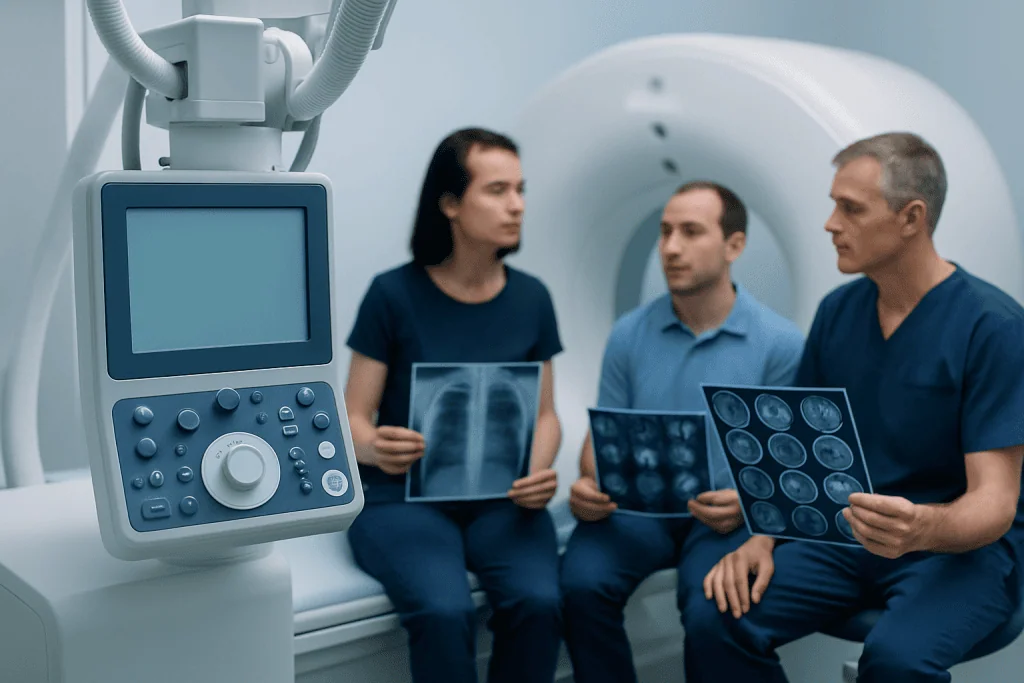
Bring both the image files and the radiology reports. They are not interchangeable. The images are the raw evidence; the report is one radiologist’s written interpretation at one point in time. A specialist planning treatment will usually want to look at the images directly, and a report alone cannot substitute for that. Equally, a disc of images without the report leaves the receiving team guessing at the original clinical question. If you can only obtain one, bring it, but ask for both.
For the images, request the original digital files. Imaging centres usually provide these on a CD or DVD in DICOM format, the international standard hospitals use to view scans at full diagnostic quality. DICOM files preserve slice thickness, contrast phases, and measurement data that a screenshot or exported photo strips away. If your provider offers an online patient portal, download the files rather than relying on a login, and confirm they open before you travel. If you use a USB drive, label it clearly with your name and keep it in your cabin bag.
For the reports, carry printed copies and PDF versions. Bring the original-language report even if you also have an English translation: the receiving radiologist may want to check specific terminology against the source. Alongside the reports, prepare a short summary sheet: the date of each scan, the body area, the facility where it was performed, and why it was ordered.
- Original scan files, ideally DICOM, for every relevant study
- The radiology report matching each scan
- Printed copies plus PDF backups
- A one-page timeline of your imaging history
- Related pathology results, lab work, or discharge notes tied to the scan findings
How to organise your scans before you fly
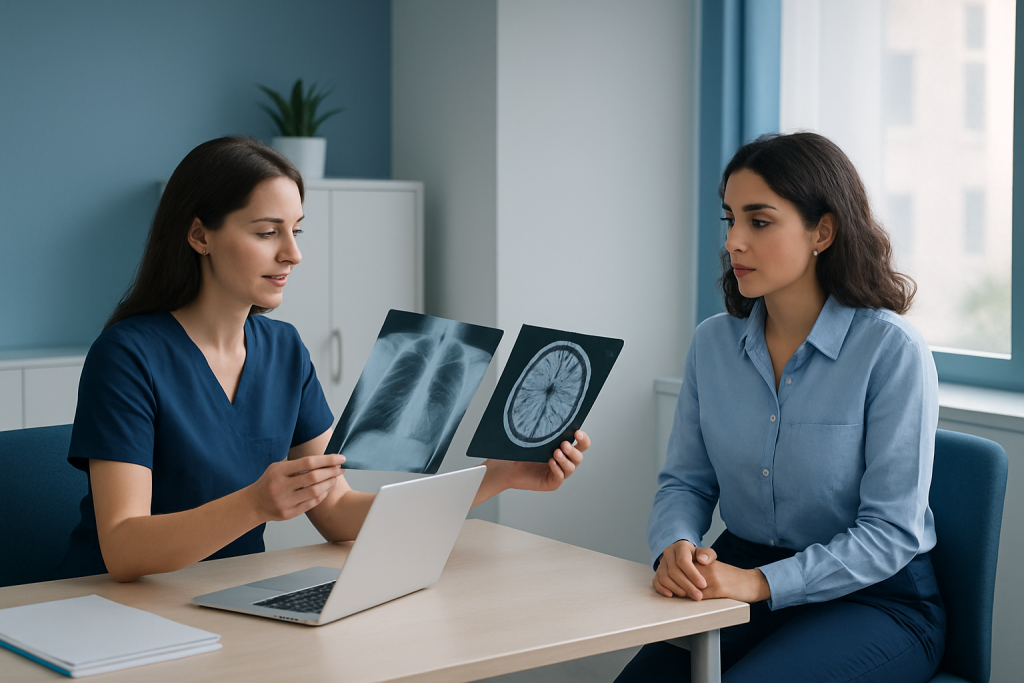
An hour of preparation at home prevents most of the problems patients run into at the hospital desk. Group your records by body area or condition, knee, spine, breast, chest, brain, abdomen, then put each group in date order with the newest study first. Chronological order is how a specialist reads a case, and handing over a sorted folder saves real consultation time.
Test every disc and file before departure. It is genuinely common for patients to arrive with a CD that is scratched, blank, or written in a format that will not open. Load each disc on a computer, confirm the images display, and check that the name, date of birth, and scan date on screen match your documents. If a portal link is your only source, confirm it works from outside your home country and download local copies anyway, hospital Wi-Fi and expiring links are not things to depend on.
Then split your copies sensibly. Carry the original discs, USB drive, and printed reports in your cabin bag. Keep a second, password-protected set in secure cloud storage or on your phone. Never put your only copy in checked luggage: delayed bags are routine, and you may need your imaging within hours of landing. Treat scans the way you treat your passport and your medicines: our guide on traveling to Turkey with prescription medicines applies the same hand-luggage logic to your pharmacy bag.
Finally, put everything in one waterproof folder together with your passport copy and appointment details. The full set of admission paperwork is covered in our guide to documents international patients should bring for hospital admission in Turkey.
Formats, language, and what scans are called in Turkish
Different hospitals run different viewing systems, so DICOM is the safe common denominator. JPEG images, phone photos of a lightbox, and PDF screenshots of scans can serve as a rough reference, but they are usually not sufficient for detailed review or treatment planning, particularly for MRI and CT. If your imaging centre offers a choice, always take the DICOM export.
If your reports are not in English, do not let that stop you bringing them. The image files themselves are language-neutral, and radiology reports follow fairly standard structures that specialists can often work through. Original-language documents remain legally and clinically authoritative, so carry them even alongside a translation. Large international hospitals in Turkey, including Acibadem, routinely receive records in many languages and can typically arrange interpretation and translation support as part of international patient services.
Knowing the local terms also helps you read signage and appointment slips once you arrive:
| English | Turkish | Common short form |
|---|---|---|
| X-ray | Röntgen | Röntgen |
| CT scan (computed tomography) | Bilgisayarlı tomografi | BT, or simply “tomografi” |
| MRI (magnetic resonance imaging) | Manyetik rezonans görüntüleme | MR, spoken as “emar” |
| Ultrasound | Ultrason / ultrasonografi | USG |
| Radiology report | Radyoloji raporu | Rapor |
So if a Turkish document mentions a “BT raporu”, that is a CT report; “MR görüntüleri” are your MRI images. Label everything clearly with your full name, date of birth, and scan date, especially if several family members are traveling together or you carry discs from different years.
Flying with your scans, and flying after a scan
Two separate questions get tangled when people research traveling to Turkey with X-rays, MRI, and CT scans, so it is worth separating them.
Does airport security damage imaging?
No, not in any way that matters for modern records. CDs, DVDs, USB drives, and files stored on your phone or in the cloud are digital media and are unaffected by cabin baggage X-ray scanners and body scanners. The only historical concern was undeveloped photographic film; printed radiographic films you already hold are developed and stable, though they can be bent or scratched, which is another reason to favour digital copies and keep any films flat in your cabin bag rather than in the hold.
Can you fly after a CT scan or X-ray?
A standard X-ray or CT scan uses an external beam of radiation that passes through the body during the scan. Nothing radioactive remains in you afterwards, so the scan itself places no restriction on boarding a flight. Contrast agents used in some CT and MRI studies are cleared by the body in the normal way. The exception worth knowing about is nuclear medicinestudies such as PET scans, where a small amount of radioactive tracer is injected. Traces of these can remain detectable for days and occasionally trigger sensitive radiation monitors at some borders, which is why departments often provide a letter describing the study and its date. Whether it is sensible for you to fly at a given moment depends on your underlying condition and any recent procedures, and that judgement belongs with your treating team, not a checklist.
If you carry an implant, pacemaker, or other device alongside your imaging, airport screening involves a few extra steps, see our guide on traveling to Turkey with medical implants, letters, scans, and airport checks.
What imaging in Turkey costs, and why nobody quotes a single number honestly
Search results for imaging in Turkey are full of headline prices. Treat them cautiously. The honest answer is that the cost of an MRI, CT, or X-ray is not one number; it is a function of several variables, and any figure quoted before those variables are known is a guess.
What a genuine quote depends on:
- The body region and number of regions scanned. A single-joint MRI and a multi-region study are different examinations.
- Whether contrast is used. Contrast-enhanced studies involve additional material, screening blood tests, and monitoring.
- The technical protocol. A scan performed to a surgical-planning or oncology protocol takes longer and produces more sequences than a basic screening study.
- What is bundled in. Some quotes include the radiologist’s report, a specialist review, and copies of your images; others cover the scan alone.
- The setting. A standalone imaging centre, a hospital outpatient department, and imaging embedded in a broader check-up programme are priced differently.
The same logic applies to “full body MRI” packages, which vary enormously in what they actually scan and report. In practice, international hospitals prepare an itemised quotation after reviewing your existing records and the clinical question, so the imaging you already carry directly shapes what you are quoted for. That is one more practical reason to bring it.
When older scans may still need to be repeated
Even excellent records sometimes get supplemented with new imaging, and this is not a sign that your preparation was wasted. Common reasons include:
- Time has passed. A spine MRI from many months ago may no longer reflect your current symptoms, and in cancer care the team usually needs an up-to-date picture of disease status.
- The protocol differs. A CT performed elsewhere may use slice thicknesses, contrast phases, or sequences that do not match what a surgeon or interventional team needs to plan safely.
- Image quality or completeness. Some exported discs contain only selected images rather than the full study.
- Consistency for follow-up. Measuring change over time is most reliable when studies are done on comparable equipment with comparable settings.
When a repeat is recommended, your old scans still earn their place in your luggage: they become the baseline against which new findings are compared, which supports more accurate and better-coordinated decisions. The same reasoning applies to laboratory work: our guide on why blood tests and scans may be repeated before treatment in Turkey explains the clinical and legal reasons behind it.
How Acibadem handles imaging from abroad
At Acibadem, international patient teams routinely coordinate medical documents before a patient arrives, so that specialists can review imaging in advance and identify gaps early. When files are received ahead of travel, the team can usually confirm which existing studies are sufficient and which questions remain open, which means fewer surprises at the first consultation. Patients are still advised to carry their originals during travel, because a physical set in your hand luggage is the one copy no server outage or expired link can take away.
Once you arrive, international patient services handle the practical layer: registration, document handling, and language support. Where a case is complex, prior imaging may be reviewed by specialists from more than one department alongside any new tests, so that decisions rest on the full picture rather than a single study.
You do not need to organise everything perfectly. Incomplete records are a normal part of international care: bring the best set you have, keep it accessible, and note anything you know is missing. Gaps that genuinely matter for a consultation are usually identified quickly once the available studies have been reviewed.
Step by step
- Request your imaging records early. Contact the hospital or imaging centre where your scans were done and ask for both the image files and the written radiology reports. Some centres need several days to prepare discs or portal access, so do this well before your travel date.
- Collect the right versions. Ask for original digital files in DICOM format, not screenshots or phone photos. Request printed reports or PDFs so your doctor in Turkey can read the official interpretation alongside the images.
- Test every file before departure. Open each disc, download, or portal file and confirm it works and belongs to you. Check names, dates, and body areas, and make sure each report matches its scan.
- Create a one-page scan timeline. List the date, type of scan, body area, and reason for each study. It saves consultation time and shows the team at a glance which records matter most.
- Pack originals in hand luggage. Discs, USB drives, printed reports, and your summary sheet travel in your cabin bag, never in the hold. If bags are delayed, your medical records still land with you.
- Store secure digital backups. Keep password-protected copies in secure cloud storage or on a device you carry. A backup rescues you if a disc is damaged, lost, or refuses to open at the hospital.
- Share records with your treating hospital in advance. If pre-arrival review is offered, send files before your trip so specialists can confirm whether your existing imaging is sufficient or newer studies will be needed.
Your checklist
- Passport and hospital appointment details
- Original X-ray, MRI, or CT image files in DICOM format
- Printed and digital radiology reports for each scan
- A one-page timeline of scan dates, body areas, and facilities
- Related lab results, biopsy reports, or discharge notes
- Secure, password-protected digital backup of everything
- Original-language documents plus English versions where available
- A waterproof folder keeping all imaging records together in your cabin bag
Key takeaways
- Bring both the scan images and the written radiology reports, neither replaces the other.
- DICOM files on disc or USB are the format hospitals can review at full diagnostic quality; phone photos are not.
- Carry originals in hand luggage and keep a secure digital backup; airport scanners will not harm digital media.
- A standard X-ray or CT leaves nothing radioactive in your body, so the scan itself does not restrict flying; nuclear medicine studies are the exception worth documenting.
- Older scans stay valuable even when a repeat is recommended, because they give the team a baseline for comparison.
Frequently asked questions
Can I fly after a CT scan?
A standard CT scan uses an external X-ray beam, so nothing radioactive remains in your body afterwards and the scan itself places no restriction on flying. Nuclear medicine studies such as PET scans differ: injected tracers can remain detectable for days and occasionally trigger radiation monitors at some borders, so a letter from the imaging department is useful. Whether flying suits your overall condition is a question for your treating team.
What is a CT scan called in Turkish?
Computed tomography is “bilgisayarlı tomografi” in Turkish, usually shortened to “BT” or simply “tomografi”. An MRI is “manyetik rezonans”, written MR and spoken as “emar”, and an X-ray is a “röntgen”. A “radyoloji raporu” is a radiology report.
How much does a CT or full-body MRI scan cost in Turkey?
There is no single honest number. The price depends on the body regions scanned, whether contrast is used, the technical protocol, whether the radiologist’s report and specialist review are included, and whether the scan sits inside a wider check-up programme. Hospitals prepare itemised quotations once these details are known, which is why figures quoted before any record review should be treated as rough at best.
Should you bring the actual scan images or just the report?
Both whenever possible. The report gives the radiologist’s written findings; the images let your specialist review the study directly and compare it with any new imaging. Either one alone leaves the receiving team with half the picture.
Is a phone photo of an X-ray or MRI enough?
Usually not. Phone photos can serve as a quick reference, but they lose the resolution and technical data needed for proper review or treatment planning, especially for MRI and CT. Ask your imaging centre for the original DICOM files instead.
What if your records are not in English?
Bring them anyway. The image files themselves need no translation, and original-language reports remain the authoritative record. Large international hospitals in Turkey routinely work with records in many languages and can typically arrange translation and interpreter support.
Can you keep your imaging in checked luggage?
Keep all important medical records in your hand luggage. Checked bags can be delayed or lost, and you may need your scans soon after landing. Cabin security scanners do not damage discs, USB drives, or digital files, so there is no downside to carrying them with you.
Will bringing previous scans mean you can avoid repeat imaging?
Not always, but it often reduces duplication and speeds up decision-making. When a repeat is still needed, because time has passed, the protocol differs, or the study is incomplete, your previous scans remain valuable as a baseline for comparison.
Add us as a Preferred Source to see more of our trusted health content across Google Search, AI Overviews and Discover.

Update history
- PublishedJuly 8, 2026
- Medical review approvedSeptember 1, 2026
- Last content updateSeptember 1, 2026
References3
- NHS: CT scan nhs.uk
- NHS: MRI scan nhs.uk
- MedlinePlus: X-Rays medlineplus.gov
More Patient Guides
Sleep Apnea Testing in Turkey: What Happens During Your Evaluation
Sleep apnea testing in Turkey may include a consultation, overnight sleep study or home test, and a clear review of your results…

How to Organize Your Test Results Before Traveling to Turkey
Organize your test results before traveling to Turkey by sorting records, images, medicines and timelines so your Istanbul care team can review…

When Extra Tests Are Needed Before Treatment in Turkey
Extra tests before treatment in Turkey may be needed to confirm diagnosis, timing, and safety. Here is what you can expect in…

At Acibadem, How to Prepare for Blood Tests, Scans, and Pre-Op Checks
Blood tests, scans, and pre-op checks at Acibadem in Turkey help confirm you are ready for treatment and avoid delays on the…