

Using the Nurse Call System During a Hospital Stay in Turkey

Press the nurse call button whenever you need help that should not wait for the next routine round: pain, dizziness, bathroom assistance, device alarms, medication questions or an interpreter. The button is usually on a bedside handset or bed rail. Ask the nurse to show you the controls when you arrive, keep the button within reach, and always call before getting up if you feel unsteady.
Wondering whether it is really acceptable to press that button by your bed at two in the morning? It is. The nurse call system is your direct line to the care team, whether you need pain support, help walking to the bathroom, an interpreter, or simply reassurance about an unfamiliar alarm. Nurses expect these calls and plan their shifts around them. This guide explains how using the nurse call system during a hospital stay in Turkey works in practice: where the button is, when to press it, what happens next, and how to communicate if you do not speak Turkish.
At a glance
- What it is: A button by your bed, on a handheld controller or on the wall that alerts the nursing team when you need assistance.
- When to use it: Pain, dizziness, nausea, bleeding, bathroom help, device alarms, medication questions, or any concern you cannot judge yourself.
- Language support: You can ask for an interpreter or your international patient coordinator through the nurse; short, simple words are enough to start.
- Response: Calls are prioritised by urgency, so a safety concern is attended to before a request for an extra blanket.
- Best practice: Call before getting out of bed if you feel weak, have had sedation, or have lines and equipment attached.
- Companions: They can press the button for you, but should never adjust equipment or silence alarms themselves.
What the nurse call system is for
The nurse call system is one of the most important tools in your hospital room, and one of the most underused by international patients. It is usually a button near your bed: attached to the bed rail, built into a handheld controller, or placed on the bedside table within easy reach. Pressing it sends a signal to the nursing station so the team knows that someone in your room needs assistance.
You do not need to wait until something feels serious. The system exists for everyday support as well as urgent concerns: help getting to the bathroom, pain that is creeping up, nausea, dizziness, a question about when your next dose is due, or a device alarm you do not recognise. If you are unsure whether a concern is important enough to raise, that uncertainty is itself a reason to call. The nurse can assess in seconds what might worry you for an hour.
In Acibadem hospitals, nursing teams work alongside physicians, international patient coordinators and interpreters. The call system connects you to that wider network, particularly when you are resting in your room and need practical help quickly. If you are being monitored regularly, the button also complements routine checks: our guide to vital signs monitoring during your hospital stay explains what those scheduled visits involve, and the call button covers everything that happens in between.
One point worth stating plainly: using the nurse call system during a hospital stay in Turkey is not a cultural imposition or a sign of being a difficult patient. It is how inpatient care is designed to work. Patients who call early tend to have smaller problems solved before they become larger ones.
Where to find it in your room
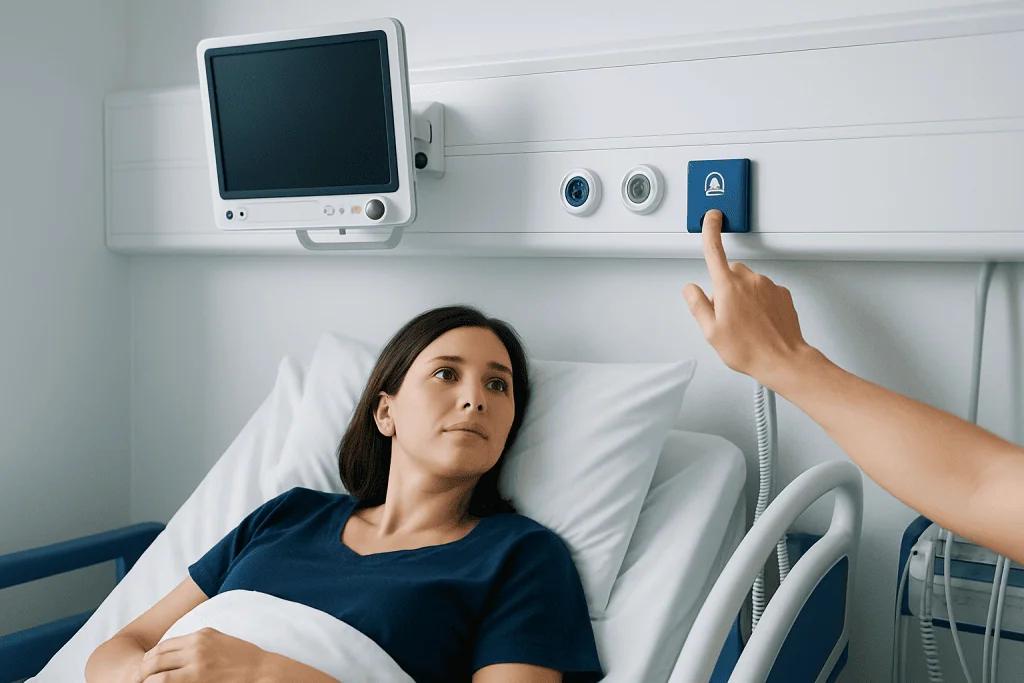
When you arrive in your room, ask the nurse to show you the call button before you settle in. Room layouts vary between buildings and ward types, so do not assume it looks like the one in a hospital at home. It may be integrated into a handheld remote that also controls the lights, the bed position or the television. Ask specifically which button calls the nurse, pressing the reading-light button repeatedly at 3 a.m. helps nobody.
Check the bathroom as well. Many rooms have a separate emergency cord or wall button near the toilet or shower. This exists because bathrooms are where dizziness and falls most often happen, and because you may not have your handheld controller with you. Locate it before you need it.
Make sure the main button sits where you can reach it without stretching. This matters most after surgery, during the night, when you have an IV line in your arm, or when you feel weak. If the controller slips to the floor or ends up tangled in the bedding, ask a nurse or your companion to reposition it, do not lean out of bed to retrieve it yourself.
If someone is staying with you, walk them through the controls too. Your companion can press the button on your behalf if you are asleep, uncomfortable, unable to speak clearly, or struggling to explain what is happening. Practical details like this are part of settling in well; our guide to staying comfortable during a multi-day hospital stay in Turkey covers the rest of the room setup.
When you should press the call button
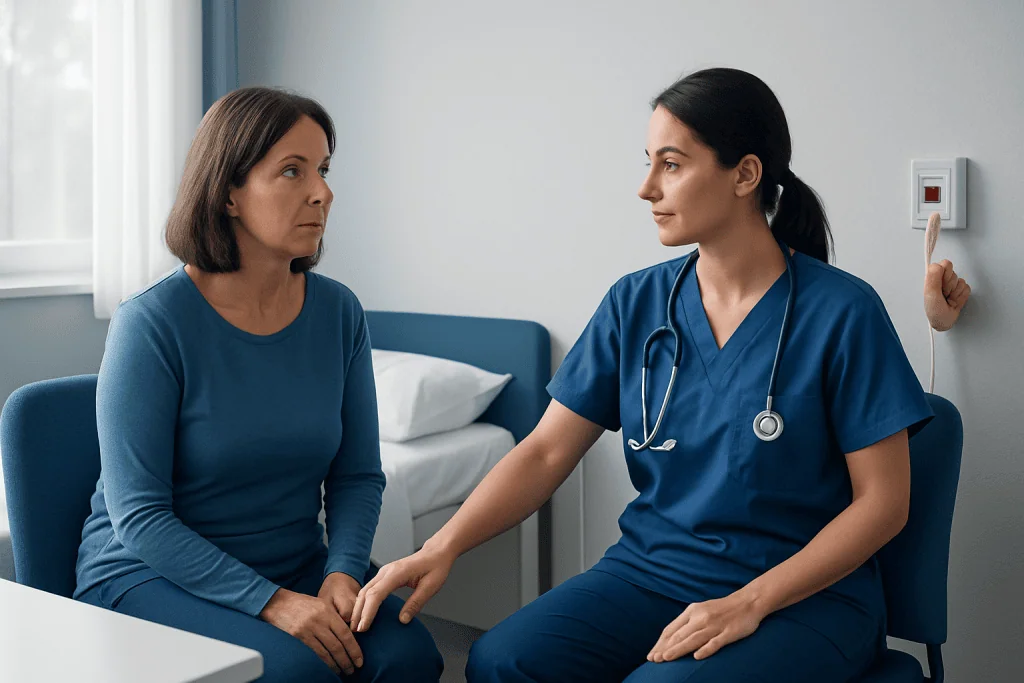
Press the button whenever you need support that should not wait until the next routine nursing round. That covers physical symptoms, safety concerns, equipment questions and practical needs that affect your comfort. You are not disturbing the team by using the system appropriately; you are helping them care for you safely and in the right order.
Common reasons to call include pain that is not controlled, shortness of breath, chest discomfort, sudden weakness, bleeding, vomiting, feeling feverish, new confusion, or anything that makes you feel unsafe on your feet. You should also call before standing up if you have been advised not to walk alone, if you recently received sedation or pain medication, or if you feel lightheaded when you sit up.
- Call for help before going to the bathroom if you feel unsteady in any way.
- Call if an IV pump, monitor or any bedside device alarms, never silence it yourself.
- Call if you do not understand a medication, an instruction, or what happens next in your care.
- Call if you need an interpreter or want your international patient coordinator contacted.
- Call if pain, nausea, anxiety or general discomfort is increasing rather than settling.
- Call if your dressing feels wet, your drain looks fuller than expected, or a line feels loose.
Medication questions deserve special mention. Never adjust, skip or take extra doses on your own initiative, raise the question through the call button and let the treating team decide. Our guide to medication safety during a hospital stay in Turkey explains how inpatient medication rounds work and what to ask.
What happens after you press it
After you press the button, the nursing station receives an alert identifying your room. Depending on the setup, a nurse may come directly, answer through an intercom, or send the most appropriate team member. If someone asks what you need, answer as simply as you can: pain, bathroom, dizzy, nausea, alarm, interpreter, or doctor question. A single clear word tells the team more than a long, hesitant sentence.
Calls are prioritised by urgency. A patient with a sudden breathing problem or an active fall risk will be attended to before a request for water or an extra blanket. This means a non-urgent request may take a little longer during busy care periods, handovers, medication rounds and admission times are usually the busiest. That is normal ward rhythm, not a sign that you have been forgotten.
If your need changes while you wait, the discomfort sharpens, you start to feel faint, the bleeding increases, press the button again and say clearly that the situation has become urgent. If a companion is with you, they can walk to the nursing desk and say the same. Escalating is expected behaviour, not rudeness.
It also helps to be honest about intensity. Many patients understate pain out of politeness. Nurses can only respond to what you tell them, so if the pain is severe, say severe. If a symptom frightens you, say so. Precise information leads to faster, better-matched responses.
Using the system safely at night
Night is when most hospital falls happen. Patients wake needing the bathroom, feel roughly normal, and stand up alone, while sleepy, medicated, dehydrated or attached to equipment, in a dark and unfamiliar room. Even if you are fully independent at home, your balance can behave differently during a hospital stay. New medication, fasting before a procedure, blood loss, or simply lying flat for many hours can all change how standing feels.
Before you sleep, arrange your immediate world: call button, water, glasses, phone and any approved personal items within easy reach. Ask the nurse a direct question: “Should I call before getting out of bed?” The answer may change from day to day as your treatment progresses, so ask again after any procedure or medication change.
If you have a bed alarm, IV line, surgical drain, urinary catheter, compression device or oxygen tubing, do not disconnect or work around it without help unless the care team has explicitly said it is safe. Equipment that seems simple often is not, and a tugged line at 3 a.m. creates problems that take far longer to fix than the thirty seconds it takes a nurse to reach you.
If you wake and need the bathroom, press the button first and wait. It can feel faintly ridiculous to wait for an escort to walk five metres. It is not. Nurses assist with night-time mobility dozens of times per shift; they would far rather help you early than respond after a fall.
How companions can help without replacing nurses
A companion is a real asset during a hospital stay far from home. They can help you remember instructions, keep your belongings organised, notice changes in how you look or sound, and communicate your preferences to staff. They can and should press the call button when you cannot: if you are asleep and in visible distress, trying to get up when you should wait, or unable to find the words.
The boundary is equally clear. Companions should not lift you, adjust equipment, silence alarms, change bed settings that affect drains or lines, or handle medication, unless the care team has specifically instructed them to. These limits exist to protect you, not to sideline the person who loves you. The division of labour is simple: your companion provides emotional and practical support; the clinical team manages care and safety.
Companions have practical needs of their own during a longer admission, from meals to rest. If someone is staying overnight with you, our guide to companion meals during a hospital stay in Turkey explains how their day-to-day arrangements typically work.
If your companion does not speak Turkish or English confidently, tell the international patient team early. Interpreter support reduces misunderstandings for both of you, and a companion who understands the plan is a far more effective advocate at the bedside.
Communication tips if you do not speak Turkish
You do not need fluent language skills to use the nurse call system effectively. Short, concrete words carry almost all the meaning that matters in the first minute: pain, bathroom, dizzy, nausea, cold, bleeding, alarm, medicine, interpreter, doctor. Pointing to the affected area helps. Showing a translated sentence on your phone helps too: our guide to using translation apps safely during medical visits in Turkey covers where apps work well and where they should not be relied on alone.
Before admission or soon after arrival, tell your international patient coordinator your preferred language and any communication concerns. If you have hearing loss, low vision, speech difficulty, anxiety or cognitive needs, ask for this to be noted in your care plan so that every shift knows, not only the nurse who admitted you.
Keep a short note on your phone with key phrases, your allergies, emergency contacts and your coordinator’s details. When you are tired, medicated or stressed, having this ready makes a nurse call far less daunting. A working phone and data connection underpin all of this; see staying connected during treatment in Turkey if you have not yet sorted a local connection.
Common mistakes international patients make
A few patterns come up repeatedly, and all are easy to avoid once named.
- Waiting for the round instead of calling. Routine checks are scheduled; your needs are not. If something is wrong now, call now.
- Downplaying symptoms out of politeness. Vague reports get vague responses. Describe what you feel accurately, including how bad it is.
- Getting up alone “just this once”. Most falls happen on exactly that trip. Using the nurse call system during a hospital stay in Turkey before standing is the single simplest fall-prevention habit you have.
- Letting a companion manage equipment. Well-meaning relatives silence alarms or reposition lines. Press the button instead.
- Not asking which button is which. Two minutes of orientation on arrival prevents a night of guessing.
- Assuming language will be a barrier. Interpreter support exists precisely for this. Ask for it rather than staying silent.
Step by step
- Ask for a demonstration on arrival. When you enter your room, ask the nurse to show you the call button, the bathroom cord or wall button, the light controls and any bed controls. Confirm exactly which button calls the nurse and which are comfort features only.
- Keep the button within reach. Clip it near your hand, rest it on the bed, or place it on the bedside table where you can reach it without leaning. If it moves or falls, ask someone to reposition it before you rest.
- Call before standing if you feel unsure. Weak, dizzy, sleepy, in pain, or attached to equipment, any of these means press first, stand second. This matters most after surgery, sedation, new medication or a long period in bed.
- Lead with one clear word. When the nurse responds, start with the main problem: pain, bathroom, nausea, dizzy, alarm, bleeding, interpreter. Then add detail, point, use your phone translator, or ask your companion to help.
- Never silence alarms yourself. If an IV pump, monitor or other device alarms, press the call button and wait. Even an alarm that seems trivial should be checked by staff, who will decide what action is needed.
- Escalate if things change. If symptoms worsen while you wait, press the button again and say so plainly. Mention clearly if you feel breathless, faint, confused or in severe pain, or send your companion to the nursing desk.
- Give feedback if communication is failing. If you feel your calls are not being understood, tell the nurse, your physician or your international patient coordinator. Clear feedback lets the team adjust language support for the rest of your stay.
Your checklist
- Ask where the nurse call button and the bathroom emergency cord or button are located.
- Confirm which button on the handset calls the nurse, not the lights or television.
- Keep the call button within reach before sleeping or whenever you are alone.
- Call before walking if you feel weak, dizzy, medicated, or are connected to equipment.
- Use the system for pain, nausea, bleeding, shortness of breath, alarms and bathroom help.
- Ask for interpreter support whenever you cannot explain a concern clearly.
- Show your companion how and when to press the button on your behalf.
- Never adjust IV pumps, monitors, oxygen, drains or alarms yourself.
- Keep water, glasses and your phone close so you never stretch or climb out of bed for them.
- Save your international patient coordinator’s contact details and key phrases on your phone.
Key takeaways
- The nurse call system is your direct link to nursing support during a hospital stay in Turkey, use it early and without embarrassment.
- It covers urgent symptoms, mobility help, equipment alarms, medication questions and communication needs alike.
- Calling before getting out of bed, especially at night, is the simplest way to reduce fall risk.
- Calls are prioritised by urgency; press again and say clearly if your situation worsens while you wait.
- Companions can press the button and help you communicate, but clinical equipment and medication belong to the care team.
- Interpreter support and international patient coordination at Acibadem exist so that language never has to stand between you and help.
Frequently asked questions
Is it okay to press the nurse call button for small things?
Yes, if the request affects your comfort, safety or care. Nurses expect calls about bathroom needs, pain, nausea, bedding, equipment alarms and questions. Non-urgent requests may wait a little longer during busy periods, but it is always appropriate to ask rather than to sit on a concern.
What if I press the wrong button?
Do not worry. Hospital room handsets often carry several controls, and confusion is common at first. Nothing bad happens if you press the wrong one; simply explain when someone responds, and ask the nurse to point out or label the nurse call button again so you are sure next time.
Should I call the nurse before going to the bathroom?
Call first if you feel weak, dizzy or sleepy, have recently had surgery or sedation, or are connected to IV lines, drains, oxygen or monitoring equipment. Staff assist with bathroom trips constantly and there is nothing to be embarrassed about. Calling first is one of the most effective ways to prevent a fall.
What should I do if no one comes quickly?
Response time depends on urgency and on how busy the ward is at that moment. If your need becomes urgent or your symptoms worsen, press the button again and state the main concern in one clear word. A companion can also go directly to the nursing desk on your behalf.
Can I ask for an interpreter through the nurse call system?
Yes. Tell the responding nurse you need an interpreter, or have your companion say it for you: the single word “interpreter” is enough. Acibadem international patient services can coordinate language support so that instructions, consent discussions and your own concerns are understood clearly.
Can my companion use the call button for me?
Yes. Your companion can press it if you are asleep, uncomfortable, confused, unable to reach it, or need help explaining something. What they should not do is lift you, disconnect equipment, silence alarms or handle medication: those tasks stay with the clinical team, and the call button is how to summon it.
What symptoms should I always call about right away?
Call promptly for chest discomfort, shortness of breath, sudden weakness, fainting, heavy bleeding, severe pain, new confusion, a fall, or anything sudden and frightening: the team would rather assess and reassure than miss something. If such symptoms appear after you have been discharged and are no longer in hospital, call your local emergency number or go to the nearest emergency department now.
Will I understand the nurse who answers if I do not speak Turkish?
Usually enough for the first exchange. Start with a single clear word for your main need, point to the problem, or show a translated phrase on your phone. If the conversation goes beyond basics, ask for an interpreter through the nurse; the international patient team can arrange fuller language support for detailed discussions.
Add us as a Preferred Source to see more of our trusted health content across Google Search, AI Overviews and Discover.

Update history
- PublishedJune 9, 2026
- Medical review approvedSeptember 13, 2026
- Last content updateSeptember 12, 2026
References2
- Preventing falls in the hospital: MedlinePlus medlineplus.gov
- Patient Safety: MedlinePlus medlineplus.gov
More Patient Guides

When a Hospital Stay in Turkey Becomes Longer Than Planned: What to Arrange
If your hospital stay in Turkey is longer than planned, arrange medical updates, accommodation, travel changes, insurance and support for your companion.

Waiting for Test Results in Turkey: How to Use Time Between Appointments
Waiting for test results in Turkey is easier with a clear plan for appointments, rest, records, questions and support in Istanbul.

Unexpected ICU Stay in Turkey: What Patients and Families Should Expect
Unexpected ICU stay in Turkey: learn what patients and families can expect, from communication and visiting to care updates and travel support.

How to Manage Special Diets During Medical Travel in Turkey
Special diets during medical travel in Turkey are easier to manage when you share your needs early, confirm meals and carry safe…